
Caregiver decision guide
Should your aging parent get cancer genetic testing?
Cancer genetic testing can provide actionable information for seniors and their families, but the decision framework differs from testing in younger adults. This guide helps caregivers weigh Medicare coverage rules, the senior's overall health, and the potential for family cascade testing when deciding whether testing is right.
Cancer genetic testing for seniors is worth considering when the result can change medical care, clarify a known family risk, or spare younger relatives from years of guessing. It is less useful when it is ordered out of general curiosity, with no personal cancer history, no known familial variant, and no clear person ready to explain what the result means.
That distinction matters because an older parent’s test is not just another box on a lab form. Someone has to decide whether the parent qualifies, whether Medicare may pay, whether the parent is well enough for the result to affect treatment, and whether adult children, grandchildren, siblings, nieces, and cousins are prepared to hear information that may belong to the whole family.

The first question is not age. It is why testing is being ordered.
A parent can be old and still be the right person to test. The more useful starting point is the reason for the test. In everyday caregiver terms, most decisions fall into three different lanes.
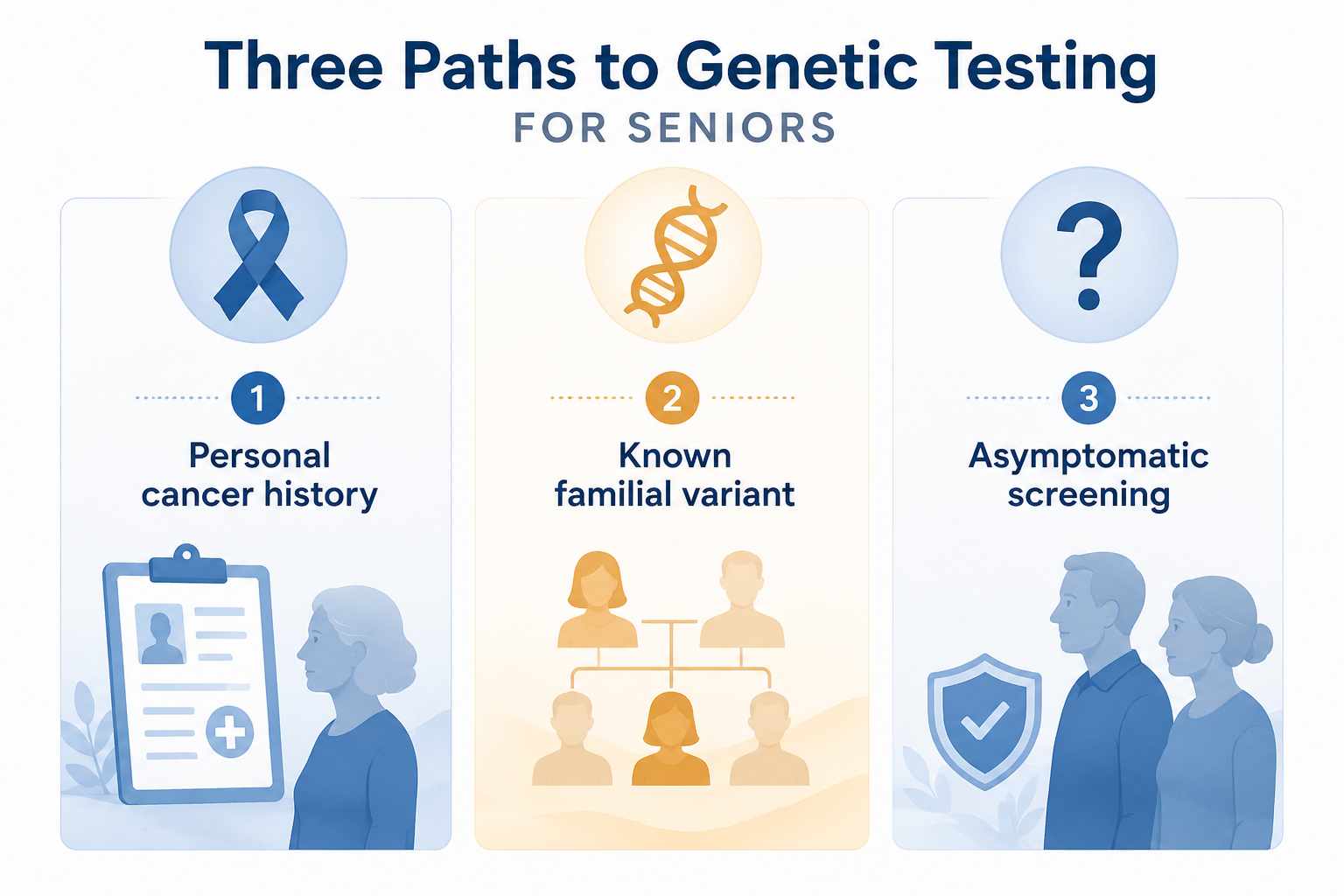
| Situation | Why it may matter | Coverage reality |
|---|---|---|
| Parent has a personal cancer diagnosis that meets guideline-based testing criteria | The result may affect treatment, future screening, or relatives’ testing | Medicare Part B may cover diagnostic testing when it is medically necessary and criteria are met |
| A disease-causing variant is already known in the family | Testing the parent can confirm whether that branch of the family inherited the variant | Coverage may be possible when the known familial variant makes the test medically necessary, but confirmation is needed |
| Parent is healthy and wants broad cancer risk screening | The result may satisfy curiosity but may not change the parent’s care | Medicare generally does not cover general genetic risk screening for asymptomatic people |
Medicare belongs near the beginning of this conversation, not as a surprise after the blood draw. Medicare Part B coverage is generally tied to diagnostic medical necessity, such as a qualifying personal cancer history or a known familial variant. It does not generally cover broad genetic screening for an asymptomatic person who wants to know future risk. Without coverage, genetic tests may cost from about $100 to more than $2,000; when covered, the patient may owe $0 after meeting the Part B deductible, listed as $283 for 2026 in the cited coverage summaries. Local Medicare Administrative Contractor rules can vary, so the ordering clinician or lab should verify coverage before the sample is collected.[1][2]
That is the practical dividing line many families need. “Could this be interesting?” is not the same question as “Could this change care, qualify for coverage, or give the family an answer we cannot get another way?”
Older adults are not outside the hereditary cancer conversation
It is easy to assume hereditary cancer testing is mainly for people diagnosed young. Early diagnosis is important, but it is not the whole story. A review of genetic cancer predisposition syndromes among older adults reported that about 6% of women diagnosed with breast cancer at age 65 or older carried a pathogenic variant, nearly double the rate seen in unselected populations. The same review reported hereditary variants in about 8% of seniors with colorectal cancer diagnosed at age 60 or older, most commonly in Lynch syndrome genes. Among men with metastatic prostate cancer, 12% carried germline pathogenic variants, and 60% of those carriers were diagnosed at age 60 or older.[3]
Those figures do not mean every older adult should have a large cancer panel. They do mean that age alone is a poor reason to dismiss testing when the cancer type, tumor features, family history, or a known familial variant points toward an inherited risk.
There is also a gap between interest and understanding. A National Poll on Healthy Aging report found that 54% of older adults were interested in DNA testing to guide medical care, and 90% agreed that genetic testing may help recognize health risks earlier.[4] Interest can open the door, but it does not answer the harder questions: Which test? Ordered by whom? Paid for by whom? Explained to which relatives?
When cancer genetic testing for seniors is most useful
Germline cancer genetic testing looks for inherited variants a person was born with, not just mutations found inside a tumor. If a parent carries a germline pathogenic variant, the result may matter to that parent’s treatment team and to blood relatives who may have inherited the same variant.
The most direct reason to test is a current or past cancer diagnosis that meets clinical criteria. Depending on the cancer, this may include tumor type, age at diagnosis, metastatic disease, multiple primary cancers, tumor testing results, ancestry-related risk, or a family pattern that raises suspicion for an inherited syndrome. NCCN guideline materials report that 30% to 40% of patients with mismatch repair gene variants associated with Lynch syndrome are first identified at age 60 or older. They also note that moderate-penetrance pathogenic variants, including CHEK2 and ATM, are more enriched among older women with pathogenic variants than among younger women in the cited comparison.[5]
For a parent in active cancer treatment, the first question is whether the result could change anything now. A germline result may affect eligibility for a targeted therapy, the choice of surgery, surveillance for another cancer, or whether relatives should be offered targeted testing. If the parent is frail, has limited treatment options, or would not pursue additional screening, the personal medical benefit may be smaller. That does not automatically make the test pointless, but it changes whose benefit is carrying the decision.
The second strong reason is a known familial variant. If a sibling, niece, nephew, adult child, or cousin has already tested positive for a specific pathogenic variant, testing an older parent may show whether that variant came through the parent’s side of the family. This is different from broad fishing. The lab is often looking for a known answer, and the result can immediately sort who in the family needs their own testing.
Cascade testing is the name for that family follow-up. Once a pathogenic variant is identified in one person, relatives can be tested for that specific variant instead of starting from scratch. A negative result in a relative may mean they did not inherit the family variant. A positive result may change their screening schedule, prevention options, or treatment decisions if cancer develops.

One published oncology nursing case makes this point without dressing it up as futuristic medicine. A 96-year-old aunt was tested because she was the oldest informative relative in a family with cancer concern. Her result unlocked risk information for more than 30 family members. The lesson was not that a 96-year-old needed decades of prevention planning. It was that she held the clearest genetic clue for people who did.[6]
That can feel like a heavy thing to ask of an older parent, especially one already tired from appointments. It can also be unfair to dismiss the parent as “too old” when skipping them leaves everyone younger with more uncertainty, more testing, and sometimes more cost.
When testing may be low-value
The weakest case is broad screening in an asymptomatic older parent with no personal cancer history, no known familial variant, and no family history that meets testing criteria. That kind of testing may still be available through some labs, but availability is not the same as clinical usefulness or insurance coverage.
A result also has less value if no one has agreed in advance what will happen next. A positive result may need to be shared with relatives. A negative result may not erase a strong family history. A variant of uncertain significance may create anxiety without changing care. FORCE’s patient education materials emphasize that genetic testing has both benefits and risks, including possible emotional effects, privacy concerns, uncertain results, and implications for relatives.[7]
This is why genetic counseling is not a decorative extra. A genetic counselor or genetics-trained clinician can help the family understand what the test can and cannot answer before anyone mistakes a lab report for a complete family plan.
The senior-specific complication many families never hear about
Older adults bring one testing issue that deserves plain language: clonal hematopoiesis. As people age, some blood-forming cells can acquire genetic changes that are present in blood cells but were not inherited from a parent and are not present in every cell of the body. If a germline test uses a blood sample, those acquired blood-cell changes can sometimes look confusing.
This is not a reason to avoid testing. It is a reason to ask whether the result is clearly germline. The older-adult cancer predisposition review reported clonal hematopoiesis in 9.5% to 18% of healthy adults age 70 and older, compared with less than 2% in younger adults. The review specifically notes that clonal hematopoiesis can confound germline interpretation for genes such as TP53, ATM, and CHEK2 on blood-based testing, and that confirmatory testing using another tissue type, such as a skin biopsy, may sometimes be needed.[3]
For caregivers, the practical question is simple: “If this blood test finds a variant, how will you confirm whether it is truly inherited?” A clinician who orders genetic testing in older adults should be able to explain when saliva, blood, tumor testing, or confirmatory tissue testing is appropriate, and when the lab report needs careful interpretation before relatives act on it.
This point matters most when the result would send adult children and grandchildren into their own testing. A false assumption about an inherited variant can ripple through a family. So can a missed inherited variant. The answer is not fear; it is competent interpretation.
Medicare coverage: what to verify before the sample is taken
Medicare genetic testing coverage is usually narrower than families expect. Part B may cover testing when it is diagnostic and medically necessary, such as in someone with a qualifying cancer diagnosis or a known familial variant. It generally does not cover testing done only to estimate future cancer risk in an asymptomatic person.[1][2]
Before agreeing to testing, ask the ordering office or laboratory to check four things:
- Which diagnosis code or known familial variant supports medical necessity.
- Whether the test meets the Medicare Administrative Contractor criteria in the parent’s region.
- Whether the lab accepts Medicare assignment and what the parent could owe if coverage is denied.
- Whether pre-test genetic counseling is required or recommended.
- Whether the planned sample type is appropriate for an older adult, especially if genes such as TP53, ATM, or CHEK2 are involved.
Coverage pages can make the rules sound tidy. Real billing can be less tidy because local coverage determinations, lab policies, and documentation all matter. If the family is also trying to understand broader Medicare and care costs, a general Medicare planning resource such as How to Pay for Senior Care in 2026 can help with the bigger payment picture, but the genetic testing order itself still needs test-specific verification.
What to ask before saying yes
A caregiver does not need to become a genetics expert before the appointment. It is enough to bring the right facts and slow the decision down until the purpose is clear.
- What cancers has my parent had, and at what ages were they diagnosed?
- Has any relative already tested positive for a pathogenic variant? If yes, can we get a copy of that report?
- Does my parent’s cancer history meet NCCN-style or other clinical testing criteria?
- Could the result change my parent’s treatment, surgery, surveillance, or medication options?
- If the result is mainly for relatives, who will receive it, explain it, and help them find testing?
- Has Medicare coverage been verified for this exact test and indication?
A caregiver guide from Genomic Genetics also emphasizes the practical side of support: helping a loved one prepare questions, organize family history, attend appointments if invited, and make space for emotional reactions before and after results.[8] That kind of work is not small. It is often the difference between a test that produces a useful family answer and a report that sits unread in a portal.
How to think about the result
A positive result means the lab found a pathogenic or likely pathogenic variant associated with hereditary cancer risk. For the parent, that may or may not change current care, depending on cancer type, health status, and treatment options. For relatives, it can make testing more direct because they can be checked for that specific variant.
A negative result can mean different things. If the family already has a known pathogenic variant and the parent tests negative for that exact variant, that may be reassuring for that branch of the family. If no familial variant is known and the family history is strong, a negative panel may not fully explain the pattern.
A variant of uncertain significance is not a diagnosis and usually should not drive major medical decisions for relatives. Families often need help sitting with that uncertainty, especially when they expected the test to provide a clean answer.
The most respectful path is to ask what the parent wants shared, identify who in the family needs the information for health reasons, and have a clinician or genetic counselor help put the result into words relatives can act on. Family communication can be tender even in close families. In families with old conflicts, it can be harder. The health information still deserves a responsible route.
A caregiver-ready next step
Start by gathering your parent’s cancer history, ages at diagnosis, pathology or tumor testing results if available, and a three-generation family history of cancer on both sides. Ask the oncology team, primary clinician, or a genetics professional whether the parent meets clinical testing criteria or whether a known familial variant applies. Before the test is ordered, ask the office or lab to verify Medicare coverage for that exact indication and to explain possible out-of-pocket costs.
Then ask for genetic counseling or a genetics-trained clinician to review what a positive, negative, or uncertain result would mean for your parent and for relatives. Cancer genetic testing for seniors is most useful when it answers a real medical or family question. The parent’s age is part of that decision, but it should not be the reason the family never asks.
References
- Does Medicare Cover Genetic Testing?, Humana
- Medicare and genetic testing: Coverage, options, and costs, Medical News Today
- Genetic Cancer Predisposition Syndromes among Older Adults, PMC
- Older Adults Have High Interest in Genetic Testing, Michigan Medicine
- NCCN Guidelines, National Comprehensive Cancer Network
- How Old Is Too Old for Genetic Testing?, The Oncology Nurse, 2012
- Benefits and Risks of Genetic Testing, Facing Our Risk of Cancer Empowered
- Supporting a Loved One Through Genetic Testing, Genomic Genetics
Questions to bring to a clinician or OT
This is not medical, legal, or a family's final decision — only a framework. Bring these questions to a clinician, occupational therapist, or your local Area Agency on Aging.
Find Local HelpRelated reading
Noticed something outdated or inaccurate on this page? Flag a correction. We review every report against CDC, NIA, and AARP HomeFit guidance before updating a page.