
Caregiver decision guide
How to Support an Elderly Parent's Cancer Treatment Decisions
When an older parent is diagnosed with cancer, treatment decisions require more than medical factors—they need a geriatric assessment to evaluate overall health, resilience, and personal values. This guide explains how family caregivers can prepare for appointments, ask the right questions, and support their parent's autonomy while ensuring safe, preference-aligned care.
After an older parent is diagnosed with cancer, the first family question often comes out as, “What treatment is best?” It is understandable, but it is too broad to help much. For cancer treatment for elderly family members, the more usable question is: does the proposed treatment fit this person’s body, memory, daily function, other illnesses, support at home, and own reasons for wanting—or not wanting—more treatment?
A healthy 78-year-old who walks every morning, manages medications accurately, and wants aggressive treatment should not be dismissed because of a birth date. An 82-year-old with diabetes, neuropathy, recent falls, mild memory problems, and a long drive to the infusion center should not be pushed through a standard plan as if those facts are side notes. Memorial Sloan Kettering’s geriatrics guidance makes this distinction clearly: treatment decisions for older adults should be based on physiological age and geriatric assessment findings, not chronological age alone.[1]

That distinction matters because the family is not choosing between “treat” and “give up.” More often, the choice is between different intensities, different starting doses, different sequences, different monitoring plans, and sometimes a decision to focus on comfort because the likely burden is too high for the benefit the parent actually values.
Why Age Alone Is the Wrong Starting Point
Older adults with the same cancer diagnosis can have very different treatment reserves. One parent may recover from surgery quickly and tolerate systemic therapy with manageable fatigue. Another may lose enough strength after the first complication that getting to the bathroom safely becomes the new crisis. The cancer stage matters, but so do the facts that are often easier to see at home than in a short clinic visit: whether the parent is eating, balancing, remembering appointments, sleeping, paying bills, driving safely, or getting up from a chair without pushing hard with both arms.
Other illnesses are not background noise. The American Cancer Society reported in April 2026 that as many as 90% of older adults with cancer have at least one additional chronic illness that can affect treatment tolerance.[2] Heart disease, kidney disease, diabetes, lung disease, arthritis, prior stroke, neuropathy, depression, and cognitive impairment can change what “standard treatment” feels like in a real body.
This is where a geriatric assessment earns its place. It gives the oncology team a structured way to look beyond the tumor and ask whether the treatment plan matches the person who has to live through it.
What a Geriatric Assessment Actually Looks At
A geriatric assessment, often shortened to GA, is not a decorative intake form. In oncology, it evaluates domains that influence treatment tolerance and decision-making: physical function, falls, other medical conditions, cognition, mood, nutrition, medications, social support, and the ability to manage daily activities. The National Cancer Institute describes GA-guided care as a way to identify vulnerabilities that may not be obvious during a routine oncology visit and to tailor care accordingly.[3]
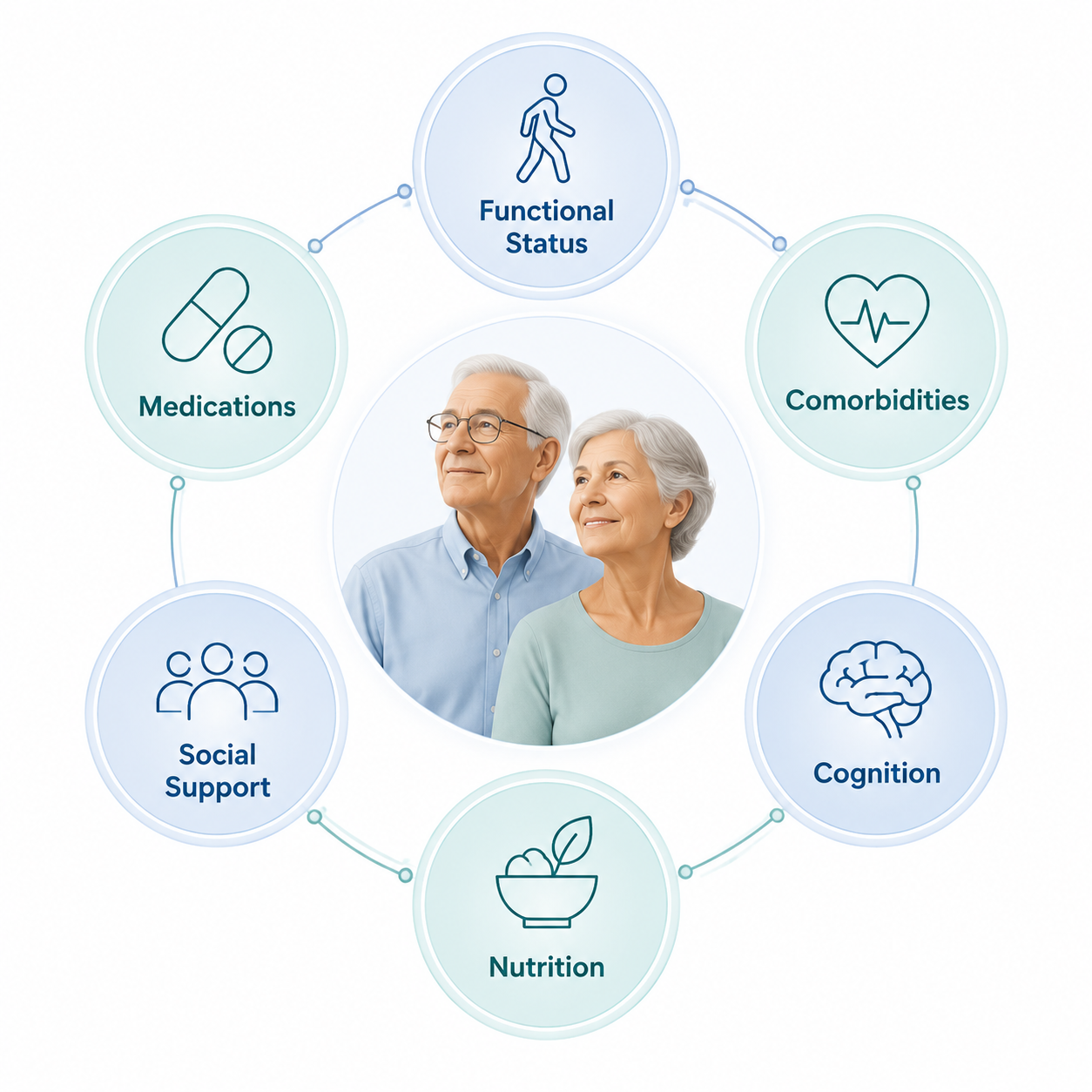
The assessment may ask whether the parent can bathe, dress, cook, shop, manage money, and take medicines without help. It may include walking speed, fall history, weight loss, appetite, memory screening, depression screening, medication review, and questions about who is available at home. None of those details automatically rule treatment in or out. They make the treatment conversation more honest.
| GA domain | What the family can help the team see |
|---|---|
| Functional status | Whether the parent can walk, climb stairs, get out of a chair, bathe, dress, cook, shop, and recover after ordinary errands |
| Falls and mobility | Recent falls, near-falls, dizziness, use of a cane or walker, neuropathy, and whether home stairs or bathrooms are becoming unsafe |
| Comorbidities | Diabetes, heart disease, kidney disease, lung disease, prior stroke, arthritis, pain, depression, or other illnesses that may affect treatment tolerance |
| Cognition and mood | Memory lapses, confusion with instructions, medication mistakes, anxiety, depression, or changes noticed by family |
| Nutrition | Weight loss, appetite changes, swallowing problems, dehydration, and whether the parent can prepare meals |
| Medications and support | Prescription drugs, over-the-counter medicines, supplements, duplicate medications, transportation, caregiving availability, and financial strain |
The practical value is that GA can change the plan. In the NCORP trial described by NCI, patients were age 70 or older, had advanced cancer, and were receiving chemotherapy. GA-guided care reduced serious chemotherapy side effects from about 70% to about 50% and falls from 21% to 12%, with no survival difference in the studied group.[3] That does not prove the same result for every cancer, every stage, every targeted therapy, or every immunotherapy plan. It does show why asking for this assessment is not fussiness.
The same NCI report showed concrete treatment changes: 48% of GA-guided patients received standard treatment, 32% received less intensive treatment, 50% started at lower-than-standard doses compared with 35% in usual care, and 23% received single-drug rather than combination chemotherapy.[3] Those are the kinds of changes families need to know are possible before everyone silently assumes there is only one legitimate plan.
How to Prepare Before the Oncology Appointment
The appointment will move fast. The oncologist may be kind and still have limited time. A family caregiver can make the visit more useful by bringing the facts that show the parent’s real baseline—not the best day, not the worst day, and not the version everyone performs in public.
Start with a one-page snapshot. It does not need to be polished. It needs to be accurate.
- Current cancer information: diagnosis, stage if known, pathology report, imaging reports, and names of doctors already involved.
- Medication list: prescriptions, over-the-counter medicines, vitamins, supplements, doses, timing, allergies, and recent medication changes.
- Other illnesses: diabetes, heart disease, kidney disease, lung disease, memory problems, neuropathy, pain, depression, prior stroke, or anything currently managed by another clinician.
- Function at home: walking, stairs, bathing, dressing, cooking, shopping, driving, managing money, and taking medicines.
- Recent changes: falls, near-falls, weight loss, appetite changes, confusion, new weakness, ER visits, infections, or missed appointments.
- Support limits: who can drive, who can stay overnight, whether the parent lives alone, what caregiving help is realistic, and what would be unsafe to assume.
Then add what the parent says matters. This part should not be guessed from the family’s fear. Some parents will say, “I want the treatment most likely to give me more time.” Others will say, “I want treatment if I can stay home and think clearly.” Others may accept hospitalization but not a nursing facility, or accept fatigue but not severe neuropathy that makes walking unsafe. Write the words down as close to the parent’s own language as possible.
What to observe at home
Families often notice decline before a clinic can measure it. A parent may tell the doctor, “I’m fine,” because the answer is socially easier, or because they are scared treatment will be withheld. The caregiver’s job is not to embarrass them. It is to give the team enough truth to make a safer plan.
- Mobility: Does your parent furniture-walk, avoid stairs, stop halfway across a parking lot, or need both arms to rise from a chair?
- Falls: Have there been falls, near-falls, new dizziness, or fear of showering alone?
- Thinking: Are instructions repeated often, bills unpaid, medications doubled or missed, or appointment times confused?
- Eating: Is there weight loss, food left untouched, trouble swallowing, dehydration, or lack of energy to cook?
- Recovery: After a normal outing, does your parent bounce back by evening or need two days in bed?
- Care logistics: Who is actually available for transportation, symptom calls, pharmacy pickups, meals, and overnight help?
If your parent would feel undermined by hearing these concerns stated bluntly in the room, ask ahead of time how they want sensitive details handled. Some parents want everything said openly. Some prefer that the caregiver send a short portal message before the visit. The goal is not to take over; it is to prevent a treatment decision from being made from incomplete information.
Questions That Make the Treatment Conversation More Specific
When a plan is presented—surgery, chemotherapy, radiation, immunotherapy, targeted therapy, hormonal therapy, surveillance, palliative treatment, or some combination—the family needs more than the name of the regimen. The useful questions connect the cancer plan to the parent’s actual reserves.
- “Is a geriatric assessment available before we choose or start treatment?”
- “If not, can we involve a geriatric oncologist, geriatrician, pharmacist, physical therapist, nutritionist, social worker, or palliative care clinician before the plan is finalized?”
- “What is the goal of this treatment for my parent: cure, longer survival, symptom control, slowing the cancer, or maintaining quality of life?”
- “What side effects are most likely to affect walking, thinking, eating, independence, or the ability to stay at home?”
- “Are there reasonable options for a lower starting dose, single-agent treatment, a less intensive regimen, or closer monitoring?”
- “What changes would make us pause, reduce, switch, or stop treatment?”
That last question deserves a clear answer before treatment starts. Families should know whether two falls, worsening confusion, inability to eat, repeated dehydration, uncontrolled pain, severe diarrhea, new shortness of breath, or loss of ability to perform basic daily activities should trigger a reassessment. If the answer is vague, ask who to call and how quickly the team wants to know.
Shared Decision-Making Is Not the Same as Family Consensus
A family meeting can sound harmonious while the parent quietly disappears from the decision. The adult children may want every possible treatment because losing time feels unbearable. The parent may want treatment only if it does not mean repeated hospitalizations. A spouse may focus on side effects because they will be the one up at night managing them. None of these reactions is strange. They are just different stakes.
Shared decision-making works only if everyone understands the goal and the tradeoffs well enough to discuss them. That is harder than families expect. A 2021 Journal of Clinical Oncology review reported that 50% to 73% of older adults with advanced cancer have poor understanding of their prognosis, and that 48% to 52% of caregivers hold views that differ from the patient’s oncologist; the review linked these gaps with more aggressive end-of-life care and lower hospice utilization.[4]
Those numbers do not mean families are careless. They mean prognosis conversations are emotionally loaded, medically uncertain, and easy to hear differently. One person may hear, “There is a treatment option.” Another hears, “This will probably work.” Another hears, “We are out of time unless we act now.” Before agreeing to a plan, it is reasonable to ask the oncologist to say plainly what is known, what is uncertain, and what the best-case, likely, and worst-case paths may look like.
Let the parent’s values become part of the medical record
Values are easy to praise and easy to ignore. They become more useful when translated into treatment boundaries. “I want to stay independent” may mean avoiding treatment likely to worsen neuropathy. “I want to be at my granddaughter’s wedding” may mean accepting a short-term burden for a time-limited goal. “I don’t want to be confused” may make certain medications, hospitalizations, or intensive regimens less acceptable. “I want to fight” may still leave room for dose adjustment if the first plan is too punishing.
The caregiver can help by asking the parent before the appointment: “What are you willing to go through for a chance of more time? What would make treatment not worth it to you? Who do you want speaking for you if you cannot speak for yourself?” These are not one-time questions. Answers can change after the first scan, the first hospitalization, or the first week of treatment.
How the Caregiver Role Changes as Illness Changes
Family involvement often starts small. A caregiver listens, takes notes, drives to appointments, and watches symptoms. As cancer progresses or treatment becomes more demanding, the role may shift. Meeker’s work in the Journal of Clinical Ethics describes family involvement moving through phases: monitoring needs, buffering demands, and eventually surrogate decision-making when the patient can no longer decide or communicate clearly.[5]
Monitoring needs is the folder stage: medication lists, appointment notes, side-effect tracking, and making sure a new fall or confusion episode reaches the team. Buffering demands is more active: arranging transportation, protecting rest, organizing meals, asking whether every appointment is necessary, and helping the parent refuse obligations they no longer have energy for. Surrogate decision-making is different. At that point, the caregiver’s duty is not to choose what the caregiver wants; it is to represent what the parent would have wanted, as specifically as possible.
Current oncology practice guidance also recognizes that shared decision-making can and should actively involve family caregivers, especially when older adults rely on them for information processing, logistics, and care at home.[6] The important safeguard is that involvement should support the patient’s voice, not replace it while the patient can still speak.
If the Clinic Does Not Offer Geriatric Assessment Routinely
Many families will not hear the words “geriatric assessment” unless they ask. Some cancer centers have geriatric oncology clinics. Some community practices use screening tools or refer selectively. Some do not have a formal process. That does not mean the family has no options.
- Ask directly: “Do you use geriatric assessment for older adults starting systemic therapy?”
- Ask what the practice does instead if a full GA is not available.
- Request a geriatric oncology referral if the center has one.
- Ask whether a geriatrician, primary care clinician, pharmacist, physical therapist, nutritionist, or social worker can assess specific concerns before treatment starts.
- Bring your own concise home baseline so the oncologist has functional, cognitive, medication, fall, and support information in hand.
The American Society of Clinical Oncology’s 2025 Global Guideline, as cited by the American Cancer Society, recommends geriatric assessment for all patients with cancer older than age 65 who are being considered for systemic therapy.[2] That recommendation is useful language to bring into the room. It turns a vague request—“Can we be careful because my parent is older?”—into a specific care question.
Money and Coverage Are Part of the Plan
Treatment decisions should not be made from insurance panic alone, but cost and coverage shape what families can actually sustain. If a plan requires frequent infusions, oral cancer drugs, scans, anti-nausea medications, injections, home equipment, or paid help, the financial details belong in the decision conversation before treatment starts.
For Medicare beneficiaries, geriatric assessment may be covered under Part B when it is part of evaluation and management services, with the patient generally responsible for 20% after the deductible.[7] Medicare Part D also has a $2,100 out-of-pocket cap in 2026, which can matter for families facing expensive outpatient prescription drugs.[7] Coverage rules still depend on the service, clinician, plan design, pharmacy network, and whether a drug is covered, so the practical move is to ask the oncology social worker, financial counselor, or plan directly for an estimate.
The caregiver’s folder should include insurance cards, Medicare and supplemental plan information, pharmacy benefit details, prior authorization notices, copay assistance contacts if offered, and the name of anyone at the clinic who handles financial counseling. If treatment is medically reasonable but logistically impossible, that needs to be visible early—not after the first missed appointment.
A Usable Plan for the Next Appointment
Before the next oncology visit, choose one person to take notes and one person, if possible, to listen without writing. Bring the one-page baseline, medication list, recent test reports, and the parent’s stated priorities. If several relatives want input, gather their questions beforehand rather than letting the appointment become a family debate.
- Ask whether a geriatric assessment is available before treatment starts or changes.
- Clarify the treatment goal: cure, longer survival, cancer control, symptom relief, or comfort.
- Ask how the plan accounts for function, falls, cognition, nutrition, medications, other illnesses, and support at home.
- Discuss alternatives, including lower starting doses, less intensive regimens, single-agent therapy, supportive care, or watchful waiting when medically appropriate.
- Name the side effects or functional changes that should trigger an urgent call or reassessment.
- Ask that the parent’s priorities be documented in the medical record.
There may still be no clean answer. Prognosis may be uncertain. The first plan may need revision. The parent may change their mind after understanding the tradeoffs more clearly. The family may hear the same sentence differently and need another conversation. Preparation does not remove the brutality of the decision; it only gives the parent a better chance of being treated as a whole person.
The family’s role is not to choose cancer treatment for the parent. It is to help make sure the decision is medically informed, realistically supported, and recognizably the parent’s own.
References
- How to Help Older Adults with Cancer Make Treatment Decisions, Memorial Sloan Kettering Cancer Center.
- How Geriatric Assessments Can Benefit Older Adults with Cancer, American Cancer Society, April 2026.
- For Older Adults, Geriatric Assessment Reduces Cancer Treatment Side Effects, National Cancer Institute, 2021.
- Decision Making in Older Adults With Cancer, Journal of Clinical Oncology, 2021.
- Factors Influencing Family Involvement in Treatment Decision-Making for Older Patients with Cancer, Journal of Clinical Ethics.
- Shared Decision Making Can—and Should—Actively Involve Family Caregivers, JCO Oncology Practice, 2026.
- Medicare coverage information for geriatric assessment and Part D out-of-pocket costs, NCOA, Healthline, KFF.
Questions to bring to a clinician or OT
This is not medical, legal, or a family's final decision — only a framework. Bring these questions to a clinician, occupational therapist, or your local Area Agency on Aging.
Find Local HelpRelated reading
Noticed something outdated or inaccurate on this page? Flag a correction. We review every report against CDC, NIA, and AARP HomeFit guidance before updating a page.