
Caregiver decision guide
How AI Is Spotting Pancreatic Cancer Earlier in Seniors
A new Mayo Clinic AI shows promise for detecting pancreatic cancer years earlier on routine CT scans. This guide explains the breakthrough for caregivers of older adults, the current limitations, and steps you can take now to identify risk.
If you are caring for an older parent or spouse, the Mayo Clinic REDMOD study matters for one very practical reason: it suggests that AI may be able to notice pancreatic cancer on CT scans before doctors usually can. In the April 2026 validation study, REDMOD identified 73% of prediagnostic pancreatic cancers a median of 16 months before standard clinical diagnosis, and more than two years before diagnosis it detected nearly three times as many early cancers as specialist radiologists reviewing the same scans without AI.[1]
That is a strong signal. It is not the same as saying your local hospital can run this tool today. REDMOD is investigational, not FDA-approved, and not yet clinically available. For a family trying to make sense of AI early detection for pancreatic cancer in an elderly loved one, the honest answer is: this technology is promising, but the action you can take now is still old-fashioned caregiver work — notice risk patterns, document changes, and bring the right questions to the physician before months slip by.

Why this matters more in older adults
Pancreatic cancer is not common compared with many other illnesses a family may worry about. The American Cancer Society describes it as accounting for about 3% of all cancers in the United States.[2] That matters because every unexplained symptom in an aging parent should not be treated as cancer until proven otherwise.
But the disease is dangerous partly because it is often found late. The American Cancer Society reports a 13% five-year survival rate overall, with more than 85% of cases diagnosed after the cancer has spread.[2] When cancer is still localized, the five-year relative survival rate is 44%; when it is distant, it is 3%.[3] That gap is why early detection receives so much attention, and why a tool that can read old CT scans differently is worth taking seriously without pretending it is ready for routine use.
Age also changes the frame. Two-thirds of pancreatic cancer patients are 65 or older, and the average age at diagnosis is 70.[2] In real caregiving life, that overlaps with the years when appetite changes, weight loss, fatigue, diabetes, back pain, and digestive complaints may get filed under “getting older.” Sometimes that is exactly what they are. Sometimes the pattern deserves a second look.
The warning pattern caregivers can act on now
The most useful question is not “Should every senior be screened?” The evidence does not support that. A better question is “Does this older adult have a risk pattern that should be discussed with a clinician?”
| What to notice | Why it matters | What to do with it |
|---|---|---|
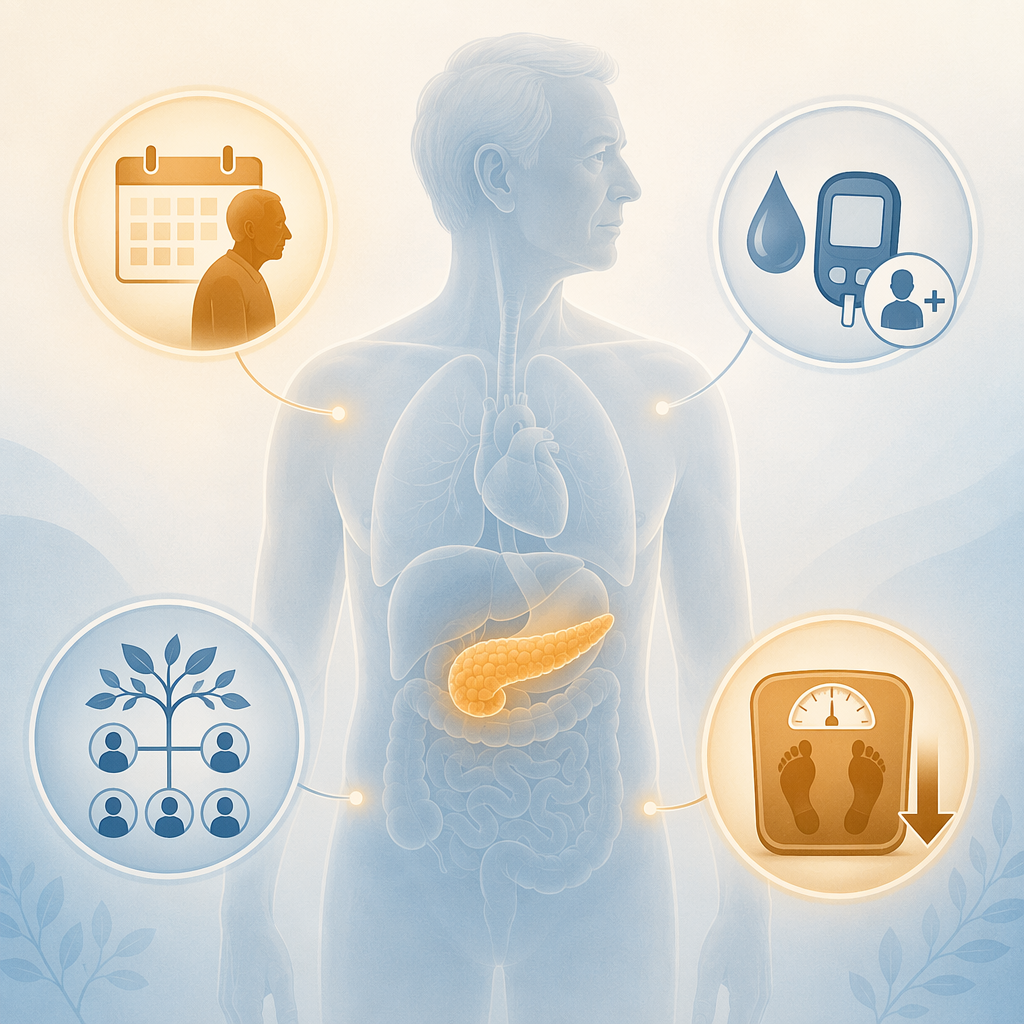
| Age 65 or older | Most pancreatic cancer patients are in this age range. | Treat new, persistent changes as worth documenting, not dismissing. |
| New-onset diabetes after age 50 | This group has a higher pancreatic cancer risk than peers without new-onset diabetes. | Ask whether the diabetes pattern needs additional evaluation. |
| Unexplained weight loss | Weight change is part of research-based risk scoring in new-onset diabetes. | Track dates, approximate amounts, appetite change, and medication changes. |
| Family history of pancreatic cancer | Family history can place someone into a higher-risk conversation. | Bring the specific relationship and age at diagnosis to the appointment. |
| Subtle symptoms that persist | Digestive changes, fatigue, or appetite loss can be easy to normalize in older adults. | Look for combinations and persistence rather than one isolated bad day. |
New-onset diabetes deserves special attention because it can be both common and misleading. The National Cancer Institute reports that older adults with new-onset diabetes after age 50 have an approximately eightfold higher risk of pancreatic cancer.[4] That does not mean most new diabetes diagnoses are cancer. Only about 1% of new-onset diabetes cases are caused by pancreatic cancer.[4] The point is not panic; it is not letting a meaningful pattern disappear inside a routine diagnosis.
How ENDPAC fits into the conversation
ENDPAC is a research score that looks at age, blood glucose change, and weight change in people with new-onset diabetes. In the NCI summary, an ENDPAC score of 3 or higher flagged about 75% of pancreatic cancers in that new-onset diabetes population.[4]
That does not make ENDPAC a home test or a reason to demand a scan in isolation. Its practical value for a caregiver is simpler: it gives shape to the physician conversation. Instead of saying, “I’m worried because I read something online,” you can say, “My parent developed diabetes after 50, has had weight change, and I’m wondering whether their risk pattern needs evaluation.”
What REDMOD actually did
REDMOD was trained to review routine CT scans and look for subtle imaging signals that may precede a pancreatic cancer diagnosis. The important part for families is that these were not necessarily special cancer-screening scans. The promise is in finding signals in imaging that may already exist in medical records or may be ordered for other reasons.
In Mayo Clinic’s report, the tool detected pancreatic cancer up to three years before diagnosis in a landmark validation study, with the median earlier detection at 16 months.[1] That “up to” phrase should be handled carefully. It does not mean every cancer would be found three years early. It means some were, and the median lead time in the reported result was shorter.

This is also where availability matters. Mayo Clinic says REDMOD is being tested prospectively in the AI-PACED trial and is not FDA-approved. Dr. Ajit Goenka estimated a target of about five years before clinical use.[5] That is an estimate, not a guaranteed date. For families making decisions in 2026, REDMOD should be understood as a serious research development, not a service to request from a radiology department.
What to bring to the next appointment
A short, specific note is more useful than a long speech in the exam room. The goal is to help the clinician see the pattern quickly and decide whether the older adult fits a high-risk category, whether existing imaging should be reviewed, or whether any further evaluation is appropriate.
- Date of new diabetes diagnosis, especially if it began after age 50.
- Recent weight loss or appetite change, including when it started and whether it was intentional.
- Family history of pancreatic cancer, including which relative was affected.
- Persistent digestive changes, fatigue, pain, or other symptoms that are new for this person.
- Recent CT scans or abdominal imaging, if any, and where they were performed.
The wording can stay measured: “Given their age, new-onset diabetes, weight change, and family history, do they meet any criteria for pancreatic cancer risk evaluation or screening?” That question leaves the medical decision where it belongs, but it also prevents the visit from ending with every change waved away as age.
Keeping fear proportional
Most tired older adults do not have pancreatic cancer. Most people with new-onset diabetes do not have pancreatic cancer. Most weight changes have explanations that are more common than a pancreatic tumor. A careful caregiver has to hold those truths alongside the other one: this cancer is often diagnosed late, and delay can close options.
That is why the REDMOD finding is encouraging without being immediately actionable as a test. It points toward a future in which routine imaging may carry more early-warning value than it does today. For now, the caregiver’s job is narrower and still important: notice new-onset diabetes after 50, unexplained weight loss, family history, and persistent changes in an older adult; write them down; and ask a physician whether the overall risk profile warrants further evaluation.
References
- Mayo Clinic AI detects pancreatic cancer up to 3 years before diagnosis in landmark validation study, Mayo Clinic News Network, April 2026.
- Key Statistics for Pancreatic Cancer, American Cancer Society.
- Survival Rates for Pancreatic Cancer, American Cancer Society.
- Can a New Diabetes Diagnosis Help Detect Pancreatic Cancer Early?, NCI Cancer Currents.
- AI identifies pancreatic cancer years before diagnosis, offering potential for earlier treatment, Mayo Clinic.
Questions to bring to a clinician or OT
This is not medical, legal, or a family's final decision — only a framework. Bring these questions to a clinician, occupational therapist, or your local Area Agency on Aging.
Find Local HelpRelated reading
Noticed something outdated or inaccurate on this page? Flag a correction. We review every report against CDC, NIA, and AARP HomeFit guidance before updating a page.