
Caregiver decision guide
Tailor creative hobbies to chemotherapy side effects
A caregiver guide to choosing and setting up creative activities for elderly cancer patients based on their current energy level and specific side effects like chemo brain, neuropathy, or nausea — making each hobby safe and genuinely enjoyable without trial and error.
Start with today's limit
Creative hobbies for elderly cancer patients during chemotherapy only help when the day and the task actually fit. The best evidence is cautious, not magical: a 2025 scoping review found that art therapy and art making can ease cancer-related pain and distress in some adult studies, but the results varied, 8 of 23 studies reported significant pain reductions, and the review also notes heterogeneity and a mostly female study base that limits how confidently the findings travel to older men [1]. One study in that review reported roughly a 40% drop in pain, which is encouraging without being a promise [1].
A day-based filter is more useful than a hobby list. Beat Cancer EU's low-, medium-, and good-day structure matches the way caregivers actually decide at the kitchen table, because energy is the first gate before anyone worries about supplies [2].
| When the day looks like | Creative work that usually fits | Caregiver move |
|---|---|---|
| Good energy, but still chemo-tired | A memory box, easy watercolor, simple knitting, or collage with a visible finish | Set a stopping point before starting and keep the first round short |
| Foggy, overwhelmed, or unable to follow steps | Large-shape coloring, sticker collage, sorting printed photos, or a phone-based album | Offer one prepared option only and remove the rest from view |
| Hands numb, shaky, or weak-grip | Thick markers, broad brushes, air-dry clay with large tools, or pre-cut collage pieces | Use larger handles, do the trimming and gluing, and keep pieces big |
| Nauseated or smell-sensitive | Low-scent paper work, dictating captions, digital scrapbooks, or a tiny project that can stop fast | Keep supplies clean and contained, and avoid glue or paint odor |
| Low counts or needs isolation | Solo activities that stay on one tray and do not need shared tools | Skip crowded settings and shared materials if the care team wants extra exposure caution |
Chemo-brain days
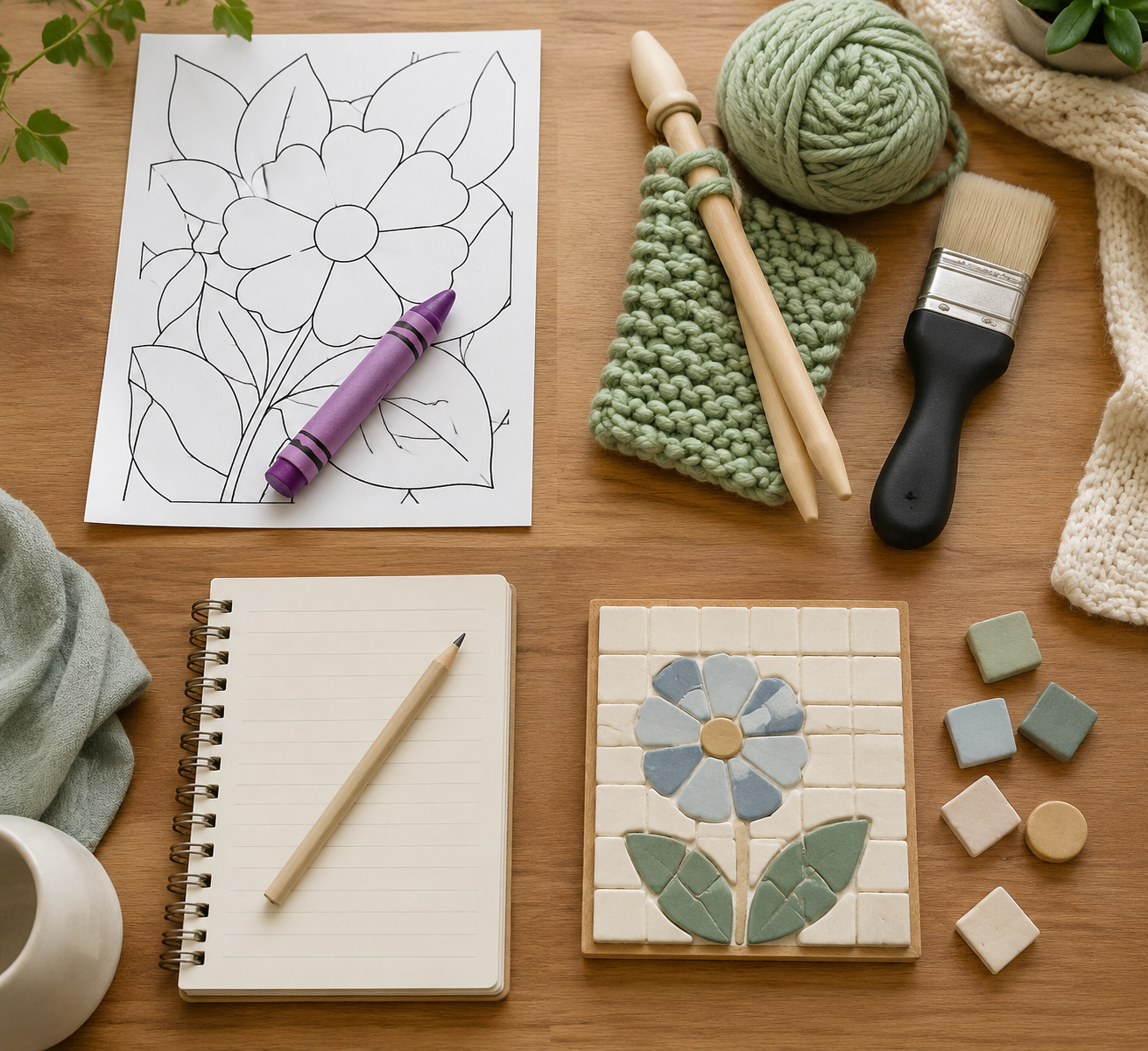
When chemo-brain is the limiter, memory and sequencing need to disappear from the task. Large-shape coloring, sticker collage, sorting printed photos, simple journaling prompts, and phone-based photo albums work better than anything that asks the patient to remember steps or choose from a dozen supplies [3].
A first-person account from Comfort Through Cancer describes phone photo albums as one of the least demanding options, which makes sense because the patient can point, approve, and stop without a craft pile taking over the room [3]. The caregiver should narrow the menu to one prepared option, then handle the trimming, tapping, or sorting while the patient gives the directions.
When the hands are the problem
Neuropathy changes the unit of work from small to large. Thick markers, broad brushes, air-dry clay with large-handled tools, pre-cut collage pieces, and oversized knitting needles are easier to manage than anything that asks for pinching or fine fingertip control. For an older adult who also has arthritis or vision changes, contrast and handle size matter as much as the activity itself.
That is also where shared-time projects can work well. In a Henry Ford example, a patient directed a body-mapping exercise while the caregiver handled the actual placement of materials, and the patient's subjective pain moved from 7 to 5-6 on a pain scale [4]. The useful part is not the specific project; it is the division of labor: patient chooses, caregiver executes the fiddly steps.
When nausea or low counts narrow the options
Nausea punishes smell, motion, and clutter, so keep the activity low-scent and low-spill: digital photo sorting, dictating captions, a tiny paper project, or listening while a caregiver assembles a memory page. If the oncology team has asked for extra infection caution because counts are low, keep it solo, use supplies that clean easily, and skip shared tools or group classes. The point is to leave the room calm and the cleanup short.
What the label changes
Professional art therapy is not the same thing as a home craft project. The American Cancer Society and Cancer Research UK both describe art therapy as guided by a trained therapist, which matters when the patient needs more than distraction or wants help working through feelings that do not fit into ordinary conversation [5][6]. The NIH review also notes that the literature still blurs art therapy and art making, so the practical question at home is less about labels than about whether the activity lowers strain without creating more of it [1].
The evidence for creative work is promising, but still uneven. The review found 8 of 23 studies with significant pain reductions, and some studies showed attention moving away from pain for a period; UCLA also reports art therapy has been associated with lower cortisol, better mood, less anxiety, and non-verbal expression [1][7]. That is enough to justify trying a calm, well-matched activity. It is not enough to pretend every craft does the same job.
Make the caregiver the facilitator
- Put out one activity, not five.
- Pre-open, pre-cut, pre-sort, and pre-fill whatever can be done ahead of time.
- Use larger tools, strong contrast, and a tray that keeps the mess in one place.
- Do the glue, threading, cropping, or app navigation when the patient wants to direct rather than handle.
- Stop while the patient is still okay; a short calm session counts as success.
That is the practical verdict: creative hobbies are worth trying during chemotherapy when they are matched to today's symptoms, and when the caregiver quietly makes them possible instead of harder.
References
- Art Therapy and Art Making for Addressing Cancer-Related Pain and Distress in Adult Populations: A Scoping Review — NIH/PMC, 2025
- 15 Fun Activities for Cancer Patients at Home (By Energy Level) — Beat Cancer EU
- 10 Gentle Hobbies to Pick Up During Chemotherapy — Comfort Through Cancer
- How Art Therapy Can Benefit Those With Cancer — Henry Ford Health, 2026-04
- Art Therapy — American Cancer Society
- Art Therapy — Cancer Research UK
- Creating Art During Cancer Treatment Allows Patients to Express Challenging Emotions — UCLA Health
Questions to bring to a clinician or OT
This is not medical, legal, or a family's final decision — only a framework. Bring these questions to a clinician, occupational therapist, or your local Area Agency on Aging.
Find Local HelpRelated reading
Noticed something outdated or inaccurate on this page? Flag a correction. We review every report against CDC, NIA, and AARP HomeFit guidance before updating a page.