
Caregiver decision guide
How to help an elderly loved one cope with a celebrity death
Learn how to validate an elderly parent's grief over a celebrity death, distinguish normal mourning from complicated grief, and strengthen your caregiving bond through shared reminiscence and structured rituals.
Your mother is crying over an actor she never met. Your father keeps replaying the same interview clip. Your spouse talks about the celebrity as if a neighbor died. It can feel disproportionate from the outside, especially when you are already managing medications, appointments, bills, and your own workday.
The first response should not be, “You didn’t even know him.” For an elderly person, grieving a famous actor can mean coping with the loss of a familiar voice, a remembered decade, a marriage-era ritual, or one of the few steady companions left in daily life. The actor may have been on the television every week when the children were small, during a deployment, after a move, after widowhood, or through years when the house became quieter.
That does not mean every tear is a medical crisis. It does mean the grief deserves a humane first response, followed by practical observation. Validate it, ask what the actor represented, help your loved one remember without being overwhelmed, and watch for signs that ordinary mourning is turning into something more serious.
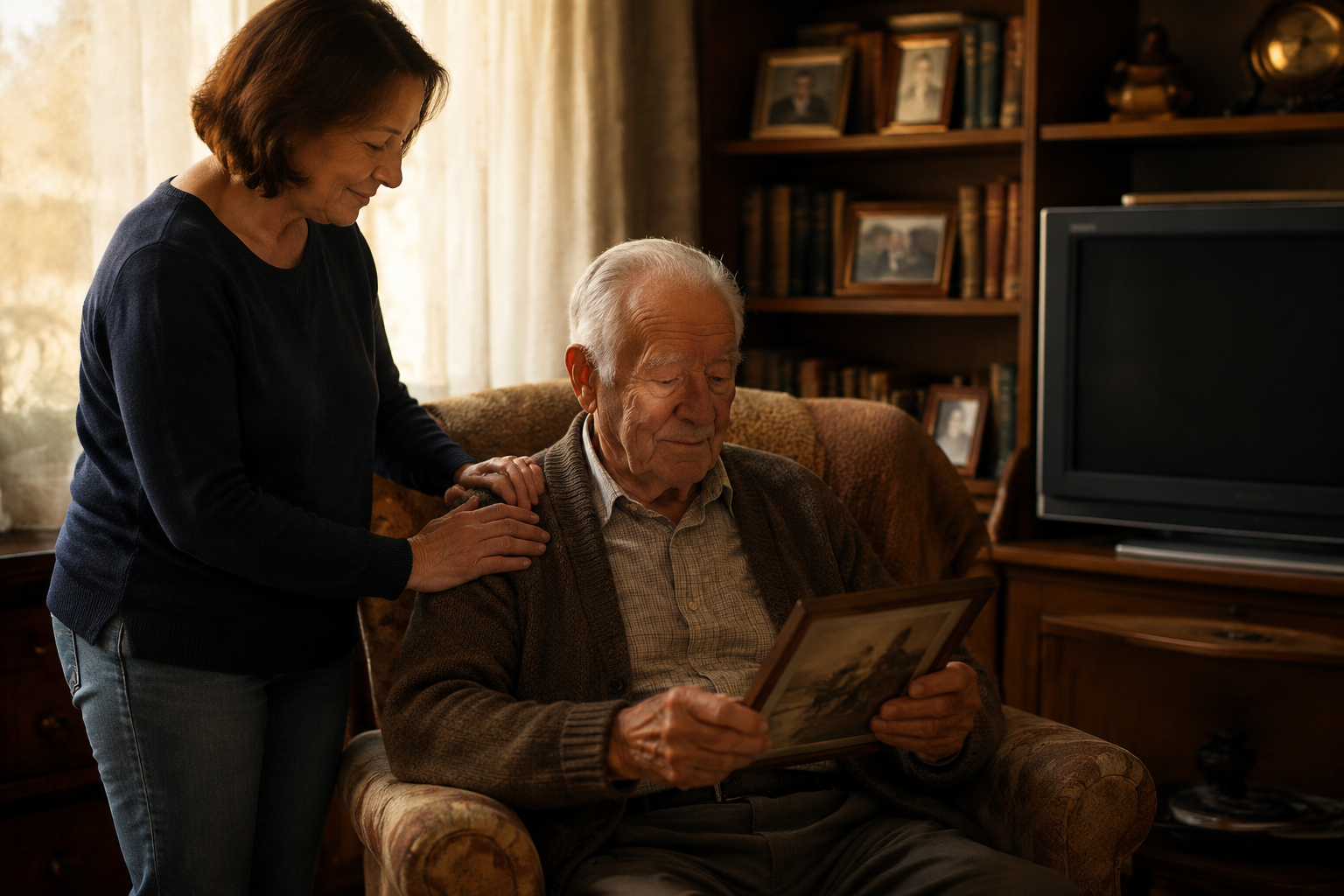
Start By Treating The Grief As Real
Parasocial bonds — the one-sided attachments people form with public figures, fictional characters, hosts, musicians, and actors — are not a sign that someone is confused about reality. A 2024 Scientific Reports study found that parasocial relationships can supplement real friendships rather than simply replace them, and research on adults 55 and older found that relationships with favorite television characters may serve companionship needs, especially when family relationship quality is lower.[1][2]
Those studies do not prove that every older adult grieves a real actor in the same way they grieve a television character. They do, however, support what many families see at home: a screen relationship can carry emotional weight. If your loved one has watched the same actor for 40 or 50 years, the bond may be attached to a whole private archive of memory.
A better opening line is simple: “I can see this hit you hard.” Then stop long enough to let the person answer. You are not agreeing that the actor was a personal friend. You are acknowledging that the loss has landed somewhere real.
- Say: “You watched him for so many years. What are you remembering right now?”
- Say: “Was there a time in your life when his movies or shows meant a lot to you?”
- Say: “Do you want to tell me what you liked about him?”
- Avoid: “You didn’t know him,” “Don’t be silly,” or “There are worse things happening.”
If you already said the wrong thing, repair it plainly. “I’m sorry I brushed it off. I didn’t understand how much he meant to you.” That kind of repair often matters more than finding the perfect grief phrase on the first try.
A Caregiver Response That Usually Helps
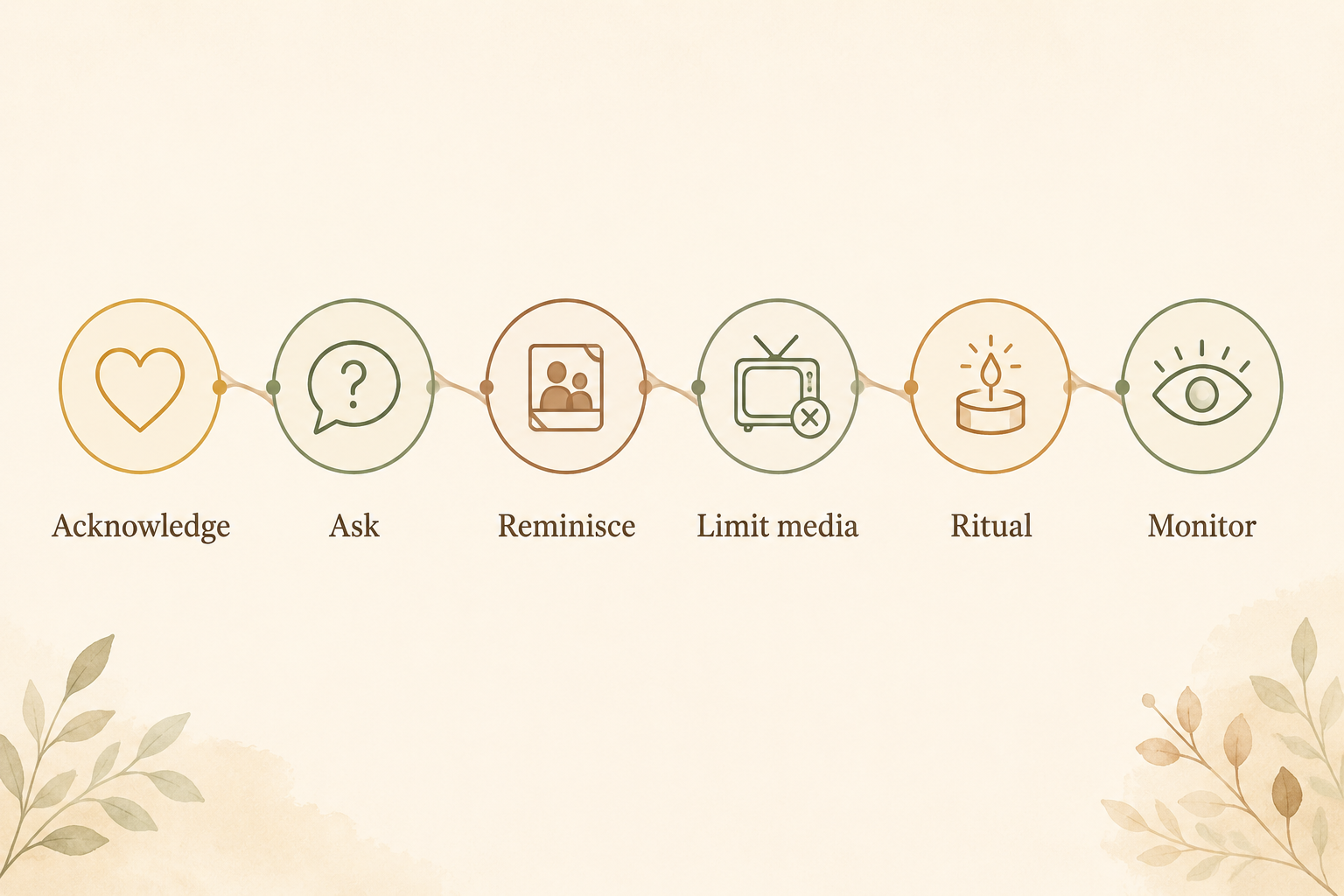
| Caregiver move | What it does |
|---|---|
| Acknowledge the loss | Reduces shame and stops the conversation from becoming a debate over whether the grief is legitimate. |
| Ask what the actor represented | Turns a celebrity death into a doorway to memory, identity, and sometimes older unresolved grief. |
| Use shared reminiscence | Lets the older adult tell stories instead of sitting alone with repeating clips or headlines. |
| Limit distressing media repetition | Protects the person from being pulled back into the first shock all day. |
| Create a simple ritual | Gives the grief a shape without making it grander than the person wants. |
| Monitor over time | Helps you distinguish normal sadness from grief that is becoming functionally or medically concerning. |
This is not a script to perform perfectly. It is a sequence that keeps you from doing the two least helpful things: dismissing the grief immediately or treating ordinary sadness as an emergency before you have watched the pattern.
Ask About The Actor Without Sounding Patronizing
The conversation should not feel like an interview. Sit down if you can. Turn away from the sink, the doorway, or the phone. Older adults often know when a caregiver is offering “emotional support” while also trying to escape the room.
Start with the actor, not with an explanation of grief. “When did you first start watching him?” is usually gentler than “Why are you so upset?” “Did Dad like these movies too?” may open a memory that “Are you depressed?” would shut down. If your relationship with your parent is tense, guidance on having hard conversations with aging parents can help you ask without making the older person feel examined.
Listen for what sits underneath the celebrity name. Sometimes the answer is straightforward: the actor was funny, handsome, talented, or familiar. Sometimes the answer is much larger.
- “Your father and I watched that show every Friday” may mean the death has reopened spousal grief.
- “Everyone from that time is gone now” may point toward loneliness, lost peers, or fear of outliving one’s world.
- “He was my age” may bring mortality into the room more sharply than a medical brochure ever could.
- “My sister loved him” may connect the celebrity death to an older sibling loss that the family rarely discusses.
You do not need to solve those meanings the moment they appear. A useful response is often just a small invitation: “Tell me about watching that with Dad.” “What was that time like for you?” “Do you miss having people around who remember it the same way?”
This is also where the caregiver’s own impatience can flare. You may be thinking about unpaid bills, a meeting starting in ten minutes, or the fact that your parent did not show this much emotion when you were exhausted last week. That reaction does not make you cruel; it means caregiving has narrowed your margin. If guilt and resentment are becoming regular companions, it may help to read about the hidden emotional toll of caring for aging parents alongside any advice you give your loved one.
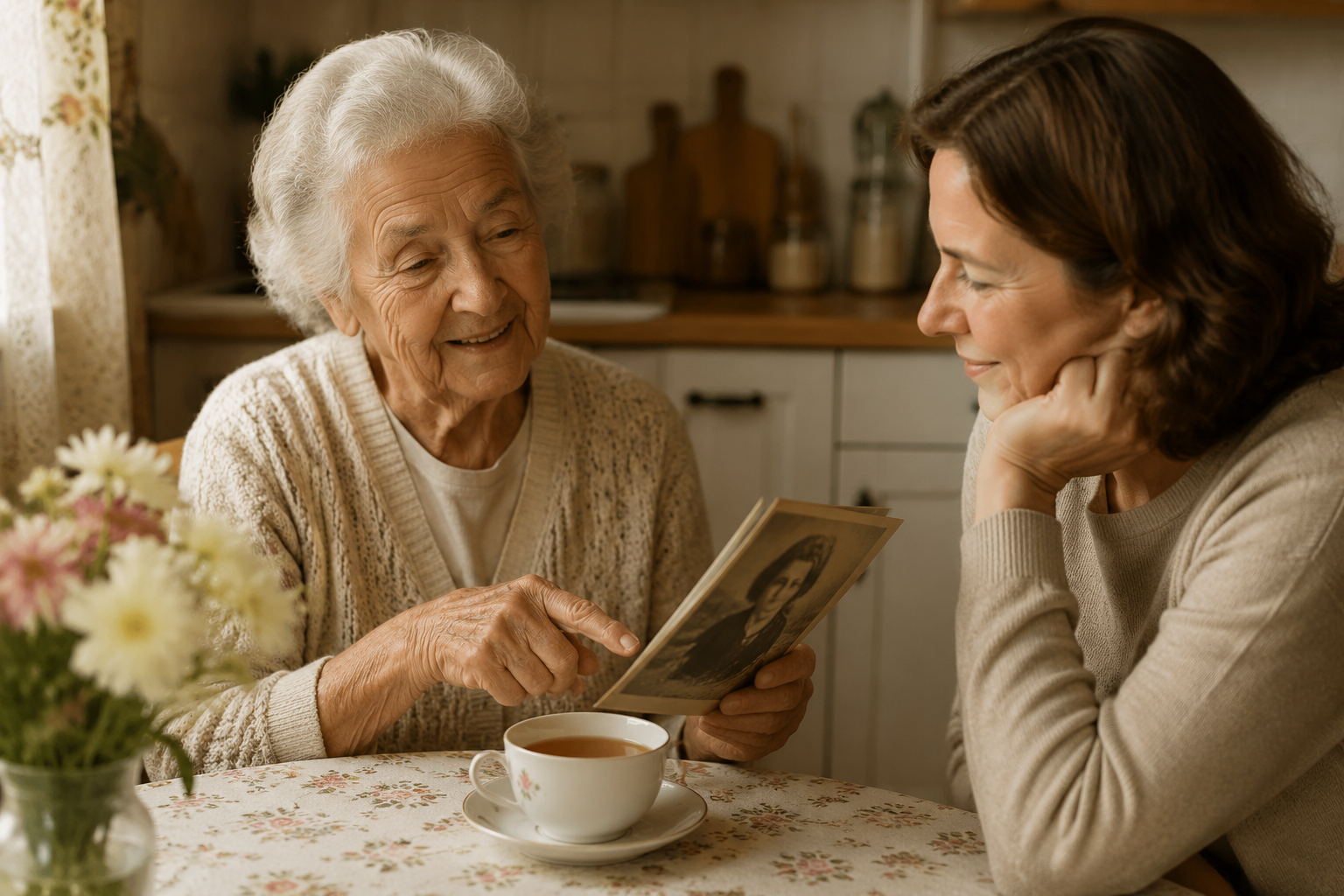
Use Reminiscence, But Do Not Let The News Cycle Run The House
A celebrity death often arrives with endless material: tribute reels, interviews, cause-of-death speculation, funeral footage, social media reactions, and old scenes clipped out of context. Some of it comforts. Some of it keeps the nervous system in the moment of impact.
Instead of banning coverage, help choose a form of remembering that has a beginning and an end. Watch one favorite film together after dinner. Look at old photographs from the period when the show was part of family life. Play a song from the soundtrack. Let your loved one tell you who sat where in the old living room, what snacks they made, what the children were doing, what the neighborhood was like then.
If the same breaking-news segment keeps playing, make the limit about distress rather than control: “This seems to hurt every time it comes back on. Let’s watch the interview you like, then turn the TV off for a while.” For a person with memory problems, repeated coverage may feel newly shocking each time; in that situation, reducing exposure can be an act of protection, not censorship.
A simple ritual is often enough
The ritual does not need to imitate a funeral. In fact, smaller is usually better. The aim is to give the feeling somewhere to go.
- Watch one favorite movie or episode together and let your loved one choose it.
- Light a candle during a song, scene, or closing credits if that fits your family’s beliefs.
- Write a short note of thanks and place it in a memory box or journal.
- Cook a meal connected to the era, show, or family routine the actor brings back.
- Call a sibling, cousin, or old friend who remembers watching the actor too.
Public grief organizations and medical commentators commonly advise acknowledging the emotional impact of celebrity deaths rather than minimizing it, while also making room for shared grieving and conversation.[3][4] For an elderly person, that shared space may be the difference between “I am foolish for caring” and “Someone understands what this brought back.”
When Normal Sadness Needs Closer Attention
Most grief after a celebrity death will soften. Your loved one may cry, talk about the actor for several days, want to watch old performances, or seem unusually reflective about age and death. That can be normal, especially when the actor’s death touches a personal loss.
The reason to keep watching is that grief is not only emotional in older bodies. A University of Birmingham study reported that grieving participants around age 75 had reduced neutrophil function, elevated cortisol, and DHEAS levels at about 20% of those seen in younger adults, suggesting that bereavement-related stress may be harder on immune functioning in old age.[5] That finding comes from bereavement research, not a study of celebrity deaths, but it explains why a caregiver should notice when grief coincides with physical decline.
Complicated grief is also not rare enough to ignore. A primary-care review of bereavement in older adults reports that about 10% of bereaved people develop complicated grief and notes higher risk among adults aged 75 to 84.[6] The same review describes persistent yearning, searching, preoccupation with the deceased for 6 months or more, disbelief, and feeling stunned as part of the clinical picture.[6]
A celebrity death by itself does not mean your parent has complicated grief. The more important question is whether this loss has fused with another loss and begun to interfere with daily life.
Watch for these red flags
- The grief remains intense, consuming, or functionally disruptive for 6 months or more.
- Your loved one shows persistent yearning, searching, disbelief, or stunned numbness.
- They cannot stop watching distressing coverage, even when it clearly worsens their mood or sleep.
- They stop eating normally, miss medications, neglect hygiene, withdraw from usual contact, or lose interest in nearly everything.
- The celebrity death reopens a spouse’s, child’s, sibling’s, or friend’s death in a way that feels unmanageable.
- They talk about wanting to die, being a burden, or having no reason to continue.
If there is talk of self-harm or not wanting to live, treat it as urgent and contact emergency services, a crisis line, or the person’s healthcare provider immediately. Do not wait to see whether it passes.
Screening tools can help you describe what you are seeing
The Brief Grief Questionnaire is a 5-item tool that takes about 3 minutes and has been used in primary care research with older adults.[6] A family caregiver should not use it to diagnose a parent at the kitchen table. Its value is more modest and more practical: it gives you language for what to tell a clinician.
Instead of saying, “She is obsessed with that actor,” you can say, “For the past several weeks she has been yearning, replaying clips for hours, sleeping poorly, and saying this feels like when my father died.” That is the kind of pattern a primary care clinician, geriatrician, therapist, or grief counselor can assess.
Depression can overlap with grief, especially when sleep, appetite, concentration, and daily functioning change. A healthcare provider can help sort out whether the person is experiencing normal mourning, complicated grief, depression, cognitive changes, medication effects, or a combination.
What This Moment Can Tell You About Their Larger Emotional Life
Many adult children first learn an aging parent’s emotional map through moments that seem inconvenient: a celebrity death, a canceled church event, a broken object, a move from one chair to another. Practical caregiving trains you to look for tasks. Emotional caregiving asks you to notice what those tasks are attached to.
If your parent’s grief over an actor reveals loneliness, fear of death, longing for a spouse, or the loss of a younger self, that is not a distraction from caregiving. It is part of the work. The broader caregiver wellbeing roadmap can be useful if you are realizing that care now includes more than appointments, groceries, and safety checks.
Meaning-making appears to matter in older bereavement. Studies using the Changing Lives of Older Couples data have found that finding meaning after loss is associated with better psychological adjustment in older bereaved adults.[7] Those studies concern personal bereavement, not celebrity grief, so the lesson should stay narrow: when a famous actor’s death opens a path into memory, gratitude, identity, or connection, it is worth helping the older person walk that path rather than shutting it down.
Take the grief seriously. Ask what the actor held for them. Share the memories that surface. Reduce media exposure when it keeps hurting them. Create one small ritual if they want one. Then keep watching the body, the routines, and the duration of the grief. That posture is neither dismissive nor alarmist, and it gives both of you a better chance of getting through the loss with more connection than strain.
References
- Parasocial relationships can enhance, not diminish, social life, Scientific Reports, 2024.
- Older Adults' Parasocial Relationships with Favorite Television Characters and Depressive Symptoms, ResearchGate.
- Why celebrity deaths hit us so hard, Ohio State Health & Discovery.
- Celebrities, Cruse Bereavement Support.
- How Grief Makes You Sick in Old Age, TIME.
- Bereavement in the elderly: the role of primary care, PMC / NIH.
- The role of meaning in bereaved elders' adaptation to loss, Changing Lives of Older Couples research.
Questions to bring to a clinician or OT
This is not medical, legal, or a family's final decision — only a framework. Bring these questions to a clinician, occupational therapist, or your local Area Agency on Aging.
Find Local HelpRelated reading
Noticed something outdated or inaccurate on this page? Flag a correction. We review every report against CDC, NIA, and AARP HomeFit guidance before updating a page.