
Caregiver decision guide
When Cyclospora Symptoms in Older Adults Need a Doctor
The 2026 Cyclospora outbreak can cause serious illness in older adults, but its symptoms—watery diarrhea, fatigue, and loss of appetite—are easily mistaken for a routine stomach bug. This guide explains the warning signs that warrant a same-day call to a clinician and why seniors face a higher risk of dehydration and complications.
If an older parent has watery diarrhea during the current Cyclospora outbreak, the safest question is not “Does this look dramatic enough?” It is “How long has this been going on, are they still drinking and urinating, and have they become unsteady?” In a younger adult, a mild stomach illness often buys a day or two of watching. In an 80-year-old who is barely drinking, moving more slowly, or getting dizzy when standing, the margin is thinner.
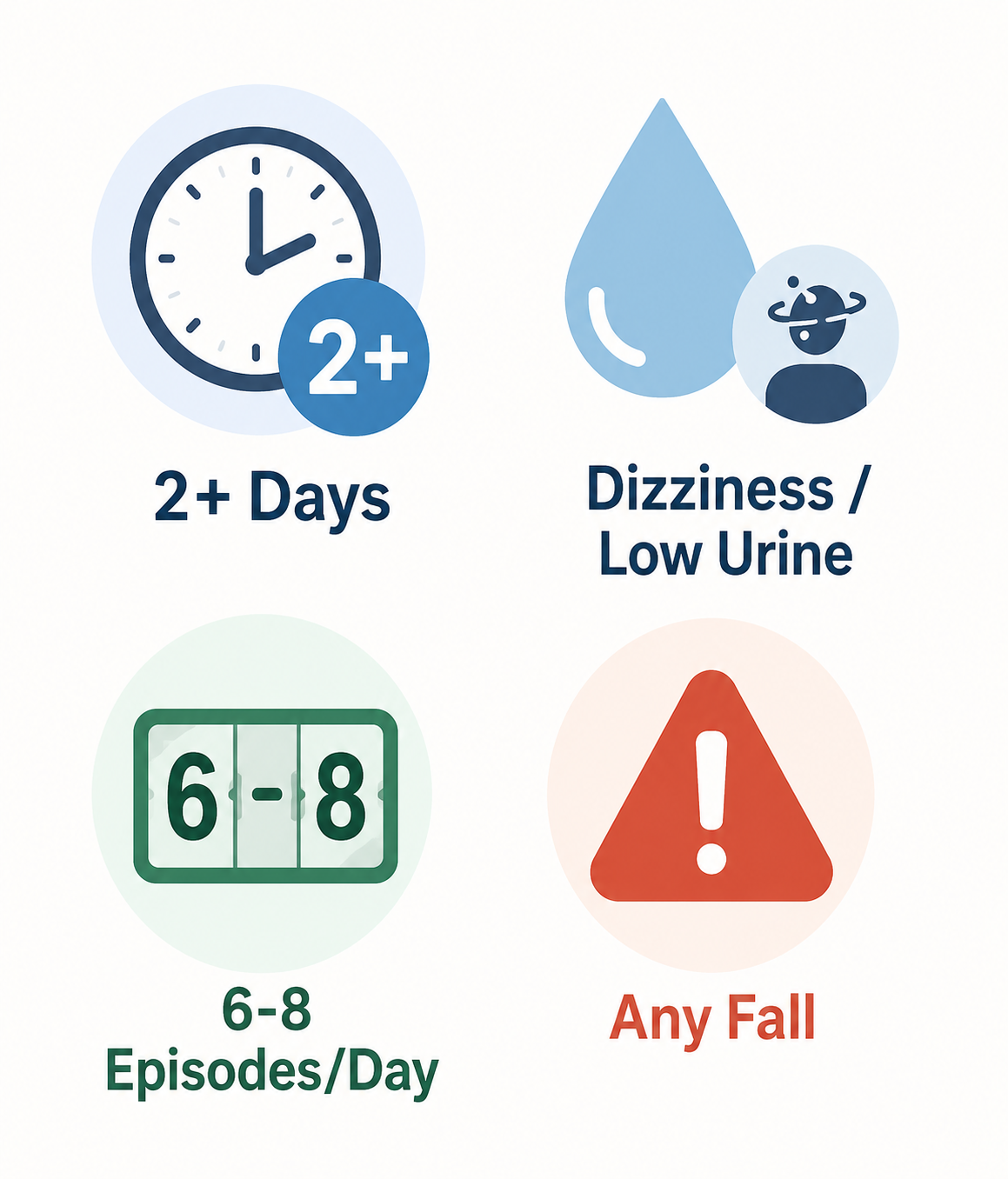
For Cyclospora symptoms in older adults, call a clinician the same day if diarrhea lasts more than 2 days, if there is dizziness or reduced urination, if diarrhea reaches more than 6 to 8 episodes in a day, or if there is any fall. Those thresholds are deliberately lower than many families use for themselves because dehydration can turn quickly into kidney strain, weakness, confusion, and another fall.
This is not internet noise. As of July 14, 2026, the CDC had reported 1,645 confirmed cyclosporiasis cases in the 2026 outbreak, with illnesses affecting people ages 2 to 95 and a 9% hospitalization rate. This article was last reviewed on July 20, 2026, and outbreak numbers may have changed since the CDC’s July figures were posted.[1]
That 9% hospitalization figure is not an older-adult-specific rate. There is no large dedicated geriatric Cyclospora cohort that proves exact outcomes for adults 65 and older. The reason for a lower call threshold comes from what watery diarrhea does to an aging body and from clinician warnings about dehydration risk in older adults, not from pretending the outbreak data isolates seniors perfectly.
Why a “Stomach Bug” Can Turn Faster in an Older Adult
Cyclospora illness can begin in a way that feels ordinary: watery diarrhea, fatigue, low appetite, stomach discomfort, and a general sense that the person is “off.” The hard part for families is that ordinary-looking symptoms can have different consequences in an older body.
Dr. Luis Marcos of Stony Brook Medicine, quoted by AARP, described the older-adult risk in practical terms: diarrhea and reduced intake can lead to dehydration, electrolyte problems, acute kidney injury, falls, and worsening of chronic conditions.[2] That is the cascade families are trying to interrupt.
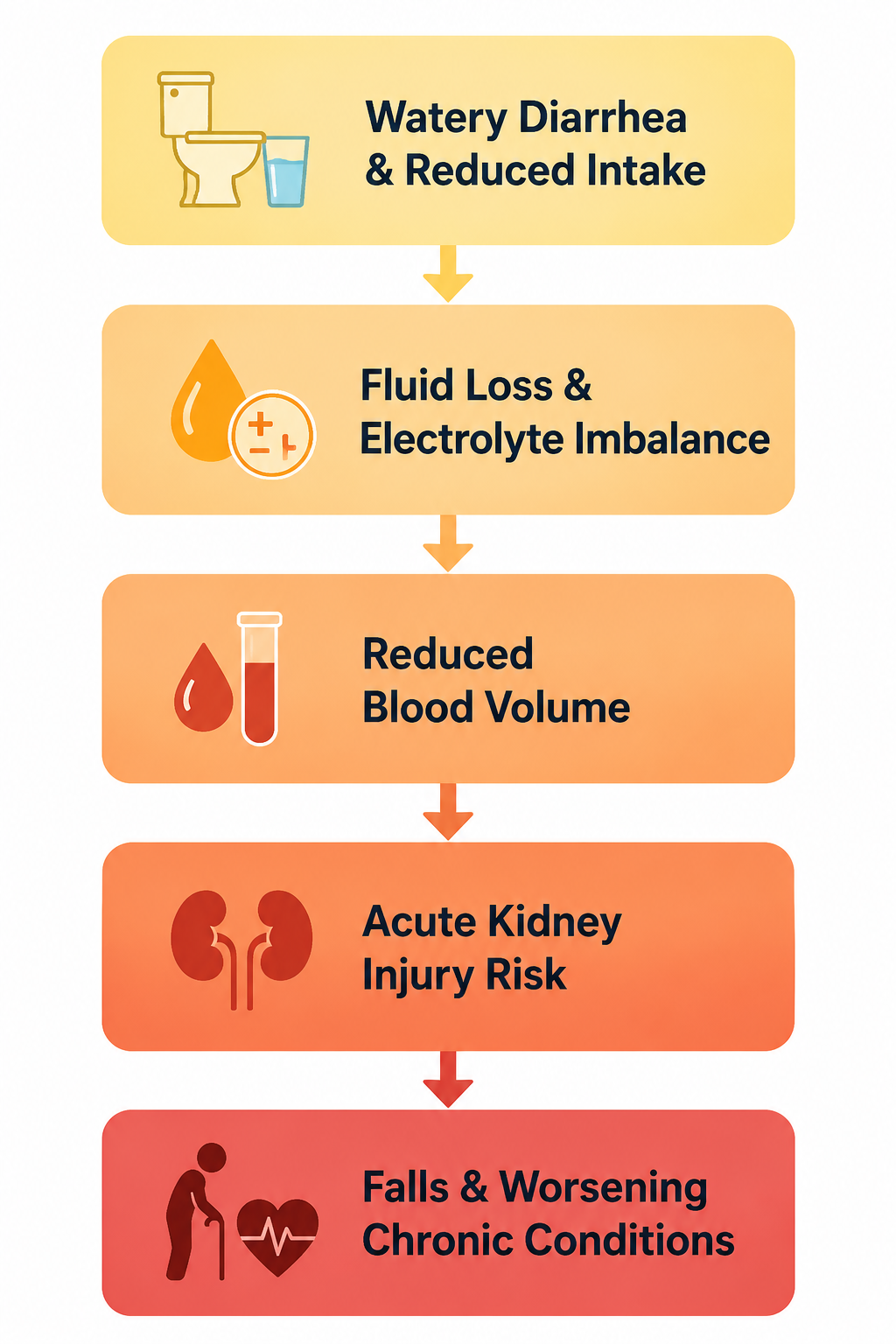
Watery diarrhea removes fluid. Loss of appetite cuts down replacement. Nausea, fatigue, or fear of another bathroom trip may make an older adult drink even less. If the person already takes medications for blood pressure, heart disease, diabetes, or kidney disease, the body may have less room to absorb that stress. The family sees “not eating much today.” The body may be dealing with lower blood volume and electrolyte shifts.
The fall risk is not a side issue. A dehydrated person who stands up at night to get to the bathroom may be dizzy, weaker than usual, or rushing. One fall can change the whole week: urgent care, imaging, pain, fear of walking, missed medications, or a new question about whether the person can safely be alone. Families who already watch for geriatric syndromes recognize this pattern: the trigger looks small, but the decline is not.
The Symptoms That Make Cyclospora Easy to Miss
Cyclospora does not announce itself with a special symptom that a family can confidently identify at home. The CDC clinical overview describes cyclosporiasis as an illness that commonly includes watery diarrhea and can also involve fatigue, loss of appetite, weight loss, cramping, bloating, increased gas, nausea, and other gastrointestinal symptoms.[3]
The pattern can be misleading. Symptoms may seem to improve and then return, and untreated illness can last from days to more than a month.[3] That waxing-and-waning course matters because a better morning after a bad night is not the same as recovery, especially if the older adult is still barely drinking, still having loose stools, or still weaker than usual.
During an active outbreak, Cyclospora belongs on the list when an older adult has persistent watery diarrhea, fatigue, and low appetite. It is still possible the cause is another infection, a medication effect, or a different medical problem. The point is not to diagnose Cyclospora from the living room. The point is to avoid treating prolonged diarrhea in an older adult as harmless just because the symptoms sound familiar.
Call the Same Day at These Thresholds
Dr. Cory Fisher of Cleveland Clinic, quoted by AARP, cited red flags that include more than 6 to 8 diarrheal episodes in a day, diarrhea lasting more than 2 to 3 days, or any sign of dehydration.[2] For an older adult, those are not “keep an eye on it” details. They are enough reason to call the clinician, urgent care line, or nurse triage service the same day.
| What you see | Why it matters | What to do |
|---|---|---|
| Diarrhea beyond 2 days | Fluid loss has had time to accumulate, even if symptoms come and go | Call the clinician the same day |
| Dizziness, lightheadedness, or reduced urination | These can signal dehydration and lower blood volume | Call the same day; ask whether urgent evaluation is needed |
| More than 6 to 8 diarrheal episodes in a day | Fluid and electrolyte losses may outpace what the person can replace | Call the same day |
| Any fall | A fall may be the first visible sign that dehydration, weakness, or unsteadiness has become dangerous | Call promptly; seek urgent care if injury, head impact, confusion, severe weakness, or inability to walk is present |
Reduced urination is one of the details families often miss because nobody wants to monitor bathroom trips. It is worth asking directly: “When did you last pee?” “Was it much less than usual?” “Was it dark?” The answers are imperfect, but they are more useful than asking only whether the person feels thirsty.
The same goes for steadiness. If an older adult is furniture-walking, pausing before standing, or newly afraid to go to the bathroom alone, that belongs in the call. Do not wait for a dramatic collapse. The clinician needs the functional change, not just the stool description.

What to Say When You Call
A useful call is specific. Start with the time course, the fluid status, and the fall risk. Then mention the outbreak and ask about testing by name.
- “My parent is older and has had watery diarrhea for more than 2 days.”
- “They have had about [number] episodes today.”
- “They are drinking less than usual / dizzy when standing / urinating less than usual.”
- “They fell, nearly fell, or are newly unsteady walking to the bathroom.”
- “Given the current Cyclospora outbreak, should they be tested specifically for Cyclospora?”
That last sentence matters more than it should. The CDC has warned clinicians that routine ova-and-parasite stool testing may not include Cyclospora unless specifically requested, and some gastrointestinal PCR panels do not test for Cyclospora unless the panel includes it.[1] A caregiver can do the responsible thing, get care, and still have the infection missed if nobody asks the lab question clearly.
Do not ask the clinician for a particular medication plan based only on an article. Ask what evaluation is appropriate, whether stool testing should include Cyclospora, whether dehydration needs to be assessed, and whether any current medicines require temporary review because of diarrhea and low intake. Medication changes belong with the clinician who knows the person’s kidney function, heart history, blood pressure, and diabetes status.
When Brief Improvement Is Not Enough
Cyclospora’s waxing-and-waning pattern creates a bad trap for caregivers. A parent may have a miserable day, then a quieter half-day, and everyone wants to believe the crisis is passing. If the diarrhea returns, appetite stays poor, or the person remains weak, the better spell should not reset the clock to zero.
Track the whole course: first day of diarrhea, number of episodes in the past 24 hours, fluid intake, urination, dizziness, falls or near-falls, fever if present, and whether symptoms are returning after partial improvement. This is not about building a perfect medical chart at home. It is about giving the clinician enough information to judge dehydration risk and decide what testing or evaluation is needed.
For readers who need the broader treatment picture, including how cyclosporiasis is generally managed in seniors, the companion guide “Cyclosporiasis Symptoms and Treatment for Seniors” is the better place to spend time. Here, the decision is narrower: persistent diarrhea, dehydration signs, heavy stool frequency, or a fall should move the situation from observation to a same-day clinical call.
References
- HAN Archive - 00531. Centers for Disease Control and Prevention. July 2026.
- Cyclospora Outbreak Sickens More Than 1,600 People. AARP. 2026.
- Clinical Overview of Cyclosporiasis. Centers for Disease Control and Prevention.
Questions to bring to a clinician or OT
This is not medical, legal, or a family's final decision — only a framework. Bring these questions to a clinician, occupational therapist, or your local Area Agency on Aging.
Find Local HelpRelated reading
Noticed something outdated or inaccurate on this page? Flag a correction. We review every report against CDC, NIA, and AARP HomeFit guidance before updating a page.