
Caregiver decision guide
Dallas Heat Wave Safety Tips for Elderly Caregivers
Protect your elderly parent during a Dallas heat wave with this guide covering cooling centers, emergency AC programs, heat stroke prevention, and local resources — because generic heat safety tips don't account for North Texas extreme summer conditions.
If your parent is in Dallas during a heat wave, start with the house, not the forecast. Check the indoor temperature where they actually sit and sleep. Confirm the air conditioner is cooling, not just running. Move the chair out of the west-facing sun. Make the next pharmacy trip earlier in the day or send someone else. Then write down where they can go if the house becomes unsafe before you need that answer.
That is the difference between generic summer advice and heat safety for older adults in Dallas. North Texas is not dealing with an occasional hot afternoon. The National Weather Service Fort Worth office tracks 100-degree days for Dallas-Fort Worth, including long runs of triple-digit heat; its records show past stretches of 30 or more consecutive 100°F days, and the 2026 season is still unfolding, with the first 100°F day listed on July 7 as of July 22, 2026.[1]
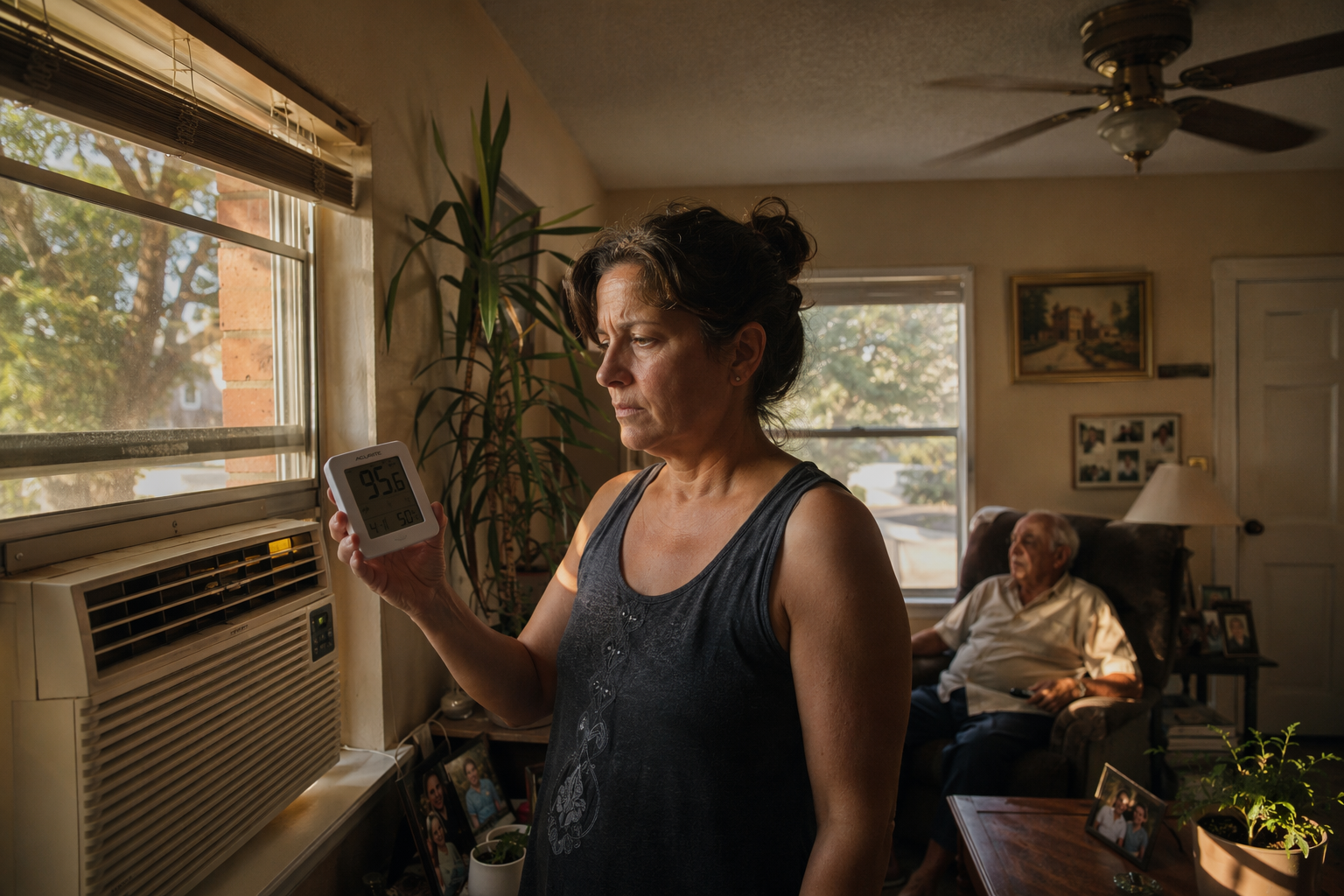
The first practical rule is uncomfortable but necessary: do not wait for an older parent to say they are overheated. CDC guidance says people over age 60 account for more than 80% of heat-related deaths, and older adults are at higher risk because age, chronic conditions, medications, reduced sweating, and lower thirst sensation can all interfere with the body’s cooling response.[2] Mayo Clinic describes heat stroke as a medical emergency and notes that high body temperature, altered mental state, nausea, flushed skin, rapid breathing, and racing heart rate can be part of the picture.[3]
Dallas County’s recent heat-death reporting makes this more than a seasonal warning. NBC 5 DFW reported Dallas County’s first heat-related death of summer 2025 in July of that year, and Scripps News reported in June 2026 that a massive U.S. heat wave had turned deadly while warnings continued.[4][5] Those reports do not prove what will happen in one home on one block. They do prove that the risk is local, current, and worth planning around before the air conditioner fails.
The Dallas Heat Plan Starts Inside the Home
A thermostat reading of 78°F in a hallway is not enough information. Put a simple thermometer in the bedroom and another near the chair where your parent spends the afternoon. West-facing rooms, upstairs bedrooms, enclosed garages, cars, and apartments with weak airflow can run hotter than the number on the wall suggests. Dallas’s urban heat island effect can also keep neighborhoods warmer, especially where pavement, buildings, and limited shade hold heat into the evening; Climate Central identifies older adults as a population at risk as heat and climate conditions intensify.[6]
For a caregiver, the useful question is not whether the house feels “a little warm.” It is whether the cooling system can keep the rooms your parent uses at a safe, tolerable level through the hottest part of the day and overnight. If the answer is uncertain, treat that as a planning problem immediately.
- Check the indoor temperature in the bedroom and main sitting area, not only the thermostat.
- Close blinds or curtains on sun-exposed windows before the afternoon heat builds.
- Move the usual chair, walker, oxygen equipment, or medication station away from direct sun.
- Confirm the AC is producing cool air and that vents are not blocked by furniture.
- Set a phone reminder for water, meals, and symptom checks instead of relying on thirst.
- Decide who can visit in person if the indoor temperature rises or the AC stops working.
Fans can help move air, but they are not a complete safety plan during dangerous heat. CDC heat guidance warns that fans may not prevent heat-related illness when temperatures are very high, especially for people at higher risk.[2] In a Dallas heat wave, a fan in a hot room may buy time while you arrange a cooler location; it should not become the whole answer.
Use Local Cooling Options Before the House Becomes Unsafe
Cooling centers are not a last-minute trivia question. They belong in the family plan before a compressor quits or an electricity bill forces someone to keep the house too warm. The City of Dallas Office of Emergency Management maintains a cooling centers page, but locations and hours can change with season, staffing, weather conditions, and city operations.[7] Check the page before relying on it, and call ahead when possible.
The Salvation Army North Texas also lists heat relief stations, with 13 station locations shown on its heat relief page.[8] That is useful, but it still needs the same practical verification: Is the location open today? What are the hours? Is there seating? Can your parent bring a walker, oxygen, medications, or a caregiver? Is transportation realistic at the time of day you would need to move them?
| Need | Resource to Check | What to Confirm Before You Go |
|---|---|---|
| A public place to cool down in Dallas | City of Dallas cooling centers page | Current location, hours, accessibility, parking or drop-off, and whether the site is open during the current heat event |
| Heat relief station in North Texas | Salvation Army North Texas heat relief page | Open hours, exact address, whether seating is available, and whether the site fits your parent’s mobility needs |
| Help locating nearby cooling options | Texas 2-1-1, option 1 | Nearest available site, current status, transportation limits, and whether the information is updated for today |
| Emergency window AC help | Call 214-819-1909 | Eligibility, availability, documentation, installation requirements, and whether units are still available |
| Help with utility bills | Dallas County CEAP at 214-819-1848 | Eligibility, required documents, appointment process, and whether assistance can prevent disconnection or restore service |
| Federal energy assistance referral | LIHEAP at 1-866-674-6327 | Program availability, local administering agency, and application steps |
The emergency window AC number, 214-819-1909, is worth saving in more than one phone. Treat it as a starting point, not a guarantee. The number was cross-checked through local reporting and Dallas County social media references, but program availability can change quickly during an active summer. Ask specifically about eligibility, installation, documents, and whether a unit is available before telling a parent to wait at home for help.
For utility assistance, Dallas County Health and Human Services lists the Comprehensive Energy Assistance Program, or CEAP, with 214-819-1848 as the contact number.[9] LIHEAP can also be reached at 1-866-674-6327 for energy-assistance referral. If you are coordinating from another city, keep a shared note with the account holder’s name, utility provider, ZIP code, shutoff notice status, and any documents the program requests. Heat planning gets harder when the person who knows the bill details is not the person making the calls.
A Caregiver Checklist for the Hottest Days
The daily routine should be boring, visible, and easy for someone else to take over. Put it on the refrigerator. Text it to siblings. Leave a copy with a neighbor who has permission to check in. A plan that lives only in one adult child’s head will fail the first time that person is in a meeting, on a flight, or stuck on Central Expressway.
- Morning: check the forecast, indoor thermometer, AC function, medication supply, and transportation needs.
- Late morning: finish errands, pharmacy trips, appointments, dog walking, or trash pickup before peak heat.
- Afternoon: keep blinds closed, limit cooking heat, encourage water and light meals, and check for confusion or unusual fatigue.
- Evening: recheck the bedroom temperature, because a warm room can stay unsafe after sunset.
- Before bed: make sure a phone is charged, emergency numbers are visible, and the parent knows who is calling or visiting the next day.
Hydration still matters, but it needs structure. Older adults may not feel thirsty early enough to keep up with heat stress, and some medical conditions or medications complicate fluid intake.[2] If your parent has heart failure, kidney disease, takes diuretics, or has been told to limit fluids, ask their clinician what a safe hot-weather hydration plan should look like. “Drink more water” is too vague when the person has a medication list.
Medication timing also deserves attention. Do not change prescriptions on your own, but do ask a pharmacist or clinician whether any medications increase heat sensitivity, dehydration risk, dizziness, or confusion. Then adjust the logistics you can control: refill before a heat alert, use delivery if available, and avoid sending an older adult across a parking lot at the worst hour of the day.
When Symptoms Stop Being a Home Problem
Heat illness can look like ordinary tiredness until it does not. Watch for heavy sweating or the sudden absence of sweating, weakness, dizziness, headache, nausea, muscle cramps, flushed skin, rapid breathing, fast pulse, fainting, confusion, agitation, slurred speech, or trouble staying awake. Mayo Clinic identifies altered mental state and high body temperature among heat stroke warning signs and describes heat stroke as requiring emergency treatment.[3]
Call 911 for suspected heat stroke, fainting, severe confusion, seizure, chest pain, trouble breathing, or a parent who cannot be cooled quickly. While waiting for help, move the person to a cooler place, remove excess clothing, use cool cloths or a cool shower if safely possible, and do not force fluids into someone who is confused, vomiting, very drowsy, or not fully alert. This is the point where independence stops being the deciding factor.
For Long-Distance Caregivers, Build a Local Chain
If you are coordinating from Austin, Chicago, Atlanta, or anywhere outside North Texas, you need a person, not just a phone tree. One neighbor with a key, one nearby relative, one church member, one building manager, or one paid caregiver who can physically see the room is more useful than three relatives refreshing the weather app.
- Ask someone local to read the indoor thermometer out loud during afternoon check-ins.
- Keep the cooling center and heat relief station options in a shared note with addresses and verified hours.
- Arrange backup transportation before a heat emergency, including who can drive and who can help with mobility.
- Give the local contact permission to call 911 if your parent sounds confused, collapses, or refuses help while showing danger signs.
- Save 214-819-1909, 214-819-1848, Texas 2-1-1 option 1, and 1-866-674-6327 in the shared note.
The verification step matters because Q3 2026 is an active summer. A cooling site listed last week may have different hours today. An assistance program may still exist but have a waitlist, documentation requirement, or limited inventory. Before moving an older parent across town in dangerous heat, confirm the destination is open, reachable, and appropriate for their mobility and medical needs.
The Plan That Actually Holds Up
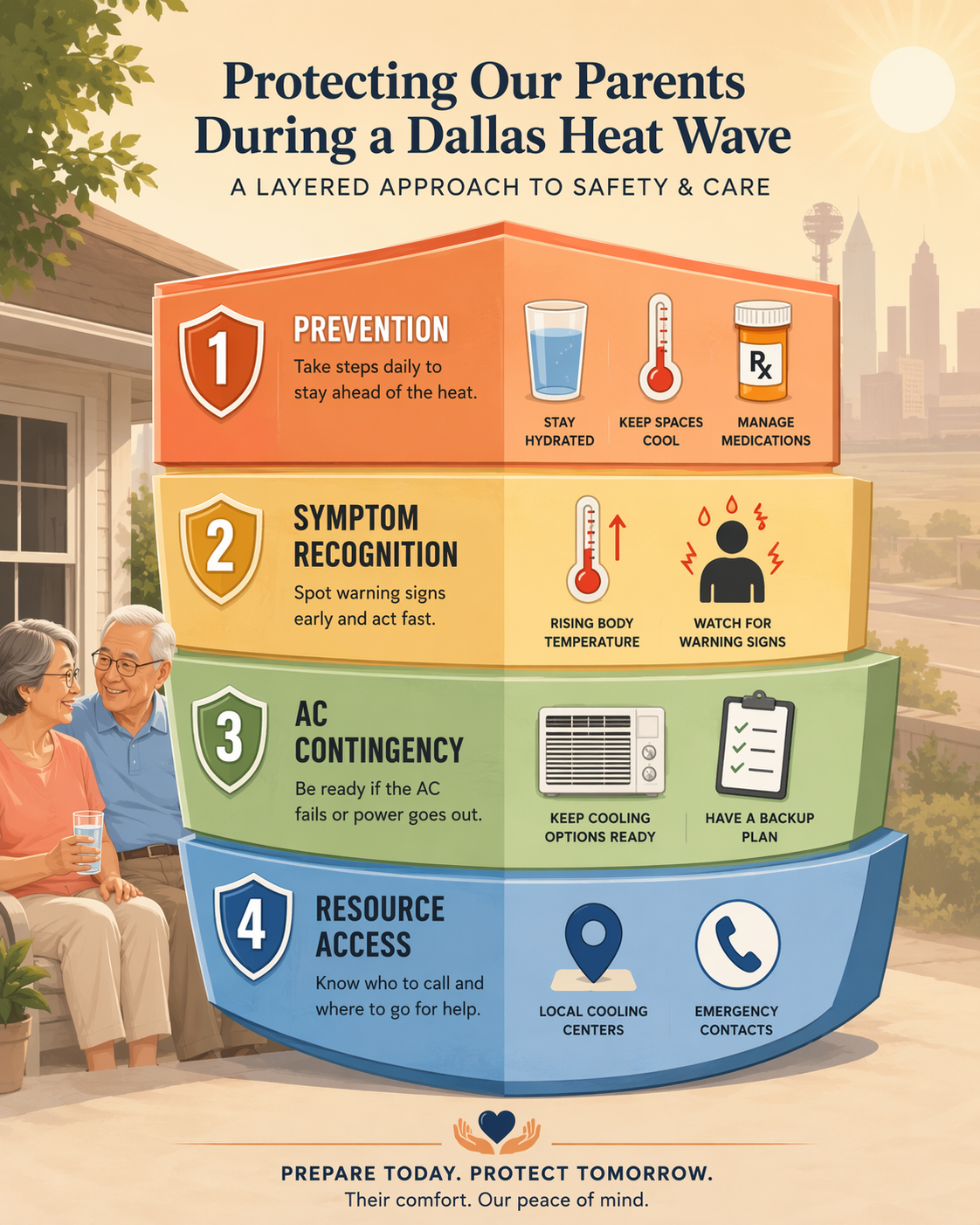
A safe Dallas heat plan is layered. Prevention keeps the house cooler and the day simpler. Symptom recognition keeps the family from mistaking heat illness for stubbornness or normal aging. AC contingency planning answers the question nobody wants to face at 4 p.m. Resource access gives the caregiver numbers, pages, and places to verify before the home becomes unsafe.
That is more work than saying “stay hydrated.” It is also closer to what Dallas heat asks of families caring for older adults.
References
- 100° Day Data, National Weather Service, https://www.weather.gov/fwd/d100data
- Heat and Older Adults (Aged 65+), Centers for Disease Control and Prevention, https://www.cdc.gov/heat-health/risk-factors/heat-and-older-adults-aged-65.html
- Heatstroke - Symptoms and causes, Mayo Clinic, https://www.mayoclinic.org/diseases-conditions/heat-stroke/symptoms-causes/syc-20353581
- Dallas County reports summer's first heat-related death, NBC 5 DFW, https://www.nbcdfw.com/news/local/dallas-county-reports-summers-first-heat-related-death/3893399/
- Massive US heat wave turns deadly as warnings continue, Scripps News, https://www.scrippsnews.com/weather/massive-us-heat-wave-turns-deadly-as-warnings-continue
- Seniors at Risk: Heat and Climate Change, Climate Central, https://www.climatecentral.org/climate-matters/seniors-at-risk-heat-and-climate-change
- Cooling Centers, City of Dallas Office of Emergency Management, https://dallascityhall.com/departments/officeemergencymanagement/Pages/Cooling-Centers.aspx
- Heat Relief, The Salvation Army North Texas, https://salvationarmyntx.org/north-texas/heat-relief/
- Comprehensive Energy Assistance Program (CEAP), Dallas County Health and Human Services, https://www.dallascounty.org/departments/dchhs/human-services/ceap.php
Questions to bring to a clinician or OT
This is not medical, legal, or a family's final decision — only a framework. Bring these questions to a clinician, occupational therapist, or your local Area Agency on Aging.
Find Local HelpRelated reading
Noticed something outdated or inaccurate on this page? Flag a correction. We review every report against CDC, NIA, and AARP HomeFit guidance before updating a page.