
Caregiver decision guide
Senior Travel Safety Tips Every Caregiver Should Know
Planning a trip with an aging parent? This guide provides a systematic pre-travel checklist covering medical clearance, medication logistics, mobility planning, documentation, accommodation vetting, and communication — so you can prevent the most common health and safety incidents before you leave home.
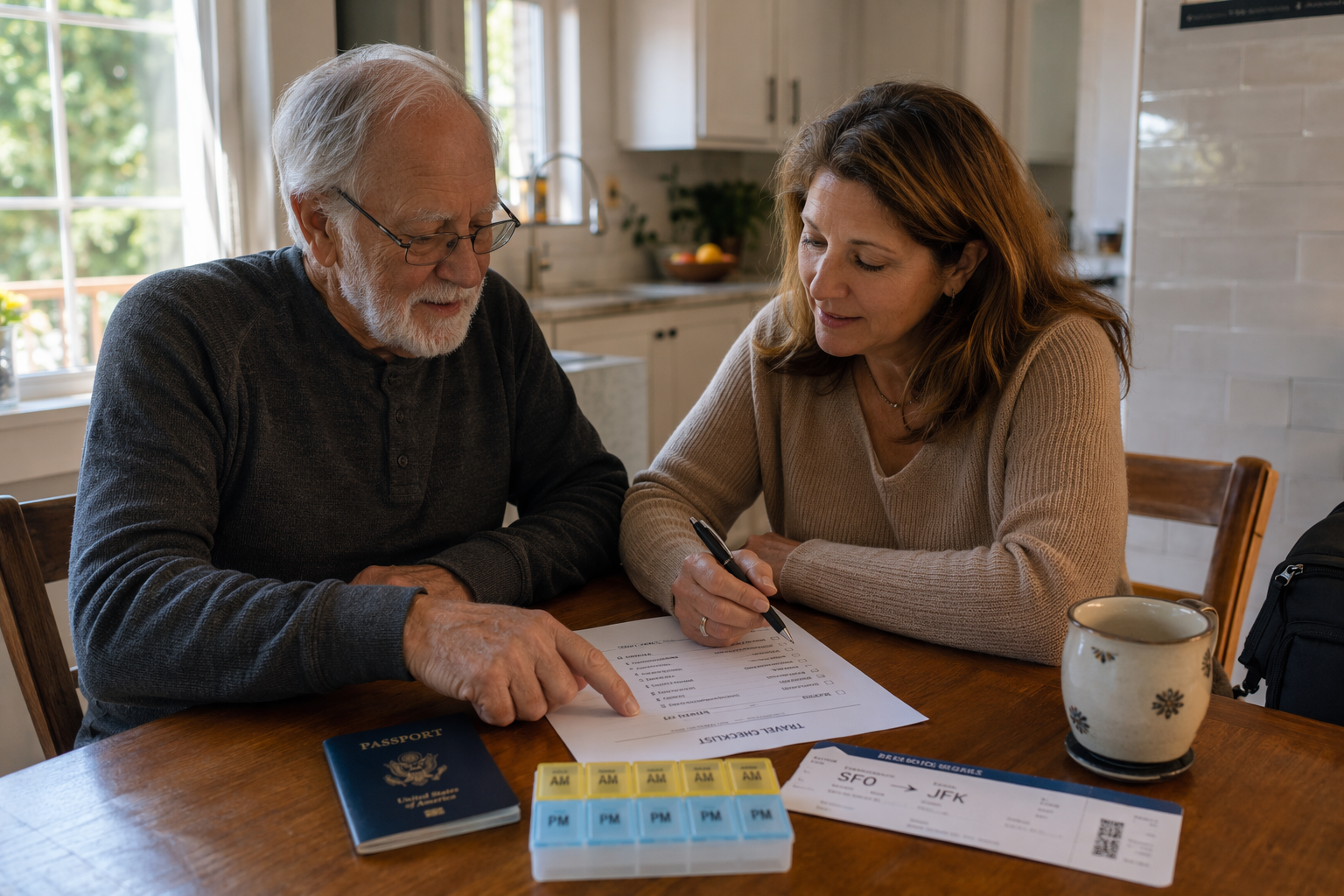
The trip usually starts becoming real at the kitchen table: boarding pass printed, hotel confirmation open, pill organizer sitting off to the side like a quiet warning. The question behind most travel safety tips for senior citizens is not whether an older parent is “safe to travel.” It is whether the ordinary parts of travel have been made specific enough that they will still work when everyone is tired, late, hungry, or too polite to ask for help.
Nearly 9 in 10 older adults take at least one prescription medication, according to the National Council on Aging, citing CDC National Health Statistics Report data from September 2024.[1] That one fact changes the order of preparation. Medication planning is not a line item after packing; for many families, it is the center of the travel safety plan.
Start 4 to 6 weeks before departure if you can. The CDC recommends a pre-travel health appointment in that window so there is time for vaccine series, destination-specific advice, and medication adjustments.[2] If the trip is sooner, do not abandon the process. Use the same checklist, but mark what must be handled today rather than what would have been ideal a month ago.
The Pre-Trip Safety Checklist
| What to Check | What to Confirm Before Departure |
|---|---|
| Medical clearance | Travel health visit, routine and destination vaccines, chronic condition stability, DVT prevention plan, emergency instructions |
| Medication logistics | Enough supply for the full trip plus delays, original containers, carry-on packing, written medication list, refill plan, time-zone instructions |
| Mobility and fall-risk planning | Airport assistance, rollator or other aid, walking breaks, realistic daily pacing, safe shoes, rest points |
| Documentation | REAL ID or passport, insurance cards, emergency contacts, diagnosis summary, medication list, digital and paper copies |
| Accommodation vetting | Bathroom layout, grab bars, roll-in shower if needed, elevator access, room distance from entrance, bed height, thresholds |
| Communication | Shared itinerary, emergency contact tree, pharmacy and clinician numbers, travel insurance details, who carries which documents |
This is not meant to make the trip feel clinical. It is meant to keep the clinical pieces from taking over the trip later. A parent who still wants to choose the restaurant, carry their own jacket, and decide when to rest deserves a plan that protects those choices instead of waiting for a preventable problem to make the decisions for everyone.
Medical Clearance: Put a Date on the Calendar
The pre-travel appointment should answer practical questions, not just produce a vague “cleared to travel.” Bring the itinerary, expected walking, flight or drive duration, destination, current medication list, allergies, diagnoses, and recent health changes. Ask directly whether the trip requires vaccine updates, medication timing changes, mobility precautions, or limits on exertion.
For older adults, the CDC points to routine vaccines such as pneumococcal pneumonia, shingles, annual influenza, and COVID-19, with destination-specific vaccines added when relevant.[2] Because vaccine recommendations can change and destination requirements vary, the useful step is not memorizing a list. It is checking the current CDC Travelers’ Health page and the clinician’s recommendation for the actual destination and date of travel.
If the trip involves a long flight, train ride, or car day, ask about blood clot prevention. Older adults have higher-than-average risk for deep vein thrombosis, and long periods of sitting can contribute to clot formation; guidance from the American Geriatrics Society and CDC emphasizes movement breaks, leg exercises, and, for some travelers, compression stockings.[4][5] Compression stockings are not a universal purchase to make without context, especially when circulation problems or other conditions are present, so confirm what is appropriate for the person traveling.
Medication Logistics Deserve the Most Time
The first medication task is arithmetic. Count how many doses are needed from the day of departure through the day after returning, then add extra for delays. A weekend trip can turn into a longer stay because of weather, illness, or a missed connection. That is not dramatic planning; it is what travel does.

Keep medications in the carry-on, not in checked luggage. If a suitcase goes missing, the clothes are an inconvenience; the prescriptions may be the trip. Keep prescriptions in their original labeled containers when possible, especially for air travel, controlled substances, international travel, or any situation where a medication may need to be identified quickly.
- Ask the prescribing clinician or pharmacist whether each medication should stay on home time or shift to local time.
- Confirm whether any medication requires refrigeration, food, spacing from other drugs, or avoidance of alcohol or sun exposure.
- Refill early enough that pharmacy delays, prior authorization issues, or out-of-stock problems do not become travel problems.
- Carry a printed medication list with drug name, dose, schedule, reason taken, prescriber, pharmacy, and known allergies.
- Place a copy of the medication list in the document folder and another in the day bag, not only on one person’s phone.
The pill organizer is useful for daily routine, but it should not be the only source of truth. If a parent becomes ill, skips breakfast, crosses time zones, or sees an urgent care clinician away from home, the written list matters more than the colored compartments. If a morning dose is delayed because of an early flight, the family needs to know whether to take it late, skip it, or adjust the next dose. That answer should come from the clinician or pharmacist before the trip, not from a guess in the boarding area.
For international trips, check whether every medication is legal at the destination and whether documentation is required. There is no single universal rule for every country, so this is a verification task: check official destination guidance, the airline if needed, and the prescribing clinician’s office before packing.
Mobility Planning Is Not the Same as Calling Someone Frail
This is often the hardest part to discuss because mobility help can sound, to the older adult, like a verdict. A caregiver may see a long terminal, a sloped hotel driveway, and a museum with few benches. A parent may hear, “You can’t handle this anymore.” The wording matters. Frame mobility tools as energy management for a specific trip, not as a permanent identity.
AARP’s travel guidance, drawing on expert Joy Loverde, recommends considering a rollator walker with a built-in seat even for some older adults who do not have a diagnosed mobility issue, because the consequences of a fall can be far more serious for an older person.[3] The built-in seat is the part worth noticing. It solves a travel problem that pride often hides: there may be no place to sit when the line stalls, the gate changes, or the tour group pauses in full sun.
Airport wheelchair assistance belongs in the same category. It does not mean the parent cannot walk. It means the family is choosing not to spend half the day’s energy on security lines, terminal distances, and gate changes before the trip has even begun. Arrange assistance through the airline ahead of time when possible, and still leave extra time at the airport because assistance desks and attendants can have their own waits.
- Build walking breaks into long car, train, or flight days rather than treating movement as optional.
- Choose shoes by stability and traction, not by whether they look fine for dinner.
- Plan the first day lightly if travel itself will be physically demanding.
- Identify where the parent can sit at the airport, hotel lobby, attraction entrance, and restaurant wait area.
- Decide in advance who will carry bags so the older adult is not balancing luggage while stepping onto curbs, shuttles, or escalators.
Call the Hotel and Ask Impolite-Sounding Questions
“Accessible room” is too broad to trust without details. AARP’s guidance notes that hotel accessibility language can be vague, and caregivers should ask directly about features such as grab bars, roll-in showers, and elevator access.[3] This is one of those moments when a pleasant front-desk answer is not enough. The person answering may be kind and still not know whether the bathroom layout will work.

- Is the shower walk-in, roll-in, or a tub-shower combination?
- Are there grab bars by the toilet and in the shower, and are they fixed bars rather than suction accessories?
- Is there a shower chair or bench available, and can it be reserved?
- Is the room reachable by elevator without stairs anywhere along the route?
- How far is the room from the entrance, elevator, breakfast area, parking, or shuttle pickup?
- Are there raised thresholds at the bathroom, balcony, or room entrance?
- What is the bed height, and is there space to maneuver a walker or rollator if one is used?
After the call, write down the date, the name of the person who answered, and exactly what was promised. If the setup is essential, call again closer to departure. This can feel excessive until the family arrives after dark and the only available room has a tub no one can safely step into.
Documents That Can Stop a Trip Before It Starts
For domestic U.S. air travel, the ID check now needs special attention. Since May 2025, travelers need a REAL ID-compliant license or another acceptable form of identification for domestic U.S. flights, according to NCOA’s travel guidance citing TSA policy.[1] Check the card itself before travel day. A wallet that has worked for years can still fail at the airport if the ID is not compliant.
For international travel, verify passport validity, visa requirements, destination entry rules, and State Department items such as STEP enrollment directly through official government sources. Do not rely on memory, a travel forum, or what was true on a previous trip.
- Government ID, REAL ID-compliant license, passport, or other accepted travel document
- Health insurance cards, prescription insurance card, and travel insurance documents
- Medication list, diagnosis summary, allergies, clinician contact information, and pharmacy contact information
- Emergency contacts, including someone not traveling with the group
- Copies stored in two ways: paper in the travel folder and digital copies accessible to the caregiver
Insurance Is Part of the Safety Plan, Especially Abroad
Do not assume Medicare travels the way luggage does. Medicare generally does not cover health care received outside the United States, with limited exceptions, so international travelers need to verify supplemental coverage, travel health insurance, and medical evacuation coverage before leaving.[6] The CDC also advises travelers to consider medical evacuation insurance because evacuation can be expensive and may not be covered by standard health plans.[2]
The practical test is simple: if your parent fell, developed chest pain, ran out of an essential medication, or needed hospital care abroad, who would you call first, what policy number would you give, and who would decide whether transfer to another facility was covered? If that answer is buried in an email attachment no one has opened, the insurance task is not finished.
Communication: Decide Before the Stress Starts
A shared itinerary prevents small confusion from becoming a family-wide search operation. Give every traveling adult the flight or train details, hotel address, room reservation name, ground transportation plan, emergency contacts, and the location of key documents. If one caregiver is carrying the folder, someone else should still know what is in it.
Also decide what the older adult wants disclosed and to whom. A parent may be comfortable having a daughter know the medication list but not want every sibling copied on medical details. Sorting that out before travel respects independence and reduces awkward decision-making if a clinician, hotel manager, airline employee, or relative asks questions later.
- Name one person responsible for medication timing during travel days.
- Name one person responsible for passports, IDs, insurance cards, and printed confirmations.
- Share the itinerary with an at-home contact who can help if a phone is lost or a reservation needs to be found.
- Put clinician, pharmacy, hotel, airline, travel insurance, and emergency contact numbers in both phones and paper form.
- Agree on a phrase the parent can use when they need a break without having to explain or defend it.
A Dated Final Pass
Two weeks before departure, review the checklist with dates beside each completed item. One week before departure, confirm prescriptions, hotel accessibility details, transportation assistance, IDs, insurance documents, and the shared itinerary. The day before departure, move medications, documents, chargers, glasses, hearing aid supplies if used, and essential medical items into the carry-on or day bag.
The goal is not to remove every uncertainty from travel. That is impossible, and it would make the whole trip feel like a medical drill. The goal is to remove the preventable failures: the refill that cannot be filled across state lines, the hotel shower no one can use, the parent standing too long because no one wanted to ask for a chair, the ID that stops the trip before security. Preparation is not pessimism. It is what lets the trip remain about the parent, the family, and the destination.
References
- How to Travel Safely as an Older Adult, National Council on Aging
- Older Adults and Healthy Travel, CDC Travelers’ Health
- 8 Steps to Consider When Traveling with an Older Adult, AARP, August 2025
- Tip Sheet: Safe Travel Tips for Older Adults, American Geriatrics Society Health in Aging Foundation
- Blood Clots During Travel, CDC Travelers’ Health, August 2022
- Medicare coverage outside the United States, Medicare.gov
Questions to bring to a clinician or OT
This is not medical, legal, or a family's final decision — only a framework. Bring these questions to a clinician, occupational therapist, or your local Area Agency on Aging.
Find Local HelpRelated reading
Noticed something outdated or inaccurate on this page? Flag a correction. We review every report against CDC, NIA, and AARP HomeFit guidance before updating a page.