
Caregiver decision guide
Earthquake Preparedness for an Elderly Parent Living Alone
This guide provides a caregiver-led action plan—the safety triangle—covering home hazard mitigation, a verified local support network, and a medical-equipment-aware survival kit to help ensure an older adult living alone is ready for an earthquake.
The earthquake alert is usually not the part that keeps an adult child awake. It is the next ten minutes: your parent is alone, the floor may be covered with glass, the walker may be across the room, the phone may have slid under a chair, and nobody in the family can get there quickly.
That is why earthquake preparedness for elderly living alone has to be built differently from a regular household checklist. Food and water matter, but they are not the first failure point for many older adults. The first failure point is often reach: reaching shoes, medication, a flashlight, a phone, a door, a neighbor, or a backup power plan.
The preparedness gap is real. In a 2020 study of 2,256 adults ages 50 to 80, older adults living alone had lower odds of having a 7-day food and water supply, a stocked emergency kit, and a discussed evacuation plan; the adjusted odds were 0.74, 0.64, and 0.59, respectively. The study did not include adults over 80, so it should not be treated as a full picture of the oldest adults, but it does put numbers on a problem families often notice only after a scare: independent living can quietly depend on help that has never been assigned.[1]
Older adults also carry a disproportionate share of disaster harm. In the 2011 Japan earthquake and tsunami, 77% of deaths were among people over 65.[2] During Hurricane Katrina, people 75 and older were about 6% of New Orleans’ population but accounted for 50% of deaths.[3] Those are different disasters, not earthquake-specific predictions for one household. They are a reminder that age, mobility, chronic illness, transportation, and isolation change what “prepared” has to mean.
Start With The Safety Triangle
For a parent living alone, the plan needs three parts that support each other. If one side is missing, the rest gets weaker.
| Part of the plan | What it solves | Caregiver job |
|---|---|---|
| Home walk-through | Falling objects, blocked paths, misplaced mobility aids, power-dependent equipment | Walk the home from the bed outward and fix hazards before shaking starts |
| Verified local support network | No immediate helper, no transportation, no one with access | Confirm at least two local people who agree to check, enter, communicate, and help |
| Bedside emergency kit | Injuries, darkness, lost glasses, dead phone, missed medication | Put the right supplies where your parent can reach them after the quake |
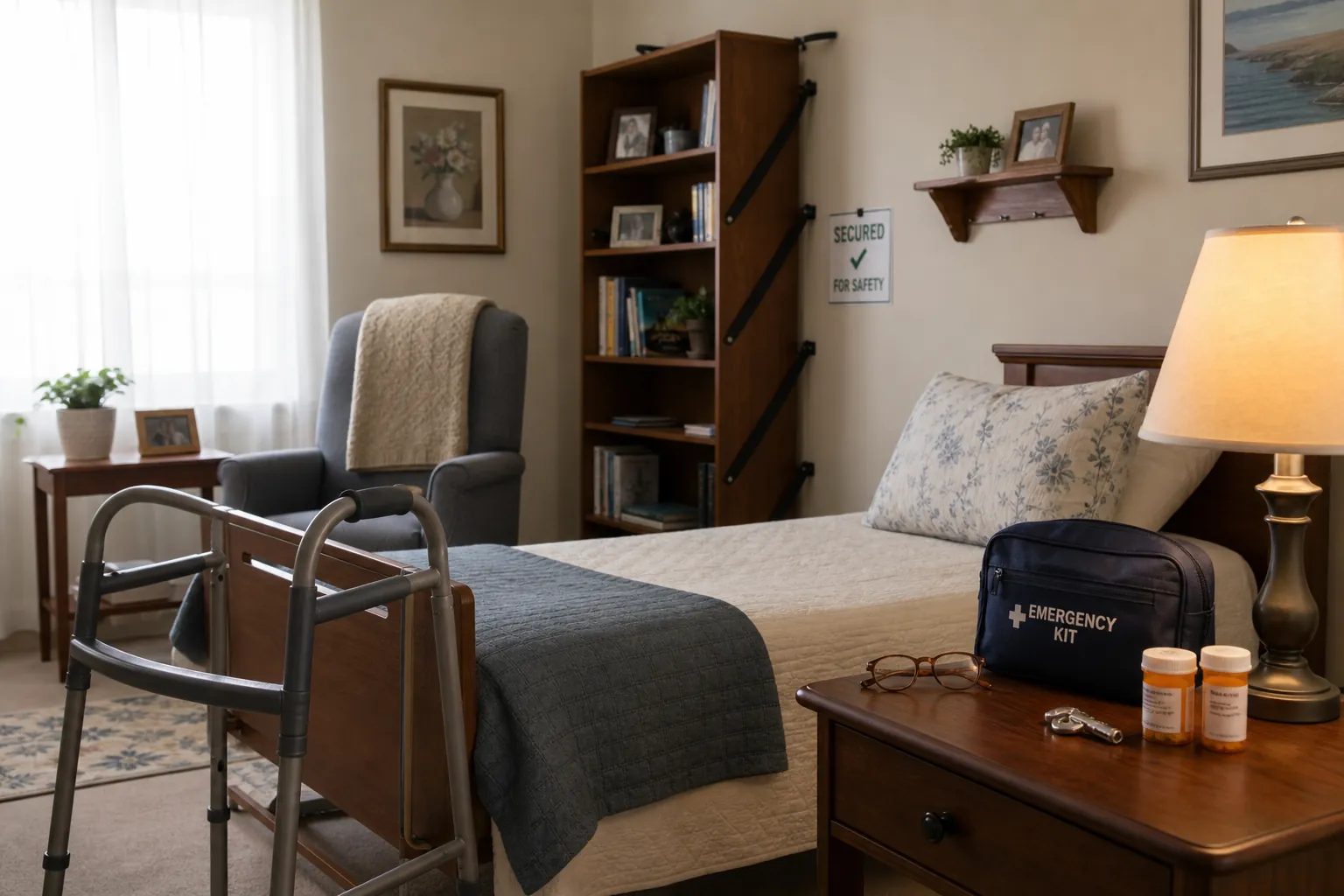
This is not a plan you finish by ordering supplies. It is a plan you test against your parent’s actual morning, actual nighttime route to the bathroom, actual hearing and vision, actual medication schedule, and actual willingness to let someone else hold a key.
Walk The Home From The Bed, Not From The Front Door
Most checklists start with supplies. In a home where an older adult lives alone, start where the earthquake may find them: in bed, in the bathroom, in a favorite chair, or at the kitchen sink. The question is not “Is there an emergency kit somewhere?” It is “Can my parent move safely from here, in the dark, if shelves have emptied and the power is out?”
Illinois emergency guidance for seniors identifies falling objects as a primary earthquake hazard, especially for older adults who may not be able to move quickly under sturdy furniture. The practical answer is not encouragement to be faster. It is anchoring and rearranging before the shaking happens.[4]
- Anchor tall bookcases, cabinets, dressers, televisions, and other heavy furniture that could fall into walking paths.
- Move heavy items from high shelves to lower shelves, especially over beds, recliners, and seating areas.
- Check that the route from bed to bathroom is wide enough for the walker, cane, wheelchair, or rollator your parent actually uses.
- Keep sturdy shoes at the bedside, not in the closet, because broken glass and scattered objects can make bare feet dangerous.
- Place a flashlight where it can be reached from bed and from the main sitting area.
- Make sure mobility aids are parked within reach, not across the room, behind a door, or beside furniture that may shift.
Do this walk-through with your parent if possible, not around them. Ask where they would naturally reach for a cane at night. Ask which chair they sit in when they take afternoon medication. Ask whether they would actually wear the shoes you put by the bed. A plan that preserves independence usually works better than one that announces a parent has become a project.
Medical Equipment Needs Its Own Failure Plan
If your parent uses an oxygen concentrator, CPAP machine, powered bed, lift chair, refrigerated medication, electric wheelchair, nebulizer, or charging-dependent communication device, the earthquake plan is also a power-outage plan. A University of Iowa Health and Retirement Study analysis reported that 15% of older adults used an electrically powered medical device that could fail during a power outage.[5]
Confidence drops where equipment dependence rises. Bell et al. found that older adults using mobility aids or electrically dependent equipment had significantly lower confidence in handling an outage lasting more than 24 hours, with adjusted odds of 0.65 and 0.66.[1] That does not mean every parent with equipment is unsafe alone. It means the device should not be treated as background furniture. Someone local needs to know what it is, what it does, how long any backup lasts, and what action to take if power is out.
- Label each critical device with its purpose, power source, backup battery status, and supplier or clinician contact.
- Keep charging cords and backup batteries in one visible place, not scattered through drawers.
- Ask the equipment supplier what the backup options are during an extended outage.
- Tell local contacts which devices are essential and which are optional comfort items.
- If evacuation may be necessary, decide in advance who can transport both your parent and the necessary equipment.
The Local Support Network Is The Plan, Not A Nice Extra
This is the part families tend to keep vague because it feels awkward. A neighbor “would probably help.” A cousin “is nearby.” Someone “could check.” After an earthquake, probably is not a plan. Someone has to know they are on the list, agree to the job, have a way in, and understand what they are looking for.
Older emergency guidance from CalEMA and current Illinois guidance both point to the same practical standard: build a network of at least two local contacts, provide spare keys where appropriate, and make sure those contacts know the older adult’s medical equipment and needs.[6][4] The CalEMA page is not a newly updated source, but this recommendation lines up with current emergency-preparedness guidance from agencies that still tell older adults to plan for helpers, communication, and medical needs.
Two contacts is the floor, not because two is magic, but because one person may be at work, injured, out of town, caring for their own family, or unable to get through damaged roads. If you live far away, this network is the difference between knowing your parent should be checked and knowing who is checking.
Transportation deserves a direct conversation. In the University of Iowa analysis, nearly 1 in 4 older adults who lived alone lacked a car or transportation access during emergencies. The data came from 2010 and was published in 2014, so it is not a current count of every community, but it remains directionally useful: evacuation instructions often assume access to a ride that many older adults do not have.[5]
What Each Local Contact Should Agree To Do
Do not hand someone a name and phone number and call it finished. Make the job small enough to agree to and clear enough to carry out under stress.
- Check on your parent after a significant earthquake if phones are down or family cannot reach them.
- Use a spare key, lockbox, building access code, or agreed entry method with your parent’s consent.
- Know where the bedside kit, medication list, mobility aids, and medical equipment instructions are kept.
- Report back to a designated family contact using text, phone, or another agreed method.
- Help your parent get to a safer location if the home is damaged, if utilities fail, or if equipment cannot run.
- Know when to call emergency services instead of trying to manage the situation alone.
The spare-key conversation needs care. Some parents will welcome it. Others will hear it as surveillance or loss of control. Offer choices: a trusted neighbor, a lockbox code, a building manager, a nearby relative, or a sealed envelope held by someone your parent names. Consent matters, and so does making sure help can get through the door.
Make A One-Page Contact Sheet
The contact sheet should live in three places: with your parent, with each local contact, and with the adult child or family coordinator. Keep it plain. Nobody should have to open an app, remember a password, or scroll through old texts while alarms are going off.
- Parent’s full name, address, apartment or gate instructions, and preferred name.
- Primary and backup family contacts, with mobile numbers.
- Two or more local contacts, listed in the order they should be called.
- Key medical conditions, allergies, medications, pharmacy, clinicians, and insurance information.
- Medical equipment used at home, including what requires electricity.
- Evacuation preference: where your parent would go first if the home is unsafe.
Then test it in the most ordinary way possible. Call Contact 1 and ask, “If there is a strong quake and I cannot reach Mom, can you check on her? Do you still have the key? Do you know where the kit is?” Do the same with Contact 2. If either person hesitates, that is useful information, not an insult. Replace uncertainty before you need certainty.
Build The Kit Around The Bedside, Then Add The Larger Supplies
A garage shelf full of emergency supplies may help eventually. It does not help much if your parent wakes up after a quake and cannot safely cross the room. The first kit should be a bedside bag: reachable from bed, light enough to handle, and specific to the person.
The Red Cross recommends keeping sturdy shoes, a flashlight, glasses, a dust mask, and a whistle in a bedside bag, and notes that broken glass is the most common earthquake injury.[7] That small bag is often more important in the first minutes than a bin of canned food in the garage.
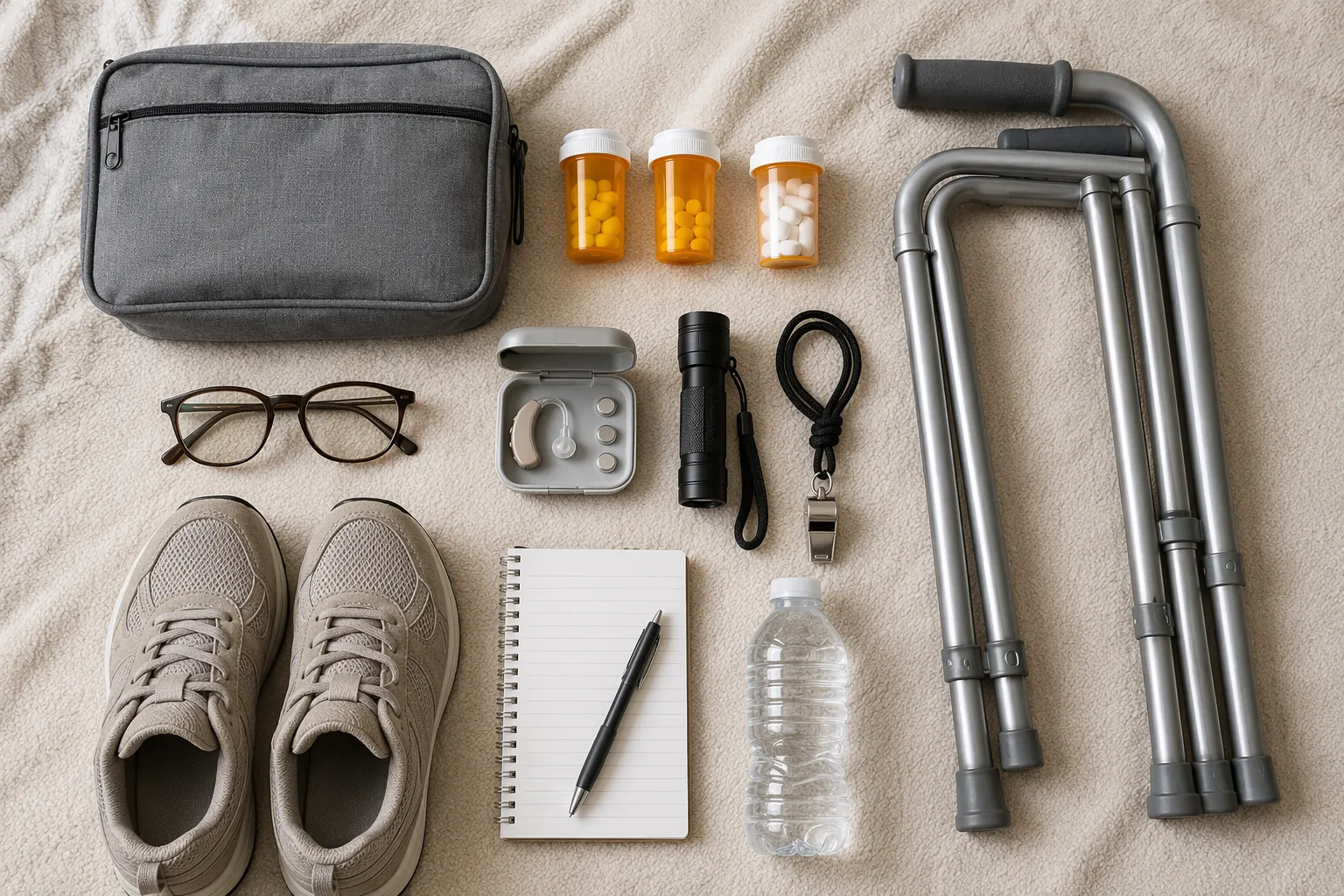
- Sturdy closed-toe shoes and socks.
- Flashlight or headlamp with working batteries.
- Backup glasses, hearing aid batteries, and hearing aid case if used.
- Whistle on a lanyard or clipped to the bag.
- Dust mask.
- Small bottle of water and easy-to-open snack, if medically appropriate.
- Medication list, emergency contacts, and a short medical-equipment instruction sheet.
- Phone charger, backup battery, or charging cord placed where it is easy to find.
- Backup cane tip, folding cane, or other small mobility backup if your parent uses one.
- Notepad and pen for writing messages if hearing, speech, or phone service is a problem.
Medication planning should be more deliberate than tossing a few pill bottles in a bag. Ready.gov tells older adults to plan for medications and medical supplies, including having a 1-month supply of medication in the emergency kit when possible.[8] That may require physician approval, insurance timing, pharmacy coordination, or a documented rotation system so nothing expires unnoticed.
For the larger household kit, food, water, first aid, sanitation supplies, radio, batteries, and copies of documents still matter. The California Earthquake Authority estimates that a basic earthquake supplies kit can be assembled for about $104.[9] For an older adult living alone, treat that as the starting layer, then add the personal items that decide whether the kit is usable: medication, glasses, hearing supplies, mobility backups, medical-device instructions, and contact information.
Put The Plan Where People Can Use It
Once the home is safer, the contacts are verified, and the bedside kit is packed, place the instructions where the right person will actually see them. A perfect binder in a file cabinet is less useful than a simple sheet on the refrigerator, a copy in the bedside bag, and a copy in the hands of the people who agreed to help.
- On the refrigerator: emergency contacts, medical conditions, medication list, equipment notes, and local helper names.
- In the bedside bag: contact sheet, medication list, copy of insurance information, and device instructions.
- With each local contact: address, entry method, family phone numbers, equipment notes, and evacuation preference.
- With the adult child caregiver: photos of the kit location, equipment labels, shutoff locations if relevant, and contact confirmations.
If your parent uses a medical alert system, smart speaker, monitoring device, or fall-detection tool, fold it into the support network rather than treating it as a substitute for one. Technology can send a signal. Someone still has to receive it, interpret it, and act.
Recheck When Your Parent’s Reality Changes
The plan should change when your parent changes. A new walker, new oxygen equipment, a fall, a medication change, a new caregiver, a neighbor moving away, or a decision to stop driving can all make last year’s earthquake plan quietly wrong.
Set a plain review trigger: after any major health change, after any move, after a new medical device, and at least when you replace expired medication or batteries. The point is not to keep polishing an emergency plan. The point is to keep the safety triangle matched to the person who lives in that home now.
A finished caregiver action plan looks like this: you have walked the home from the bed outward, reduced falling hazards, placed mobility aids and shoes within reach, identified power-dependent equipment, verified at least two local contacts, given them access and instructions with your parent’s consent, built the bedside kit, and placed the larger supplies where they can be reached. After that, the work is maintenance: update the plan when mobility, medical equipment, transportation, or living arrangements change.
References
- Predictors of Emergency Preparedness among Older Adults, PMC7704536
- Disasters and the Elderly: A Critical Analysis of the 2011 Japan Tsunami, Debonera & Zarogiannis, 2024
- AARP Disaster Resilience Tool Kit, AARP
- Planning Guide for Seniors, Illinois IEMA
- UI Health & Retirement Study, University of Iowa, 2014
- Earthquake Preparedness Month: Tips for the Elderly, CalEMA
- Older Adults Emergency Preparedness, Red Cross
- Older Adults, Ready.gov
- How to Make an Earthquake Emergency Kit, California Earthquake Authority
Questions to bring to a clinician or OT
This is not medical, legal, or a family's final decision — only a framework. Bring these questions to a clinician, occupational therapist, or your local Area Agency on Aging.
Find Local HelpRelated reading
Noticed something outdated or inaccurate on this page? Flag a correction. We review every report against CDC, NIA, and AARP HomeFit guidance before updating a page.