
Caregiver decision guide
How to Care for an Elderly Parent with Cancer
A practical, stage-aware guide for adult children caring for a parent with cancer, covering what to do from the first oncology visit through treatment—with attention to the unique challenges of aging, comorbidities, and care coordination.
The first few days after an elderly parent is diagnosed with cancer are usually not organized. There may be a pathology report no one has fully explained yet, an oncology appointment on the calendar, a stack of portal messages, and one adult child quietly becoming the person who remembers every medication, ride, meal, symptom, and sibling update.
Cancer care and support for elderly loved ones is not simply ordinary cancer caregiving with an older patient added in. Aging changes the work. A parent may already have heart disease, diabetes, kidney problems, arthritis, memory changes, neuropathy, frailty, or a long medication list before cancer treatment even begins. Those conditions can affect which treatments are safe, how side effects show up, whether a fall becomes a crisis, and how much help is needed at home.
That distinction matters because older adults are not a small edge case in oncology. A geriatric oncology review citing GLOBOCAN projections notes that by 2030, an estimated 70% of new cancer cases will be diagnosed in adults age 65 and older. The same review reports that older adults with cancer are significantly more likely than peers without cancer to experience geriatric syndromes such as falls, cognitive impairment, polypharmacy, and functional decline.[1]
Those are not background details. They are the things that turn “watch for side effects” into a refrigerator list, a pill-box check, a bathroom safety problem, a call to cardiology, and a decision about whether your parent can be left alone after treatment.

Start by Building the System Before Treatment Starts
Before the first oncology visit, the goal is not to become an expert in cancer. The goal is to make sure the oncologist sees the whole older adult, not just the tumor. A treatment plan that looks reasonable on paper can become risky if no one has accounted for poor balance, skipped meals, kidney disease, confusion after anesthesia, or five specialists changing medications separately.
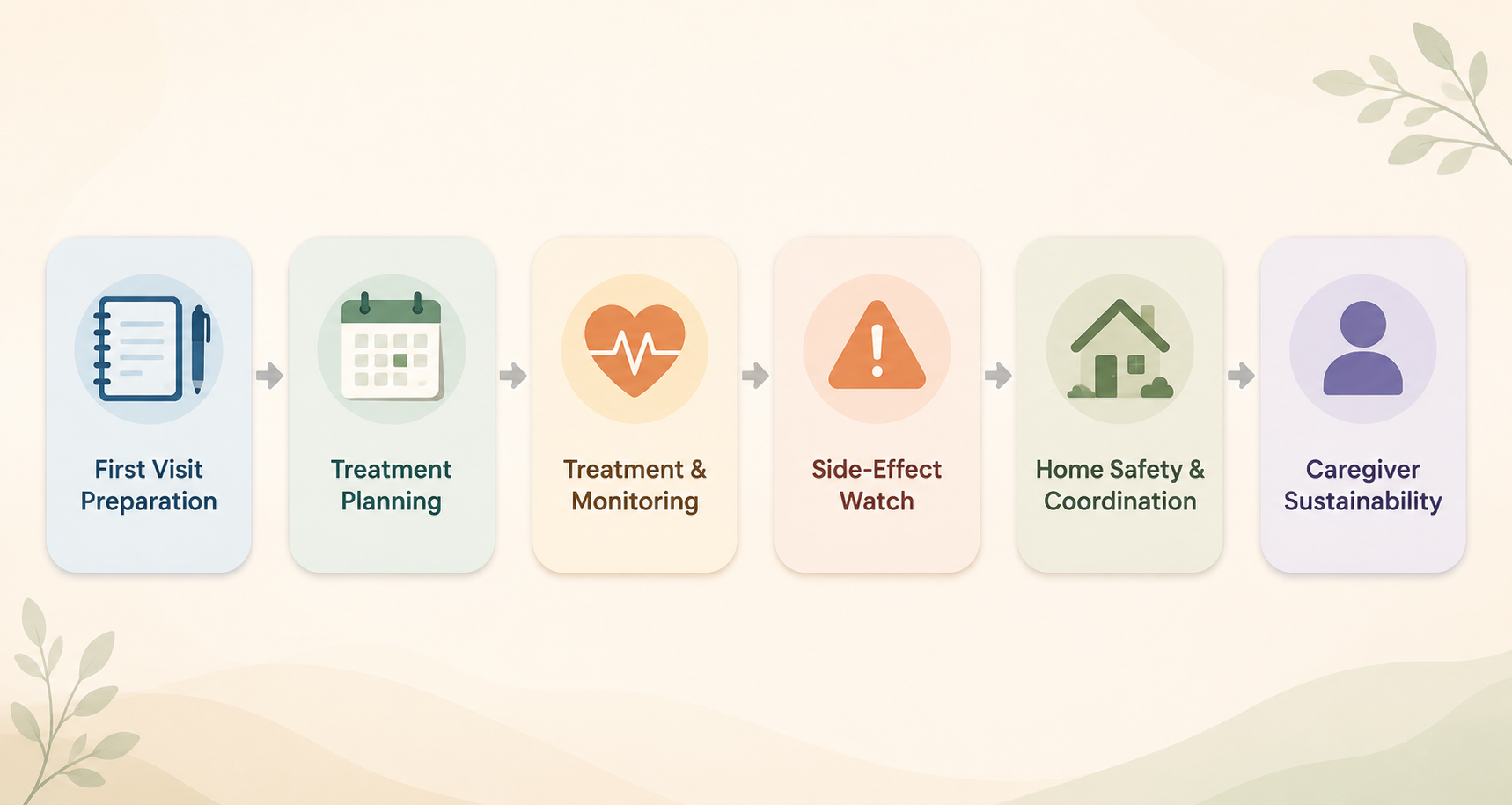
A useful early order of tasks looks like this:
| Stage | What the adult child is trying to prevent |
|---|---|
| First oncology visit preparation | Missing information, vague responsibilities, and decisions made without the parent’s baseline health in view |
| Treatment planning | A plan that ignores frailty, chronic disease, cognition, transportation, nutrition, or the caregiver’s actual capacity |
| Treatment days and monitoring | Medication errors, missed symptoms, delayed calls, falls, dehydration, and unmanaged pain |
| Home safety and coordination | Specialists working in silos while the parent’s function declines at home |
| Caregiver sustainability | The adult child becoming an invisible second patient |
What to Bring to the First Oncology Visit
The first oncology visit often carries too much emotional weight for one conversation. Your parent may be hearing words like staging, surgery, chemotherapy, radiation, immunotherapy, scan, recurrence, or prognosis for the first time. You may be trying to listen while also wondering who will drive them home, whether they understood the plan, and whether the doctor knows about the blood thinner prescribed by another specialist.
Bring the information that helps the care team judge treatment in the context of aging. The American Cancer Society’s caregiver resources emphasize practical caregiving tasks such as keeping records, preparing for appointments, helping with medicines, and planning for discharge needs.[2] For an older parent, that recordkeeping needs to be more specific than “Mom takes a few pills.”
- A current medication list, including dose, timing, prescribing doctor, over-the-counter drugs, vitamins, supplements, sleep aids, pain relievers, and anything your parent takes only “as needed.”
- A list of chronic conditions, prior surgeries, allergies, recent hospitalizations, falls, infections, weight loss, memory concerns, and mobility limits.
- Names and contact information for the primary care doctor and key specialists, especially cardiology, nephrology, pulmonology, endocrinology, neurology, psychiatry, and pain management.
- A simple description of your parent’s baseline: whether they cook, bathe, dress, manage money, drive, climb stairs, use a walker, shop, take medications independently, or need reminders.
- A notebook or shared digital document for questions, answers, medication changes, new symptoms, and follow-up tasks.
This is where many adult children can reduce later confusion. If your parent has three doctors and two pharmacies, someone has to reconcile the full list before treatment begins. Polypharmacy is not just a paperwork problem in older adults with cancer; it is one of the geriatric syndromes more common in this group and can affect falls, cognition, side effects, and treatment tolerance.[1]
Questions That Make the Care Plan Usable at Home
A good question is not always the most medically sophisticated one. Often it is the question that tells you who does what after the appointment ends. MD Anderson’s guidance for people caring for a parent with cancer stresses preparing questions, taking notes, and helping the parent communicate with the care team.[3] For an older parent, the questions should make responsibility visible.
- What is the goal of treatment right now: cure, control, symptom relief, slowing progression, or more information before deciding?
- Which symptoms mean we call the oncology team the same day, and which symptoms mean emergency care?
- Who manages pain medicines, nausea medicines, constipation, appetite problems, sleep problems, anxiety, and confusion?
- Should the primary care doctor or any specialist review the plan before treatment starts?
- Could any current medication interfere with treatment or become unsafe if appetite, kidney function, hydration, or balance changes?
- What changes would make the team pause, reduce, switch, or stop treatment?
- If my parent becomes weaker, more confused, or less able to manage daily activities, who should we tell first?
The answer “call us if symptoms worsen” is not enough unless you know what “worsen” means for this parent. A fever instruction may be straightforward. A pain instruction may not be, especially if your parent already has arthritis, neuropathy, or back pain. A fatigue instruction may not be, especially if they already nap every afternoon. Ask for thresholds, examples, phone numbers, and after-hours instructions while everyone is still in the room.
Treatment Planning Has to Include the Parent’s Baseline Life
Cancer treatment decisions belong with the patient and medical team. The adult child’s job is not to take over. But older parents sometimes underreport how much help they already need, and families sometimes describe a parent as “independent” when they mean “independent as long as the routine never changes.” Cancer treatment changes the routine.
If treatment requires weekly infusions, daily radiation, frequent labs, surgery, new medications, home wound care, or careful temperature checks, someone has to map that onto the parent’s actual life. Who drives? Who hears the discharge instructions? Who watches for dehydration? Who notices if the pill organizer is untouched? Who can leave work if the clinic calls at 2 p.m.?
This is also the point to ask whether a geriatric assessment, palliative care consult, nutrition support, physical therapy, occupational therapy, social work, or home health evaluation would help. Palliative care is often misunderstood. It is not the same thing as hospice. Palliative care can be provided alongside treatment meant to cure or control cancer, with attention to symptoms, function, decision support, and quality of life. Hospice is for end-of-life care when the focus has shifted away from disease-directed treatment.
Pain deserves special attention before treatment starts, not after weeks of decline. In older adults with cancer, daily pain is reported in an estimated 25% to 40% of patients, and pain is associated with fall risk, malnutrition, depression, and loss of independence.[1] If your parent already has pain, ask who owns that problem and how the plan avoids sedation, constipation, confusion, and falls while still treating pain seriously.
During Treatment, Track Changes the Way the Clinic Can Use Them
Once treatment starts, the family system needs a way to catch small changes before they become emergencies. This does not have to be elaborate. It has to be consistent enough that you are not relying on memory during a stressful call.
Create one treatment log. It can be a notebook, spreadsheet, shared note, or printed calendar. The format matters less than whether the same information is recorded in the same place.
- Treatment dates, lab dates, scans, medication changes, and upcoming appointments.
- Daily symptoms: pain, nausea, appetite, bowel movements, sleep, fever, shortness of breath, dizziness, confusion, mood, and fatigue.
- Function: walking, bathing, dressing, cooking, toileting, stairs, medication management, and whether more help is needed than last week.
- Food and fluids, especially after chemotherapy, radiation, surgery, infections, or medication changes.
- Falls, near-falls, new use of furniture for balance, or reluctance to walk.
- Calls to the care team, what they advised, and when follow-up is expected.
This is not about turning family life into a hospital chart. The point is to call with facts. “She is weaker” is easy to minimize. “She needed help getting off the toilet twice this week, skipped dinner three nights, and almost fell walking to the bedroom” gives the oncology nurse something to work with.
For older adults, do not automatically file new problems under “just aging.” A new fall, sudden confusion, reduced appetite, worsening constipation, missed pills, new incontinence, or trouble getting out of a chair may be related to cancer, treatment, infection, dehydration, pain, anemia, medication interactions, or a chronic condition that has destabilized. The family may be the first to see the pattern because the clinic sees a snapshot.
Make One Medication List the Source of Truth
Medication confusion is one of the fastest ways for home care to unravel. Cancer treatment can add anti-nausea drugs, steroids, antibiotics, pain medicines, stool softeners, appetite medications, blood thinners, or temporary holds on older prescriptions. A parent who managed pills alone for years may not manage a changing regimen safely while tired, nauseated, or cognitively foggy.
Keep a medication list that includes the reason for each drug, the prescriber, the dose, the timing, and the date of any change. Bring it to oncology, primary care, emergency visits, hospital admissions, and discharge conversations. If one doctor says to stop a medication, write down who said it and whether another prescriber needs to know.
This is a practical place to involve a pharmacist or nurse if the system is getting complicated. Ask specifically whether any medicines increase dizziness, bleeding risk, constipation, confusion, sleepiness, dehydration, or poor appetite. Those side effects can carry heavier consequences for an older adult who already has reduced reserve.
Coordinate the Doctors Before They Accidentally Work in Silos
An elderly parent with cancer may have an oncologist, surgeon, radiation oncologist, primary care doctor, cardiologist, endocrinologist, nephrologist, neurologist, and home health team. Each may be doing the right thing from a narrow view. Someone still has to notice when the combined plan is too much for the person living inside it.
At each major transition, ask who is coordinating the whole picture. After a new diagnosis, that may be oncology. After a hospitalization, it may briefly be the inpatient team, then oncology or primary care. After surgery, it may be the surgeon for wound issues but oncology for treatment timing and primary care for chronic disease. Do not assume the handoff happened because all the doctors use computers.
- Ask which doctor should receive updates after emergency visits, hospitalizations, medication changes, falls, or new confusion.
- Request written discharge instructions that name medication changes, activity limits, warning signs, and follow-up appointments.
- Confirm whether the primary care doctor should review diabetes, blood pressure, anticoagulation, kidney disease, or heart medications during treatment.
- Use the patient portal carefully: send concise updates with dates, symptoms, medication names, and the question you need answered.
- If siblings or relatives are involved, assign one person to communicate with the medical team so messages stay consistent.
Hospital discharge is a particular danger point. The NCI’s PDQ summary reports that 72% of cancer caregivers assist with medical or nursing tasks, while only 54% are asked what help they need after discharge.[4] That gap is where families end up doing wound care, medication changes, injections, symptom monitoring, transfers, and phone triage without knowing whether they are doing it correctly.
If your parent is being discharged, ask the nurse or case manager to watch you perform any task you will need to do at home. Ask what supplies are needed, who orders them, what should be documented, and what failure looks like. “Call if there is drainage” is less useful than knowing what amount, color, smell, fever, pain change, or skin change matters.
Protect Function, Not Just Appointments
Appointments are visible. Function disappears more quietly. An older parent may still make every infusion visit while gradually stopping laundry, skipping showers, holding walls to walk, eating toast for dinner, or sleeping in a recliner because the stairs are too hard.
Watch the activities that keep your parent safe and dignified at home: bathing, dressing, toileting, walking, eating, managing medications, using the phone, preparing food, and getting to appointments. When one of those changes, tell the care team. Functional decline is one of the geriatric concerns more common among older adults with cancer, and it can affect treatment tolerance and home safety.[1]
Home safety does not need to wait for a serious fall. Remove loose rugs, improve lighting, clear pathways, check footwear, place commonly used items within reach, consider grab bars, and make sure the bathroom setup matches the parent’s current strength rather than last year’s independence. If your parent is weaker after treatment, ask whether physical therapy or occupational therapy can assess mobility, transfers, equipment, and energy conservation.
Nutrition deserves the same practical attention. Appetite loss, mouth sores, nausea, constipation, taste changes, fatigue, pain, depression, or trouble shopping can all reduce intake. Instead of asking only “Did you eat?” notice what is actually gone from the refrigerator, whether meals are being prepared, whether fluids are within reach, and whether weight or strength is changing. Ask the oncology team when a dietitian should be involved.
When Cognition or Prognosis Is Unclear
Memory and understanding can be difficult to judge during cancer care. A parent may nod through an appointment and then ask the same question in the parking lot. That may be shock, normal overwhelm, hearing trouble, medication effect, sleep loss, delirium, dementia, depression, or a mix of several things. The practical response is to slow down the information flow and document it.
Ask for written instructions. Use teach-back gently: “I want to make sure I heard this right. We take the nausea medicine tonight, call for fever, and come back Friday for labs—is that correct?” If your parent wants you involved, make sure the clinic has the proper permission forms so staff can speak with you. Fox Chase Cancer Center’s guidance for adult children caring for a parent with cancer emphasizes communication, attending appointments when possible, and helping the parent navigate decisions without taking away their voice.[5]
Advanced cancer adds another layer. The NCI PDQ summary notes that 50% to 73% of older adults with advanced cancer have poor prognostic understanding.[4] That does not mean families should force one dramatic conversation in the hallway. It does mean you may need to ask the oncology team to explain the goal of treatment plainly, revisit the discussion over time, and check whether your parent’s decisions match what they understand.
Do Not Let the Caregiver Become Invisible
Adult children often describe themselves as “just helping,” even while managing a part-time job’s worth of tasks: rides, meals, medication setup, portal messages, insurance calls, symptom checks, sibling updates, home safety, and emotional support. The NCI PDQ summary reports that 88% of cancer caregivers care for a relative, 50% report high emotional stress, and 42% show depressive symptoms. The burden is higher for caregivers of older adults with multiple chronic conditions.[4]
This is not a character test. It is workload. If the work is not named, it cannot be shared or adjusted.
- Make a task list instead of a vague request for help: Tuesday ride, pharmacy pickup, dinner delivery, overnight stay, lawn work, bill review, portal monitoring, or sitting with your parent during an infusion.
- Hold short family updates on a predictable schedule so the main caregiver is not retelling the same medical news all week.
- Tell the care team when caregiving tasks are beyond what the family can safely do.
- Ask for social work, transportation resources, home health evaluation, respite options, financial counseling, or caregiver support before a crisis.
- Protect at least one reliable recovery block for the primary caregiver each week, even if it is small.
The National Cancer Institute’s caregiver support information encourages caregivers to seek help, communicate with the health care team, and use available support resources.[6] That advice can sound gentle on a website and still feel awkward in real life. Ask anyway. The discharge planner, oncology social worker, nurse navigator, or clinic nurse may know resources you would not find while searching at midnight.
Keep the Parent in the Plan
Role reversal is one of the quiet shocks of caring for an elderly parent with cancer. You may be scheduling appointments for the person who once scheduled yours. You may be checking pills for someone who taught you responsibility. The practical work is necessary, but it can easily slide into managing around the parent instead of with them.
Whenever possible, ask what matters most to your parent in concrete terms. Staying at home? Attending a family event? Avoiding hospitalization? Keeping mental clarity? Reducing pain? Living long enough for a milestone? Being able to walk to the mailbox? These answers do not replace medical recommendations, but they help the care team understand what tradeoffs your parent may or may not accept.
If your parent can make decisions, preserve that authority. If they need help understanding, slow the process and support comprehension. If decision-making capacity is changing, ask the care team what documentation and legal steps are needed so the right person can help at the right time. Do not wait until an emergency admission to find out no one can access records or speak with the team.
A Working Order of Operations
When everything feels urgent, order helps. Not everything has to be solved this week. These are the tasks that most often prevent avoidable confusion early.
- Create one shared medical file with diagnosis information, medication list, chronic conditions, doctors, allergies, baseline function, and emergency contacts.
- Prepare for the oncology visit with questions about treatment goals, side-effect thresholds, medication responsibility, specialist coordination, and what would change the plan.
- Clarify communication rules: who can call, who receives portal access, what number to use after hours, and which symptoms require same-day contact.
- Map treatment onto real logistics: rides, meals, medication setup, supervision after treatment, work schedules, finances, and backup coverage.
- Track symptoms and function during treatment in one place, especially pain, falls, confusion, eating, hydration, bowel changes, mobility, and daily activities.
- Ask for help when the plan requires medical or nursing tasks the family has not been trained to do safely.
You cannot control the diagnosis, and you should not be expected to make every treatment decision alone. What you can do is build a care system that makes aging-related risks visible. Write things down. Ask who owns each problem. Treat falls, pain, appetite loss, medication changes, confusion, and functional decline as part of the cancer-care picture, not side issues. Coordination is not clerical work here. It is one of the ways an elderly parent’s safety, dignity, and choices are protected after the appointment ends.
References
- Delivering Palliative and Supportive Care for Older Adults with Cancer — PMC, 2023.
- Cancer Caregiver Resources — American Cancer Society.
- Caring for a parent with cancer? Follow this advice — MD Anderson Cancerwise.
- Informal Caregivers in Cancer (PDQ®) — National Cancer Institute.
- Caring for a Parent with Cancer — Fox Chase Cancer Center.
- Caregivers of Cancer Patients — National Cancer Institute.
Questions to bring to a clinician or OT
This is not medical, legal, or a family's final decision — only a framework. Bring these questions to a clinician, occupational therapist, or your local Area Agency on Aging.
Find Local HelpRelated reading
Noticed something outdated or inaccurate on this page? Flag a correction. We review every report against CDC, NIA, and AARP HomeFit guidance before updating a page.