
Caregiver decision guide
How to report a power outage for an elderly parent
Learn the exact steps to report a power outage on behalf of an elderly parent, including what information to have ready and which utility contact to call — even if you live out of town.
If your parent calls and says the power is out, you can usually report the outage even if the electric account is not in your name. Outage systems are built around the service location: the address, the account number, or the phone number tied to the account. The fastest version of this call is not “I’m her daughter, can I do this?” It is: “I’m reporting an outage at this address.”
Have the parent’s full name, service address, phone number on file, and any medical-risk detail in front of you before you call. Caregiver-preparedness guidance recommends saving the utility outage number ahead of time rather than searching during a storm, when websites, nerves, and cell service are all less dependable.[1]

What to Have Ready Before You Report the Outage
Do not wait until you have every piece of information. If you only have the address, start there. But if someone is standing near a bill, a refrigerator magnet, or the parent’s online utility account, these are the details that make the report easier to place.
| Information | Why it helps |
|---|---|
| Parent’s full name | Helps the agent match the address or account record. |
| Service address, including apartment or unit number | The outage has to be tied to the exact meter location. |
| Phone number on file | Many outage systems use this to find the account. |
| Account number, if available | Useful, but not always necessary for a basic outage report. |
| Utility company name | The electric utility may not be the same company that sends another household bill. |
| Medical equipment or senior vulnerability | This does not guarantee priority restoration, but it is important for the utility to know. |
| Whether neighbors also lost power | Helps distinguish a house problem from a wider outage. |
| A callback number for you and for your parent | Gives the utility a way to reach someone who can answer clearly. |
If your parent is calm enough to help, ask only for what you need: “Is the whole house out or just one room?” “Do the neighbors have lights?” “Is the oxygen machine, phone, refrigerator, or heat affected?” Long interviews are not useful when someone is sitting in the dark.
A Call Script You Can Use
When you reach the outage line or a live agent, be plain and specific. You are not asking for private billing information. You are reporting a service problem at a known address.
Hi, I’m calling to report a power outage for my mother/father.

The account holder is [parent’s full name].
The service address is [full address, including apartment or unit].
The phone number on file may be [phone number].

I am not the account holder, but I am reporting the outage on their behalf.
They are an older adult, and [they use oxygen / they use an electric medical device / they live alone / they have limited mobility].

Can you confirm that the outage has been reported for this address, and is there an estimated restoration time or outage map update I should check?
If the system asks whether there is a life-threatening emergency, answer carefully. A power outage by itself is not usually a 911 call. Mass.gov and Ready.gov direct residents to report outages to the utility, while emergency services are for hazards such as downed power lines, fire, carbon monoxide exposure, or a medical emergency that cannot wait.[2][3]
Find the Right Outage Line, Not the General Customer Service Number
Search for the electric utility’s outage page, not just the company homepage. Many utilities run a 24/7 outage phone line and an online outage report form. If your parent lives in an area with more than one utility, check an old electric bill, the utility name on the meter, the city or county emergency-management page, or your parent’s bank records for the company receiving the electric payment.
A January 2026 caregiver guide gave examples of why saving the exact number matters: National Grid customers in Buffalo were directed to 1-800-642-4272, while NYSEG customers were directed to 1-800-572-1111.[1] Those numbers are useful examples, not a national directory. Verify your parent’s current utility number on the utility’s own outage page before you rely on it.
If You Cannot Identify the Utility
- Ask your parent to read the name from an electric bill, if they can do that safely.
- Check shared banking records for recurring electric payments.
- Search the service address plus “electric outage” and the town or county name.
- Call the town, city, or county non-emergency line if local guidance identifies utilities by neighborhood.
- Ask a nearby neighbor which electric company serves the street.
Do not let the search for the perfect number delay a safety decision. If your parent uses oxygen, a powered bed, a stair lift, refrigerated medication, or another electricity-dependent device, start arranging human help while someone else finds the utility.
Check Whether It Is the House, the Block, or a Breaker
If your parent can safely look outside, ask whether nearby homes, streetlights, or hallway lights are out. If only one room is out, it may be a tripped breaker or a local wiring issue. If the whole home and the neighborhood are dark, it is more likely a utility outage.
Do not ask an older adult to go into a basement, garage, or icy exterior area to inspect a panel if balance, lighting, weather, or confusion are concerns. A nearby spouse, neighbor, building superintendent, or relative may be the safer person to check whether breakers are on.
If there is a downed wire, sparking equipment, smoke, the smell of gas, flooding around electrical equipment, or a medical crisis, move away from the hazard and call emergency services. That is a different problem from filing an outage report.
After the Outage Is Reported, Shift to Safety
The outage report does not keep your parent warm, charged, hydrated, or medically supported while crews work. Once you have a confirmation number, outage map status, or estimated restoration time, the next job is to decide whether waiting at home is still reasonable.
That decision changes quickly when medical equipment is involved. NPR reported that about 4.5 million Medicare recipients use electricity-dependent durable medical equipment, citing the HHS emPOWER Program. The same article noted research finding that weather-related blackouts are more likely to last eight hours or longer, a timeframe that can become medically relevant because many medical-device batteries are depleted by then.[4]
If the parent uses powered medical equipment, ask three questions immediately: How long does the backup battery last? Is the device currently running on battery or plugged into a backup power source? Where can the parent go if power is not restored before that battery is low?
- Call the prescribing doctor’s after-hours line, home health agency, oxygen supplier, or device supplier if you do not know the battery limit.
- Ask a nearby person to check the device display, battery indicator, extension cords, and whether the parent has moved safely away from trip hazards.
- Identify a relocation option before the battery is nearly gone: a relative’s home, a neighbor with power, a cooling or warming center, or a hospital if the medical need requires it.
- Keep the parent’s cell phone charged from a power bank or vehicle only if it can be done safely and without carbon monoxide risk.
Do Not Treat Priority Status as a Backup Plan
Medical baseline, life-sustaining equipment, chronic-condition, or critical-care programs are worth applying for after the immediate outage is handled. They can help the utility identify households where power loss has medical consequences. They should not be treated as a promise that the lights will come back first.
ABC13 Houston reported on a 100-year-old veteran who was still waiting for power five days after Hurricane Beryl despite being enrolled in a priority program.[5] That is the difference between being flagged in a system and being safe in a house. Enroll if your parent qualifies, but still build a plan for batteries, transportation, relocation, and in-person checks.
What to Do While Your Parent Waits
The waiting period needs a dispatcher, even if that dispatcher is you from 90 minutes away. Someone should know who is checking the parent, who is watching the outage map, who has the key, and who can drive if the home becomes unsafe.
- Ask your parent to keep refrigerator and freezer doors closed unless they need something essential.
- Have them use flashlights instead of candles if possible.
- Confirm that cordless phones, medical alert bases, routers, and garage doors may not work without power.
- Ask a nearby person to bring a charged phone, power bank, flashlight, and medication list if they are checking the home.
- Set a check-in schedule, not a vague “call me if you need anything.”
Food safety matters, but it should not distract from immediate medical and temperature risks. Ready.gov says a refrigerator keeps food cold for about four hours if the door stays closed, and a full freezer keeps temperature for about 48 hours if unopened.[3] The Red Cross gives the same general food-safety timeframes and advises throwing out food that has been exposed to unsafe temperatures.[6]
Generator safety is another short, serious item: never run a generator inside a home, basement, garage, porch, or near windows. Mass.gov warns that generators must be used outdoors and away from openings because of carbon monoxide risk.[2] If your parent does not already know how to use a generator safely, a storm outage is not the time to coach them through it by phone.
Build a Small Local Backup Team
One distant adult child can report the outage, monitor updates, and make calls. That person cannot feel the indoor temperature, see whether the hallway is dark, or notice that a parent is getting confused. The Family Caregiver Alliance recommends building an emergency support network, including at least three people who can help in a crisis.[7]
For an outage, the useful network is not a long list of well-wishers. It is a short list of people with jobs.
- A nearby checker: someone who can physically go to the home.
- A key holder: someone who can enter if the parent cannot get to the door.
- A driver: someone who can take the parent to a safer location.
- A medical contact: someone who knows the doctor, pharmacy, oxygen supplier, or home health agency.
- A backup caller: someone who can take over if your phone battery, work shift, or travel delay gets in the way.
If the parent is able and prefers to make decisions directly, keep them in the center of the plan. The goal is not to take over every call. It is to make sure someone can act when the house is dark, the phone is low, or the parent cannot safely troubleshoot alone.
After This Outage, Save the Information Where You Will Actually Find It
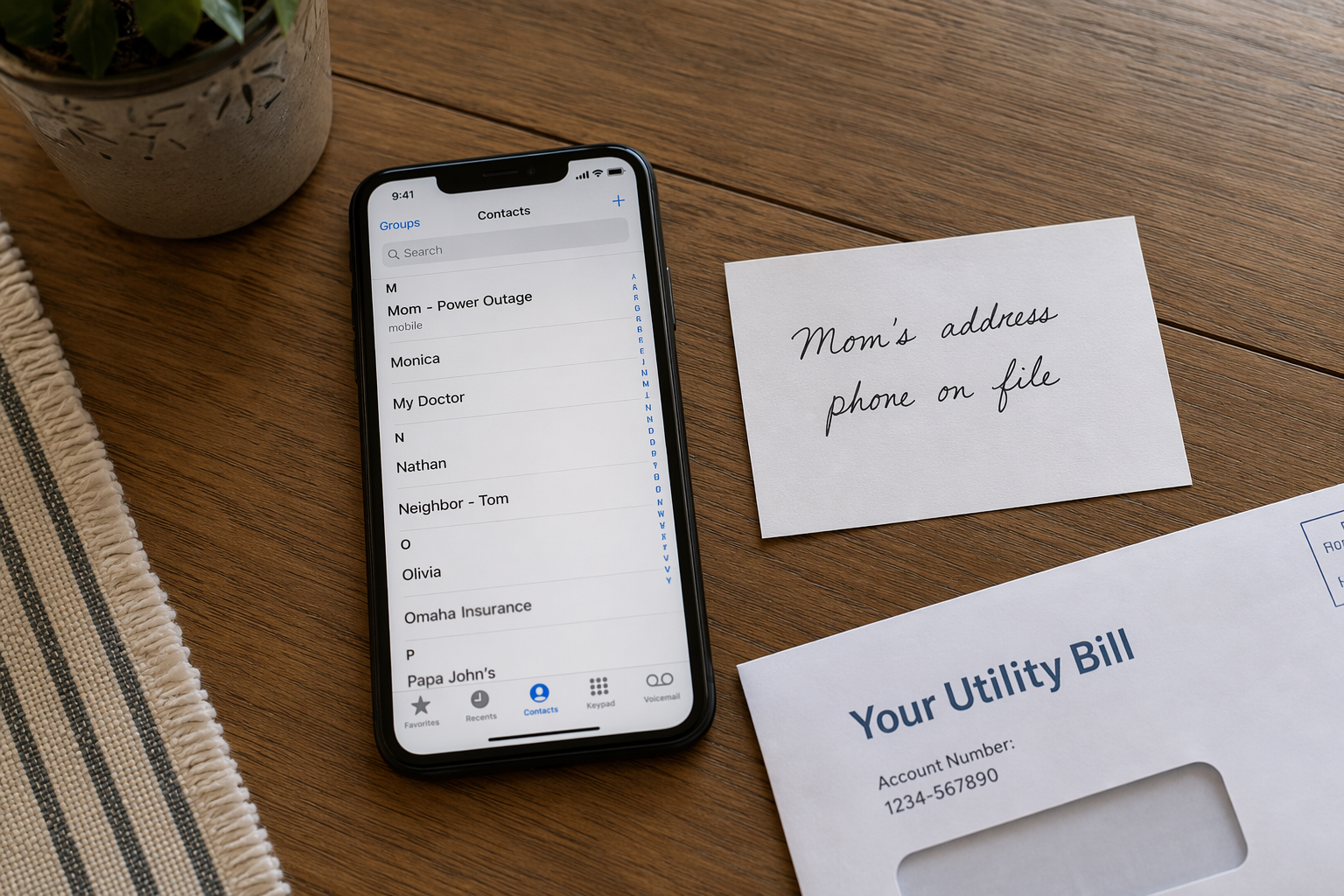
When the power comes back, do the unglamorous work while the details are still fresh. Create one phone contact named something obvious, such as “Mom - Power Outage.” Put the outage line, utility name, account number if available, service address, phone number on file, and outage map link in that contact or in the shared notes app.
If your parent uses electricity-dependent medical equipment, check the utility’s medical program. PG&E’s Medical Baseline Program and National Grid Massachusetts’ Life Sustaining Equipment page are examples of the kind of utility-specific programs that may apply, depending on where the customer lives and what equipment they use.[8][9] Your parent’s utility will have its own rules, forms, and renewal process.
Also save the non-utility details that matter during a real outage: who has a key, who can drive, where the parent can go, how long the medical-device battery lasts, where spare batteries or power banks are kept, and which medications need refrigeration. The next outage should not start with everyone trying to remember whose name is on the bill.
References
- The caregivers' survival guide to power outages and storms — NY & MI Solutions Journalism Collaborative, January 2026
- Power Outage Safety Tips — Mass.gov / Massachusetts Emergency Management Agency
- Power Outages — Ready.gov
- How to prepare for power outages if your health depends on home medical devices — NPR, July 11, 2024
- Priority designated to customers with a chronic illness or taking care of elderly parent during Beryl's power outages — ABC13 Houston
- Power Outage Safety — American Red Cross
- Emergency Preparedness Checklist for Caregivers — Family Caregiver Alliance
- Medical Baseline Program — PG&E
- Life Sustaining Equipment — National Grid Massachusetts
Questions to bring to a clinician or OT
This is not medical, legal, or a family's final decision — only a framework. Bring these questions to a clinician, occupational therapist, or your local Area Agency on Aging.
Find Local HelpRelated reading
Noticed something outdated or inaccurate on this page? Flag a correction. We review every report against CDC, NIA, and AARP HomeFit guidance before updating a page.