
Caregiver decision guide
What Fidelity's $100 ETF Fee Means for Your Retired Parent's Account
Fidelity's expanded $100 service fee on select ETFs took effect June 1, 2026. This guide helps adult children check a retired parent's Fidelity account to see if any holdings are affected and whether action is needed.
A headline about a $100 Fidelity ETF fee lands differently when the account belongs to an 82-year-old parent. The first worry is not brokerage-industry theory. It is whether an old habit, a suggested trade, or a small recurring purchase just created a charge nobody expected.
The calming part comes first: Fidelity’s expanded service fee took effect June 1, 2026, and the reporting so far points to a narrow list of select ETFs, not a broad charge on ordinary ETF ownership or mainstream retirement portfolios. Motley Fool reported that Fidelity’s list began with 27 ETFs in November 2025 and expanded to more than 120 ETFs starting June 1, 2026.[1] The important distinction for a caregiver is this: owning an ETF is not the same as placing a purchase order for an affected ETF.
Last reviewed: July 19, 2026. Because the affected-fund list is changing, treat Fidelity’s current fee information as the final authority before acting.

What the Fidelity ETF Fee Actually Applies To
The fee at issue is a service fee on certain ETF purchase orders. Fidelity’s standard pricing still advertises $0 commissions for online U.S. stock, ETF, and options trades, with separate disclosures for other fees and expenses.[2] That is why vague wording around “Fidelity ETF fees for retirees” can be so unhelpful: it makes the change sound like a blanket retirement-account fee when the practical question is much narrower.
For the affected ETFs, the service fee is described as 5% of the purchase amount, capped at $100. The fee applies to purchases, not sales, dividend reinvestments, or recurring scheduled buys, according to the available reporting and Fidelity fee disclosures.[3] That means the account-review task is not “find every ETF and panic.” It is “find whether this account has bought, is buying, or is about to buy one of the affected ETFs.”
| Account activity | Why it matters |
|---|---|
| Already owns an affected ETF | Ownership alone is not the same as a new purchase order, but the holding deserves review before any future buys. |
| Recently bought an affected ETF after June 1, 2026 | This is where a fee may already have appeared on trade confirmations or account activity. |
| Has an open or planned purchase order for an affected ETF | This is the situation to catch before the order goes through. |
| Sells an affected ETF | The service fee described in the current materials is tied to purchases, not sales. |
| Receives dividend reinvestments | The current materials distinguish dividend reinvestments from the purchase orders that trigger the fee. |
That distinction is also the reason most retired parents’ accounts probably do not need emergency action. A portfolio built around broad index ETFs from Vanguard, iShares, Schwab, or State Street is not the center of the current reporting. The affected universe described by College Investor leans toward specialty ETF issuers, with Roundhill identified as the largest impacted issuer at more than 40 funds; the article named MAGS, with $4.4 billion in assets under management, and CHAT, with $1.3 billion, as the largest affected ETFs on the list.[4]
The Account Check That Matters Most
If you are the second set of eyes on a parent’s Fidelity account, the cleanest approach is to check in the order a fee could actually happen. Start with what the account holds, then move to what it has bought or plans to buy, then compare only the questionable names against Fidelity’s current affected-fund list.
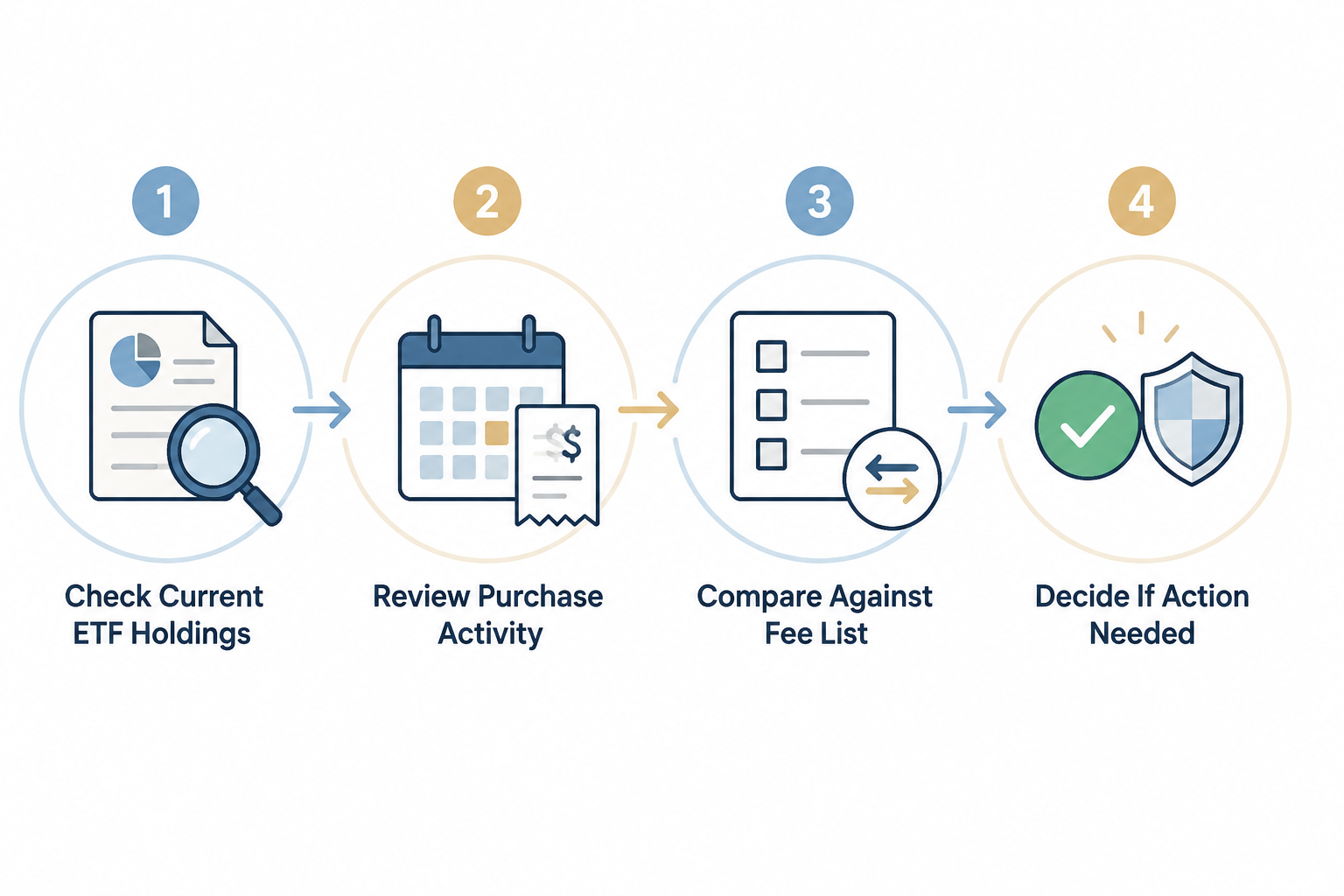
1. Look at Current ETF Holdings First
Open the account positions page and scan the ETF names and tickers. You are not trying to judge whether each ETF is a good investment. You are looking for unfamiliar specialty issuers or ticker names that do not look like the broad core funds many retirees hold.
- Make a short note of ETF tickers that are not obvious broad-market core funds.
- Pay extra attention to specialty or thematic names, including issuers mentioned in current reporting such as Roundhill, Kurv, Inspire, and Hedgeye.
- Do not assume a holding created a fee just because it appears on the positions page.
- Do not sell anything merely because the ticker looks unfamiliar.
This is the part where a calm review helps. An ETF position may have been purchased years ago, transferred into the account, inherited, or bought before the June 1, 2026 expansion. The fee question starts with purchases, so the holdings page is only a filter. It tells you which tickers deserve a closer look.
2. Check Recent Purchase Activity
Next, go to account activity, history, or trade confirmations and filter for ETF buys after June 1, 2026. That date matters because the expanded list took effect then, according to Motley Fool and College Investor reporting.[1][4]
For each ETF buy, note the ticker, trade date, dollar amount, and any service fee shown on the confirmation. If you see a $100 charge, or a smaller fee that looks like 5% of the trade amount, do not try to infer the whole policy from memory. Save the confirmation or download it, then compare the ticker against Fidelity’s current list.
If your parent has not placed any ETF purchase orders since June 1, the chance of this specific fee having already hit the account is much lower. There may still be a reason to check planned buys, especially if someone else helps with the account or an advisor has discussed a specialty ETF.
3. Review Scheduled, Recurring, and Open Orders
The phrase “purchase order” is where small account habits matter. A retired parent may not be trading actively, but an account can still have planned activity: an open limit order, a saved trade ticket, a recurring investment instruction, or a standing routine where cash from a pension, annuity, or required distribution is reinvested.
Current materials distinguish recurring scheduled buys from the affected purchase orders, but the safest caregiver move is still to inspect the setup rather than rely on a headline summary.[3] If a scheduled instruction points to an ETF on Fidelity’s affected list, pause long enough to confirm how Fidelity treats that exact transaction type before letting new money go in.
- Check open orders for ETF tickers that have not executed yet.
- Check automatic investment or recurring purchase settings, if the account uses them.
- Check recent dividend reinvestment entries separately from new cash purchases.
- Check whether an advisor, family member, or account helper has proposed a future ETF purchase.
4. Compare Questionable Tickers Against Fidelity’s Current List
This is the step that prevents wasted worry. Third-party articles are useful for understanding the change, but they are not the final list. Kiplinger reported that Fidelity reached agreements with some affected ETF issuers, meaning the list was expected to shrink after the initial expansion.[5] A ticker that appeared in one article may not remain affected, and a saved screenshot can become stale.
Use Fidelity’s own pricing and commissions information, including its current fee disclosures, before deciding whether a trade is affected.[2][3] If Fidelity provides a downloadable list or notice inside the account, use the current version from Fidelity rather than an old article, PDF saved to a desktop, or social-media summary.
How to Read the $100 Cap Without Overreacting
The “up to $100” wording is what makes the headline feel worse than the actual account risk for many retirees. The reported fee is 5% of the purchase amount, capped at $100.[3] A small affected purchase would not automatically create a $100 charge; a larger affected purchase could hit the cap. Either way, the fee is large enough that it should not be discovered casually after the fact.
Ordinary ETF costs can also confuse the review. ETFs may have expense ratios and bid-ask spreads, and Fidelity’s own learning materials explain that ETF costs can include more than a trading commission.[6] Those ongoing investment costs are separate from the specific service fee on select ETF purchases. When reviewing a parent’s account, keep the questions separate: one is whether the fund is appropriate for the portfolio, and the other is whether a particular purchase order triggers an avoidable platform fee.
What Names Should Make You Slow Down?
The reporting does not describe the fee expansion as a broad attack on the plain-vanilla ETFs most retirees use for core exposure. The issuers and examples named in current coverage point more toward specialty products. College Investor identified Roundhill as the largest impacted issuer, with more than 40 funds affected, and named MAGS and CHAT among the largest affected ETFs by assets under management.[4]
That does not mean every specialty ETF is bad, and it does not mean every retired person should avoid them. It means a specialty ETF in a retired parent’s account deserves a more deliberate check before new money goes in. A broad-market ETF from a major issuer and a narrowly themed ETF from a smaller issuer are not the same review problem.
| What you see in the account | Reasonable next move |
|---|---|
| Only familiar broad-market ETFs from large mainstream issuers | Document the review and check again before future ETF purchases. |
| Unfamiliar thematic, leveraged, income, or strategy ETF | Compare the ticker against Fidelity’s current affected-fund list. |
| Recent buy order in a named affected ETF | Review the trade confirmation for any service fee and contact Fidelity if unclear. |
| Planned buy order in a questionable ETF | Confirm the current fee status before placing or allowing the order. |
| Advisor recommendation involving a specialty ETF | Ask the advisor to address Fidelity’s current purchase fee treatment in writing. |
If You Find an Affected ETF
Finding an affected ETF is not the same as finding a portfolio emergency. The first decision is whether there is new purchase activity. If the ETF is simply sitting in the account, the service fee described in the current materials is not a holding fee. The next risk point is a future purchase.
If a purchase already occurred after June 1, 2026, check the confirmation and activity ledger. If a fee appears, document it before calling. If no fee appears, that may be because the ETF was not affected at that time, the transaction type was excluded, the issuer had reached an agreement, or another account-specific detail applied. Do not guess; ask Fidelity to explain the exact transaction.
- Confirm the ticker against Fidelity’s current fee list or current account disclosure.
- Pause new purchases of that ETF until the fee treatment is clear.
- Save trade confirmations, fee entries, and any Fidelity notice shown during order entry.
- Call Fidelity if the fee status or transaction type is unclear.
- Talk with a qualified financial professional before selling or replacing a holding for portfolio reasons.
The last point matters. A fee can make a future purchase unattractive without automatically making the existing holding wrong for the account. Selling can create tax consequences, change risk exposure, or disrupt an income plan. A caregiver can identify the fee issue; that is different from giving individualized investment advice.
If You Do Not Find Anything
If the account holds no questionable specialty ETFs, shows no affected ETF purchases after June 1, and has no planned ETF buys in the affected universe, there is probably nothing urgent to do. Write down the date you checked, the account reviewed, and where you looked. That note saves you from repeating the same worried search the next time the headline recirculates.
A simple reminder is enough for many families: review Fidelity’s current fee list before any future purchase of an unfamiliar ETF. That is especially useful if your parent occasionally follows newsletter recommendations, receives advisor trade suggestions, or likes buying small positions in funds that sound interesting.
Most retired parents’ accounts likely need one careful review, not a broker switch, a rushed sale, or a weekend spent rebuilding the portfolio. The fee is worth catching because $100 is real money. It is also narrow enough that the answer for many families will be: checked, documented, no affected purchase activity found.
References
- If You Want to Buy One of These ETFs on Fidelity's Platform, It's Going to Cost You Up to $100 — Motley Fool
- Straightforward and Transparent Pricing — Fidelity
- Commissions, Margin Rates, and Fees — Fidelity
- Fidelity Adds 100+ ETFs to $100 Service Fee List Starting June 2026 — The College Investor
- Did Fidelity Just Kill Commission-Free Trading? — Kiplinger
- ETF vs. mutual fund cost comparison — Fidelity Learning Center
Questions to bring to a clinician or OT
This is not medical, legal, or a family's final decision — only a framework. Bring these questions to a clinician, occupational therapist, or your local Area Agency on Aging.
Find Local HelpRelated reading
Noticed something outdated or inaccurate on this page? Flag a correction. We review every report against CDC, NIA, and AARP HomeFit guidance before updating a page.