
Caregiver decision guide
Navigating VA Sleep Apnea Benefits for Your Older Veteran Parent
This guide helps adult children understand how to qualify for VA sleep apnea benefits for their older veteran parent, explains current and proposed rating changes, and shows how the right claim can unlock caregiver support through the PCAFC program.
An older veteran can spend years waking up tired, napping through the afternoon, forgetting appointments, or alarming a spouse with loud snoring and pauses in breathing before anyone uses the words sleep apnea. Families often file those changes under “getting older,” especially when there are already other diagnoses in the house. That is the dangerous part: sleep apnea is common among older adults, but testing has not kept up. Among adults 65 and older, 56% may be at high risk for obstructive sleep apnea, yet only 8% receive sleep testing; when tested, 94% are confirmed to have obstructive sleep apnea.[1]
For an older veteran parent, that missed test can become more than a medical delay. Sleep apnea is also a VA disability issue when the family can show a diagnosis, a connection to military service, and evidence that fits the VA rating criteria. Veterans have been reported to have more than double the obstructive sleep apnea rate of civilians, 21% versus 9%, and sleep apnea is described in veterans’ benefits materials as one of the most common respiratory conditions among veterans receiving VA compensation.[2]
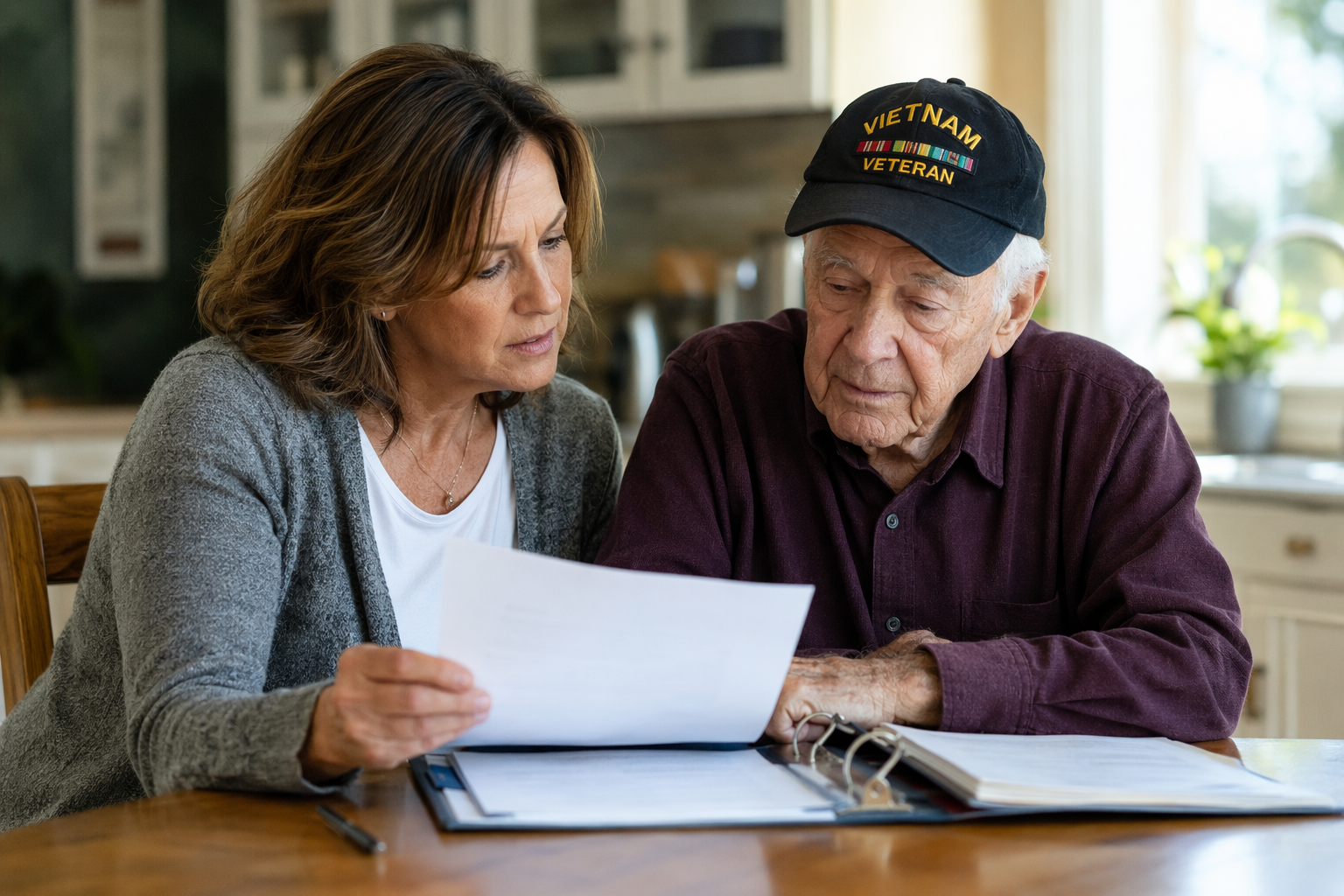
The practical question is not simply whether your parent snores. It is whether there is enough medical and service evidence to support VA sleep apnea benefits for older adults, and whether a pending rule change makes timing matter. As of July 2026, the current rating rules are still in effect. Proposed changes have not become law.
What A Current VA Sleep Apnea Rating Can Mean
The VA does not pay compensation because a person sleeps badly. It pays when a diagnosed condition is service connected and rated under the VA’s disability schedule. For sleep apnea, the current structure can make a large difference because a prescribed breathing device, such as a CPAP machine, is tied to a 50% rating under the current criteria.[3]
| Current rating | What the rating generally reflects | Monthly compensation noted in 2026 materials |
|---|---|---|
| 0% | Diagnosed sleep apnea without compensable symptoms | $0 |
| 30% | Persistent daytime hypersomnolence | $552.47 |
| 50% | Requires use of a breathing assistance device such as CPAP | $1,132.90 |
| 100% | More severe respiratory complications described in the rating criteria | $3,938.58 |
Those numbers should not turn the family binder into a scoreboard. A 50% rating matters because it may change how much care the household can afford, but it still has to be earned through evidence. A CPAP prescription is not a substitute for service connection. It helps establish rating level after the VA accepts that the sleep apnea is linked to service.
Treatment records are still worth gathering even before a claim strategy is clear. A sleep study, diagnosis, CPAP prescription, notes about CPAP intolerance, oral appliance records, or specialist recommendations can all help show what the condition is and how it is being treated. VA materials and older-adult sleep apnea guidance describe CPAP, oral appliance therapy, and Inspire hypoglossal nerve stimulation as treatment options for appropriate patients, with the choice belonging to clinicians rather than claims paperwork.[1]
The Pending Rating Change Is A Timing Issue, Not Current Law
Families have good reason to be confused about the sleep apnea rules in 2026. The VA has discussed rating changes since February 2022, but as of July 2026 those changes remain proposed, not enacted, and no effective date has been set.[4]
| Issue | Current rule as of July 2026 | Proposed change discussed for 2026 |
|---|---|---|
| CPAP or similar device | Use of a breathing assistance device such as CPAP supports a 50% rating | The automatic 50% result for CPAP use would be eliminated |
| 30% level | Persistent daytime hypersomnolence can support 30% | The 30% level would be replaced by 10% |
| 50% level | Generally tied to required use of a breathing assistance device | Would require documented treatment ineffectiveness |
| Existing ratings | Existing ratings remain protected unless VA follows formal reduction rules | Grandfathering is expected for existing ratings; reductions would require formal procedures and evidence of sustained improvement |
This is where waiting can have consequences, but panic is not helpful. A veteran who files before any final rule takes effect is generally evaluated under the rules in place at that time, while existing ratings are expected to be grandfathered unless VA uses formal reduction procedures and shows sustained improvement.[4] That does not mean every older veteran should file a weak claim immediately. It means a family with a credible basis should not put the file aside for another year just because the process feels irritating.
The Claim Turns On Service Connection
For an adult child helping with paperwork, the cleanest way to think about the claim is in three folders: diagnosis, service connection, and rating level. The diagnosis folder asks whether there is a sleep study and a clinician’s diagnosis. The rating folder asks what symptoms and treatment the records show. The service-connection folder is the one that most often decides whether the claim goes anywhere.
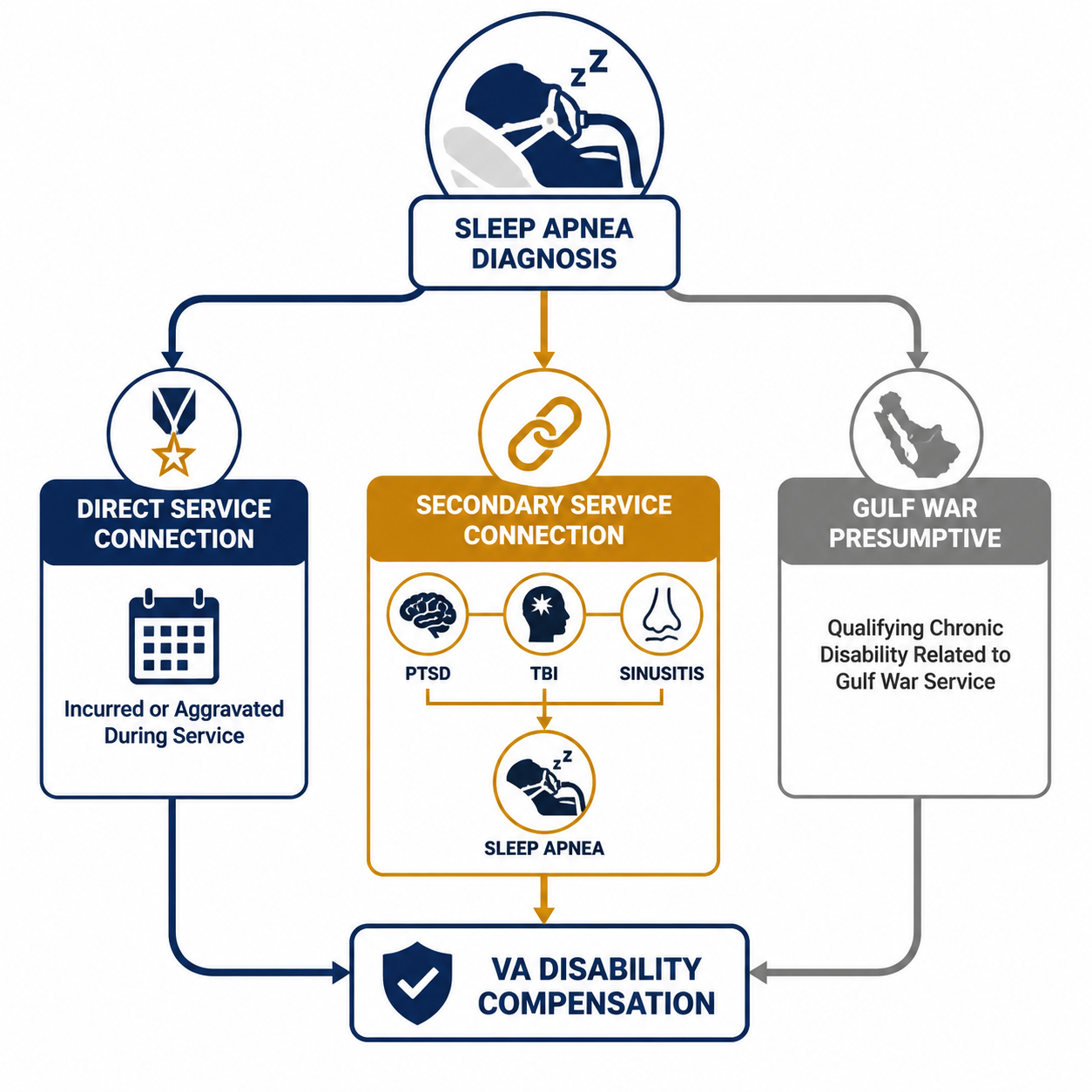
Benefits guides identify three main pathways for sleep apnea service connection: direct service connection, secondary service connection, and a Gulf War presumptive route for certain veterans who served in Southwest Asia, Afghanistan, or Djibouti.[2][3] The pathway matters because an older parent may have no sleep apnea diagnosis from active duty, especially if discharge happened decades before home sleep tests and CPAP machines became familiar household items.
Direct Service Connection
Direct service connection is the most straightforward on paper and often the hardest for older cases. It looks for evidence that sleep apnea began during active duty or within one year of discharge.[2] Useful records may include service treatment notes, a sleep study from the period near discharge, documented complaints of choking or daytime sleepiness, or credible lay statements from someone who observed breathing pauses during or soon after service.
The problem is not that the parent is being dramatic now; it is that the file may be thin from then. If your father says he was exhausted for years in service but never went to sick call, that memory may be meaningful to the family, but the claim usually needs something more organized. A spouse’s statement, a buddy statement, old medical notes, or a clinician’s nexus opinion may help connect the old symptoms to the current diagnosis.
Secondary Service Connection
Secondary service connection is often the route families need to examine carefully for an older veteran. It asks whether sleep apnea is caused or aggravated by another condition that is already service connected. Commonly discussed examples include PTSD, traumatic brain injury, chronic sinusitis, and rhinitis.[2][3]
This is not a box to check casually. If the veteran is already service connected for PTSD, that does not automatically make sleep apnea service connected. The claim needs medical reasoning that links the conditions for this veteran. The same is true for TBI, sinusitis, or rhinitis. The strongest file usually shows the already-service-connected diagnosis, the sleep apnea diagnosis, treatment history, and a clinician’s explanation of how one condition caused or worsened the other.
Aggravation deserves attention. A parent may have developed sleep apnea for multiple reasons, but a service-connected condition may still make it worse. If chronic nasal obstruction from service-connected rhinitis interferes with sleep breathing or CPAP tolerance, for example, the family should not assume the claim is impossible just because sleep apnea was diagnosed late in life. That is the kind of question to take to a VA-accredited representative or a qualified clinician, not to solve with a guess at the kitchen table.
Gulf War Presumptive Route
Some benefits materials also describe a Gulf War presumptive pathway for veterans who served in Southwest Asia, Afghanistan, or Djibouti.[2] If your parent served in one of those locations, the first task is not to argue the whole claim from memory. It is to confirm deployment records, dates, locations, and the exact medical diagnosis, then ask whether the facts fit the current VA framework.
This is an area where families should be careful about broad internet language. Presumptive rules depend on the veteran’s service location, medical condition, and current VA interpretation. If the file involves Gulf War service, a VA-accredited representative can help identify whether presumptive service connection, direct evidence, or secondary service connection is the cleaner argument.
What To Put In The Binder Before Filing
A family does not need to become a law office to prepare well. The goal is to reduce the number of missing pieces before the claim lands in front of someone who does not know your parent.
- Current diagnosis: sleep study results, diagnosis notes, and the name of the diagnosing clinician or sleep clinic.
- Treatment evidence: CPAP prescription, machine records if available, oral appliance records, Inspire evaluation notes, or documentation that a treatment was not tolerated.
- Service evidence: service treatment records, discharge documents, deployment records, and any records showing symptoms during or near service.
- Secondary-condition evidence: VA rating decisions showing PTSD, TBI, sinusitis, rhinitis, or another already-service-connected condition that may be medically connected to sleep apnea.
- Lay evidence: statements from a spouse, adult child, roommate, or fellow service member who observed snoring, choking, breathing pauses, daytime sleepiness, or worsening symptoms over time.
- Medical nexus support: a clinician’s opinion, when needed, explaining how the sleep apnea is at least as likely as not connected to service or aggravated by a service-connected condition.
The medical nexus is where many families get stuck. A diagnosis proves the condition exists. A CPAP prescription helps with rating level. Neither one necessarily proves the condition is related to service. When the claim depends on secondary service connection or a long gap between discharge and diagnosis, getting help before filing can prevent a denial that was avoidable.
Where Caregiver Benefits Enter The Picture
Sleep apnea benefits and caregiver benefits are connected, but not in the simple way families sometimes hear. Sleep apnea alone, even at a typical 50% rating under current rules, does not meet the 70% combined-rating threshold for the VA’s Program of Comprehensive Assistance for Family Caregivers, or PCAFC.[5]
The connection becomes important when sleep apnea combines with other service-connected conditions. A veteran may already have ratings for PTSD, TBI, sinusitis, rhinitis, orthopedic injuries, or other conditions. If a new sleep apnea rating raises the combined service-connected rating to 70% or more, and the veteran also needs personal care services because of service-connected disability, the family may have a reason to look at PCAFC eligibility.[5]
PCAFC can provide a monthly stipend, CHAMPVA health insurance for eligible family caregivers, 30 days of respite care per year, and caregiver training.[5] Those benefits are not awarded because a daughter fills pill boxes or drives to appointments out of love. The VA looks at eligibility rules, service-connected disability, personal care needs, and the caregiver’s role.
This is why the combined-rating review matters. A sleep apnea claim that looks modest by itself may still change the care plan if it moves the veteran across a benefits threshold. The family should review all existing VA ratings together rather than treating each diagnosis as a separate envelope that never touches the others.
When To Bring In A VA-Accredited Representative
A straightforward claim with a recent diagnosis, a clear CPAP prescription, and obvious service records may be manageable. Many older-parent cases are not that clean. If the diagnosis came decades after service, if the claim depends on PTSD, TBI, sinusitis, rhinitis, or Gulf War service, or if caregiver benefits may be affected, a VA-accredited representative is worth involving before the claim is filed.
The representative’s job is not to make symptoms sound worse. It is to match the evidence to the right legal path: direct, secondary, or presumptive. That distinction can affect which records are requested, whether a nexus opinion is needed, and how the claim is worded.
For the family paperwork person, the first move is concrete: confirm the sleep apnea diagnosis and treatment records, identify the most likely service-connection route, review all existing service-connected conditions for combined-rating implications, and decide whether the file needs accredited help. Understanding the rating structure and claim pathways will not guarantee benefits, but it can turn an overlooked diagnosis into compensation and, in some families, caregiver support that changes the care plan.
References
- Sleep Apnea in Older Adults: Diagnosis and Treatment Options, National Council on Aging.
- Sleep Apnea VA Rating Guide, Hill & Ponton.
- How VA Rates Sleep Apnea, Chisholm Chisholm & Kilpatrick LTD, July 2026.
- Proposed VA Sleep Apnea Rating Changes: 2026 Update, Marc Whitehead & Associates, 2026.
- VA Family Caregiver Assistance Program, VA.gov.
Questions to bring to a clinician or OT
This is not medical, legal, or a family's final decision — only a framework. Bring these questions to a clinician, occupational therapist, or your local Area Agency on Aging.
Find Local HelpRelated reading
Noticed something outdated or inaccurate on this page? Flag a correction. We review every report against CDC, NIA, and AARP HomeFit guidance before updating a page.