
Caregiver decision guide
When a Garlic Powder Recall Hits, Seniors Need a Plan
Multiple garlic powder and seasoning recalls in 2026 involve pathogens that are especially dangerous for older adults. This guide explains why seniors face higher risks and provides a step-by-step system to identify recalled products, respond safely, and watch for symptoms.
Last reviewed: July 21, 2026.
A garlic powder recall sounds like a small pantry errand until the kitchen belongs to an older adult who may have bought spices from more than one store, kept duplicates in two cabinets, or used the jar last week without remembering the brand. The July 2026 headline many families are seeing involves Heavenly Spices garlic powder sold in 70 g containers at Dollarama, recalled in Canada because of Bacillus cereus contamination; it is a Canadian Food Inspection Agency recall, not a U.S. recall notice.[1]
U.S. caregivers should still pay attention, not because that Canadian notice automatically applies to their pantry, but because garlic and seasoning recalls in 2026 have not been one tidy story. In March, Christopher Ranch recalled peeled garlic sold at Tops stores in New York, Pennsylvania, and Vermont in a Class I recall tied to botulism risk.[2] In April and May, California Dairies’ salmonella-related recall expanded through products that used powdered milk, including seasoning blends, snack mixes, and chips.[3] The useful question is not “Which headline is scariest?” It is: can someone stand in the kitchen today and correctly decide what stays, what goes, what gets cleaned, and what symptoms need help.
Why seniors need a stricter response
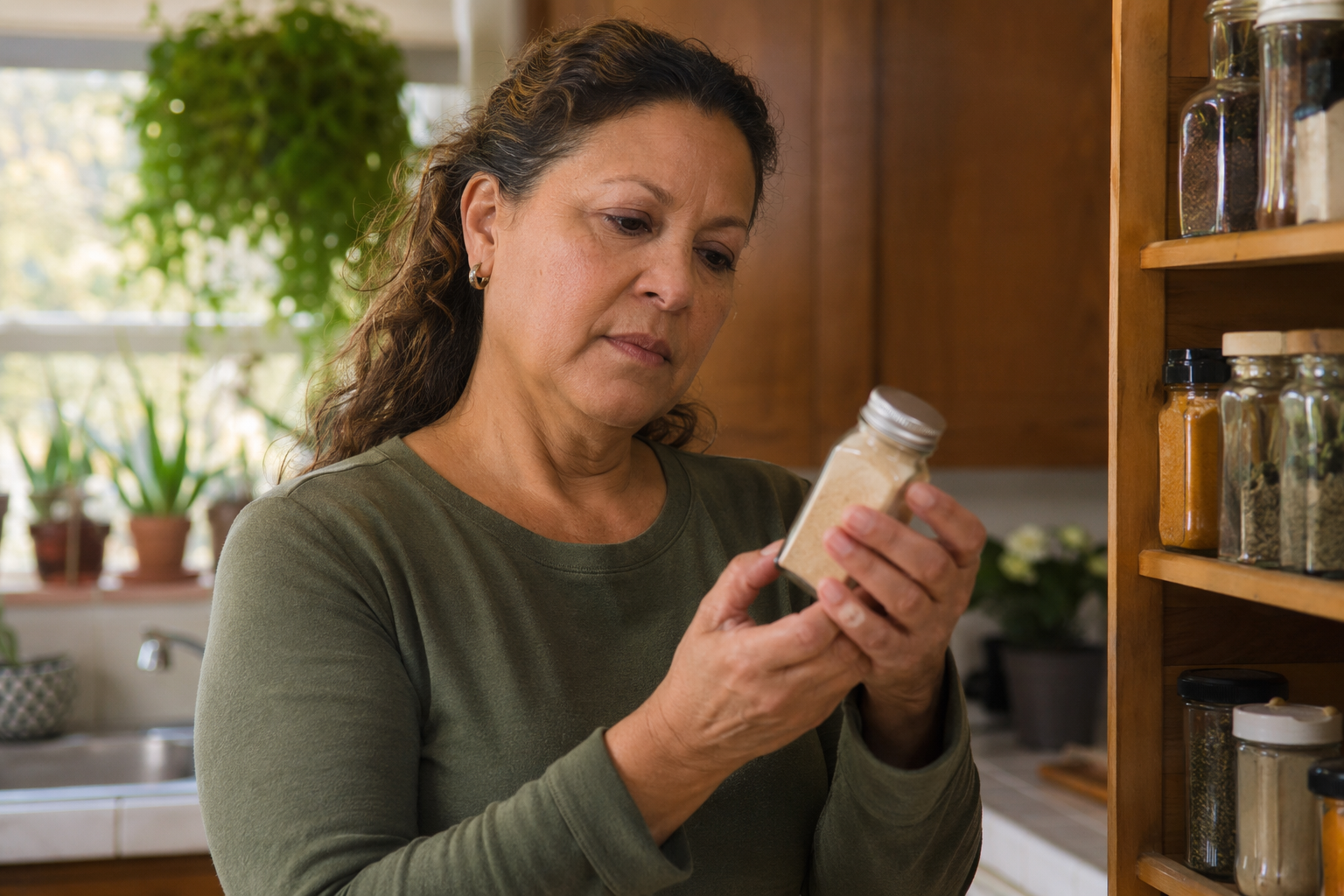
For a healthy younger adult, a recalled spice may be treated as an inconvenience: check the label, toss the jar, move on. For an older adult, especially one living alone or managing chronic conditions, the margin is narrower. The CDC says nearly half of adults 65 and older with lab-confirmed Salmonella, Campylobacter, Listeria, or E. coli infections are hospitalized.[4]
That is not just a vague “older people are fragile” warning. The FDA explains that immune function begins to decline between ages 50 and 60, becomes significantly weakened after age 75, and that older adults may have slower digestion and lower stomach acid, giving bacteria more opportunity to grow or survive.[5] Those changes are the reason a caregiver should not rely on “probably fine” when a recalled product may have been used in soups, casseroles, meat rubs, dips, or leftover meals.
The other reason to slow down is that the pathogen changes the response. Bacillus cereus usually points toward short but rough gastrointestinal illness. Botulism symptoms are rare but emergency-level. Salmonella becomes more serious in older bodies because dehydration, bloodstream infection, and hospitalization are more likely than many families expect.
The first 20 minutes in the kitchen
Start by making the search bigger than the single jar named in the headline. In a senior’s home, garlic powder may live in the main spice rack, a backup pantry shelf, a box of discount-store groceries, a basement storage area, or a bag of items brought by someone else. Garlic can also appear in blended seasonings, marinades, snack coatings, and prepared mixes.
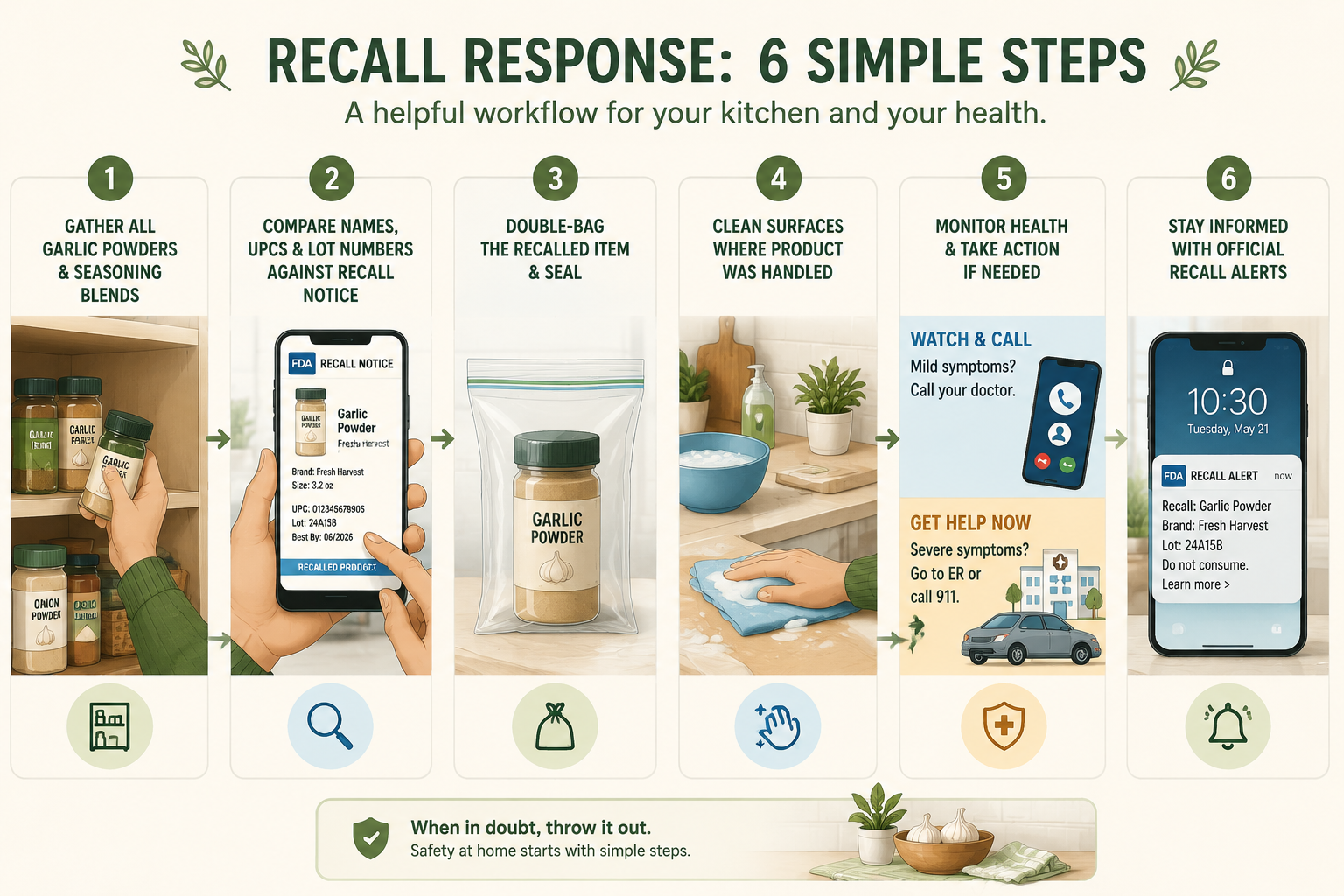
- Gather every garlic powder, garlic seasoning, peeled garlic product, seasoning blend, snack mix, and open package that may contain garlic or recalled seasoning ingredients.
- Put the items on one clean counter or table so nothing is checked twice and nothing is missed.
- Open the official recall notice on a phone or computer, preferably through FoodSafety.gov, the FDA, USDA, CFIA, or the company recall page rather than a social post.
- Compare the product name, container size, UPC, lot number, best-by date, store, and purchase location. Do not stop at brand name alone.
- Set aside anything that clearly matches or might match. Keep uncertain products separate until the recall notice, store, or manufacturer confirms them.
- Before putting safe items back, clean the counter and wash hands so the recall check itself does not spread residue.
The small label details matter. A recall may apply to one container size and not another, one lot and not another, one store chain and not another. If the label is smudged, the jar was decanted into another container, or the older adult cannot remember where it came from, treat it as unresolved rather than cleared. That does not mean panic. It means the product should not be used while someone verifies it.
Do not taste the product to decide whether it seems normal. Do not smell it closely, open it for a better look, donate it, compost it, or pour loose powder into the trash. FoodSafety.gov’s recall guidance is direct: do not open, eat, donate, or compost recalled food; return it for a refund or double-bag it and discard it, then wash hands for 20 seconds and clean surfaces that touched it.[6]
If the product matches the recall
If the notice says the product may be returned, place it in a sealed bag and keep it away from food until it goes back to the store. If the household will discard it, leave the container closed, place it in a plastic bag, seal it, put that bag inside a second bag, and place it in the trash where pets, grandchildren, and anyone with confusion cannot retrieve it. Then wash hands with soap and water for 20 seconds.
Clean the places the product may have touched: the spice shelf, counter, measuring spoon drawer, cutting board area, and any container used to decant or refill spices. Soap and water are the practical first pass for visible residue. If powder spilled inside a drawer, remove nearby utensils before wiping so it does not get pushed into corners and forgotten.
If the match is uncertain
Uncertain does not belong back in the spice rack. Put the product in a sealed bag, label it “do not use,” and take a clear photo of the front label, back label, UPC, lot code, and any best-by date. Then check the official recall record again, call the store, or contact the manufacturer. If no one can identify it and the product may plausibly be included, discarding it safely is usually the cleaner household decision than leaving it for an older adult to sort out later.
If your parent already used it
Once a recalled jar is found, the next worry is usually the meal that already happened. Write down what the older adult ate, when they ate it, whether anyone else ate the same food, and whether leftovers are still in the refrigerator or freezer. If leftovers may contain the recalled product, do not serve them again. Dispose of them safely, especially if the recalled ingredient was mixed into a dish that can no longer be separated.
| Recall concern | What to watch for | How to respond |
|---|---|---|
| Bacillus cereus | Nausea, vomiting, abdominal cramps, and watery diarrhea that may last 24 to 48 hours | Monitor closely, encourage fluids if appropriate, and call a clinician if symptoms are severe, prolonged, or worrying for that person |
| Botulism risk | Difficulty swallowing, double vision, drooping eyelids, muscle weakness, or difficulty breathing | Seek emergency care immediately |
| Salmonella | Diarrhea, fever, stomach cramps, dehydration, or worsening weakness | Take symptoms seriously in adults 65 and older because hospitalization risk is higher |
The Heavenly Spices garlic powder recall was tied to Bacillus cereus. Reported symptoms for that organism include nausea, vomiting, abdominal cramps, and watery diarrhea, with illness that may last 24 to 48 hours.[7] That does not make it harmless for a senior. Vomiting and diarrhea can quickly become a medication, hydration, and fall-risk problem, especially for someone who takes diuretics, has kidney disease, or already eats and drinks poorly.
Botulism belongs in a different category. The March Christopher Ranch peeled garlic recall involved botulism risk, and the symptoms named in coverage included difficulty swallowing, double vision, drooping eyelids, muscle weakness, and difficulty breathing.[2] Those symptoms are not “watch overnight” symptoms. They call for emergency care.
Salmonella sits somewhere many families underestimate. It may begin like a stomach bug, but for older adults the CDC hospitalization figure should change the level of attention.[4] If a senior develops diarrhea, fever, stomach cramps, dehydration, confusion, unusual weakness, or cannot keep fluids down after a possible exposure, the safer move is to call a clinician promptly rather than wait for the household to agree that it is serious.
Use official recall records, not memory
Recall details change. A notice may be expanded, corrected, or closed; distribution details may be more specific than a news article can carry; and product codes are easy to misread. For current U.S. checks, FoodSafety.gov is a practical starting point because it gathers food recall and alert information from federal agencies.[8] FDA recall pages are especially important for packaged foods, supplements, and many ingredients; USDA channels matter for meat, poultry, and egg products.
For a caregiver managing someone else’s kitchen, it helps to make the recall check a repeatable household habit instead of a one-time scramble. Set up FDA email alerts, check Recalls.gov when a headline is unclear, consider the Food Recalls & Alerts mobile app, and keep the USDA Meat and Poultry Hotline number, 888-674-6854, in the phone contacts for questions that involve USDA-regulated foods.[8]
The low-tech part matters too. Keep a small “opened date” sticker on spices used often. Avoid decanting garlic powder or seasoning blends into unlabeled jars unless the original lot code is taped to the new container. If several relatives shop for the same parent, ask them to leave receipts in one kitchen envelope or text a photo of unusual pantry purchases. That is not bureaucracy; it is how a family avoids standing in front of three nearly identical jars with no idea which one came from where.
A calm rule for the next recall
Treat a recalled garlic powder, peeled garlic, or seasoning blend in a senior’s home as a small household safety event. One person checks the official notice. One person gathers and separates the products. The recalled or uncertain item is not used, opened, tasted, donated, or composted. Contact surfaces get cleaned. Symptoms are matched to the pathogen, with botulism signs treated as an emergency and gastrointestinal illness taken seriously in adults 65 and older.
That system does not turn the pantry into a crime scene. It keeps the older adult from carrying the risk alone and gives the caregiver a way to finish the job without guessing.
References
- Heavenly Spices brand Garlic Powder recalled due to Bacillus cereus, Canadian Food Inspection Agency, July 2026, link
- Garlic sold in 3 states recalled over potentially deadly botulism risk: FDA, New York Post, March 28, 2026, link
- California Dairies recall safety page, U.S. Food and Drug Administration, April-May 2026, link
- People at Increased Risk for Food Poisoning, Centers for Disease Control and Prevention, link
- Food Safety for Older Adults, U.S. Food and Drug Administration, link
- What Do You Do If You Have a Recalled Product?, FoodSafety.gov, link
- Garlic powder sold at Dollarama recalled over contamination concerns, New York Post, July 18, 2026, link
- FoodSafety.gov recall alert tools, FoodSafety.gov, link
Questions to bring to a clinician or OT
This is not medical, legal, or a family's final decision — only a framework. Bring these questions to a clinician, occupational therapist, or your local Area Agency on Aging.
Find Local HelpRelated reading
Noticed something outdated or inaccurate on this page? Flag a correction. We review every report against CDC, NIA, and AARP HomeFit guidance before updating a page.