
Caregiver decision guide
Know the Difference Between Heat Advisory and Warning for Seniors
Heat advisories and warnings mark different danger levels, but for older adults the threshold for action is lower. This guide explains what each alert actually requires and why caregivers should act when an advisory is issued — not wait for a warning.
A Heat Advisory and an Extreme Heat Warning are not the same alert. The National Weather Service uses a Heat Advisory when dangerous heat is expected but conditions are still below local warning criteria. It uses an Extreme Heat Warning when life-threatening heat is expected or already happening.[1]
For an older parent, that official distinction needs one practical adjustment: do not wait for the warning to begin protecting them. If your parent is older, frail, socially isolated, has heart disease or memory problems, lives without reliable cooling, or takes medications that affect heat response, the advisory is already the point to act.
The Plain Difference: Advisory Means Act, Warning Means Escalate
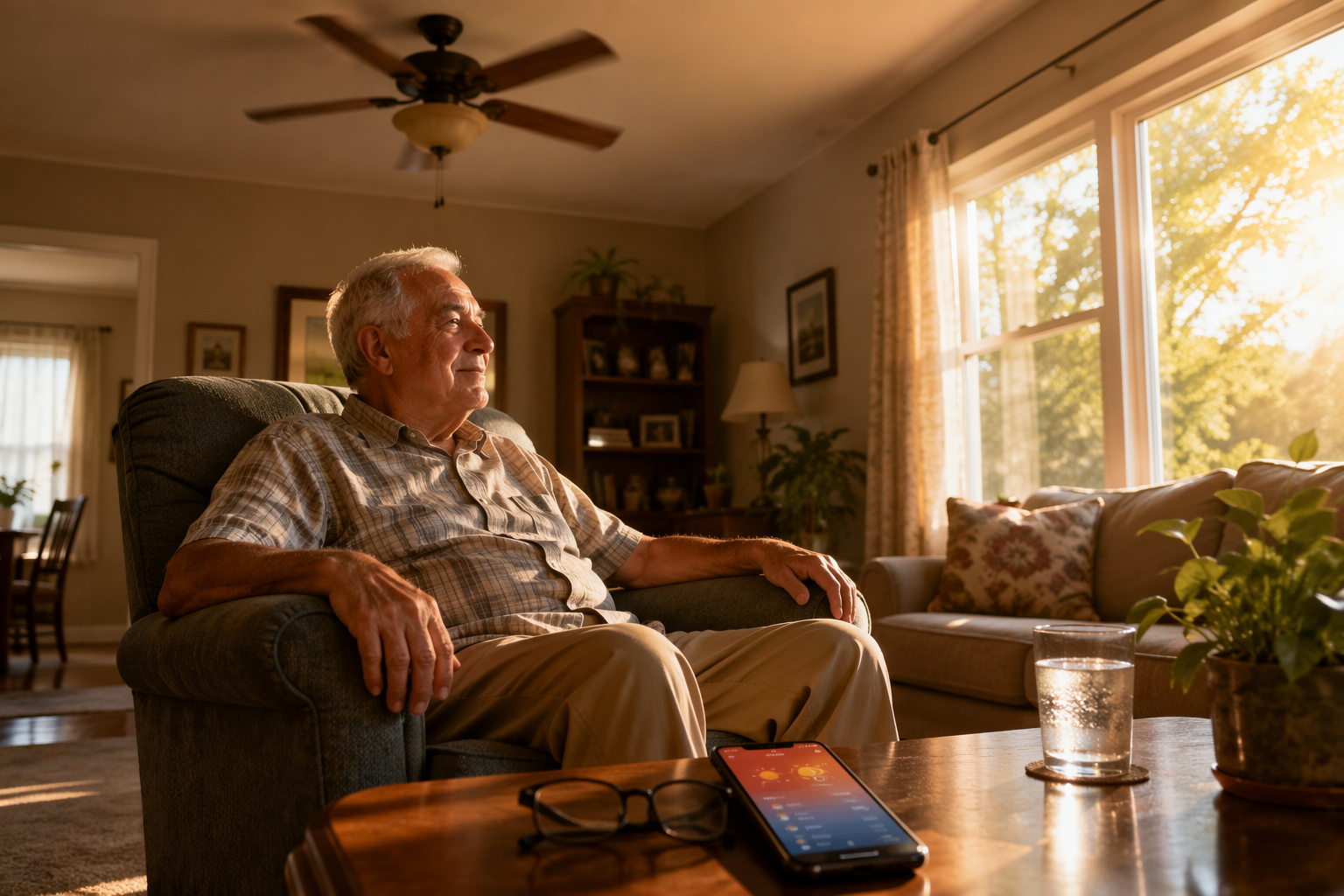
For the general public, a Heat Advisory can sound like a caution label: uncomfortable, risky if you overdo it, but not yet the worst category. For seniors, that is too relaxed. The caregiver question is not, “Is this the highest alert?” It is, “Could my parent’s body handle this heat safely without help today?”
| Alert | What it means officially | What it should trigger for an older adult |
|---|---|---|
| Heat Advisory | Dangerous heat is expected, below local warning criteria. | Confirm cooling, reduce activity, check fluids, review medication risk, and set check-ins. |
| Extreme Heat Warning | Life-threatening heat is expected or occurring. | Escalate: increase contact, involve nearby backup, consider relocation to a cooler place, and be ready to seek emergency help. |
The exact temperature or heat-index cutoff is not national. Local National Weather Service offices set criteria for their region, because dangerous heat in one climate is not the same as dangerous heat in another.[1] That local flexibility is useful for meteorology. It is less useful when your parent’s apartment is hot, the air conditioner is off, and no one has checked in since breakfast.
Why Seniors Need a Lower Heat Threshold
Older adults are more likely to have medical conditions and take medications that make heat harder to tolerate. The CDC also notes that people age 65 and older may not adjust as well as younger people to sudden temperature changes, and caregivers should check on them during hot weather.[2]
The danger is not always visible. An older person may not feel thirsty soon enough. Sweating can be less effective. The heart may not increase output as easily to move heat away from the body. A parent who says, “I’m fine,” may be reporting how they feel, not what their body temperature is doing.
Medication lists matter here. CDC clinical guidance identifies several drug classes that can increase heat risk, including diuretics, beta blockers, antipsychotics, selective serotonin reuptake inhibitors, anticholinergics, and antihistamines. The mechanisms vary: some affect fluid balance, some reduce sweating, some change blood pressure or heart rate response, and some can affect alertness or heat perception.[3]

That does not mean a caregiver should stop or adjust medications during a heat wave. It means the medication list should raise the level of attention. If a parent takes a diuretic for heart failure, a beta blocker for blood pressure, an antipsychotic, an SSRI, a sleep aid with anticholinergic effects, or a daily antihistamine, the safer move is to call the prescribing clinician or pharmacist for heat-day guidance rather than improvise.
The mortality pattern is also not evenly shared. The Center for American Progress reports that adults over 60 account for more than 80% of U.S. heat fatalities, and it notes that one in three older adults, or 14.8 million people, experienced energy insecurity in 2023.[4] Heat-death counts can differ depending on whether a source counts death certificates or broader excess deaths during heat waves, but the caregiving point is steady: older adults carry a disproportionate share of the risk.
Energy insecurity is not a side issue. A home can have an air conditioner and still be unsafe if the unit is broken, unplugged, set too high to save money, or used only in one room. Harvard Medicine described a Phoenix review in which 91% of indoor heat deaths in 2019 occurred in homes where air conditioning was present but turned off, set too high, or not working.[5]
What to Do During a Heat Advisory
A Heat Advisory is the day to interrupt normal habits. Not panic. Not scold. Interrupt. The parent who usually waters plants at noon, takes the bus to the pharmacy, opens windows instead of using the air conditioner, or says they “don’t want to bother anyone” needs a different plan before the hottest part of the day.
Confirm the Home Is Actually Cool
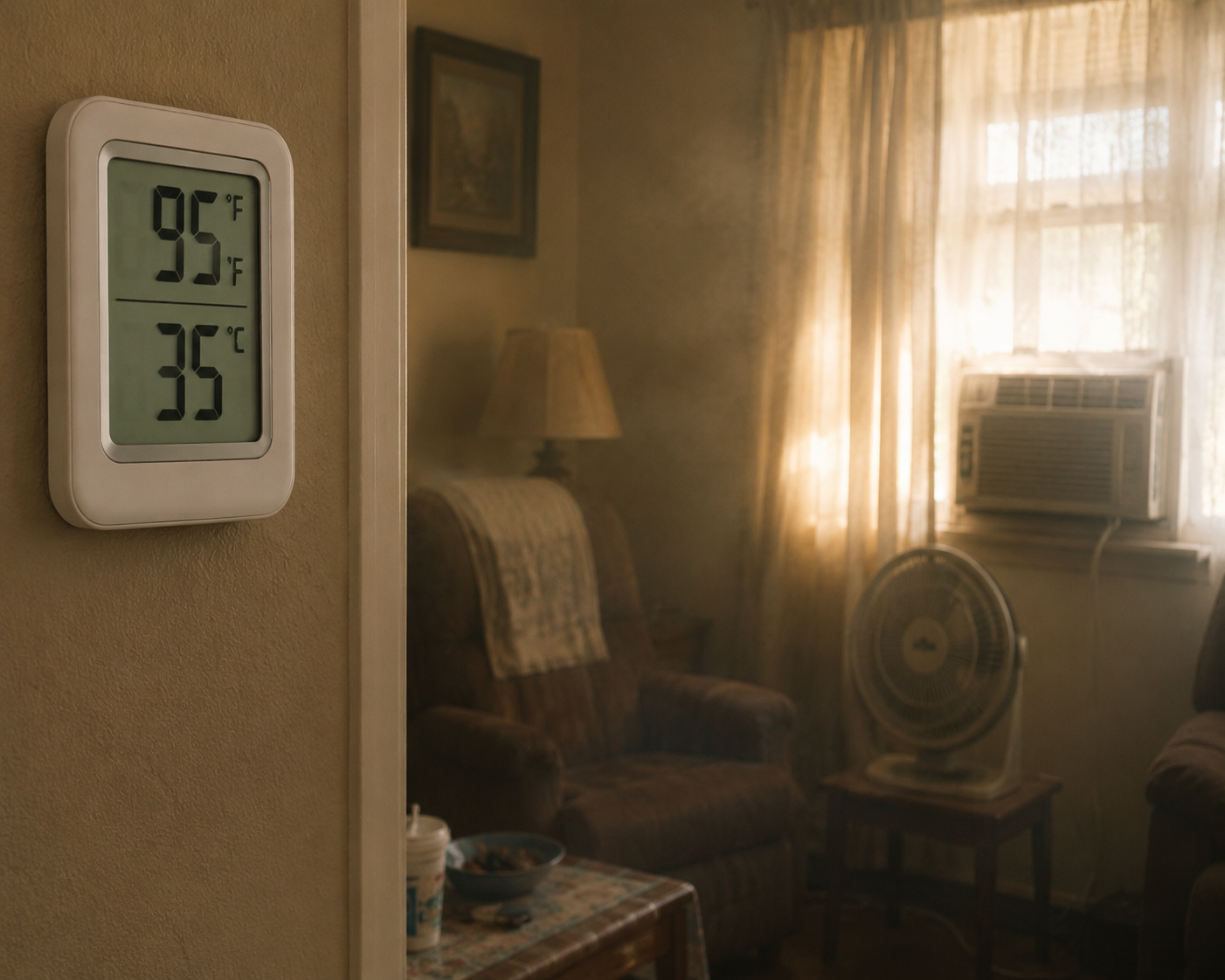
Ask a concrete question: “What does the thermostat or room thermometer say right now?” A general answer like “It feels okay” is weaker than a number. If your parent does not have a working thermometer, ask whether a neighbor, building staff member, aide, or family friend can check.
Then ask whether the air conditioning is on, not just whether the home has air conditioning. Older adults may keep it off because of cost, noise, habit, chills, or worry that it will break. Those reasons are real. They also do not make a hot room safe.
- If the air conditioner works, ask them to turn it on before the home heats up.
- If only one room can be cooled, make that the room where they will spend the afternoon and evening.
- If the air conditioner is not working, arrange repair, transportation, or a cooler temporary location.
- If they resist because of cost, treat that as a safety barrier, not a preference to ignore.
Move Errands and Outdoor Chores Off the Calendar
An advisory day is not the day for a senior to “just run out quickly” during peak heat. Cancel or reschedule yardwork, mid-day shopping, long walks, outdoor waiting, and nonurgent appointments if transportation involves heat exposure. If something must be done, look for delivery, a ride with air conditioning, or an early-morning window.
The quiet risk is the errand that sounds small. A walk across a parking lot, a bus stop without shade, or a delayed ride home can become the exposure that overwhelms an already stressed body.
Encourage Fluids, With Medical Limits in Mind
During hot weather, the CDC advises caregivers to encourage older adults to drink more water than usual and not wait until they are thirsty, while also recognizing that some people have medical instructions that limit fluids.[2] That caveat matters. A parent with heart failure, kidney disease, or fluid restrictions needs clinician-specific guidance.
For a parent without fluid restrictions, the practical step is to make drinking easy: put water within reach, pair fluids with routine moments, and check whether they have actually been drinking. A full glass beside the chair since morning is not proof.
Use the Medication List as a Risk Flag
Do not make medication changes on your own. Do use the list to decide whether the advisory deserves more supervision. A parent on a diuretic, beta blocker, antipsychotic, SSRI, anticholinergic medication, or antihistamine has at least one more reason not to spend the afternoon in a warm apartment alone.[3]
If you keep a shared medical folder, this is a good moment to update medication names, doses, prescribers, allergies, diagnoses, emergency contacts, and preferred hospital. A current emergency contact binder for aging parents is not paperwork for later; it is what helps a neighbor, aide, or paramedic act when you are not standing in the room.
Set the Check-In Plan Before the Hottest Hours
A single morning call is often not enough on an advisory day. Decide who will check in, when, and what counts as a failed check-in. If your parent usually answers the phone but does not pick up at 3 p.m., someone nearby should know whether to knock on the door.
- Ask for a morning confirmation that the cooling plan is in place.
- Check again during the hottest part of the day.
- Ask simple status questions: room temperature, fluids, urination, dizziness, confusion, nausea, weakness.
- Name the backup person who can physically check the home.
- Decide in advance when to call urgent medical help rather than keep troubleshooting by phone.
What Changes During an Extreme Heat Warning
An Extreme Heat Warning is not the time to begin wondering whether your parent’s apartment is cool enough. It is the time to escalate the plan you should already have started during the advisory.
Increase contact. If you are nearby, consider going in person. If you are not nearby, call the neighbor, building manager, home health aide, faith community contact, or local relative who can put eyes on your parent. For caregivers managing this from another town, a first-hour emergency response plan helps turn concern into assigned calls, transportation decisions, and backup checks.
Consider relocation more strongly. That might mean a cooling center, a relative’s home, an air-conditioned lobby, or a short stay somewhere safer. The right answer depends on mobility, cognition, transportation, pets, medical equipment, and whether the cooler place is truly accessible. But during a warning, “they prefer to stay put” deserves a second look if the home is hot or unreliable.
Watch for symptoms that should end the home-management phase: confusion, fainting, worsening weakness, hot dry skin or heavy sweating with distress, chest pain, shortness of breath, repeated vomiting, severe headache, or inability to keep fluids down. If those appear, seek emergency medical help. A caregiver cannot safely diagnose heat exhaustion versus heat stroke over the phone.
Check the Parent’s ZIP Code, Not Just the Regional Forecast
National headlines are too broad for caregiving. Use the local National Weather Service alert for your parent’s location, then cross-check neighborhood-level risk when possible. The CDC HeatRisk tool gives a ZIP-code-level forecast using a 0–4 color scale, separate from the NWS advisory and warning system.[6]
That second check can be useful when your weather app feels vague or when family members are in different cities trying to agree on what to do. It should not replace the NWS alert. Treat it as another way to confirm whether today’s heat is unusual enough to require action where your parent actually lives.
Also check the building, not only the weather. A top-floor apartment, poor insulation, south-facing windows, limited shade, broken elevator, or power outage can make the lived heat risk worse than the forecast suggests. If cooling fails during a storm or outage, safe movement matters too: dim hallways, extension cords, rushed trips to the bathroom, and unfamiliar sleeping arrangements can raise fall risk. Storm-related fall-prevention planning belongs in the same conversation as backup cooling.
A Caregiver Rule for Heat Alerts
For a healthy younger adult, a Heat Advisory may mean slow down and be careful. For an older adult, especially one with chronic conditions, high-risk medications, limited cooling, memory changes, or no nearby support, it means start the protective plan today. The warning level is not the first caregiving threshold; it is the escalation point, when contact increases, backup is added, and a hot or unreliable home needs a faster move to safety.
References
- Heat Watch vs. Warning, National Weather Service
- Heat and Older Adults (Aged 65+), Centers for Disease Control and Prevention
- Heat and Medications – Guidance for Clinicians, Centers for Disease Control and Prevention
- Protecting Older Adults From Extreme Heat, Center for American Progress
- The Effects of Heat on Older Adults, Harvard Medicine Magazine
- CDC HeatRisk Dashboard, Centers for Disease Control and Prevention
Questions to bring to a clinician or OT
This is not medical, legal, or a family's final decision — only a framework. Bring these questions to a clinician, occupational therapist, or your local Area Agency on Aging.
Find Local HelpRelated reading
Noticed something outdated or inaccurate on this page? Flag a correction. We review every report against CDC, NIA, and AARP HomeFit guidance before updating a page.