
Caregiver decision guide
Tom Watson’s Three Key Adjustments for Senior Golfers
Tom Watson’s three-part swing framework for older golfers offers practical ways to compensate for age-related distance loss and reduced flexibility. This article translates his advice on equipment, grip, and stance, and explains how golf’s balance and health benefits make it a valuable activity for aging adults.
The first honest sign usually shows up with a club that used to be reliable. A 5-iron that once carried the front bunker now comes out low, lands short, and asks for a perfect bounce. The backswing feels tighter. The harder swing does not go farther; it often goes crooked. That is the moment Tom Watson’s golf lessons for seniors become useful, because his advice starts before the club ever moves.
As reported by The Golfing Gazette, Watson gave older golfers three pre-swing instructions: change the equipment, soften the grip, and adjust the stance. His equipment advice was especially blunt: use hybrids from the 4-iron through the 8-iron, choose big soles and maximum forgiveness, and pair that setup with lower-compression golf balls. Then, hold the club with very light pressure and stand a little narrower with the trail foot pulled back to make turning easier.[1]
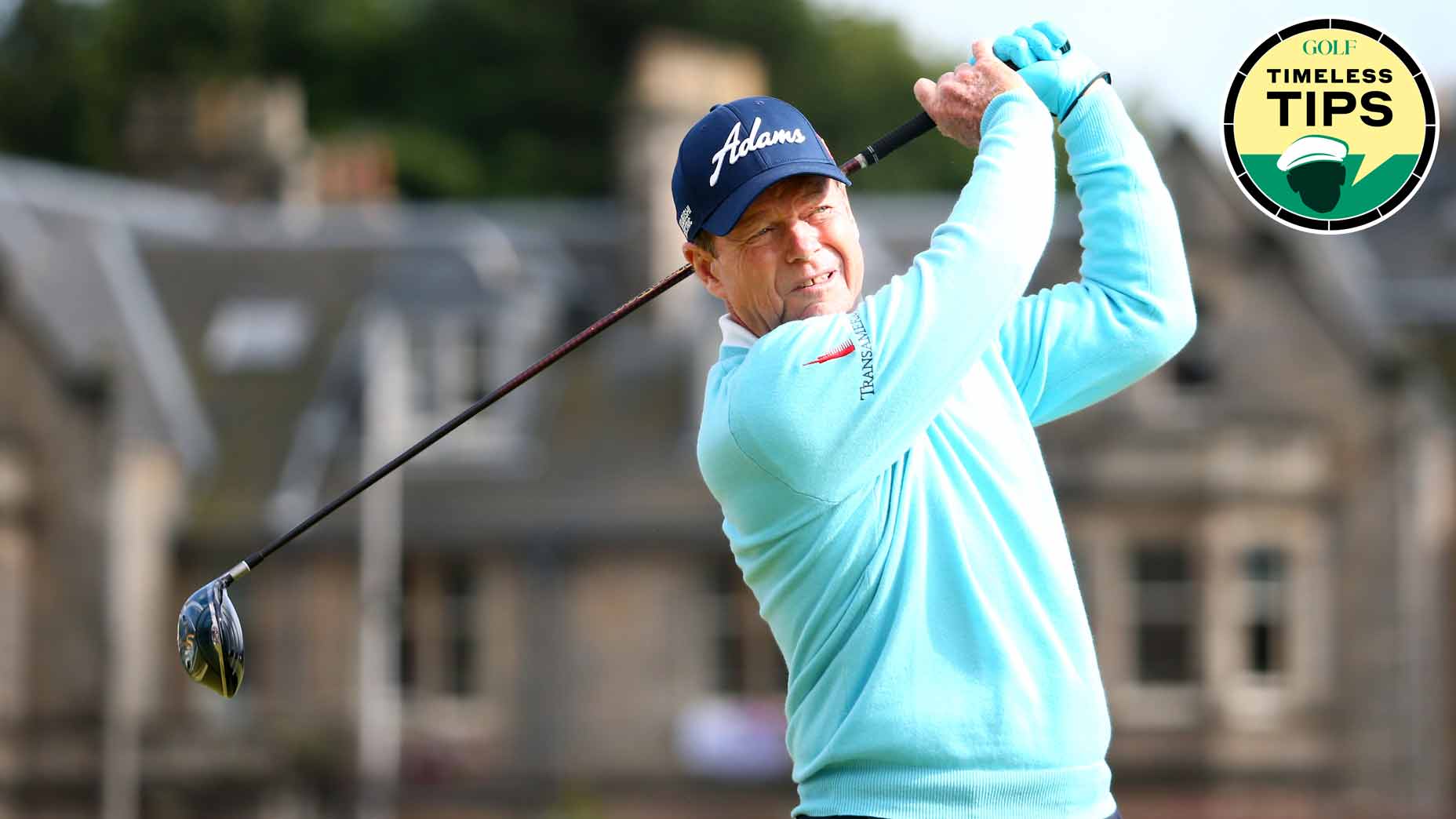
That order matters. Older golfers often try to solve a lost-distance problem with more effort from the same old tools. Watson’s framework gives the body a different bargain: let the club help the ball get up, let the hands move freely, and set the feet so the hips are not trapped.
Start With The Club That Still Lets You Play Golf
Equipment is the least dramatic senior adjustment and often the most sensible one. Nobody needs to announce a new identity because a 6-iron leaves the bag and a hybrid takes its place. The scorecard does not ask whether the ball flew on a proud old trajectory. It asks where the ball finished.
Watson’s recommendation to use hybrids from the 4-iron through the 8-iron is not a small tweak. It replaces the clubs that punish thin contact and declining launch most severely. A hybrid with a wider sole gives the club more help through the turf. More forgiveness matters when swing speed is down, contact moves around the face, and the golfer no longer wants to dig a long iron out of a tight lie with perfect timing.[1]
That is not surrender. It is matching the tool to the job. A long iron asks for speed, center contact, and enough launch to keep the ball in the air. A forgiving hybrid asks less. For an older player who still wants to walk to the next shot with a little optimism, that difference is not cosmetic.
The same thinking sits behind lower-compression golf balls. Watson’s reported advice links them to senior golfers because they can better suit reduced swing speed.[1] The important distinction is practical, not magical: a ball matched to a slower swing may help the player get better response without swinging out of his shoes. It will not fix poor contact, sore joints, or a rushed transition. It simply removes one more penalty from a body that already has less margin than it used to.
| Old Problem | Watson-Style Adjustment | What It Changes |
|---|---|---|
| Long irons fly low and come up short | Replace hard-to-launch irons with forgiving hybrids | Makes launch and turf interaction easier |
| Good swings still lose carry | Use lower-compression golf balls | Better matches equipment to reduced swing speed |
| Thin contact becomes more costly | Choose wide soles and maximum forgiveness | Reduces punishment on imperfect strikes |
There is a reason equipment belongs first. It lets the golfer keep the motion smaller and calmer. If a hybrid can carry the front edge, there is less temptation to lunge, squeeze, or make a backswing the shoulder no longer wants to make.
The Light Grip Is Not A Delicate Grip
Watson’s second instruction is the one many older golfers resist: use very light grip pressure and let the hands do the work.[1] A tight grip feels responsible. It feels as if the player is controlling the club. On the range, though, tight hands often slow the clubhead, stiffen the wrists, and drag tension into the forearms and shoulders.
Very light does not mean careless. The club still has to be held securely enough that it does not twist or slip. The point is to stop strangling the last bit of speed out of the swing. For many senior players, the hands and wrists are the only places left where speed can show up without asking the lower back or lead shoulder for something unreasonable.
A useful way to practice it is with half swings first. Take a wedge or short hybrid, soften the hands, and notice whether the clubhead can fall through the ball instead of being steered into it. If the ball flight improves, write that feel down. Senior golf is full of small adjustments that disappear by the next Tuesday unless they make it into the notebook.
Give The Hips Permission To Turn
The stance adjustment is where Watson’s advice shows its respect for older bodies. He does not tell senior golfers to simply turn more. He changes the setup so turning is less of a fight. The reported instruction is to narrow the stance and pull the trail foot back, which helps the golfer rotate when flexibility has declined.[1]
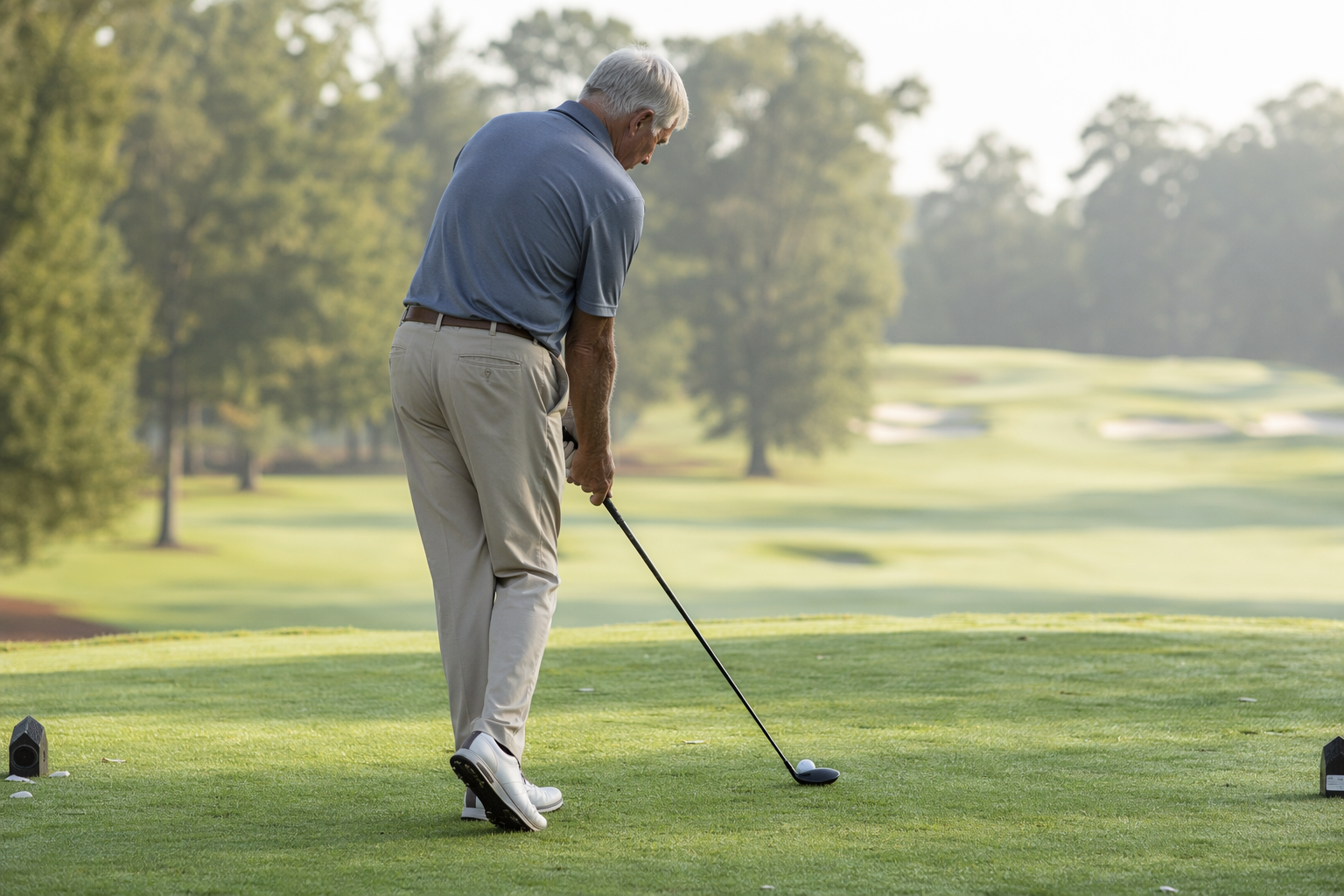
A wide stance can feel stable, and for some shots it has its place. But it can also lock the hips. When the feet are spread too far apart, the golfer may have to sway, lift, or yank the club inside just to feel as if a turn happened. Narrowing the stance reduces that resistance. Pulling the trail foot back opens a little more room for the trail hip to clear.
The trail-foot move should be modest. This is not a trick setup or a long-drive pose. A few inches can be enough to make the backswing feel less jammed. The player should still be able to finish in balance, see the target, and walk after the shot without having to recover from the swing.
This is also where individual limits matter. A golfer with a painful hip, a replaced knee, dizziness, neuropathy, or a history of falls should not treat any stance tip as a universal prescription. The adjustment is meant to make rotation easier, not to hide pain or force a turn through a joint that is warning the player to stop.
Watson’s Senior Advice Still Lives Inside The Basics
The three senior adjustments do not replace the old fundamentals. They sit on top of them. In Golf.com’s presentation of Watson’s timeless swing basics, the five points are grip, alignment, posture, rhythm, and balance. The same piece highlights Watson’s tempo idea that the takeaway should feel so slow it would look boring in a mirror.[2]
That tempo thought fits senior golf better than most power tips. A rushed takeaway can make an older player snatch the club with the hands, lose posture, and then spend the downswing trying to find the ball again. Slow enough to look boring is not timid. It gives the body time to organize.
Watson’s official Lessons of a Lifetime resource also shows that his teaching is built around instruction rather than celebrity performance alone.[3] That matters here because the senior version of the lesson is not “swing like Tom Watson.” It is closer to this: keep the useful basics, then remove the setup problems that make those basics harder for an aging body.
Why Keeping Golf In The Week Can Be Worth The Trouble
For an older adult, golf is rarely just ball-striking. It is walking over uneven ground, judging slopes, getting in and out of carts or bunkers, rotating the trunk, shifting weight, waiting with friends, and having a reason to be somewhere at 8:20 on a weekday morning. Those are not minor benefits when retirement, pain, or fear of falling can quietly shrink a person’s world.
Banner Health reports that older adults make up 15% of on-course players, citing the National Golf Foundation, and that golfers may walk about 4 to 6.6 miles over 18 holes.[4] That does not mean every senior golfer should walk 18 holes, carry a bag, or skip medical advice. It does show why the game can become a meaningful piece of a mobility routine when it is scaled correctly.
Balance is part of the same picture. A 2010 study by Tsang and Hui-Chan found that golfers ages 65 to 79 had significantly better static and dynamic balance than non-golfers of the same age.[5] That finding supports taking golf seriously as a balance-rich activity, but it should be read carefully. It does not prove that starting golf will prevent a specific person from falling. It shows an association worth respecting, especially when the activity is practiced safely.
Metabolic health research is also encouraging but not a permission slip to overdo it. A 2023 Finnish study in BMJ Open Sport & Exercise Medicine found that 18 holes of golf had positive effects on lipid profile and glucose metabolism in adults 65 and older, with stronger effects than Nordic walking or regular walking in that study.[6] The comparison is interesting because golf is sometimes dismissed as too gentle to matter. For some older adults, a round may be more physically meaningful than it looks from the parking lot.
Adult children trying to encourage a parent to move should keep the tone of this in mind. Golf does not have to be sold as treatment. It may be enough that it is familiar, social, outdoors, and adjustable. A parent who will not do “exercise” may still chip for half an hour, putt with a friend, or play nine holes from forward tees.
If falls are already a concern, golf should sit alongside a broader safety plan, not replace one. A guide such as how to choose an evidence-based fall prevention program can help families think about balance training more directly. And for daily activity beyond the course, helping an aging parent stay mobile and independent is the larger goal.
A Safe Way To Put The Three Adjustments Into Play
The safest version of Watson’s framework is gradual. Do not change every club, every ball, and every setup cue on the first tee with three other players watching. Start where embarrassment is low and feedback is clear.
- Try one or two hybrids first, especially in the iron slots that now produce low, short shots.
- Test a lower-compression ball during practice or a casual nine before making it the permanent ball.
- Practice very light grip pressure with half swings, then three-quarter swings, before full drivers.
- Narrow the stance slightly and pull the trail foot back a small amount, checking that the finish remains balanced.
- Warm up before swinging hard, especially through the hips, back, shoulders, wrists, and ankles.
- If returning after time away, begin with lessons, the putting green, or short-game practice rather than a full round.
Banner Health’s safety guidance for older golfers includes starting with lessons, beginning on the putting green, and using warm-up routines.[4] Those are not cautious extras. They are how a golfer finds out what the body will allow before fatigue and pride start making decisions.
Anyone starting a new exercise routine, returning after illness or surgery, or managing heart disease, diabetes, balance problems, joint replacements, or unexplained pain should consult a healthcare provider first. For the swing itself, a PGA-certified instructor can see what a general article cannot: whether the stance change improves rotation, whether the lighter grip is still secure, and whether the equipment fits the player’s actual speed and contact pattern.
Senior golf is not about recovering a younger swing. It is about building a smarter one: clubs that help the ball climb, hands that are free enough to create speed, and a stance that lets the body turn without being bullied into it.
References
- Tom Watson Has Three Key Instructions for Older Golfers Before They Even Hit the Ball to Help Them, The Golfing Gazette, October 2025, https://www.thegolfinggazette.com/golf-tips/tom-watson-has-three-key-instructions-for-older-golfers-before-they-even-hit-the-ball-to-help-them/
- Master These Five Basics with Tom Watson’s Timeless Tips, Golf.com, January 2024, https://golf.com/instruction/master-five-basics-tom-watson-timeless-tips/
- Lessons of a Lifetime, Tom Watson, https://tomwatson.com/lessons-of-a-lifetime/
- The Health Benefits of Golfing for Older Adults, Banner Health, 2025, https://www.bannerhealth.com/healthcareblog/better-me/the-health-benefits-of-golfing-for-older-adults
- Static and Dynamic Balance Control in Older Golfers, Journal of Aging and Physical Activity, 2010, https://pubmed.ncbi.nlm.nih.gov/20181993/
- Acute Effects of Golf, Nordic Walking and Walking on Biomarkers of Cardiometabolic Health in Older Adults, BMJ Open Sport & Exercise Medicine, 2023, https://bmjopensem.bmj.com/content/9/1/e001474
Questions to bring to a clinician or OT
This is not medical, legal, or a family's final decision — only a framework. Bring these questions to a clinician, occupational therapist, or your local Area Agency on Aging.
Find Local HelpRelated reading
Noticed something outdated or inaccurate on this page? Flag a correction. We review every report against CDC, NIA, and AARP HomeFit guidance before updating a page.