
Caregiver decision guide
How to Spot Heat Stroke Symptoms in Elderly Adults
Heat stroke in older adults often looks different than in younger people — confusion, agitation, and hot dry skin may be the first signs rather than heavy sweating. This guide helps caregivers distinguish heat stroke from heat exhaustion and know exactly when to call 911.
If an older adult becomes confused, agitated, unusually drowsy, faint, unable to speak clearly, disoriented, combative, or starts acting unlike themselves during heat exposure or in a hot room, call 911 immediately. Do not wait to see whether they start sweating. Do not wait for a perfect thermometer reading of 104°F. Brain-related symptoms in the heat are the line between watching and acting.
Heat stroke is a medical emergency because the body can no longer control its temperature, and mental-status change is one of the key warning signs that separates it from milder heat illness.[1][2] In an elderly person, that change may look less like a dramatic collapse and more like a parent who suddenly cannot answer simple questions, says strange things, becomes irritable, slurs words, stares through you, or seems “not quite there.”
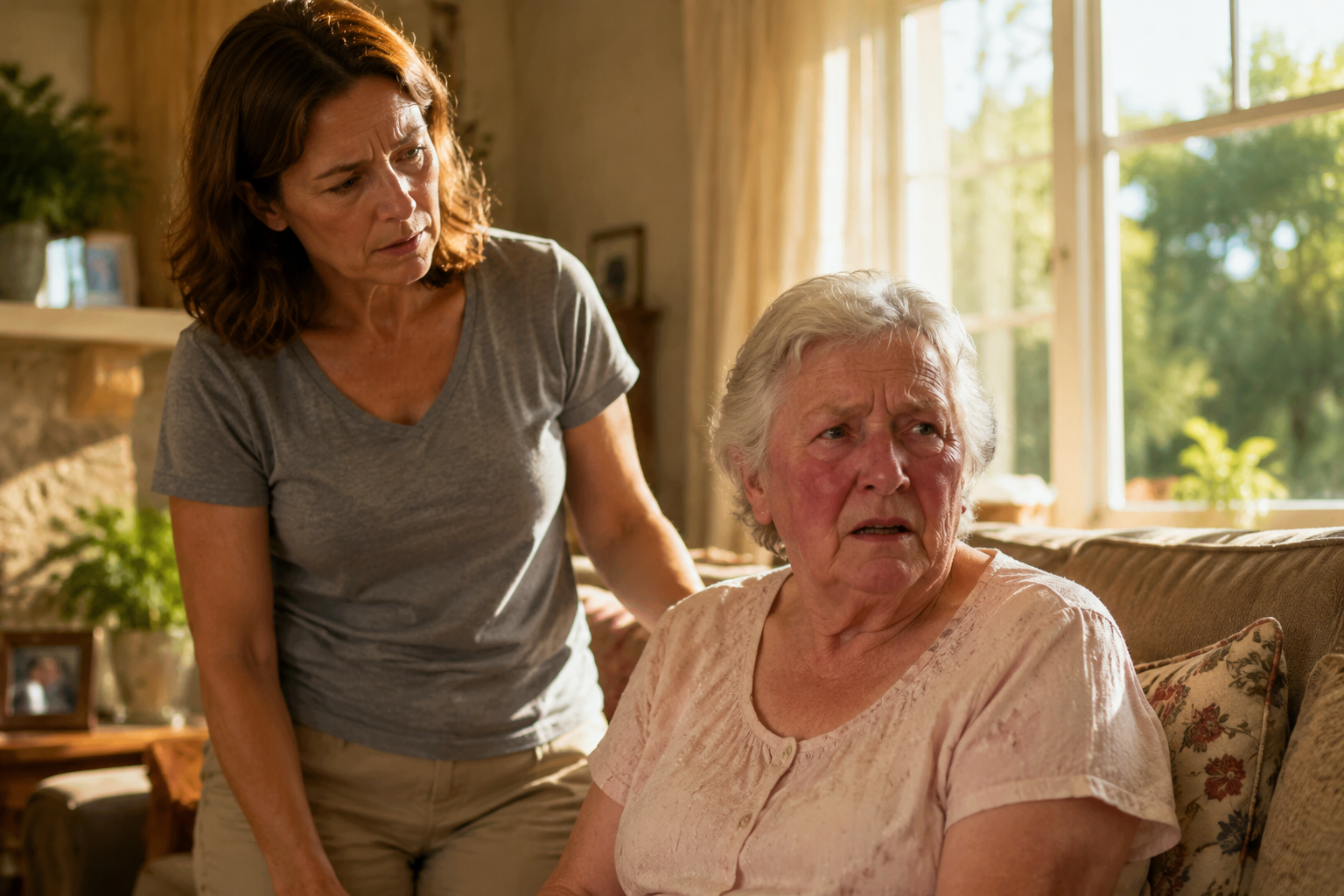
This deserves a senior-specific warning because heat deaths fall heavily on older adults. More than 80% of the estimated 12,000 heat-related deaths in the United States each year occur among people over 60.[3] That number is not just about people exercising outside. For seniors, the dangerous scene is often ordinary: a bedroom, a recliner, an apartment with weak air conditioning, a spouse saying, “She’s just tired.”
The Senior-Specific Heat Stroke Checklist
Use this checklist when an elderly adult has been in hot weather, a hot car, a warm room, a poorly cooled home, or several days of high heat. One brain-related symptom is enough to treat the situation as an emergency.
- Confusion, disorientation, or not recognizing where they are
- Agitation, unusual irritability, restlessness, or combative behavior
- Slurred speech, trouble answering questions, or strange responses
- Unusual sleepiness, fainting, collapse, seizure, or loss of consciousness
- Hot, dry, flushed, or very warm skin, especially when the person is not sweating much
- Very high body temperature if you can measure it, but do not use the absence of a reading as reassurance
- Rapid heartbeat, fast breathing, headache, nausea, vomiting, or weakness along with any mental change
The mistake to avoid is treating confusion as a side issue. In heat illness, confusion is not merely “acting old,” “being difficult,” or “having a dementia day.” Cleveland Clinic describes encephalopathy — brain dysfunction such as confusion, altered behavior, agitation, or slurred speech — as a hallmark of heat stroke.[2] Mayo Clinic also lists altered mental state or behavior, including confusion, agitation, slurred speech, delirium, seizures, and coma, among heat stroke symptoms.[1]
Heat Exhaustion vs. Heat Stroke: The Difference Caregivers Need
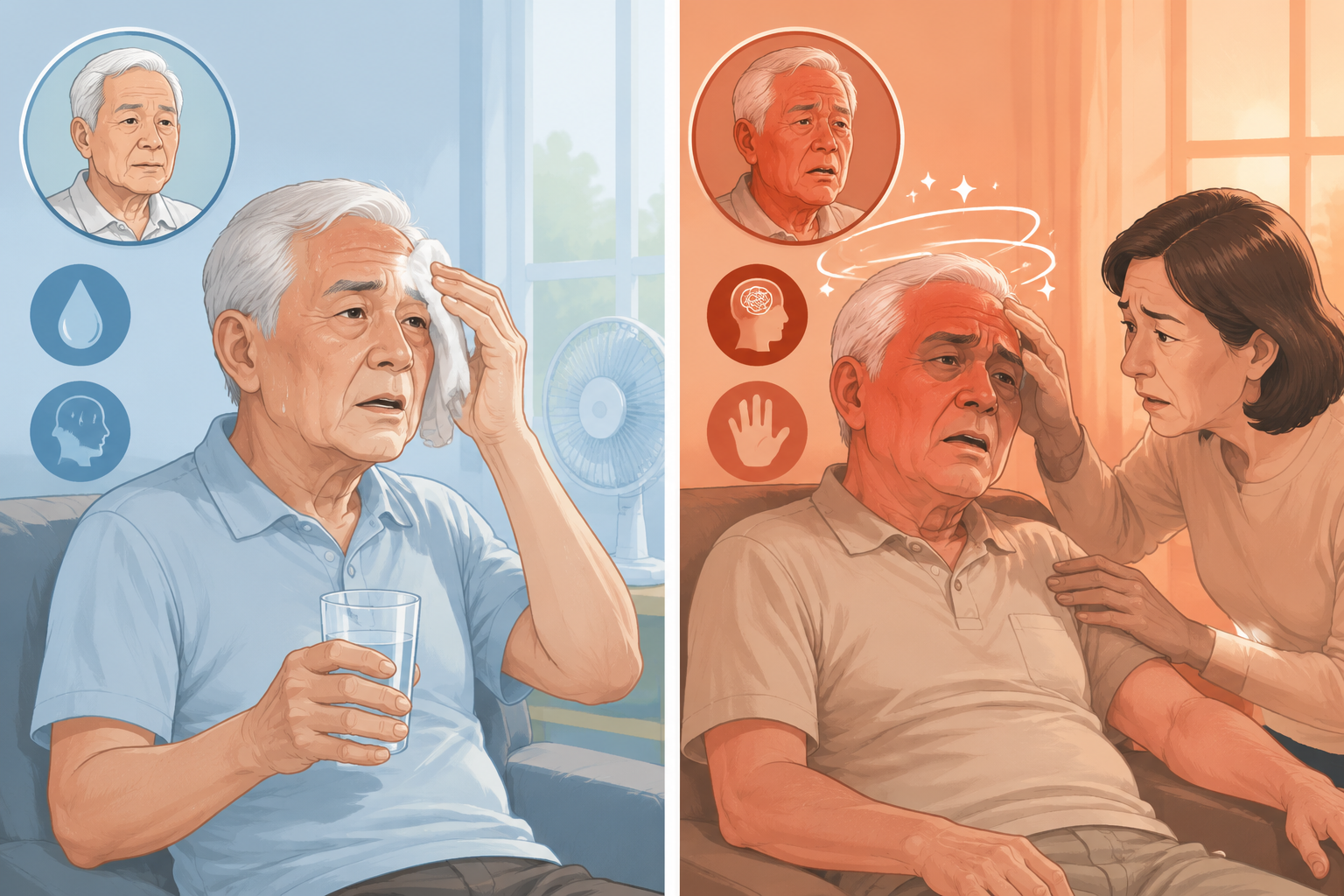
Heat exhaustion is serious and can progress, but heat stroke is the emergency that can damage organs quickly. The practical difference at home is not whether the person looks miserable. It is whether the brain is involved.
| What you observe | More consistent with heat exhaustion | Treat as possible heat stroke |
|---|---|---|
| Awareness | Awake, clear, able to answer normally | Confused, agitated, disoriented, fainting, seizure, or hard to wake |
| Speech and behavior | Tired or uncomfortable but coherent | Slurred speech, strange answers, unusual behavior, delirium |
| Skin and sweating | Often heavy sweating, cool or clammy skin | Hot, flushed skin; may be dry or may still sweat |
| Body temperature | May be elevated | Often very high; 104°F is a classic threshold, but do not wait for that reading |
| What to do | Move to a cooler place, cool the body, give fluids if fully alert and safe to swallow, seek medical advice if symptoms do not improve | Call 911 immediately, begin cooling while help is coming, do not give fluids if mental status is impaired |
NOAA’s public heat-illness guidance makes the same broad separation: heat exhaustion can include heavy sweating, weakness, dizziness, nausea, and fainting, while heat stroke includes confusion, loss of consciousness, and very high body temperature and requires calling 911.[4] In older adults, the line can look blurry because weakness, nausea, dizziness, and a change in alertness may arrive together. For a caregiver, that means the safest rule is simple: if there is mental-status change in a hot setting, stop sorting and call.
The 104°F number is useful medical information, not a home permission slip to wait. Mayo Clinic describes heat stroke as a core body temperature of 104°F or higher, often after prolonged heat exposure or exertion.[1] But many caregivers do not have a reliable thermometer, may not be able to get an accurate reading, and may be dealing with a person who cannot cooperate. A normal-looking forehead check does not rule out danger.
Why Elderly Adults May Not Look Like the Poster Version
Many people expect heat stroke to look like a young athlete collapsing after heavy exertion. Older adults more often face classic, non-exertional heat stroke, which can develop from environmental heat rather than exercise. Cleveland Clinic identifies classic heat stroke as the type associated with passive exposure to hot temperatures, especially in older adults and people with chronic conditions.[2]
That is why “she was only sitting inside” is not reassuring. A senior can overheat in a home that stays warm for hours, especially during a heat wave, after an air-conditioning failure, or in rooms that trap afternoon sun. Harvard Medicine Magazine notes that older adults have impaired thermoregulation and may also have a blunted thirst response, both of which make heat harder to detect and correct early.[3]
Sweating can also mislead. Mayo Clinic notes that in heat stroke caused by hot weather, skin may feel hot and dry to the touch, although exertional heat stroke can involve sweating.[1] Family Caregiver Alliance, drawing on aging-focused guidance, warns that older adults may not sweat as effectively, and some medications can interfere with the body’s ability to regulate heat.[5]
Medications and chronic illness do not need to be memorized in a crisis, but they should lower the threshold for concern. CDC lists older adults among people at higher risk for heat-related illness and notes that chronic medical conditions and some medications can increase risk.[6] The practical takeaway is not to diagnose the medication problem at home. It is to recognize that an elderly body may fail to cool itself before the signs look obvious.
What To Do Right Now After You Call 911
Calling 911 comes first when heat stroke is possible. Cooling at home is a bridge while emergency help is on the way, not a substitute for emergency care. Mayo Clinic and Cleveland Clinic both emphasize urgent medical treatment and rapid cooling for heat stroke.[1][2]
- Call 911 and say you are concerned about heat stroke in an elderly adult with confusion, altered behavior, fainting, seizure, or another mental-status change.
- Move the person out of heat if you can do it safely: into air conditioning, shade, a cooler room, or near a fan.
- Loosen or remove excess clothing, shoes, socks, hats, or heavy layers.
- Begin cooling while waiting for EMS: apply cool wet cloths or towels, mist with cool water, fan the skin, or place cool packs at the neck, armpits, and groin if available.
- Do not give fluids if the person is confused, very drowsy, vomiting, fainting, having a seizure, or not clearly safe to swallow.
- Stay with the person, watch breathing and alertness, and follow dispatcher instructions until emergency responders arrive.
The fluid point matters. A fully alert person with heat exhaustion may be able to sip cool water or an electrolyte drink. A confused or drowsy person can choke, aspirate, or vomit. Once brain symptoms appear, the job at home is cooling and emergency transfer, not persuading someone to drink.
If there are two caregivers, divide the work. One person stays on the phone with 911 and watches breathing and responsiveness. The other opens doors for EMS, gathers a medication list if it is nearby, and starts safe cooling. Do not delay the ambulance to search for paperwork, take a temperature repeatedly, or argue about whether the person “really wants” medical care.
Why Delay Is Dangerous
Heat stroke can injure the brain, kidneys, heart, and liver, and the damage becomes more likely the longer body temperature remains high.[1] Cleveland Clinic notes that rapid cooling within about 30 minutes of symptom onset improves outcomes, while delays increase the risk of complications.[2] That half hour can disappear quickly in a family conversation about whether to wait, whether the person is “just dehydrated,” or whether the house will cool down soon.
Recovery is also not predictable in older adults. The American Medical Association notes that recovery from heat stroke can vary, and people may have lingering sensitivity to heat after an episode.[7] In a senior with heart disease, kidney disease, diabetes, neurologic disease, limited mobility, or multiple medications, the margin for delay is smaller.
The Hot Home Problem
A caregiver may walk into a home and feel only “uncomfortable,” while the person who has been sitting there for hours is already in trouble. Harvard Medicine Magazine reported that in Maricopa County, Arizona, 91% of heat-associated deaths in homes involved air conditioning that was not functioning, was turned off, or was absent.[3] That figure is from one county, not a national rule, but it captures the risk of assuming indoor heat is mild because the person is not outside.
Older adults may also underreport thirst or avoid drinking because getting to the bathroom is difficult. Brown University Health notes that seniors may not feel thirsty even when they need fluids and recommends planning hydration rather than relying only on thirst.[8] That advice belongs in prevention; it should not distract from the emergency rule. Once confusion or drowsiness appears, drinking is no longer the first treatment.
Quick Prevention Checks for the Next Heat Wave
Prevention is less memorable than an emergency, but it is where many scares are avoided. CDC recommends that older adults stay in air-conditioned places when possible, drink fluids, avoid strenuous activity in heat, and have others check on them during hot weather.[6]
- Check the actual room temperature, not just whether the air conditioner is turned on.
- Arrange check-ins during heat waves, especially for someone living alone.
- Review medications with a clinician or pharmacist before summer heat becomes a crisis.
- Plan fluids across the day for alert adults who can safely swallow, instead of waiting for thirst.
- Know where the person can go if the home becomes too hot: a cooling center, library, relative’s home, or other air-conditioned place.
In an older adult, mental-status change during heat exposure is the threshold. Do not wait for heavy sweating. Do not wait for a perfect 104°F reading. Do not try to prove heat stroke at home before calling 911.
References
- Heatstroke - Symptoms and causes, Mayo Clinic
- Heat Stroke: Symptoms, Treatment & Recovery, Cleveland Clinic
- The Effects of Heat on Older Adults, Harvard Medicine Magazine
- Heat exhaustion or heat stroke? Know the signs of heat illness, NOAA
- HOT Weather Tips, Family Caregiver Alliance
- Heat and Older Adults (Aged 65+), CDC
- What doctors want patients to know about heat stroke, American Medical Association
- How Seniors Can Stay Safe in Summer, Brown University Health
Questions to bring to a clinician or OT
This is not medical, legal, or a family's final decision — only a framework. Bring these questions to a clinician, occupational therapist, or your local Area Agency on Aging.
Find Local HelpRelated reading
Noticed something outdated or inaccurate on this page? Flag a correction. We review every report against CDC, NIA, and AARP HomeFit guidance before updating a page.