
Caregiver decision guide
What aging leaders teach us about spotting cognitive decline at home
The national conversation about cognitive testing for aging politicians has made early warning signs of dementia a mainstream topic — but families need the same framework for their own parents. This article translates expert-identified red flags in memory, language, and executive function into practical guidance, along with clear steps for seeking professional evaluation.
The public argument over the health challenges of aging world leaders often sounds like politics wearing a stethoscope. People who have never met a public figure decide, from a clip or a debate performance, whether a pause was ordinary fatigue or proof of decline. That is not diagnosis. It is also not nothing.
In a June 2024 Harvard Gazette interview, Julie Brody Magid noted a revealing mismatch: 75% of voters supported cognitive testing for aging politicians, while fewer than half of older adults received regular cognitive screening in primary care.[1] That snapshot says something uncomfortable. Many of us want cognitive fitness checked when the person holds public power. At home, where the stakes are quieter but just as real, we often wait until a missed bill, a medication mistake, a scam call, or a driving scare makes the question impossible to avoid.

The family version is rarely clean. One sibling says Mom is just tired. Another says Dad has always told stories out of order. The parent may still be charming with neighbors, sharp in a short appointment, and insulted by the suggestion that anything has changed. Meanwhile, the person who handles the portal messages and discharge papers has started noticing patterns.
The useful question is not whether an older adult ever forgets a name, loses a train of thought, or repeats a story. Everyone does. The question is whether memory, language, or judgment is changing repeatedly, worsening, or interfering with ordinary life.
Normal aging usually leaves a trail you can retrace
Normal aging can be annoying and still be normal. A parent may take longer to retrieve a name, walk into a room and need a moment to remember why, or search for the right word while telling a story. The important feature is that the information is usually still there. With time, a cue, or a change of context, the thread comes back.
Pathological memory trouble looks different. It can feel as if the conversation never landed in the first place. A parent asks the same question minutes after it was answered. They forget an appointment you discussed at breakfast, not next month but before lunch. They may ask about people who died or moved away years ago, not as a passing slip but as if the old reality is current.[3][4]
That distinction matters because families often get reassured by the wrong evidence. A parent who remembers childhood addresses, old work stories, or family history may still be losing the ability to reliably encode new information. Long-term memory can remain vivid while recent conversations evaporate.
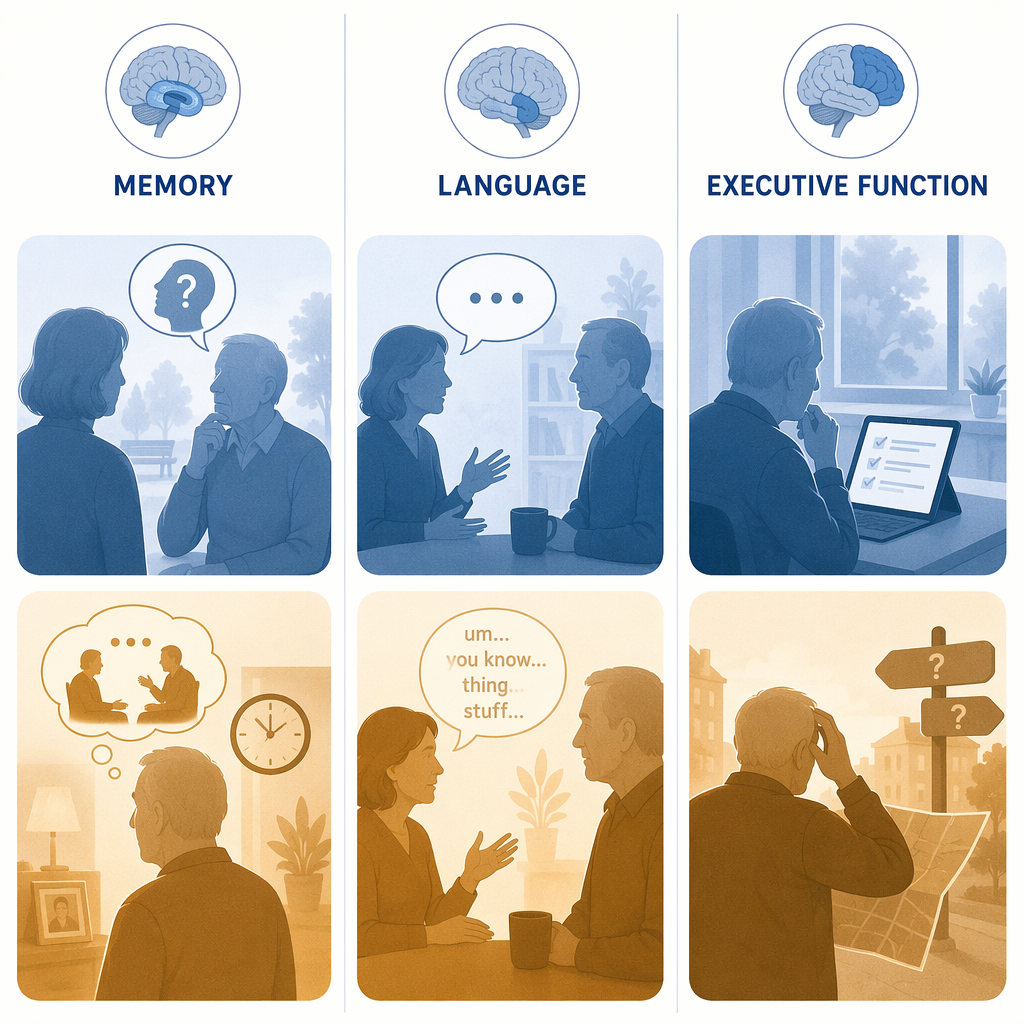
| What you notice | More consistent with normal aging | More concerning pattern |
|---|---|---|
| Memory | Takes longer to recall a name, then remembers later | Forgets a conversation moments after it ends; repeats questions; acts as if recent information was never given[3][4] |
| Language | Occasional tip-of-the-tongue pauses | Uses vague substitutes such as “the thing” or “the whatchamacallit,” simplifies speech, or develops slurring[3][4] |
| Executive function | Needs more time for complex tasks | Shows poor judgment in familiar situations, loses the thread repeatedly, becomes unusually impulsive, or cannot organize ordinary steps[3][4] |
The red flags are not only about memory
Families often wait for a dramatic memory failure because dementia has been flattened in public conversation into “forgetfulness.” But early cognitive change can first show up as language trouble, poor judgment, disorganization, or a personality shift. That is one reason the debate about older leaders catches so much attention: people are not only watching whether someone remembers a fact. They are watching whether the person can stay on topic, respond flexibly, inhibit inappropriate comments, and make sound decisions under pressure.
Brain aging gives some context, though it should not be stretched into a verdict about any individual. In a BBC Future article, neurologist Mark Fisher described prefrontal cortex volume loss of roughly 5% per decade, gradual executive-function decline beginning in the 30s and accelerating markedly in the 70s, and white matter disease affecting about one-third of people over 65.[2] Those changes help explain why a parent may not simply “forget.” They may have more trouble planning, filtering, shifting attention, or managing a situation that used to be routine.
At home, executive-function decline can look deceptively like stubbornness. The parent who handled taxes for decades cannot organize documents. The careful driver starts making risky left turns. The person who dressed appropriately for every occasion wears a heavy coat in summer. The talkative parent does not just tell a long story; they drift so far from the question that the original point disappears.[3][4]
Language changes deserve the same attention. Occasional word-searching is common. A more concerning pattern is when speech becomes increasingly vague, substitutions multiply, familiar names are replaced by generic labels, or the person’s sentence structure becomes noticeably simpler. Slurring is not something to explain away as “just age”; it needs medical attention because it may point to causes beyond dementia as well.[3][4]
What makes a pattern a pattern
One bad conversation is weak evidence. A month of repeated changes is different. The most useful family observations are specific enough that a clinician can test them against possibilities: when it happened, what was said or done, whether it was new, whether the person recovered with cues, and whether the change affected safety, money, medication, driving, cooking, or relationships.
- Less helpful: “She seems off lately.”
- More helpful: “She asked three times in one afternoon whether my brother was coming, even after writing it on the calendar.”
- Less helpful: “He is getting forgetful.”
- More helpful: “He paid the same utility bill twice and did not recognize the duplicate charge when I showed it to him.”
This kind of note-taking is not surveillance for its own sake. It protects against both family minimization and family panic. When everything is written down, it becomes easier to see whether the concern is based on a few frightening moments or a real change in reliability.
A normal screening result is useful, not absolute
The Montreal Cognitive Assessment, often called the MoCA, is one reason the public conversation about cognitive testing has become more concrete. It is a 30-point screening tool that takes about 10 minutes and checks several domains, including memory, attention, language, executive function, and orientation.[1] It is not a dementia diagnosis. It is a structured way to decide whether more evaluation is needed.
The caveat is important for families of high-functioning parents. Brody Magid told the Harvard Gazette that the MoCA can miss early decline in highly educated or highly accomplished people who can “cruise on cognitive reserve.” A normal score does not rule out early pathology.[1] Anyone who has watched a parent perform beautifully for a doctor and then fall apart over medications at home understands the gap between a brief structured test and daily life.
Cognitive reserve is not a trick or a character flaw. A person who spent a lifetime managing complex work, social expectations, or public performance may have enough practiced skill to compensate in a short appointment. They may answer orientation questions, repeat words, and make polite conversation, while still losing consistency in the unstructured parts of life: bills, driving judgment, meal planning, technology, conversations that require mental flexibility.
That is why family observations should accompany screening. The point is not to argue with the score. The point is to say, calmly and specifically, “Here is what we are seeing at home.”
Risk factors are reasons to pay attention, not reasons to predict the future
Certain risks make cognitive changes more worth acting on promptly. The BBC Future article identified hypertension as the number one modifiable risk factor for brain aging and executive-function decline, and also discussed family history and COVID infection in adults 65 and older as concerns in cognitive decline.[2] Harvard’s coverage also pointed to factors such as diabetes, hearing loss, social isolation, and sedentary lifestyle.[1]
None of those factors lets a daughter or son diagnose dementia at the kitchen table. They do change the cost of waiting. A parent with poorly controlled blood pressure, untreated hearing loss, worsening isolation, or recent major illness may need a broader medical review sooner, especially if the family is also seeing repeated memory, language, or judgment changes.
The most merciful part of early evaluation is also the most practical: not every cognitive change is dementia. University of Utah Health notes that a workup may look for reversible contributors such as vitamin B12 deficiency, thyroid dysfunction, sleep apnea, depression, and medication side effects.[4] These are not minor details. They are the difference between a family silently absorbing decline and a clinician finding something that can be treated.
When to move from watching to scheduling
There is no perfect family threshold, but there is a reasonable one: schedule a primary care visit when changes are repeated, worsening, or affecting daily judgment. That includes repeated rapid forgetting, new difficulty managing medications or finances, unsafe driving decisions, getting lost in familiar places, major changes in impulse control, or language problems that interfere with ordinary conversation.
The first appointment does not have to begin with the word dementia. It can begin with observable changes: “We are worried about memory and judgment changes over the past few months.” Ask whether cognitive screening such as the MoCA is appropriate. Ask for a medication review. Ask what labs or referrals make sense. University of Utah Health describes primary care evaluation as a starting point that may include cognitive screening, bloodwork, neuroimaging such as MRI or CT when appropriate, and assessment for reversible causes.[4]
- Bring a short written timeline of specific incidents.
- List current medications, including sleep aids, allergy medicines, supplements, and recent changes.
- Mention changes in sleep, mood, hearing, alcohol use, falls, infections, and social withdrawal.
- Ask what would make the clinician recommend neuropsychological testing, neurology referral, or imaging.
- If safety is already involved, say so directly: driving, stove use, medication errors, scams, wandering, or weapons in the home.
If the parent is defensive, the framing matters. “You are losing your mind” will close the door. “I want to make sure nothing treatable is being missed” is more accurate and usually kinder. A proud parent may accept an evaluation for sleep, medications, blood pressure, hearing, or thyroid more readily than an evaluation framed as a family vote on competence.
If the doctor seems reassured too quickly
A short office visit can miss what daily life reveals. If the clinician says the parent seems fine but the family is seeing repeated failures, provide examples in writing. If possible, send concerns through the patient portal before the visit, recognizing that privacy rules may limit what the clinician can share back without permission. The goal is not to corner the parent. It is to make sure the appointment is not judged only by a polished 15 minutes.
It is also fair to ask what follow-up should look like if the screen is normal but concerns continue. A normal MoCA may be reassuring in some situations. In a highly educated, socially skilled, or professionally accomplished parent, it may be only one piece of the picture.[1]
The hard thing to say out loud
Families often delay because they are trying to protect the parent’s dignity. That instinct is decent. It becomes dangerous when dignity is confused with silence. A person can be respected and still need evaluation. A parent can be brilliant, funny, and beloved and still be unsafe managing a medication schedule. A former executive can ace a brief conversation and still be making poor financial decisions at home.
The national debate about aging leaders will keep producing too much certainty from too little evidence. At home, the better standard is quieter and more useful: do not diagnose from a distance, do not explain away a pattern, and do not wait for a crisis to make the decision for everyone.
Early recognition matters because some causes of cognitive change can be treated, and because even progressive conditions leave more room for planning when they are named sooner. The appointment is not an accusation. It is a way of preserving choices while there are still choices to preserve.
References
- Should aging politicians take cognitive tests? — Harvard Gazette, June 2024
- Should we be worried about older politicians? — BBC Future, September 2023
- Is Your Political Candidate Showing Early Signs of Dementia? — Psychology Today
- Memory Loss in Aging Parents — Signs, Causes, and What to Do — University of Utah Health, January 2026
Questions to bring to a clinician or OT
This is not medical, legal, or a family's final decision — only a framework. Bring these questions to a clinician, occupational therapist, or your local Area Agency on Aging.
Find Local HelpRelated reading
Noticed something outdated or inaccurate on this page? Flag a correction. We review every report against CDC, NIA, and AARP HomeFit guidance before updating a page.