
Caregiver decision guide
Do humanoid robots reduce loneliness in older adults?
Humanoid and companion robots show promise for reducing loneliness in older adults, but the evidence comes with important caveats. This article reviews the latest research and helps families weigh the benefits, risks, and costs.
A humanoid robot for elderly loneliness can help some older adults feel less lonely, but the honest answer is narrower than the sales pitch. The strongest evidence is for socially assistive or companion robots as a category, not necessarily for a walking, talking, human-shaped robot in a parent’s living room. In fact, two of the most discussed platforms in the current evidence—ElliQ and PARO—are not humanoid in the ordinary sense. One is a tabletop companion device; the other is a robotic seal.
That distinction matters because families are not deciding whether “robots” are good or bad in the abstract. They are deciding whether a particular older adult would welcome a particular object into the kitchen, bedroom, or living room, and whether it would feel like support or like being monitored.
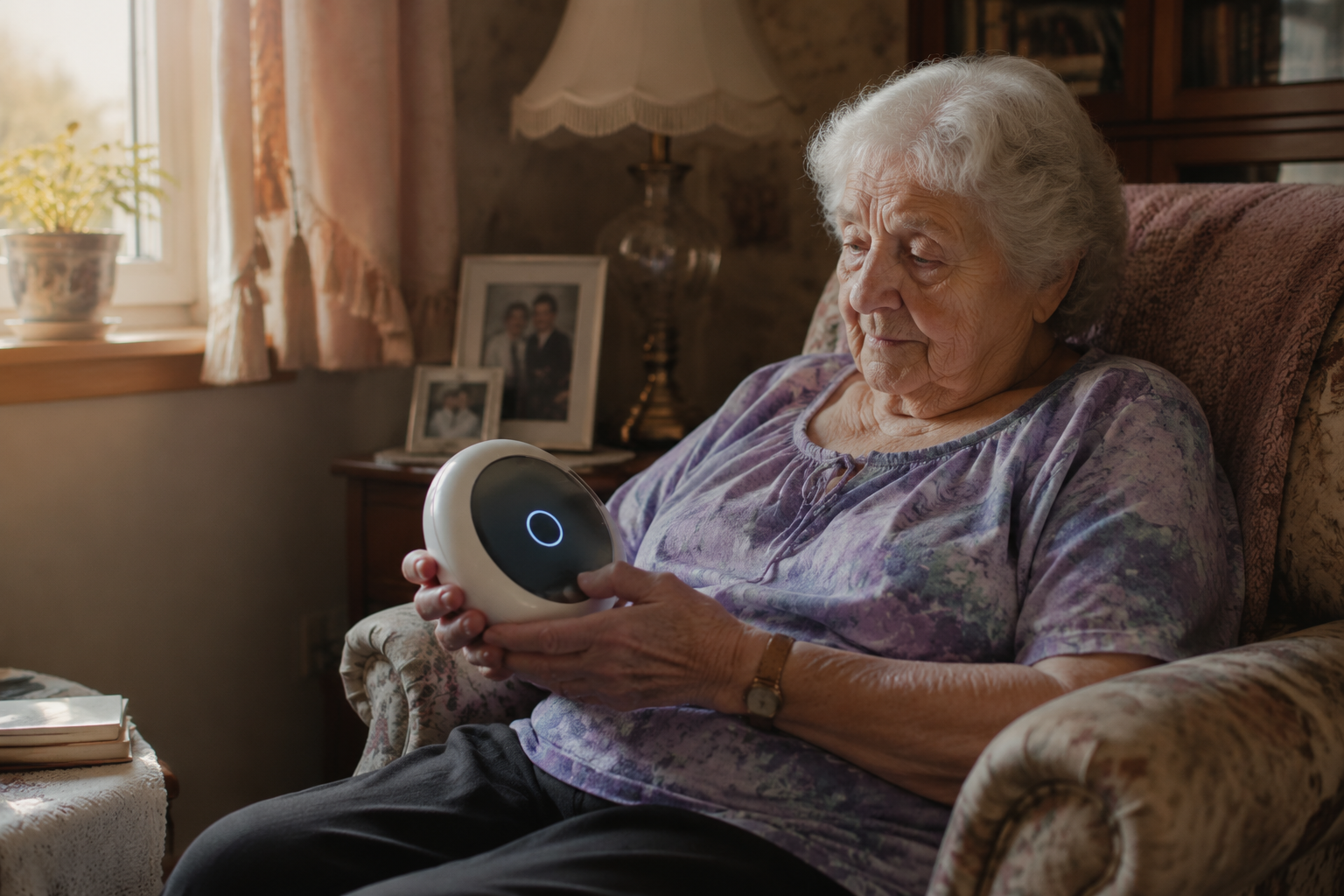
What the Evidence Says So Far
The best current summary is a 2025 meta-analysis in The Gerontologist on social robots and loneliness. It covered 19 studies with 1,083 older adults and found a statistically significant reduction in loneliness, with an effect size of -0.59 and p<0.01.[1] That is enough to say the effect is not imaginary.
It is not enough to say that any family should buy a humanoid robot and expect it to solve loneliness. The same field still has a research-quality problem. A 2026 JMIR Aging scoping review examined 59 studies across 25 humanoid robot platforms and found that 83% occurred in real-world settings, but it also noted a “striking lack of randomized controlled trials.”[2] Real-world use is valuable, but without more randomized trials, it is harder to separate the robot’s effect from novelty, extra staff attention, selection bias, or the kind of older adult who agrees to try the device in the first place.
One transparency note: the meta-analysis figures above were verified through secondary citations because direct primary access was blocked by CAPTCHA during source review. That does not erase the finding, but it is worth saying plainly in an area where numbers are often repeated faster than they are examined.
The 95% Loneliness Claim Is Promising, Not Conclusive
The number many families are likely to notice first comes from New York State Office for the Aging’s ElliQ rollout. Across more than 800 older adults, NYSOFA reported that 95% of users experienced reduced loneliness, with users averaging more than 30 interactions per day and engaging with the device 6 days per week.[3]
Those use patterns deserve attention. A device that an older adult talks to or responds to most days is different from a well-meant tablet left in a drawer. Frequency of use is one of the first clues that the object has found a place in the day rather than becoming another family project quietly abandoned after setup.
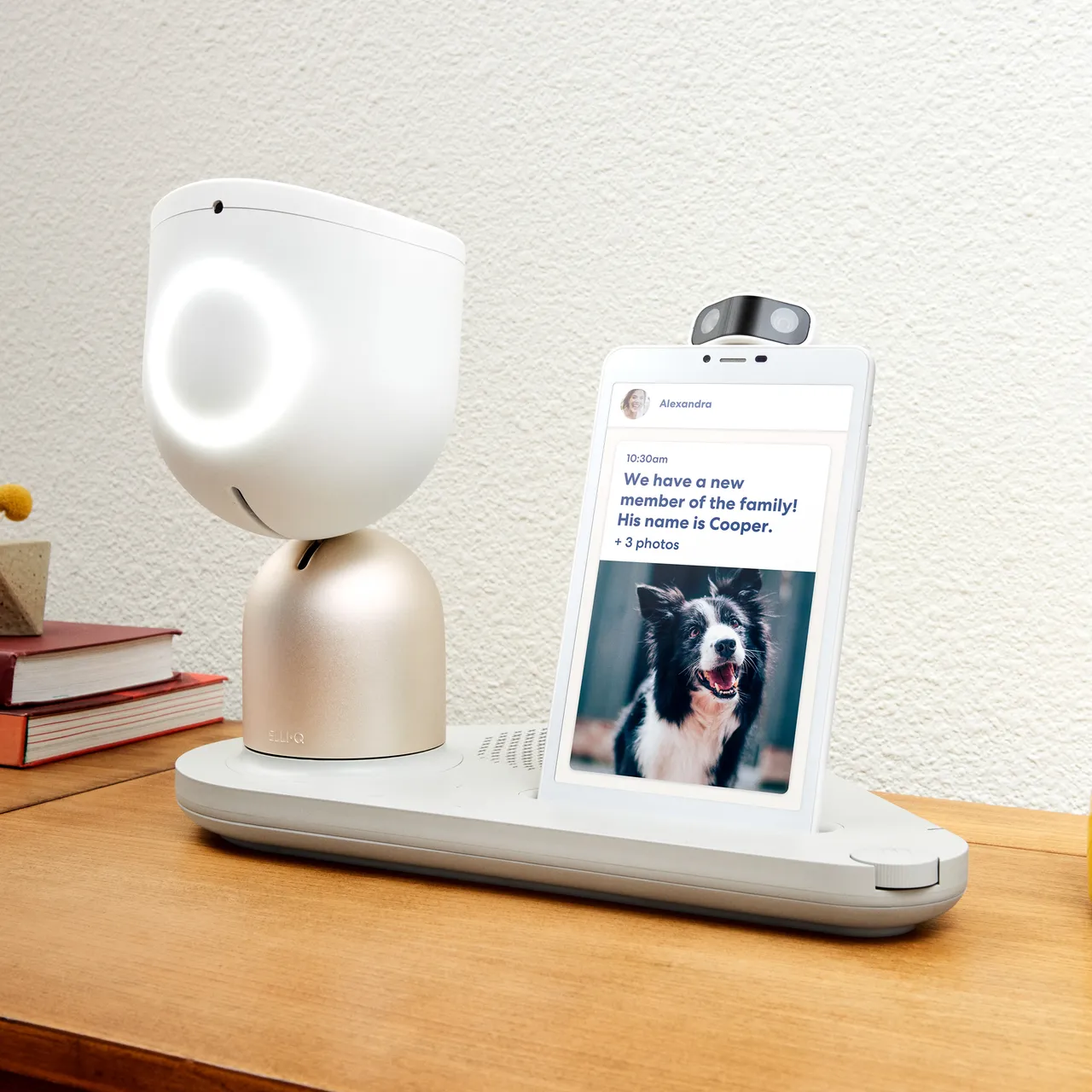
But the 95% figure should not be treated as the same kind of evidence as a peer-reviewed randomized clinical trial. It is self-reported program data commissioned by Intuition Robotics, the company behind ElliQ, rather than an independent clinical efficacy claim.[3] That does not make it useless. It does mean a family should read it as “this looked meaningful in a real deployment” rather than “this device has been proven to reduce loneliness by 95% for older adults generally.”
There is a useful split here. The meta-analysis helps answer whether social robots can reduce loneliness under studied conditions. The NYSOFA rollout helps answer whether at least one companion robot can be used regularly by many older adults outside a lab. Those are related questions, but they are not the same question.
Humanoid Is Not Always the Most Practical Category
When people search for a humanoid robot for elderly loneliness, they may picture a small person-shaped machine that talks, gestures, follows a parent around, and offers company. Some platforms, such as Pepper and NAO, fit more closely into that humanoid image. But the stronger family-relevant evidence often points elsewhere: toward companion robots and socially assistive robots that prompt, respond, entertain, or structure small interactions without pretending to be a person.
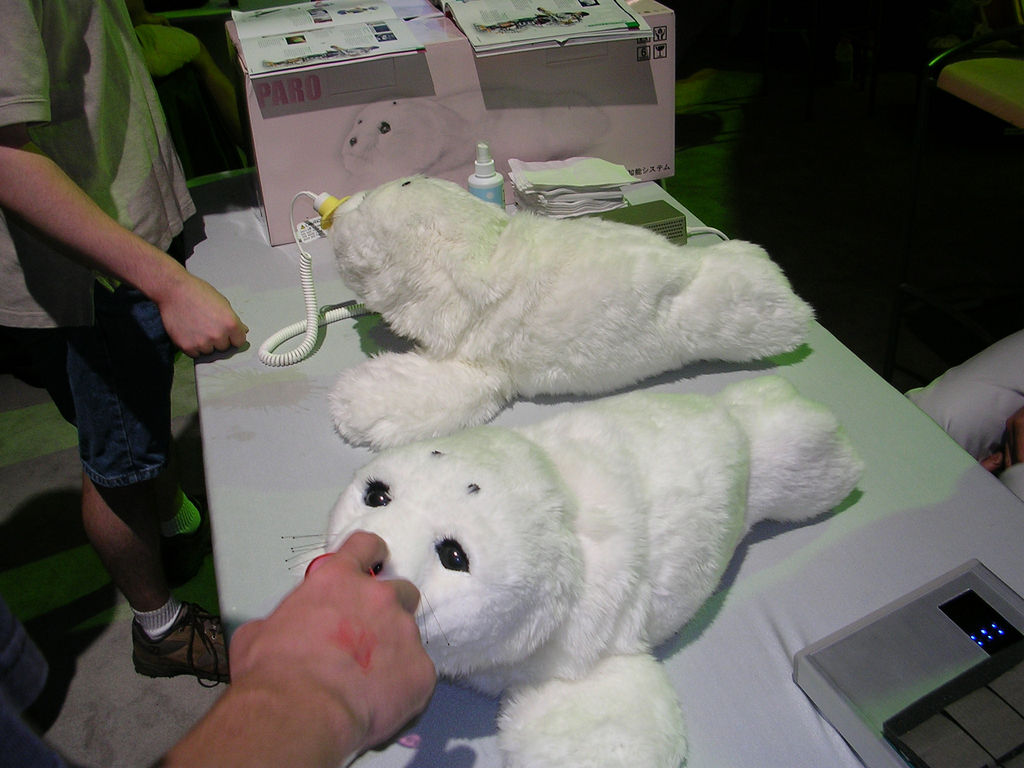
PARO is a useful reminder that a robot does not have to look human to be socially meaningful. It is a therapeutic robotic seal designed to respond to touch and sound. ElliQ is also not humanoid; it is a tabletop device with a moving interface and voice-based interaction. For an older adult who dislikes being managed, that may actually be an advantage. A device can feel less intrusive when it is clearly a tool and not a synthetic family member.
Full humanoid robots also raise practical questions that are easy to skip in a demo video: cost, availability, setup burden, maintenance, speech reliability, and whether the robot has actually been validated for home eldercare rather than institutional research. Some truly humanoid platforms have been institutionally priced around $20,000 to $25,000, Aldebaran entered bankruptcy in February 2025, and full humanoids remain less clearly validated for eldercare than the broader category of socially assistive robots.[2]
Acceptance Is Not a Small Detail
The most important household question may be whether the older adult accepts the robot’s role. A Florida International University study of 182 older adults found that 76% held positive views of robot companions and 65% said they would use one.[4] That sounds encouraging, and it is. But general openness is not the same as wanting a machine to occupy an emotionally intimate role.
A 2025 Swiss national survey of 1,211 participants found a sharper divide: only 28.8% accepted robots specifically for companionship, while 49% to 57% accepted them for practical assistive tasks. That split explains why the framing can make or break the decision. Many older adults may welcome help with reminders, activities, information, or routines while still resisting the idea that a robot is supposed to be their friend.
| Robot role | What it may feel like at home | Family decision point |
|---|---|---|
| Helper | Prompts, reminders, activity suggestions, check-ins, practical support | Does the older adult want this kind of help, and can they override it? |
| Companion | Conversation, emotional engagement, entertainment, presence during quiet hours | Does the older adult experience this as pleasant company or as make-believe? |
| Monitor | Data collection, alerts, tracking, risk detection | Who sees the data, and did the older adult agree to that arrangement? |
A family can easily get this wrong by buying the device for the feeling it gives everyone else. The adult children feel relieved because something is now “there.” The older adult is expected to be grateful. The device starts prompting, asking, lighting up, or reporting. If the parent did not choose that arrangement, the robot is no longer a companion; it is another thing being done to them.
A better test is less dramatic: would the older adult agree to try it for a limited period, in a role they can describe in their own words? “It reminds me about exercise and plays music” is different from “my children bought me a robot so I won’t be lonely.” The first leaves room for dignity. The second can land like a verdict.
Privacy Can Decide the Whole Question
Privacy is not a fine-print concern for companion robots. These devices may sit in intimate spaces, invite conversation, learn routines, or involve AI systems that process speech and behavior. University of Houston ELARA Lab research in 2026 found that fear of “severe surveillance” prevents adoption among older adults.[5] A University of Washington and Oregon Health & Science University survey of more than 800 people, about half over 64, found invasion of privacy was the most-raised concern; older adults also wanted more say in companion robots, AI, and data collection.[6]
That means consent cannot be reduced to a quick “Mom said yes” while someone is unboxing the device. The older adult should know what the robot collects, whether conversations are stored or reviewed, whether family members receive reports, what settings can be turned off, and what happens if they stop using it. If the device’s value depends on quiet surveillance that the older adult would not freely choose, it is the wrong solution no matter how charming the interface is.
What Families Can Reasonably Expect
A companion robot is most plausible when loneliness has a daily rhythm the device can actually touch: long afternoons, quiet mornings, missed routines, low motivation to start an activity, or the need for light engagement between human visits and calls. It is less plausible when the real problem is untreated depression, unsafe housing, conflict with relatives, hearing loss that makes interaction frustrating, or a parent who plainly does not want a device in the room.
Physicians are not dismissing the idea out of hand. A 2023 survey of 307 physicians found that 69% agreed social robots could provide companionship, and 70% felt insurance should cover them if proven effective.[7] The phrase “if proven effective” is doing important work. Clinical interest is a supporting signal, not a blank check.
- Treat the robot as one layer of support, not as a substitute for visits, calls, transportation, community programs, or medical care.
- Ask the older adult what role would feel acceptable: helper, entertainment device, reminder system, activity coach, or companion.
- Look for a trial period, clear return policy, and settings that let the user reduce prompts or data sharing.
- Pay attention to sustained use after the novelty period, not just delight during the first demonstration.
- Be wary of any claim that sounds like a guaranteed loneliness cure, especially if it comes from vendor-funded data alone.
There are older adults for whom a device like ElliQ or PARO may become a welcome presence: something that nudges them toward music, movement, conversation, memories, jokes, or small routines when no one else is in the room. There are also older adults for whom the same device would feel infantilizing, intrusive, or insulting.
So the careful answer is yes: socially assistive robots can reduce loneliness in older adults. But for a family considering a humanoid robot for elderly loneliness, the better question is whether this older adult wants this kind of support, understands what the device does, controls the privacy tradeoffs, and would use it as an addition to human connection rather than a replacement for it.
References
- Wired for companionship: a meta-analysis on social robots and loneliness, The Gerontologist, 2025.
- Humanoid Robot–Assisted Support for Health Care in Older Adults, JMIR Aging, March 2026.
- NYSOFA’s Rollout of AI Companion Robot ElliQ Shows 95% Reduction in Loneliness, New York State Office for the Aging.
- Seniors Welcome Help From Robot Companions, but Concerns Remain, Florida International University, Spring 2025.
- New AI-Powered Robots Could Combat Loneliness in Older Adults, UH Researchers Find, University of Houston, 2026.
- Older Adults Want More Say in Companion Robots, AI and Data Collection, University of Washington, September 6, 2023.
- How Older Adults Are Using Robots to Reduce Isolation, AARP.
Questions to bring to a clinician or OT
This is not medical, legal, or a family's final decision — only a framework. Bring these questions to a clinician, occupational therapist, or your local Area Agency on Aging.
Find Local HelpRelated reading
Noticed something outdated or inaccurate on this page? Flag a correction. We review every report against CDC, NIA, and AARP HomeFit guidance before updating a page.