
Caregiver decision guide
How to Check if Your Parent's Facility Prevents Legionella
CMS requires Medicare-certified long-term care facilities to have a water management program, but families rarely know what to look for. This guide equips caregivers with the questions and red flags to evaluate a facility's Legionella prevention efforts.
If your parent lives in a nursing home, assisted living community, or senior living facility, “Is the water safe?” cannot stop at whether it looks clear or tastes normal. For Legionella, the practical question is whether the building has a working water management program: a written, maintained process for finding where the bacteria could grow, keeping those points under control, and responding quickly when something goes wrong.
This matters more in senior homes than many families are told. The CDC says Legionnaires’ disease is fatal in about 10% of reported community-acquired cases, but the case-fatality rate rises to about 25% for healthcare-associated Legionnaires’ disease.[1] That difference is not a plumbing detail. It is the difference between a general building risk and a risk landing in a place full of older adults, people with chronic illness, and residents who may already have fragile lungs or immune systems.

Families saw that danger in Albany, New York, in 2024, when a Legionnaires’ disease outbreak at Peregrine Senior Living at Shaker hospitalized 20 residents and was reported by Fox News as involving three deaths.[2] Other public reporting around the outbreak has not always used the same death count, which is one reason families should be careful with outbreak numbers. But the basic lesson is not uncertain: ordinary facility water can become a serious resident-safety problem.
Legionella can grow in building water systems and spread through small water droplets. In a senior facility, that means the places families walk past without thinking: showers, faucets, whirlpool or therapy tubs, decorative fountains, and parts of the hot-water system. A resident does not need to drink contaminated water to be exposed.
The rule families are rarely taught to use
Medicare-certified long-term care facilities are expected to have water management policies and procedures to reduce the risk of Legionella and other opportunistic pathogens in building water systems. CMS Survey and Certification Letter 17-30 tied that expectation to ASHRAE Standard 188 and the CDC toolkit.[3] Before a formal complaint, families should verify current CMS language because agency memos can be revised or superseded. Still, the practical standard is clear enough for a family conversation: the facility should not be improvising.
The CDC also reports that Legionnaires’ disease cases reported to the agency have increased approximately 900% since 2000.[4] That does not prove every facility is unsafe, and surveillance counts can be affected by testing, reporting, and population changes. It does mean preventing Legionella in senior homes should be treated as routine safety work, not an obscure maintenance concern that only comes up after a resident gets sick.
Families usually hear the phrase “water management plan” as if the words answer the question by themselves. They do not. A binder on a shelf is not the same thing as a program people use.
What a real water management program should be able to explain
The CDC describes seven basic steps for a building water management program: establish a team, describe the building water systems, identify areas where Legionella could grow and spread, decide where control measures should be applied and how to monitor them, establish ways to intervene when limits are not met, make sure the program is running as designed, and document and communicate activities.[5] That sounds technical until you translate it into the questions a daughter or son can ask across a conference table.
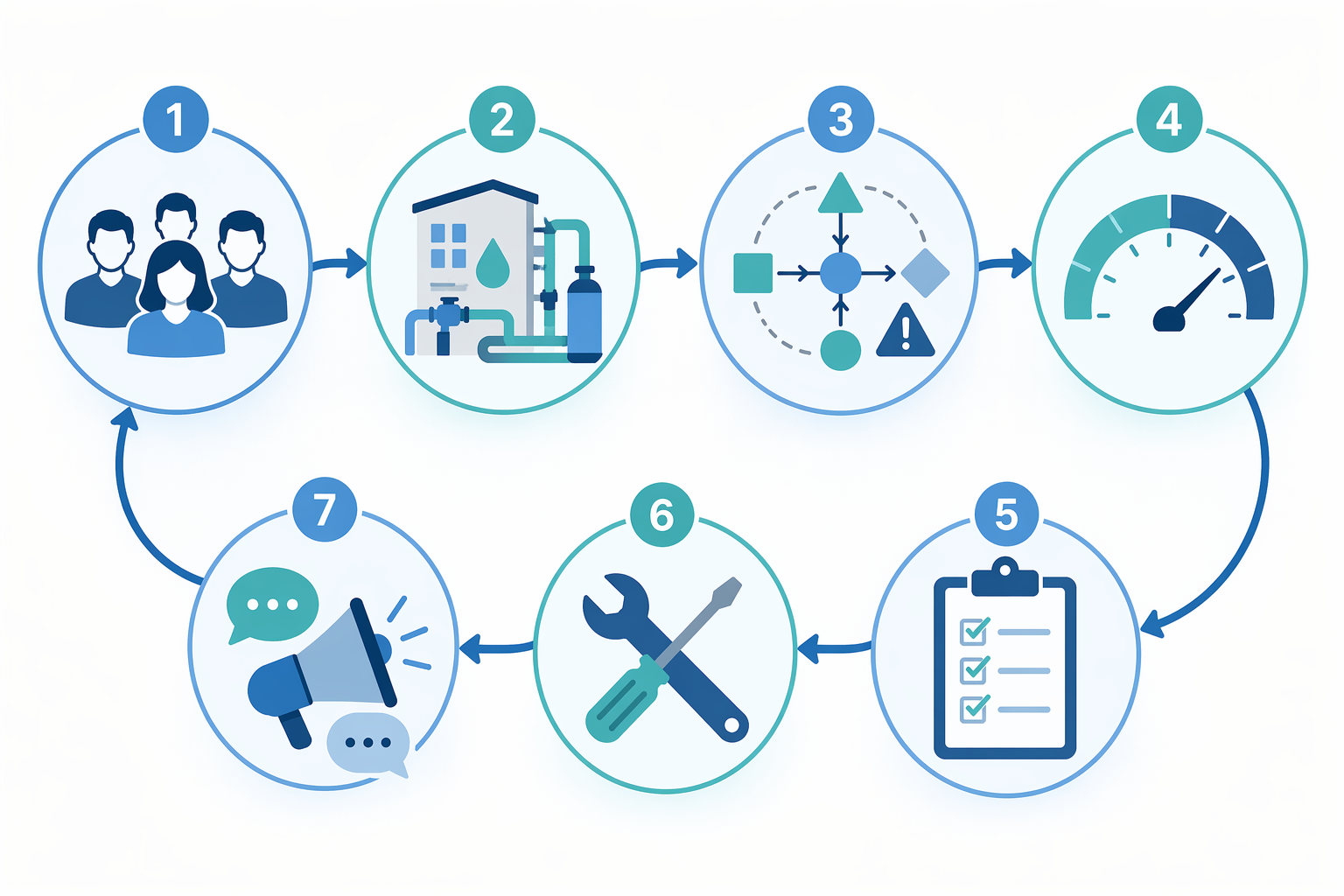
| CDC water management step | Family-facing question | A useful answer sounds like |
|---|---|---|
| Establish the team | Who is responsible for Legionella prevention here? | A named role or team, such as the administrator, maintenance lead, infection preventionist, consultant, or corporate safety contact, with clear internal ownership. |
| Describe the water system | Do you have a current map or description of the building water system? | The facility can describe hot-water loops, resident-room fixtures, showers, tubs, fountains, storage tanks, unused wings, and other relevant water features. |
| Identify risk areas | Where are the higher-risk points in this building? | They can name actual locations or conditions, not just say “all water is maintained.” |
| Monitor control measures | What do you monitor, how often, and what limits are you trying to stay within? | They mention measured items such as temperature or disinfectant level, who checks them, how often checks occur, and where results are recorded. |
| Take corrective action | What happens when a reading is outside range? | They describe a response path: who is notified, what gets adjusted, whether flushing or restrictions occur, and how the issue is documented. |
| Verify the program | How do you know the plan is actually being followed? | They describe reviews, audits, logs, outside expertise when used, and updates after building changes or incidents. |
| Document and communicate | How are residents and families told if there is a concern? | They can explain notification practices after positive findings, suspected cases, confirmed cases, or temporary water-use precautions. |
You do not need to inspect pipes or interpret engineering drawings. You are listening for whether the facility can connect policy to daily work. A good answer may be a little messy. Someone may need to call maintenance into the room, pull up a log, or say, “Let me get the infection prevention nurse because she tracks that.” That is different from a polished sentence that never leaves the clouds.
Start with ownership
Ask: “Who owns the water management program for this building?” Do not accept “maintenance handles that” as the whole answer. Maintenance may do much of the daily work, but Legionella prevention crosses infection control, resident safety, administration, construction, and communication. Someone should know who reviews the program, who receives abnormal results, and who has authority to act.
If the person giving the tour does not know, that is not automatically a failure. Tours are often led by admissions staff. The better test is what happens next. Do they offer to connect you with the administrator, director of nursing, infection preventionist, maintenance director, or another responsible person? Or do they turn the question into a vague assurance that “we follow all state and federal guidelines”?
Ask when the plan was last reviewed
Buildings change. Residents change. Plumbing ages. A facility may renovate rooms, close a wing, reopen a therapy area, replace a water heater, add a decorative feature, or change disinfectant practices. A water management program should not be treated as a one-time compliance document.
A practical question is: “When was your water management program last reviewed or updated, and what triggered that review?” Good triggers include scheduled review, construction, a water disruption, a positive test, a suspected or confirmed case, changes in occupancy, or changes in equipment. The exact interval may vary by facility and regulatory context, but “I don’t know if we still have that” is not a comforting answer.
Ask whether they have mapped the water system
The word “map” does not have to mean a glossy blueprint handed to families. It means the facility has identified the parts of the building water system that matter for risk: incoming water, water heaters, storage tanks, hot-water return loops, mixing valves, showers, faucets, ice machines if relevant, therapy tubs, decorative water features, and low-use areas where water can sit.
Ask it plainly: “Do you have a current description of the water system and the points you monitor?” If the building is older, has additions, or has unused sections, listen carefully. Stagnant water and complicated plumbing are exactly where bland paperwork can hide real-world risk.
Ask what they monitor and what happens when readings are off
Monitoring is where a plan becomes a habit. The CDC framework expects a program to identify control measures, monitor them, establish control limits, and respond when those limits are not met.[5] Families do not need the facility’s full technical chart, but they can ask for the plain-language version.
- “What do you monitor for Legionella risk: temperature, disinfectant level, flushing, testing, or something else?”
- “Where do you monitor — only at mechanical rooms, or also near resident-use fixtures?”
- “How often are checks done?”
- “Who reviews the logs?”
- “What is the corrective action if a result is outside the limit?”
The last question is often the most revealing. A facility that says, “If a temperature is low, maintenance is notified the same day, the fixture or loop is checked, flushing may be increased, and the issue is recorded until it resolves,” is giving you an operational answer. A facility that says, “Everything is always within normal limits,” without saying what those limits are or who checks them, is asking for trust without showing the system behind it.
Ask how they handle positive tests, suspected cases, or an outbreak
Not every water management program includes the same routine environmental testing strategy, and requirements can vary by jurisdiction and facility situation. The family question is not “Do you test exactly the way another building tests?” It is: “If there is a positive Legionella test, a suspected case, or a confirmed case, what is your response plan?”
The answer should include medical reporting, resident protection, environmental investigation, corrective action, documentation, and communication. If the facility has had a past issue, ask what changed afterward. After Albany, that is the question I would ask before I asked for any brochure: what did the building learn, what was repaired or changed, and how were families told?
For a state-level example of how specific this can become, the Texas Department of State Health Services task force recommendations for long-term care facilities discuss prevention planning, risk assessment, environmental sampling in certain contexts, remediation, and communication with public health authorities.[6] State guidance is not identical everywhere, but it shows the level of operational detail families should expect from serious answers.
Answers that should make you slow down
Some red flags are obvious. Others are hidden in calm administrative language. The point is not to accuse every facility that needs time to gather information. The point is to notice when nobody seems accountable for a safety system residents depend on.
- No one can identify who manages the water management program.
- The facility cannot say whether it has a written water management program.
- You hear only “we test when required,” with no explanation of risk assessment, monitoring, limits, or corrective action.
- Staff confuse routine plumbing maintenance with a formal Legionella water management program.
- The facility relies entirely on a vendor name but cannot explain who inside the building reviews results or authorizes corrections.
- Leadership is unwilling to discuss prior positive findings, corrective actions, water restrictions, or respiratory illness clusters in any meaningful way.
Vendor involvement is not a problem by itself. Many facilities need outside help, especially with older plumbing or complex systems. The problem is outsourcing accountability. If a facility uses a consultant, laboratory, or disinfection service, someone inside the facility should still understand what is being measured, what the reports mean, when action is required, and how residents are protected while problems are corrected.
You may hear technical terms such as flushing programs, thermal control, chlorine, monochloramine, copper-silver ionization, supplemental disinfection, point-of-use filters, or remediation. Those are categories of practices and technologies, not magic words. No product name or single treatment method replaces a complete water management program with monitoring, documentation, and follow-through.
What about Legionella testing?
Families often want one simple answer: “Do they test for Legionella, yes or no?” Testing can be important, especially during investigations, after certain findings, or as part of a facility’s chosen control strategy. But a negative test on one day does not prove a building is safe forever, and testing without a response plan can become another binder page nobody acts on.
A more useful question is: “Under what circumstances do you test for Legionella, where are samples taken, who interprets results, and what actions follow a positive result?” That keeps the conversation tied to decisions, not just data.
One expert-experience marker sometimes cited in long-term care discussions comes from Lin and Yu, who wrote in the Journal of Nursing Home Research that, based on their hospital experience, Legionnaires’ disease can occur when 30% or more of distal water sites are positive for Legionella.[7] That is not a CDC standard for families to enforce. It is a reminder that distal sites — the outlets residents actually use, such as showers and faucets — matter, and that a building can look orderly while risk sits deep in the plumbing.
How to ask without getting brushed off
Ask in writing when you can. A short email gives the facility time to route the question to the right person and gives you a record of the answer. It also makes it harder for everyone to rely on hallway reassurance.
Hello,

My parent lives at your facility, and I would like to better understand how the building manages Legionella risk in its water system.

Could you please tell me:
1. Who is responsible for the facility's water management program?
2. When was the program last reviewed or updated?
3. Does the program identify higher-risk water features or resident-use fixtures?
4. What control measures are monitored, and what happens if a reading is outside the facility's control limits?
5. How would residents and families be notified after a positive Legionella finding, suspected case, confirmed case, or temporary water-use restriction?

I am not asking for confidential resident information. I am trying to understand the facility's prevention and communication process.

Thank you.
If you are touring facilities after deciding that home care is no longer enough, this belongs beside the usual questions about staffing, falls, medication management, and meals. Families comparing options after reading about live-in caregivers versus assisted living can use the same folder for water-safety notes. It is part of evaluating the building your parent will actually live in.
What to do if the answers are evasive
Start inside the facility. Ask the administrator, director of nursing, infection prevention contact, or maintenance director for a plain-language explanation. If admissions staff gave you the first answer, ask who can answer more specifically. Document the date, the person you spoke with, and what they said.
If your parent is already a resident and you are worried because of respiratory illnesses, a reported pneumonia cluster, a water shutdown, a boil-water notice, visible plumbing work, or rumors of Legionella, ask whether public health has been notified and whether any resident precautions are in place. Do not ask staff to discuss another resident’s medical information. Ask about the building response.
If the facility will not answer basic process questions, consider escalating to the long-term care ombudsman, the state survey agency, or the local or state health department. Escalation is not the same as accusing individual nurses or aides of failing your parent. Frontline staff are often the ones left trying to keep residents safe when systems are weak, unclear, or underfunded.
The standard families should hold is reasonable and firm: a facility should be able to explain its water management program in ordinary language, identify who is responsible, show that it monitors and corrects risk points, and communicate honestly when something goes wrong. Ask during tours. Ask during care conferences. Ask again after respiratory illness clusters or water-system disruptions. The answer does not have to be perfect on the first try, but it does have to become specific.
References
- About Legionnaires’ Disease, Centers for Disease Control and Prevention.
- 3 deaths reported in Legionnaires' disease outbreak at senior living facility, Fox News.
- New Requirements to Prevent Legionella Infections, LeadingAge New York.
- Legionellosis Surveillance, Centers for Disease Control and Prevention.
- Overview of Water Management Programs, Centers for Disease Control and Prevention.
- Task Force Recommendations for Long-Term Care Facilities, Texas Department of State Health Services.
- Legionnaires’ Disease in Nursing Homes and Long-Term Care Facilities: An Emerging Catastrophe, Journal of Nursing Home Research.
Questions to bring to a clinician or OT
This is not medical, legal, or a family's final decision — only a framework. Bring these questions to a clinician, occupational therapist, or your local Area Agency on Aging.
Find Local HelpRelated reading
Noticed something outdated or inaccurate on this page? Flag a correction. We review every report against CDC, NIA, and AARP HomeFit guidance before updating a page.