
Caregiver decision guide
A Caregiver's Guide to Managing Menopause Symptoms After 60
Many women experience persistent hot flashes, night sweats, and vaginal discomfort years after menopause. This guide explains why symptoms continue, what treatment options are safe after 60, and how caregivers can help start the conversation with a healthcare provider.
If someone told you menopause was supposed to be finished by 60, the body did not get the memo. Roughly 15% of women 66 and older and about 10% of women over 70 still report bothersome hot flashes or night sweats 10 to 20 years after menopause, and vasomotor symptoms can last a median of 7 to 8 years, sometimes 10 to 14 years. [1][2]
That is the first thing a caregiver needs to know: persistent symptoms are common enough to be boring in the statistical sense, but they are still miserable in the kitchen-table sense. The real job is not to argue about whether she is past menopause; it is to sort out which symptom pattern is actually driving the trouble.
Why the treatment conversation changes after 60
The label landscape has changed recently, and that matters because it changes how risk gets framed. In late 2025 and early 2026, the FDA moved to remove older black-box warnings from hormone therapy labels, a correction to the way those drugs were described, not a promise that risk disappeared. [3]
The age cutoff still matters. Starting systemic menopausal hormone therapy after 60, or more than about 10 years after menopause, is generally a more cautious decision than starting earlier, so the discussion should be individualized rather than automatic. [4]
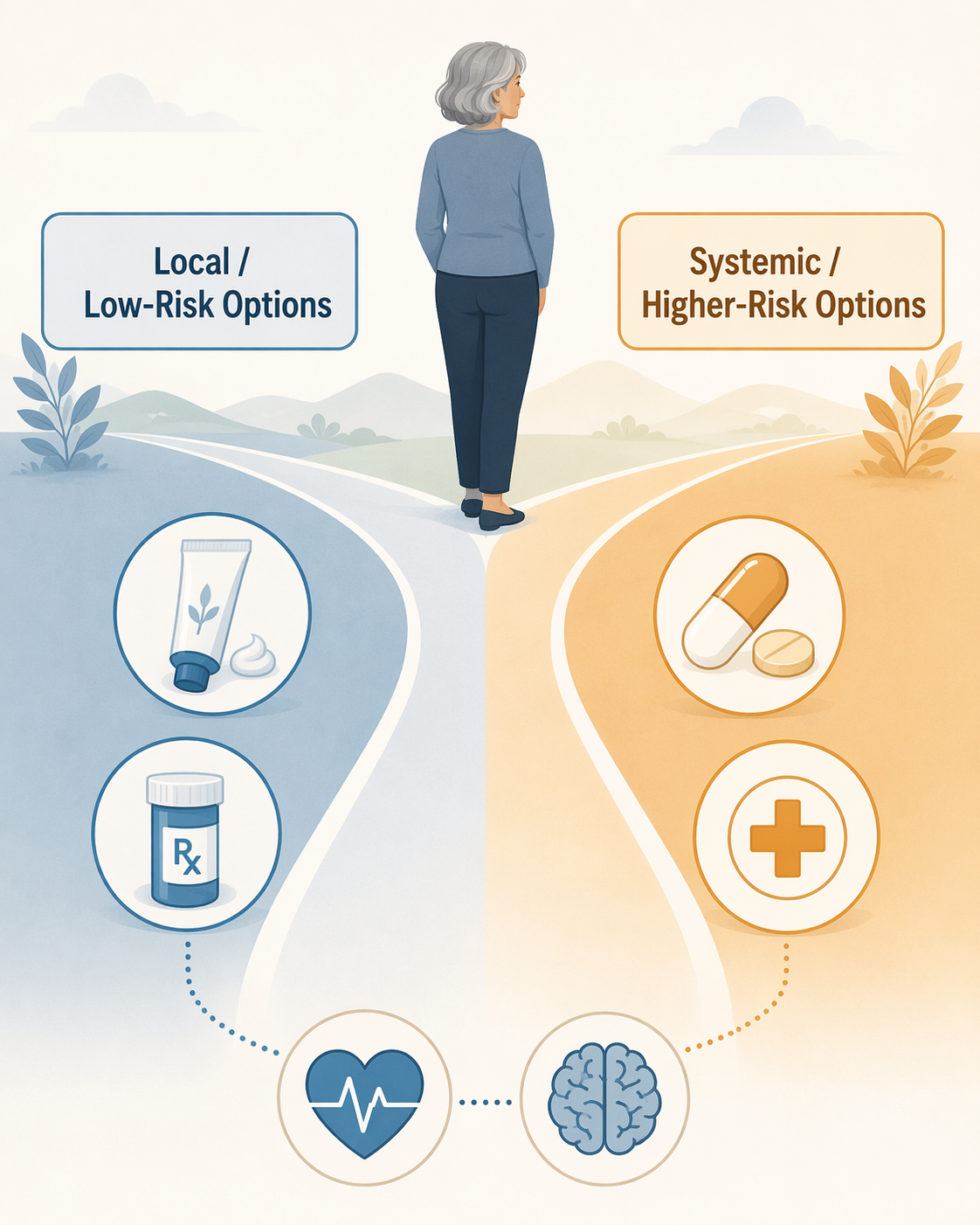
For hot flashes and night sweats, that usually means asking whether the goal is to continue a therapy that already helped, or to start one now. For someone beginning treatment after 60, the decision is a different branch of the tree, not the same conversation with a different birthday attached. [4]
For vaginal dryness, pain with sex, burning, or recurrent urinary problems tied to genitourinary syndrome of menopause, the better fit is often local treatment. Low-dose vaginal estrogen is considered appropriate at any age and has negligible systemic absorption, which is why it is not in the same risk bucket as whole-body hormone therapy. [4]
That distinction is not academic. GSM affects about 40% to 54% of postmenopausal women, tends to worsen without treatment, and still gets left out of the visit more often than it should; fewer than 25% of women discuss it with a provider. [1]
The newer nonhormonal drugs have also widened the options. Fezolinetant and elinzanetant give women with moderate-to-severe vasomotor symptoms hormone-free paths, and other nonhormonal choices such as SSRIs/SNRIs, gabapentin, and sometimes oxybutynin remain part of the conversation; the evidence base is newer than for older treatments, so women in their late 60s and beyond should not be treated as if they were an afterthought in the data. [2]
That caution is not the same as saying no. It is just the price of being honest about what is known and what is still being learned.
What still helps
Cooling strategies, sleep protection, exercise, weight management, cognitive behavioral therapy, and clinical hypnosis are useful supports, especially when symptoms are milder or when medication is not the first choice. [2] They help with symptom control and sleep, but they do not replace the basic sorting-out job of deciding whether the problem is vasomotor symptoms, GSM, or both.
For a caregiver or adult child, the most useful preparation is unglamorous: write down which symptoms are happening, how often, and what is getting worse. Is it flushing and sweating? Is it dryness, irritation, pain, or repeated urinary trouble? Is sleep the real casualty? The answer steers the treatment discussion.
What to ask at the visit
- Is this mainly vasomotor symptoms, GSM, or both?
- If it is GSM, would low-dose vaginal estrogen, vaginal DHEA, or ospemifene fit better than systemic treatment? [1][4]
- If systemic hormone therapy is still on the table, how does starting after 60 change the risk-benefit conversation? [4]
- If hormones are not a good fit, which nonhormonal option best matches her age, symptoms, and medication list? [2]
That is usually enough to turn a generic menopause appointment into a useful one. The symptoms do not expire on schedule, and they do not need to be minimized just because the woman having them is over 60. What changes is the route to relief, and that is the part worth asking about plainly, with the caregiver in the room if that helps.
References
- Managing Menopausal Symptoms in the Geriatric Population: Moving Beyond Menopausal Hormone Therapy — Consultant360, 2024
- Menopausal Symptoms — American Academy of Family Physicians, 2023
- Hormone Replacement Therapy: What Every Woman Should Know in 2026 — Eileen West MD, 2026
- Menopause - Diagnosis and treatment — Mayo Clinic
Questions to bring to a clinician or OT
This is not medical, legal, or a family's final decision — only a framework. Bring these questions to a clinician, occupational therapist, or your local Area Agency on Aging.
Find Local HelpRelated reading
Noticed something outdated or inaccurate on this page? Flag a correction. We review every report against CDC, NIA, and AARP HomeFit guidance before updating a page.