
Caregiver decision guide
Which Medications Make Seniors More Vulnerable to Extreme Heat?
This article explains how common medications for older adults — including diuretics, beta blockers, and SSRIs — interfere with the body's cooling system, and how caregivers can work with a doctor to create a summer medication plan that reduces heat-related emergency visits.
If you manage medications for an older parent, the summer question is more specific than most heat safety tips for seniors make it sound: which pills make heat more dangerous, and what should you ask the doctor before the first serious heat wave?
The answer is not to stop medications. Do not skip, reduce, delay, or “pause for heat” any prescription unless the prescribing clinician tells you to. Many of the drugs involved treat heart disease, blood pressure, depression, psychosis, thyroid disease, allergies, asthma, diabetes, or other conditions where abrupt changes can be dangerous. The safer move is a pre-summer medication review that looks at how each drug affects cooling, hydration, blood pressure, alertness, and storage.
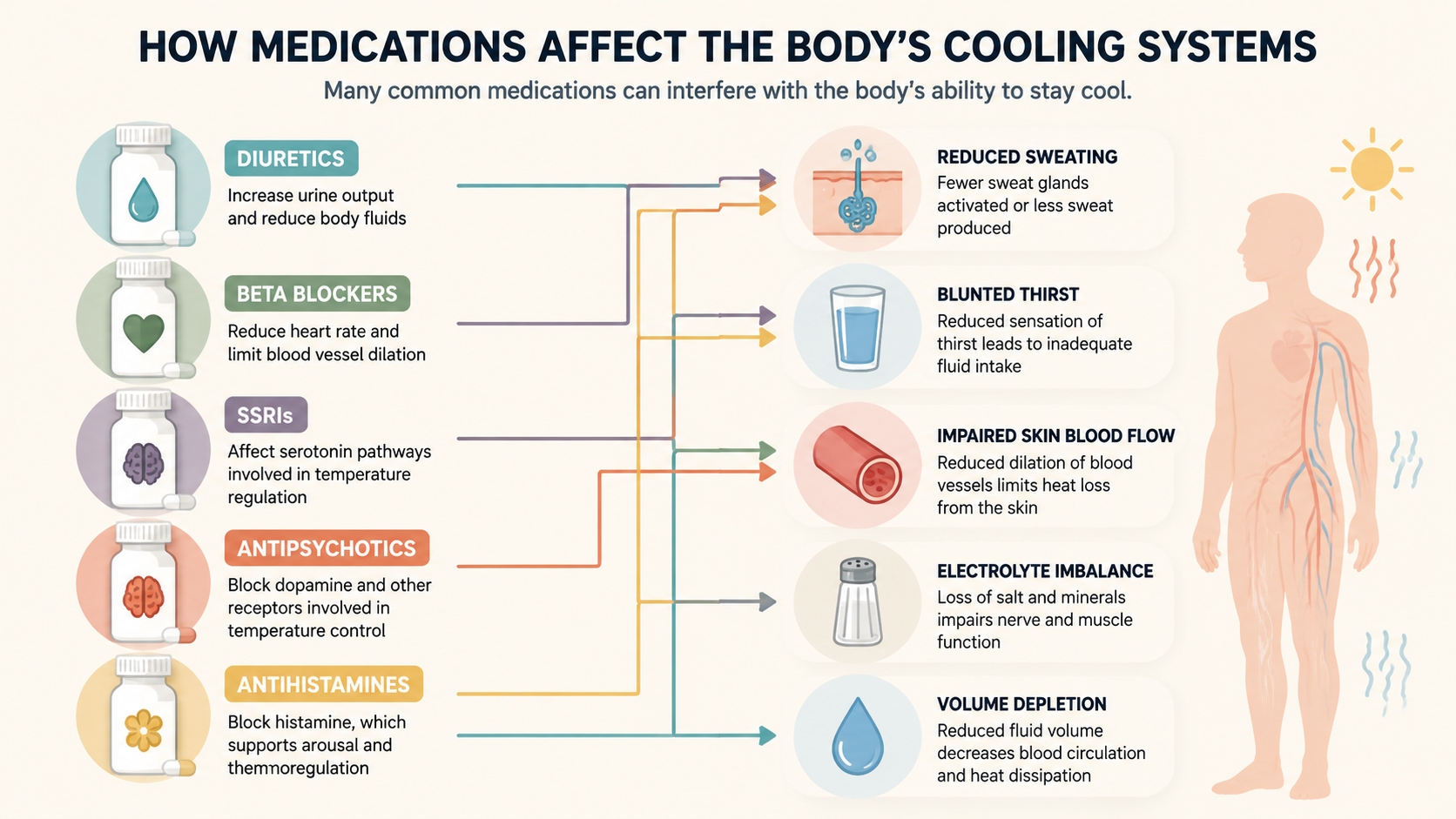
The CDC’s clinician guidance is useful because it explains the problem by mechanism. Some medications reduce sweating. Some blunt thirst. Some change how blood vessels move heat toward the skin. Some increase urination, dehydration, or electrolyte imbalance. Others affect cognition or judgment, making it harder for an older adult to notice trouble and act quickly.[1]

Why Common Medications Can Change Heat Risk
An older body already has less margin in heat. Harvard Medicine Magazine reports that more than 80% of roughly 12,000 annual heat-related deaths in the United States are among people over 60, and during Oregon’s 2021 heat dome, the average age of people who died was 70.[2] The article also notes that heat-related problems can begin below 85°F, which matters because many families wait for “extreme” temperatures before changing routines.[2]
The CDC also identifies adults 65 and older as a group at higher risk during heat because aging can reduce the body’s ability to adjust to temperature changes, and chronic medical conditions and medications can add to that vulnerability.[3] That is why a parent can be taking every medication exactly as prescribed and still need a summer-specific plan.
The practical caregiving task is to connect a medication class to the cooling pathway it may interfere with. The name of the drug matters, but the mechanism matters more.
Diuretics: Less Fluid Reserve, More Electrolyte Concern
Diuretics, often called water pills, are one of the easiest heat-risk categories for caregivers to recognize because their purpose is to help the body get rid of fluid. In hot weather, that can leave less fluid reserve for sweating and circulation. The CDC notes that diuretics can contribute to dehydration and electrolyte imbalance, both of which can make heat illness more likely or harder to recognize.[1]
For the caregiver, the question is not “Should Mom take less?” It is “What signs of dehydration or electrolyte problems should we watch for, and do you want any weight, blood pressure, lab, or symptom monitoring during heat waves?” If the parent has heart failure, kidney disease, or a history of low sodium or potassium, that question deserves more than a quick mention at the end of a visit.
Beta Blockers, ACE Inhibitors, ARBs, and Calcium Channel Blockers: Blood Pressure Meets Cooling
The body cools partly by moving warm blood toward the skin. Several cardiovascular medications can affect blood pressure, heart rate, fluid balance, or skin blood flow in ways that matter during heat exposure. The CDC includes medication effects on blood pressure and blood vessel dilation among the mechanisms that can raise heat risk.[1] AARP’s consumer guidance similarly flags beta blockers and calcium channel blockers among medication types that can make heat harder to handle.[4]
This is where families sometimes miss the connection. A parent may not feel thirsty, may not sweat much, and may already run a low-normal blood pressure. Add a hot house, a long walk to an appointment, or a few hours without air conditioning, and dizziness or confusion may be treated as “just aging” instead of a possible heat-and-medication signal.
SSRIs, Antipsychotics, Antihistamines, and Anticholinergics: Sweating, Thirst, and Alertness
Medications that affect brain chemicals, allergy symptoms, bladder symptoms, sleep, nausea, or mood can also affect heat regulation. The CDC identifies reduced sweating, impaired thirst, altered cognition, and sedation as medication-related pathways that can increase heat risk.[1] AARP’s list includes SSRIs, antihistamines, antipsychotics, and drugs with anticholinergic effects among categories caregivers should ask about before hot weather.[4]
This category is especially easy to underestimate because some of the products may be over the counter or used “only as needed.” A nightly sleep aid, a motion-sickness medication, a bladder medication, or a first-generation allergy pill may not be sitting in the weekly pill organizer. It still belongs on the summer review list.
Thyroid Drugs and Stimulants: Metabolism and Heat Load
AARP also flags thyroid medications and stimulants as drug types that may affect heat tolerance.[4] The concern here is different from a water pill or antihistamine. These drugs may influence metabolism, heart rate, or heat production, so the question for the clinician is whether the dose is current, whether symptoms suggest over- or under-treatment, and whether hot-weather monitoring should change.
| Medication category to flag | Heat-related pathway to ask about |
|---|---|
| Diuretics | Dehydration, urination, electrolyte imbalance |
| Beta blockers | Heart rate response, blood pressure, circulation |
| ACE inhibitors and ARBs | Blood pressure, kidney function, fluid balance |
| Calcium channel blockers | Blood pressure and heat-related circulation changes |
| SSRIs and other psychiatric medications | Sweating, thirst, temperature regulation, alertness |
| Antipsychotics | Sweating, temperature regulation, sedation, cognition |
| Antihistamines and anticholinergic drugs | Reduced sweating, dry mouth, sedation, confusion |
| Thyroid drugs and stimulants | Metabolism, heart rate, heat production |
How Medication Risks Stack Up
The most concerning list is often not one dramatic medication. It is three ordinary ones. A diuretic may reduce fluid reserve. A beta blocker may limit the heart-rate response. An antihistamine may reduce sweating or make the person drowsy. None of those facts means the medications are wrong. Together, they mean the care plan needs to acknowledge heat as a real stress test.
The CDC guidance also points to drug combinations and patient-specific factors as part of heat-risk assessment.[1] A parent with diabetes, heart disease, kidney disease, dementia, limited mobility, or a history of falls is not starting from the same place as a healthy younger adult with one seasonal allergy medication.
Caregivers should also take symptoms seriously when they do not look like the textbook version of heat illness. Confusion, unusual sleepiness, dizziness, weakness, a fall, fainting, headache, nausea, reduced urination, very dark urine, or a sudden change in behavior can be more useful warning signs than waiting for someone to say, “I feel overheated.”
Build the Medication Audit Before Summer
A useful medication audit is not a printout from one pharmacy. It is everything the older adult actually takes: prescriptions, over-the-counter drugs, vitamins, supplements, drops, inhalers, injections, patches, creams, and medications used only when symptoms flare. Include who prescribed it, why it is taken, the dose, the time of day, and whether it is daily or as needed.
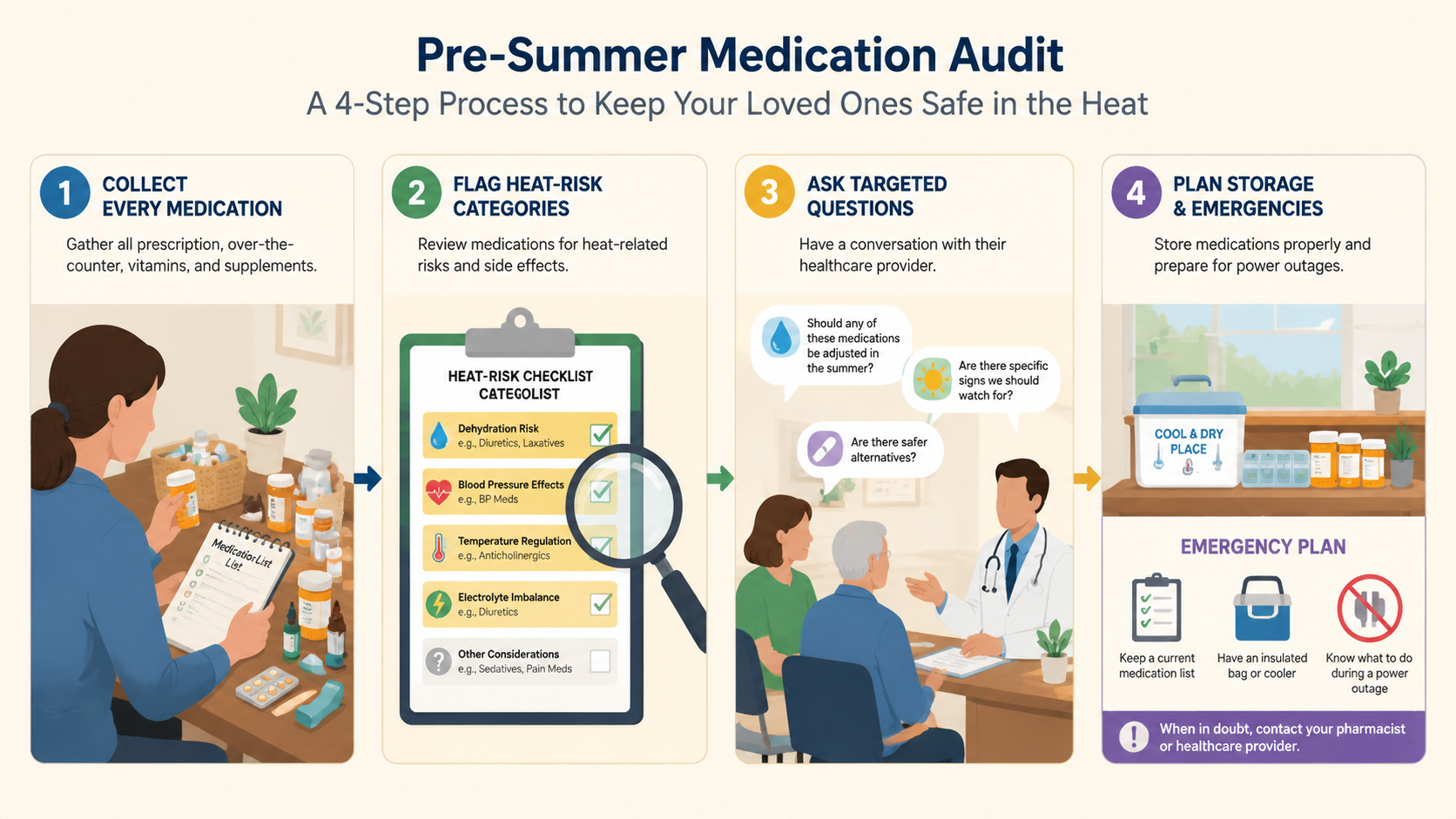
Bring the actual bottles or a current photo of each label if the appointment is in person. If the visit is virtual, send the list ahead of time. The point is to avoid the usual rushed exchange where “medications reviewed” means no one discussed what happens when the apartment is 84°F and the parent is taking a diuretic, a blood pressure medication, and a sedating allergy pill.
- Mark any medication that may affect sweating, thirst, urination, blood pressure, heart rate, cognition, or sedation.
- Circle over-the-counter products, especially allergy, sleep, cold, nausea, bladder, and motion-sickness medications.
- Add medical conditions that raise heat vulnerability, including heart disease, kidney disease, diabetes, dementia, lung disease, mobility limits, and prior heat illness.
- Note living conditions: no central air, unreliable air conditioning, upper-floor apartment, living alone, limited transportation, or difficulty reaching cooling centers.
- Write down what the caregiver can realistically monitor: weight, blood pressure, fluid intake, urine changes, daily check-ins, room temperature, or symptom changes.
Then ask targeted questions. Vague worry is easy to dismiss in a 15-minute visit. A specific question gives the clinician something to act on.
- “Which of these medications increase heat risk, and through what mechanism?”
- “Are there symptoms that should prompt us to call you, seek urgent care, or call 911 during a heat wave?”
- “Should we monitor blood pressure, weight, blood sugar, fluid intake, or urination differently during hot weather?”
- “Are any over-the-counter allergy, sleep, bladder, or cold medications unsafe with this prescription list during heat?”
- “If the power goes out or the home loses cooling, what is the plan for this medication list?”
- “If you ever want a medication adjusted during extreme heat, who gives that instruction and how do we reach them after hours?”
That last question matters. A caregiver should not be left guessing whether to hold a water pill, change a blood pressure medication, or skip a psychiatric medication because the forecast looks bad. If the clinician thinks a heat-wave plan is appropriate, it should be written clearly, with thresholds and contact instructions.
Hydration Advice Has to Match the Medical Situation
“Drink more water” is not specific enough for many older adults. A parent with heart failure, kidney disease, low sodium, or a diuretic prescription may need individualized instructions. Another parent may avoid drinking because getting to the bathroom is painful or risky. Someone with memory loss may not drink unless fluids are offered repeatedly.
Ask what adequate hydration looks like for this person. The answer may include a daily fluid target, a weight-change threshold, urine-color guidance, blood pressure checks, or lab monitoring. It may also include practical changes: keeping drinks within reach, offering fluids with medication times, checking that the bathroom path is safe, and watching for decreased urination or sudden confusion.
Plan for Air Conditioning, Power Loss, and Medication Storage
Medication safety does not stop with the pill organizer. Heat can affect where medicines are stored, whether medical devices work as expected, and how quickly a home becomes unsafe when cooling fails.
The Center for American Progress reports that the average U.S. power outage lasted 5.5 hours in 2022, about 2 hours longer than in 2013.[5] CAP also cites a Phoenix blackout study finding that a multiday summer power outage could expose a large share of residents to dangerous indoor heat, with older adults among those at particular risk.[5] A family that has an emergency contact list but no plan for refrigerated medicine, oxygen, nebulizers, elevators, or a hot apartment still has a gap.
The CDC’s medication guidance includes storage concerns for insulin, inhalers, and epinephrine auto-injectors, noting that heat can affect medication stability or device performance.[1] The caregiver’s job is to know which medications must stay within a specific temperature range, which ones should not be left in a car, and what to do if the refrigerator or air conditioning stops working.
- Keep a written storage list for insulin, injectables, inhalers, epinephrine auto-injectors, liquid medications, and any drug with special temperature instructions.
- Ask the pharmacist what to do if a medication gets too hot, including whether it should be replaced.
- Do not store emergency medications in a parked car, purse left in the sun, windowsill, garage, or hot bathroom.
- Identify where the older adult will go if the home temperature rises: a relative’s home, cooling center, library, senior center, or hotel if affordable.
- Plan transportation before the outage, especially if the person uses a walker, wheelchair, oxygen equipment, or elevator.
What to Watch During a Heat Wave
Once hot weather arrives, the plan becomes less theoretical. Check the indoor temperature, not just the forecast. Call or visit at the hottest part of the day if the parent lives alone. Confirm that the air conditioner is running, that fluids are within reach, and that medications are being taken as prescribed.
Pay attention to changes that are easy to explain away: new confusion, unusual fatigue, dizziness, fainting, a fall, nausea, headache, muscle cramps, rapid pulse, very dry mouth, reduced urination, or behavior that seems “off.” If symptoms are severe, sudden, or include confusion, fainting, chest pain, trouble breathing, or signs of heat stroke, seek emergency help.
At the same time, keep the medication boundary clear. Do not make your own heat-wave dose changes. If the doctor created instructions for certain symptoms or readings, follow those instructions. If not, call the clinician, pharmacist, nurse line, or emergency service appropriate to the situation.
The Appointment Should End With a Usable Summer Plan
A good pre-summer review does not need to produce a long document. It should leave the caregiver with four things: a current medication list, the heat-risk categories identified, symptom and monitoring instructions, and a storage or power-outage plan.
| Before the visit | By the end of the visit |
|---|---|
| Collect prescriptions, OTC drugs, supplements, inhalers, injections, patches, and as-needed medicines | Confirm which items raise heat risk and why |
| List medical conditions and living conditions that increase vulnerability | Get personalized hydration, blood pressure, weight, glucose, or symptom-monitoring guidance |
| Flag diuretics, cardiovascular drugs, SSRIs, antipsychotics, antihistamines, anticholinergics, thyroid drugs, and stimulants | Clarify what symptoms require a call, urgent visit, or emergency response |
| Check medication labels for storage instructions | Create a plan for refrigeration, hot cars, air-conditioning failure, and power outages |
That is the useful handoff. Caregivers cannot and should not make medication decisions alone. They can arrive before summer with the full list, the right categories highlighted, better questions, and a plan that treats medication effects, aging physiology, home cooling, and emergency backup as one connected system.
References
- Heat and Medications – Guidance for Clinicians, CDC, Sept. 2025
- The Effects of Heat on Older Adults, Harvard Medicine Magazine
- Heat and Older Adults (Aged 65+), CDC
- 8 Types of Medications That Can Make It Harder to Handle the Heat, AARP
- Protecting Older Adults From the Growing Threats of Extreme Heat, Center for American Progress
Questions to bring to a clinician or OT
This is not medical, legal, or a family's final decision — only a framework. Bring these questions to a clinician, occupational therapist, or your local Area Agency on Aging.
Find Local HelpRelated reading
Noticed something outdated or inaccurate on this page? Flag a correction. We review every report against CDC, NIA, and AARP HomeFit guidance before updating a page.