
Caregiver decision guide
What the 2026 IRA changes mean for your parent's retirement
The 2026 SECURE 2.0 and One Big Beautiful Bill Act introduced major IRA rule changes affecting RMD ages, QCD limits, penalties, and deductions. This guide helps adult children identify which changes apply to their parent's situation and what end-of-year actions to take to reduce taxes and avoid costly mistakes.
The hard part of the 2026 IRA changes is not memorizing every retirement-law acronym. It is sitting at the dining table in November with a parent’s IRA statement, a charity receipt from last year, a Medicare premium notice, and a vague feeling that one missed form could cost real money.
For families trying to understand how major IRA changes affect seniors’ retirement planning, the first sorting question is simple: which of these rules actually applies to this parent? A 76-year-old widow with a traditional IRA, a church-giving habit, and Medicare premiums to watch has a different checklist than a 66-year-old parent still working part time with a 401(k). The useful work starts with birth year and account type, not with a broad summary of SECURE 2.0.

Start With The Birth Year
Required minimum distributions, or RMDs, are the first deadline to check because they can turn into penalties if no one acts. Under the SECURE 2.0 schedule now in use, parents born from 1951 through 1959 generally start RMDs at age 73, while those born in 1960 or later start at age 75.[1][2]
| Parent's birth year | RMD start age | What the family should check |
|---|---|---|
| 1951-1959 | 73 | Confirm whether the first RMD has already started and whether the current-year distribution is complete. |
| 1960 or later | 75 | Do not assume the old age 70.5 rule applies; note the later start date and keep tracking account type. |
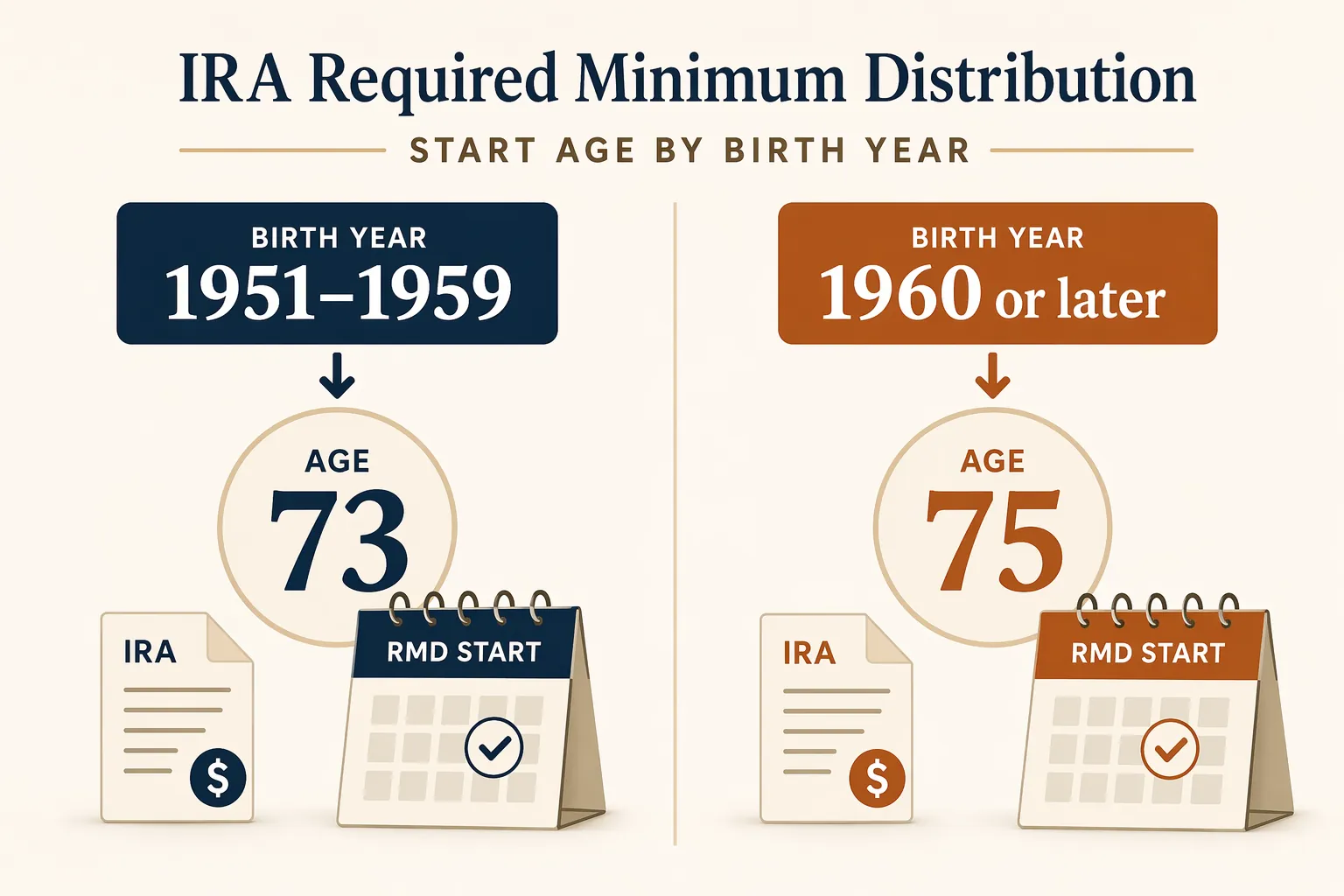
That table is the difference between urgency and recordkeeping. If your parent is already in RMD territory, the question becomes whether the distribution happened, whether it came from the right kind of account, and whether charitable giving should be handled before money lands in the checking account.
If An RMD Was Missed, Fix It Before You Panic
A missed RMD is still serious, but it is no longer the 50% disaster many older articles describe. SECURE 2.0 reduced the excise tax on a missed RMD from 50% to 25%, and it can drop to 10% if the mistake is corrected within the allowed two-year correction window.[2][3]
For a caregiver, that changes the next phone call. Instead of assuming the damage is already done, gather the statements, identify the year missed, ask the IRA custodian how to take the shortfall distribution, and flag the tax return for professional help. The lower penalty does not make an RMD optional; it makes a timely correction more valuable.
This is also where old family habits can get expensive. A parent may remember starting RMDs at 70.5 because that was the rule for someone else years ago. Another may have several traditional IRAs and assume one small withdrawal from one account settles everything. Before year-end, the family needs a current calculation from the custodian or advisor, not a memory of last decade’s rule.
Traditional IRA, Roth IRA, Employer Plan, Or Inherited IRA?
Birth year tells you when to look. Account type tells you what to look at. Make a plain list of every retirement account before deciding that a 2026 rule applies.
- Traditional IRA: usually the main account to review for RMDs and qualified charitable distributions.
- Roth IRA: different lifetime RMD treatment for the original owner, but still important for beneficiary planning.
- 401(k), 403(b), or other employer plan: check plan rules, especially if the parent is still working.
- Inherited IRA: do not apply the parent’s own IRA rules without checking beneficiary status.
The account list does not need to be elegant. It needs the institution name, last four digits of the account number, account type, owner or beneficiary name, and whether an RMD notice arrived. A spreadsheet is fine. A folder with notes is fine. What is not fine is finding an inherited IRA statement in January that should have been reviewed in December.
The QCD Is Where Careful Timing Can Matter Most
For a parent who gives to charity and is at least age 70.5, a qualified charitable distribution may be the most practical year-end tax move to review. In 2026, the QCD limit is $111,000 per person, or $222,000 for a married couple when both spouses qualify, and the limit is now indexed for inflation.[1][4]
The useful feature is not just the larger cap. A QCD can satisfy an RMD while keeping that donated amount out of taxable income.[1][4] That matters for seniors who do not itemize deductions, for parents whose income is near a tax threshold, and for families watching Medicare income-related monthly adjustment amount exposure. A regular IRA withdrawal followed by a personal check to charity does not land the same way on the tax return.
The mechanics need to be respected. The money should move directly from the IRA to the qualified charity. The parent should keep the charity acknowledgment and the IRA tax form. The family should tell the tax preparer that the transfer was intended as a QCD, because the year-end tax forms may not spell that out clearly enough by themselves.
A simple example, using hypothetical numbers: if a parent normally gives to the same local charity every December and also must take an RMD, the family can ask the IRA custodian whether part of that RMD can go directly to the charity as a QCD. The point is not to increase giving. The point is to route giving the parent already planned in a way that may reduce taxable income.
There is also a more specialized option: a one-time QCD of up to $50,000 can fund a charitable remainder trust or charitable gift annuity, potentially creating lifetime income.[1] That is not a kitchen-table caregiver task. If it sounds relevant because a parent gives substantially or wants lifetime income tied to charitable planning, it belongs on the CPA or estate-planning attorney list.
Do Not Mix Up SECURE 2.0 With The New Senior Deduction
Some 2026 retirement summaries throw every tax change into one bucket. That is how families miss the practical interaction. The RMD age schedule, reduced RMD penalty, and QCD updates come from SECURE 2.0. The new $6,000 senior deduction is tied to the One Big Beautiful Bill Act, not SECURE 2.0.[5][6]
The distinction matters because the senior deduction depends on income. The deduction is available without itemizing, but it phases out starting at $75,000 of modified adjusted gross income for single filers and roughly $150,000 for joint filers.[5][6] A taxable IRA distribution can push income up; a properly handled QCD may satisfy an RMD without adding to taxable income.
That does not mean every parent should force income lower at all costs. Medical deductions, filing status, Social Security taxation, state taxes, capital gains, and Medicare premiums can all complicate the picture. But if a parent is close to a phase-out threshold and also gives to charity, the QCD conversation should happen before the distribution is taken, not after the tax forms arrive.
A Year-End Review That Fits On One Page
The family does not need to become a retirement-planning office. It needs a first pass that catches the few facts a CPA, advisor, or custodian will need anyway.
- Write down the parent's birth year and RMD start age.
- List every traditional IRA, Roth IRA, employer retirement plan, and inherited IRA.
- Ask each custodian whether an RMD is due for the year and whether it has already been fully distributed.
- Review the parent's normal charitable giving and decide whether any giving should be routed directly from the IRA as a QCD.
- Estimate whether taxable income could affect the $6,000 senior deduction phase-out or Medicare premium brackets.
- Set aside inherited IRA questions, missed RMDs, large QCDs, and unusual employer-plan issues for professional review.
Do this early enough that the custodian can still process paperwork. December is not a generous month for fixing account registrations, charity addresses, beneficiary confusion, or portal access problems.
Roth Catch-Up Rules Are Usually A Smaller Caregiver Issue
The mandatory Roth catch-up rule mainly matters if a parent is still working and making catch-up contributions to an employer plan. High earners age 50 or older with 2025 wages over $150,000 must make 2026 catch-up contributions as Roth, meaning after-tax contributions. For workers ages 60 through 63, the enhanced catch-up limit is $11,250.[7]
There is an implementation wrinkle: the rule takes effect in 2026, but the IRS has provided transition or good-faith relief through 2027 for plan sponsors. That means a parent’s employer plan may not look perfectly synchronized yet. If your parent is retired, this may be irrelevant. If your parent is still on payroll and above the wage threshold, ask the plan administrator how catch-up contributions are being handled rather than trying to solve it from a general article.
Inherited IRAs Deserve Their Own Warning Label
Inherited IRAs are where otherwise careful families can apply the wrong rule. Non-spouse beneficiaries generally face a 10-year depletion rule, while spouse beneficiaries may have more flexibility, including the ability to treat the inherited IRA as their own and delay RMDs depending on the situation.[8]
If your parent inherited an IRA, or if you and your siblings inherited one from a parent, do not rely on the parent’s birth-year RMD table alone. Beneficiary status, the original owner’s age, and the type of account can change the answer. This is a tax-professional item, especially if no distributions have been taken and the 10-year clock is already running.
What To Hand To The CPA Or Advisor
A good professional meeting starts with fewer mysteries. Bring the parent’s birth date, Social Security estimate or benefit statement, prior-year tax return, current IRA and employer-plan statements, any RMD notices, charitable-giving records, Medicare premium notices, and a list of inherited accounts. If a distribution already happened, bring the date and amount.
Ask direct questions: Is an RMD still due? Should any planned charitable giving be made as a QCD? Could another IRA withdrawal reduce or phase out the senior deduction? Is the parent near a Medicare IRMAA bracket? Are there inherited IRA deadlines? Does a missed RMD need correction paperwork?
Before anyone acts on exact dollar limits, verify current IRS figures and plan documents. The QCD cap, deduction thresholds, and contribution limits can depend on updated guidance and inflation indexing. The practical caregiver role is to spot the issue early, gather the documents, and make sure the right person answers before the deadline.
The 2026 IRA changes are useful only when they are matched to the parent in front of you: birth year, account type, giving habits, income level, and beneficiary status. That is enough work for a family already managing appointments, medications, and mail. The goal is not to master every IRA rule. It is to catch the few rules that could change a parent’s tax bill before the year closes.
References
- SECURE Act 2.0 IRA Changes: Complete 2026 Rundown, Stonewood Financial.
- Required Minimum Distributions: What's New in 2026, Charles Schwab.
- SECURE 2.0 Changes Aim to Help Retirement Savers, AARP.
- Secure Act 2.0, Fidelity.
- 7 Retirement Rule Changes to Know for 2026, Braun-Bostich & Associates.
- 2026 Retirement Planning Guide, BMF CPA, February 11, 2026.
- 7 Smart Money Moves for 2026 Retirement Planning, Fidelity.
- Inherited IRA Rules & SECURE Act 2.0 Changes, Charles Schwab.
Questions to bring to a clinician or OT
This is not medical, legal, or a family's final decision — only a framework. Bring these questions to a clinician, occupational therapist, or your local Area Agency on Aging.
Find Local HelpRelated reading
Noticed something outdated or inaccurate on this page? Flag a correction. We review every report against CDC, NIA, and AARP HomeFit guidance before updating a page.