
Caregiver decision guide
Your Guide to Minnesota's New Assisted Living Happy Hour Rules
Minnesota's new Grandparents' Happy Hour law removes the liquor-license barrier for assisted living happy hours, but families need to understand the specific rules and have proactive conversations about medication interactions and fall risks to ensure safety.
Anita LeBrun did not ask Minnesota lawmakers for anything grand. She wanted the assisted living version of a very ordinary adult pleasure: sitting with neighbors, having a drink, and letting the day loosen up a little. Her testimony helped turn a small irritation into a state law now being called “Grandparents’ Happy Hour.” CBS News Minnesota reported that LeBrun, 88, lives at Amira Choice Champlin and became the face of the push to let assisted living communities host happy hours without first obtaining a liquor license.[1]
That part of the story is easy to like. Anyone who has watched a parent’s life shrink into meal schedules, medication times, and transportation limits understands why a glass of wine with friends can feel less like alcohol and more like normalcy. The change matters because Minnesota’s old licensing barrier could make a simple resident social event feel unnecessarily complicated.
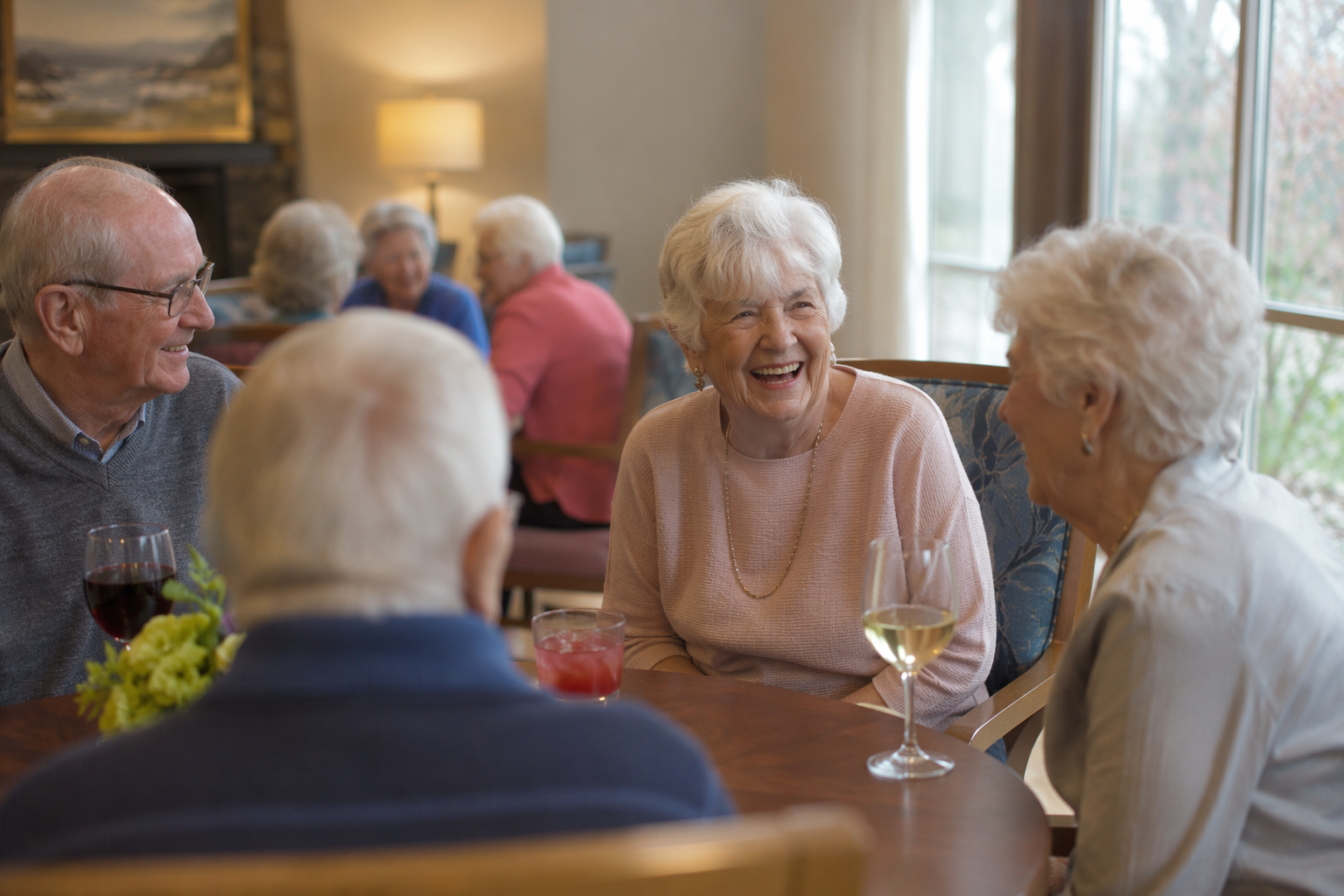
But if your parent lives in assisted living, “happy hour” is not just a hospitality phrase. It can touch medication interactions, balance, dementia symptoms, diabetes management, sleep, guest behavior, staff training, and what happens after the activity director goes home. Minnesota has made these events easier to host. Families still need to ask how one specific facility will make them safe for one specific resident.
What changed in Minnesota assisted living happy hour rules
The short answer: Minnesota’s new law removes the liquor-license requirement for certain assisted living happy hour events, but it does not turn assisted living communities into bars. Senior Housing News reported that the law is effective Aug. 1, 2026; because state and industry notices have used some conflicting wording around timing, facilities and families should verify the active requirements against the official Minnesota Department of Public Safety Alcohol and Gambling Enforcement page before relying on a notice or newsletter.[2]
The practical rules families should know are narrow and important. Assisted living facilities do not need a liquor license for these resident events, but they must register with Minnesota DPS/AGE. Alcohol may not be sold or charged for. Service is limited to residents and accompanied guests who are 21 or older. Staff members serving alcohol must be at least 18. Industry guidance describes the registration as a one-time process, with a five-day processing window.[2][3][4]
| Question | Current reported answer |
|---|---|
| Does the facility need a liquor license for resident happy hour? | No, if it follows the new assisted living registration process. |
| Can the facility sell drinks or add a happy hour charge? | No. Alcohol cannot be sold or charged for under the reported guardrails. |
| Who may be served? | Residents and accompanied guests who are 21 or older. |
| How old must staff servers be? | At least 18. |
| Does the law require individual resident screening before alcohol is served? | No requirement was identified in the cited guidance. |
| Does the law require every facility to have a written alcohol policy? | No requirement was identified in the cited guidance, though provider guidance encourages policy-level planning. |
That last part is where families should slow down. A facility can be legally allowed to host happy hour and still have unresolved questions about your parent’s health profile. The law lowers a regulatory hurdle. It does not, by itself, review your parent’s medication list, recent falls, cognition, or physician instructions.
The missing step families cannot assume someone else is doing
In a good assisted living community, staff may already be thinking through alcohol service carefully. Care Providers of Minnesota’s provider guidance discusses resident choice, medication interactions, safe storage, and staff responsibilities.[3] That is useful. It gives families language to use. It does not mean every building has adopted the same written policy or the same screening process.
So the first family question is not, “Is happy hour legal now?” It is, “Who is checking whether alcohol is safe for my parent?”
That question is not anti-choice. It is what makes choice safer. Many older adults can reasonably decide to have a small drink at a social event. Others may have a medication, diagnosis, fall history, or physician note that changes the answer. The problem comes when everyone assumes someone else has already looked.

The medication issue is not theoretical. The National Institute on Alcohol Abuse and Alcoholism says about 80% of adults 65 and older take at least one medication that could interact negatively with alcohol.[5] That figure should change the tone of the conversation. The concern is not whether an older adult “should be allowed” to drink. The concern is whether the drink interacts with what is already in the pill organizer.
Alcohol can interact with common medication categories in ways that matter at 8:40 p.m., not just on a warning label: increased drowsiness, dizziness, confusion, impaired coordination, changes in blood pressure, or a higher chance of bleeding, depending on the medication involved. Families do not need to memorize every interaction. They do need someone qualified to check the current medication list before a parent starts attending happy hour regularly.
Fall risk is where a social event becomes a care issue
The NIAAA also reports that older adults who drink have 2.3 times the risk of a fall requiring emergency care.[5] That does not mean every resident who attends happy hour will fall. It does mean alcohol belongs in the same conversation as walkers, bathroom trips, dim hallways, blood pressure medication, neuropathy, and the long walk back from the community room.
A family may know details the activity director does not. Maybe Dad fell twice this spring but hates talking about it. Maybe Mom gets steadier in the morning but wobbly after dinner. Maybe a new medication was added last week, and no one has yet seen how she responds. A facility’s event plan can look reasonable on paper and still miss the thing that matters for one resident.
This is also where timing matters. A single drink at 3 p.m. in a supervised room is not the same situation as a drink near bedtime before a resident walks back alone, takes evening medications, and gets up in the night. Families who are already tracking fall risk may want to connect the happy hour conversation to the broader safety work they are doing around footwear, mobility aids, lighting, toileting routines, and room setup.
What to ask the facility before your parent attends
The best conversation is specific enough that everyone knows who owns each decision. A cheerful “we’ll monitor it” is not enough unless the facility can explain what monitoring means, who is doing it, and what happens when a concern comes up.
- Has the facility registered with Minnesota DPS/AGE for assisted living alcohol service, and when was that registration submitted or approved?
- Does the facility have a written alcohol policy, even if the law does not require one?
- Who reviews whether a resident has medications that may interact with alcohol?
- Who checks whether alcohol is medically contraindicated for a resident?
- How does the facility handle residents with a recent fall, hospitalization, medication change, or change in cognition?
- How many drinks may a resident have, and who tracks that during an event?
- Are non-alcoholic options offered in the same setting, without making residents feel singled out?
- Where is alcohol stored, who controls access, and what prevents unsupervised drinking outside the event?
- How are guests verified as 21 or older, and what does “accompanied guest” mean in practice?
- If a resident appears impaired, dizzy, confused, or unsteady, what does staff do and who is notified?
A written policy is especially useful because it prevents the answer from changing depending on who is working that day. It can spell out storage, serving limits, staff roles, documentation, guest rules, resident refusal, and when nursing or clinical staff should be consulted. Care Providers of Minnesota’s guidance gives providers a framework for those issues, but families should still ask what their own facility has adopted.[3]
Ask about medical contraindications without turning it into a permission slip
There is a careful balance here. Older adults in assisted living do not lose their adulthood because they need help with meals, medication reminders, or bathing. The National Association of Activity Professionals’ Resident Right #17 frames alcohol use as a resident right: the right to consume a reasonable amount of alcohol unless it is medically contraindicated in the resident’s record by the attending physician.[6]
That is a helpful standard for families. The goal is not to make an adult child the gatekeeper of every small pleasure. The goal is to find out whether there is a documented medical reason alcohol is unsafe, whether the physician has weighed in, and whether the facility knows how to honor the resident’s choice within those limits.
A useful way to ask is: “Can we review whether alcohol is medically contraindicated for my parent, and if not, what would safe participation look like?” That keeps the conversation centered on the resident’s health and preferences instead of sliding into a family debate about whether seniors should drink.
If your parent has memory loss, the questions get more concrete
The law’s age and registration rules do not answer dementia-specific questions. If a resident has memory loss, families should ask how the facility handles consent, repeated requests, forgotten drinks, alcohol-seeking behavior, and residents who may not remember that they already had a serving. These are not abstract concerns for the family member who later gets the call about agitation, confusion, or a fall.
The facility should also be able to explain whether alcohol is served in memory care, whether different rules apply there, and how staff redirect residents without embarrassing them. A non-alcoholic version of the same ritual can matter: the glass, the music, the table, the neighbors, the feeling of being included. For some residents, that may preserve the social benefit without adding the same medical risk.
Guest rules deserve more attention than they usually get
The reported guardrails allow service to residents and accompanied guests who are 21 or older.[2][3][4] That sounds simple until a family event is happening in the lounge and adult grandchildren, neighbors, or visitors drift in and out. Facilities should be clear about whether guests sign in, whether IDs are checked, who counts as “accompanied,” and whether a guest may bring outside alcohol.
Guest behavior can also affect resident safety. A well-meaning visitor may pour an extra glass, bring a favorite bottle from home, or encourage a resident to drink more than the facility would have served. Families should ask whether outside alcohol is allowed, where it is stored, and whether it must be disclosed to staff. If a resident has alcohol in an apartment, the happy hour policy alone will not answer the bigger safety question.
What changed politically matters less than what changes at 4 p.m.
The legislative story moved quickly because the issue was easy to understand. Minnesota’s House Session Daily described the measure as part of an omnibus liquor bill that included the “Grandparents’ Happy Hour” provision.[7] Senior Housing News later reported the new law in the context of assisted living communities being able to host happy hours without a liquor license.[2]
For families, the political win is not the hard part to translate. The hard part is the facility notice that says happy hour is starting next month and makes it sound as if the only issue was paperwork. The paperwork matters. So do the care-plan details.
How to talk with your parent about it
Start with respect. If your parent is excited about happy hour, do not open with a list of risks. Ask what they like about it. Is it the drink, the neighbors, the music, the routine, the feeling of being treated like an adult? The answer matters because it may reveal what needs protecting.
Then move to practical safety: “I’m glad this is available. Because of your medications and that fall last month, I want to make sure the nurse and doctor have looked at whether one drink is okay for you.” That framing is different from “I don’t think you should go.” It supports participation while making the hidden risks visible.
If your parent resists family involvement, the facility may still be able to discuss its general policy without sharing protected medical details. Families can ask general operational questions first, then encourage the resident to include them in a care conference if medication interactions, falls, or medical contraindications are part of the concern.
A practical family script
If the facility sends a notice about happy hour, a short email can keep the conversation from becoming vague:
“I’m glad residents will have this social option. Before my parent participates, can you please tell me whether the facility has completed the required Minnesota DPS/AGE registration, whether you have a written alcohol policy, and who reviews medication interactions or medical contraindications for individual residents? My parent has had recent balance concerns, so I’d also like to know how staff monitor fall risk before, during, and after the event.”
That message does three things. It acknowledges the value of the event. It asks about legal compliance. And it puts the individual health review where it belongs: not as an afterthought after something goes wrong, but as part of deciding what safe participation looks like.
The real test is not whether happy hour exists
A well-run happy hour can be a real good. It can give residents something to look forward to, a reason to leave the apartment, and a setting where they are not treated only as patients or fall risks. That matters. Social routines are part of dignity, and assisted living should not make every adult pleasure feel suspicious.
The new Minnesota assisted living happy hour rules make that kind of event easier to offer. They do not replace the family’s need to ask about medications, falls, physician contraindications, guest behavior, storage, staff roles, and documentation. Minnesota removed a licensing barrier. The next step is making sure the choice is safe for the person you love, in the building where they live, with the health risks they actually have.
References
- Minnesota's 'Grandparents' Happy Hour' bill signed into law, CBS News Minnesota.
- New Minnesota Law Lets Assisted Living Communities Have Happy Hours, Sans Liquor License, Senior Housing News, July 15, 2026.
- New law clarifies alcohol service in licensed assisted living facilities, Care Providers of Minnesota, June 2026.
- What Providers Need to Know About Minnesota's New Happy Hour Process, LeadingAge Minnesota, June 4, 2026.
- Alcohol-Medication Interactions: Potentially Dangerous Mixes, National Institute on Alcohol Abuse and Alcoholism, 2025 update.
- Serving Alcohol in Facilities, National Association of Activity Professionals.
- Omnibus liquor bill that includes 'Grandparents' Happy Hour' passes House, Minnesota House Session Daily, April 2026.
Questions to bring to a clinician or OT
This is not medical, legal, or a family's final decision — only a framework. Bring these questions to a clinician, occupational therapist, or your local Area Agency on Aging.
Find Local HelpRelated reading
Noticed something outdated or inaccurate on this page? Flag a correction. We review every report against CDC, NIA, and AARP HomeFit guidance before updating a page.