
Caregiver decision guide
How new 2026 guidelines change statins for elderly parents
The 2026 ACC/AHA dyslipidemia guidelines expanded statin eligibility to millions more adults, but for primary prevention in those over 75 the recommendation remains weak. This guide helps adult children understand whether their elderly parent might benefit from a statin and how to discuss it with their doctor.
If your parent is over 75 and not taking a statin, the 2026 cholesterol guideline gives you a reason to ask a better question. It does not give you a reason to start the medication in a panic, or to assume their doctor missed something.
The headline change is real: under the 2018 guideline, 39.8% of U.S. adults ages 40 to 75 qualified for statins; under the 2026 guideline, that rose to 54.3%, adding an estimated 11.2 million adults to the statin-eligible group.[1] That is why more families are suddenly hearing about cholesterol treatment again.
But the part that matters for many elderly parents is quieter. For adults older than 75 who have not already had a heart attack, stroke, or known atherosclerotic cardiovascular disease, the 2026 ACC/AHA guideline says LDL-lowering therapy “can be considered.” That is a Class 2b recommendation, meaning it is weak and leaves room for individualized judgment.[2]

That difference between “more people are eligible” and “your parent should definitely start” is where the real appointment question begins. A useful conversation starts by sorting your parent into the right lane.
What Actually Changed In 2026
The 2026 guideline changed the front door into cholesterol treatment for many adults. It uses the newer PREVENT equations rather than the older pooled cohort equations. The PREVENT equations estimate 10-year cardiovascular risk about 40% to 50% lower than the older equations, yet the guideline also starts treatment conversations at lower absolute risk thresholds, beginning at 3% 10-year risk.[1]
That sounds backwards until you separate the risk calculator from the treatment threshold. A lower risk estimate does not automatically mean fewer people are considered for therapy if the guideline also lowers the point at which clinicians start discussing medication. The result is the large eligibility expansion.
For a 62-year-old sibling, spouse, or friend, that expansion may translate into a more direct statin discussion. For a parent who is 78, 84, or 91, the same headline has to pass through a different filter: whether this is secondary prevention or primary prevention, and whether the parent’s health status makes long-term prevention likely to matter.
The First Split: Has Your Parent Already Had Cardiovascular Disease?
Before arguing about age, ask what the statin would be trying to do.
| Situation | What the statin conversation usually means |
|---|---|
| Known ASCVD, such as prior heart attack, ischemic stroke, symptomatic artery disease, or certain revascularization procedures | Secondary prevention: trying to prevent another cardiovascular event |
| No known ASCVD, but risk factors such as high LDL-C, diabetes, high blood pressure, smoking history, or chronic kidney disease | Primary prevention: trying to prevent a first cardiovascular event |
| Previously took a statin, then stopped | Continuation versus discontinuation: asking why it was stopped and whether that reason still applies |
| Severe frailty, major medication burden, advanced illness, or limited life expectancy | Goal-concordant care: asking whether prevention still fits the parent’s current priorities and likely benefit window |
This split is not academic. Secondary prevention in an older adult is a different conversation from starting a statin for the first time in a parent who has never had known cardiovascular disease.
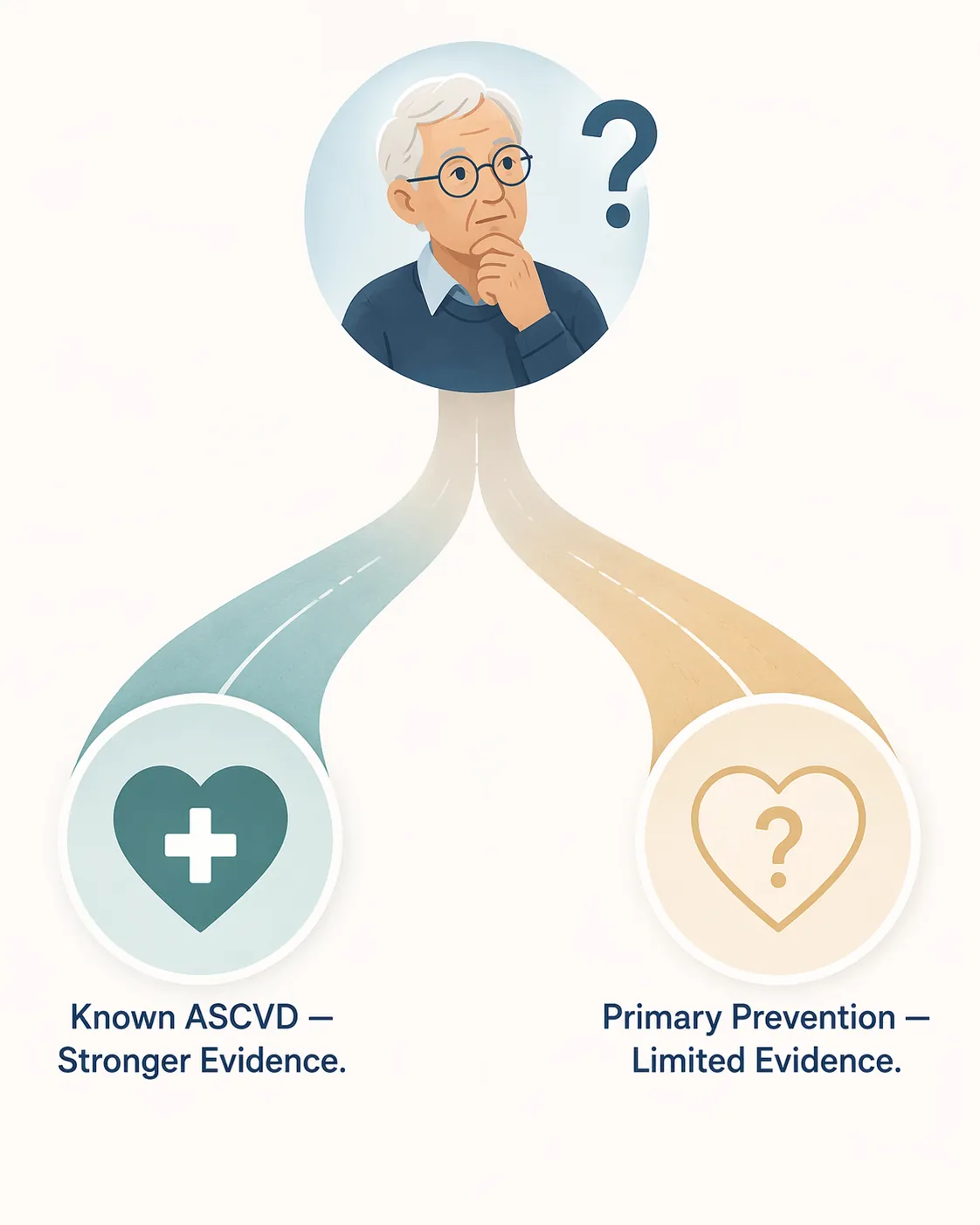
If There Is Known ASCVD, The Evidence Is Stronger
If your parent has already had a heart attack, ischemic stroke, or known atherosclerotic cardiovascular disease, the question is rarely “are they too old for prevention?” It is more often “is there a good reason they are not receiving secondary prevention?”
In the Cholesterol Treatment Trialists’ 2019 meta-analysis, patients older than 75 had about a 26% relative risk reduction in major vascular events per 1 mmol/L reduction in LDL-C, with clearer evidence of benefit in people with existing vascular disease.[3] Relative risk reduction is not the same as personal benefit, but it is enough to make omission worth questioning when the parent has known ASCVD.
This is where underuse of statins in elderly parents becomes a practical concern. The concern is not that every older person needs another pill. The concern is that some older adults with prior cardiovascular disease may drift through appointments without anyone revisiting a medication that could reduce the chance of another event.
If There Is No Known ASCVD, The Evidence Is Less Settled
Primary prevention after 75 is the harder conversation. The guideline’s “can be considered” language is doing real work here. It does not mean “don’t treat.” It means the evidence is not strong enough to turn age plus risk factors into an automatic prescription.
In the same CTT analysis, among patients older than 75 without known vascular disease, the relative risk per 1 mmol/L LDL-C reduction was 0.92, with a 95% confidence interval from 0.73 to 1.16.[3] That result was not statistically significant. It also was not proof that statins do nothing in this group; the wide confidence interval reflects limited randomized-trial data in older adults.
PROSPER, the dedicated statin trial in adults ages 70 to 82, helps explain why clinicians hesitate to speak in absolutes. It found a number needed to treat of 48 for the composite endpoint, no all-cause mortality benefit, and an attenuated primary prevention subgroup result with a hazard ratio of 0.94 and a 95% confidence interval from 0.77 to 1.15.[4]
For an active 77-year-old with high LDL-C, diabetes, and a family history of early heart disease, that uncertainty may still leave plenty to discuss. For an 89-year-old with advanced dementia, weight loss, frequent falls, and a long medication list, the same uncertainty may point in a different direction.
Do Not Treat Stopping As Harmless Just Because Of Age
One of the easiest mistakes in elder care is to assume that turning 75, 80, or 85 automatically moves a medication from “prevention” to “unnecessary.” Sometimes stopping is exactly right. Sometimes it is just tidying up the medication list in a way that shifts risk onto the parent.
Observational studies cannot prove that statin discontinuation caused worse outcomes, because people who stop medications can differ from people who continue them. Still, the signal is hard to ignore. In Denmark, older adults who discontinued long-term statins had higher cardiovascular event rates than those who continued.[5] A French cohort study of adults who turned 75 and had been taking statins for primary prevention also found higher cardiovascular event rates among those who discontinued.[6]
Those studies should not be used to scare a frail parent into continuing every medication forever. They should make everyone pause before stopping a statin for the sole reason that the birthday number changed.
The 2025 deprescribing.org statin guidance is separate from the 2026 ACC/AHA guideline, and it answers a different question. It recommends continuing statins in older adults who are not near end of life, defined there as life expectancy greater than 1 year, for both primary and secondary prevention. It suggests stopping can be reasonable when life expectancy is less than 1 year or in severe frailty.[7]
That distinction matters in the exam room. “My mother is 82” is not the same clinical fact as “my mother has severe frailty and may be in the last year of life.” Age belongs in the conversation, but it should not be the whole conversation.
Side Effects Deserve Specifics, Not Assumptions
A statin discussion with an older parent can go wrong in either direction. Some clinicians and families minimize every symptom because statins are common. Others assume older adults cannot tolerate them. Neither shortcut is careful enough.
In the PALM registry, muscle symptoms were reported less often among adults 75 and older than among younger adults: 27.3% versus 33.3%, with p<0.001.[8] That finding pushes back against the idea that older adults inevitably report more statin muscle symptoms.
But caregiver notes often capture things trials and registries may not fully settle: new fatigue, slower walking, less appetite, more hesitation on stairs, or a fall that may have many possible causes. Those changes should not be blamed on a statin automatically. They should be dated, described, and brought to the clinician in plain language.
A useful symptom note sounds like this: “She started the medication in May. By June she was skipping her morning walk because of thigh aching. She did not have a fall, fever, or new exercise routine. The pain improved when she missed several doses.” That kind of detail gives the doctor something to evaluate. “Statins are bad for old people” does not.
The ALLHAT-LLT Finding Is A Caution, Not A Verdict
Families searching online may run into the ALLHAT-LLT older-adult analysis, which reported a nonsignificant trend toward increased mortality with pravastatin in adults 75 and older. That sounds alarming if it is pulled out of context.
The limits matter. This was a post-hoc exploratory analysis, the LDL-C difference between groups was modest at 16.7%, and crossover rates were high.[9] It is fair to mention it as part of why primary prevention after 75 remains uncertain. It is not fair to treat it as proof that statins harm older adults as a group.
What To Ask At The Appointment
The most useful thing an adult child can bring to the appointment is not a demand for a statin. It is a clean question trail. If the visit is short, these are the questions that keep the conversation anchored.
- Does my parent have known ASCVD, such as a prior heart attack, ischemic stroke, symptomatic peripheral artery disease, coronary artery disease, or a stent or bypass history?
- Are we talking about secondary prevention or primary prevention?
- What is my parent’s most recent LDL-C, and what other risk factors are driving the recommendation?
- Under the 2026 guideline, would LDL-lowering therapy be recommended, reasonable, or only something to consider?
- Does frailty, functional status, medication burden, kidney or liver disease, cognition, or life expectancy change the expected benefit?
- If my parent stopped a statin, why was it stopped: side effects, preference, lab abnormality, drug interaction, cost, pill burden, or no clear reason?
- If my parent is not taking one, was that an intentional decision or has it simply never been revisited?
- If we start or restart, what dose and intensity make sense, what symptoms should we watch for, and when should labs or follow-up happen?
It also helps to bring the medication list, not just the cholesterol number. Include over-the-counter drugs, supplements, past statin names if you know them, and what actually happened when a medication was stopped. A portal message that says “statin intolerance” may hide three very different stories: severe muscle injury, mild aches that were never rechallenged, or a side effect that later turned out to have another cause.
How To Read The Doctor’s Answer
A reassuring answer is not always “yes, start the statin.” It might be, “Your father had a prior heart attack, so unless there is a clear contraindication, I think secondary prevention still matters.” It might also be, “Your mother has no known ASCVD, advanced frailty, and limited life expectancy, so starting a statin now is unlikely to match her goals.”
The answer that deserves follow-up is the vague one: “She’s too old,” “He doesn’t need it,” or “Everyone should be on one now.” Those may turn out to be shorthand for a reasonable judgment, but shorthand is not enough when you are the person trying to keep the medication list honest.
The 2026 guideline makes statin conversations more important because it expands eligibility and pulls more adults into risk-based treatment discussions. For parents over 75, it does not erase the gray zone. The responsible next step is to ask which prevention lane your parent is in, how strong the evidence is for that lane, and whether their current health makes the likely benefit worth the burden.
References
- Guideline-at-a-Glance: 2026 ACC/AHA/ACEP/ADA/AGS/APhA/ASPC/NLA/PCNA Guideline for the Management of Patients With Dyslipidemia, JACC, 2026, link
- 2026 ACC/AHA/ACEP/ADA/AGS/APhA/ASPC/NLA/PCNA Guideline for the Management of Patients With Dyslipidemia, Circulation, March 2026, link
- Efficacy and safety of statin therapy in older people: a meta-analysis of individual participant data from 28 randomised controlled trials, The Lancet, 2019, link
- Pravastatin in elderly individuals at risk of vascular disease (PROSPER): a randomised controlled trial, The Lancet, link
- Statin Discontinuation and Cardiovascular Events Among Older People in Denmark, JAMA Network Open, 2021, link
- Cardiovascular effect of discontinuing statins for primary prevention at the age of 75 years: a nationwide population-based cohort study in France, European Heart Journal, 2019, link
- Deprescribing Guidelines and Algorithms, deprescribing.org, link
- Statin Use and Adverse Effects Among Adults >75 Years of Age: Insights From the Patient and Provider Assessment of Lipid Management Registry, JAHA, link
- Effect of Statin Treatment vs Usual Care on Primary Cardiovascular Prevention Among Older Adults: The ALLHAT-LLT Randomized Clinical Trial, JAMA Internal Medicine, link
Questions to bring to a clinician or OT
This is not medical, legal, or a family's final decision — only a framework. Bring these questions to a clinician, occupational therapist, or your local Area Agency on Aging.
Find Local HelpRelated reading
Noticed something outdated or inaccurate on this page? Flag a correction. We review every report against CDC, NIA, and AARP HomeFit guidance before updating a page.