
Caregiver decision guide
Why There's No SSI Check in August 2026
If your parent's August 2026 SSI payment didn't arrive, it's not a benefit cut or an error—it's a simple calendar rule. This article explains why the payment is moved to July 31 and gives you a practical checklist to make sure your parent's August expenses are covered.
If your parent’s August SSI payment did not arrive, first check the bank account, Direct Express card, or deposit history for Friday, July 31, 2026. That July 31 deposit is almost certainly the August SSI payment arriving early, not extra July money.
The reason is simple: Supplemental Security Income is normally paid on the 1st of the month, but August 1, 2026 falls on a Saturday. When the 1st falls on a weekend or federal holiday, the Social Security Administration sends SSI on the previous business day, so the August payment moves to Friday, July 31.[1]
That means SSI recipients receive a July 1 payment for July and a July 31 payment for August, with no separate SSI payment during August. No SSI money is lost, and this is not a benefit cut, suspension, or individual account problem.[2]

The July 31 Deposit Belongs to August
The most important household mistake is treating the July 31 deposit as leftover July money. On paper, the payment arrived in July. In the budget, it belongs to August.
That distinction matters when someone else is helping with rent, utilities, prescriptions, groceries, or automatic withdrawals. A bank balance can look healthier than it really is at the end of July, especially if the caregiver has not yet connected that deposit to the missing August check.
For 2026, the maximum federal SSI payment is $994 per month for an eligible individual, $1,491 for an eligible couple, and $498 for an essential person.[3] Many households receive different actual amounts because income, living arrangements, and state supplements can affect SSI, but the federal figures show why a misplaced monthly payment can be a serious cash-flow problem rather than a small bookkeeping issue.
Steps for Covering August
Before calling SSA or assuming something has gone wrong, follow the payment trail. The goal is not just to confirm that the money came in; it is to keep that money from being absorbed by late-July spending.
- Check for a deposit dated Friday, July 31, 2026. Look at the checking account, Direct Express card, or whatever account normally receives the SSI payment.
- Label that deposit as August SSI. If you use a budgeting app, spreadsheet, notebook, or shared family note, record it under August income, not July income.
- Reserve the money for August bills. If possible, move it to a bill-pay subaccount or mark it mentally as unavailable for July purchases.
- Review automatic payments scheduled for early August. Pay special attention to rent, utilities, phone service, insurance, pharmacy charges, and grocery delivery accounts.
- Tell any siblings or helpers what happened. A short message such as “Mom’s August SSI came early on July 31, so there will not be another SSI deposit in August” can prevent duplicate calls and unnecessary panic.
- Mark September 1, 2026 as the next normal SSI payment date, unless another account-specific issue appears.
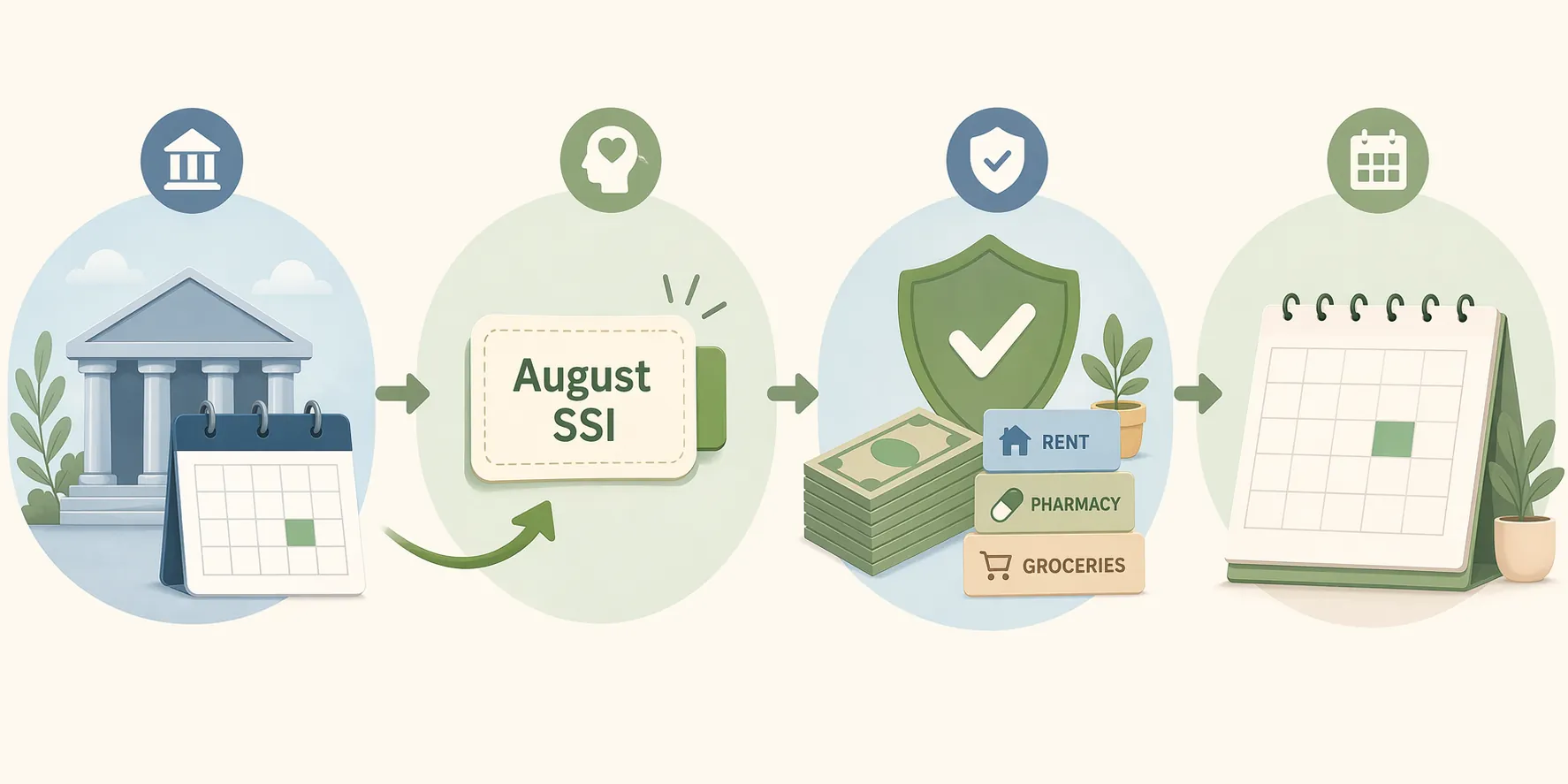
If the July 31 deposit is there and matches the usual SSI amount, the practical answer is usually finished: August has already been paid. The remaining work is cash-flow protection.
If the July 31 deposit is not there, check whether the account changed recently, whether a representative payee account is involved, whether the bank is showing pending transactions differently, or whether a mailed check is part of the situation. Most recipients receive payments electronically; less than 1% still receive paper checks, so for most families the July 31 payment should show through direct deposit or Direct Express rather than arrive later by mail.[2]
Who Is Affected—and Who Is Not
This specific August 2026 gap applies to SSI, not every payment with “Social Security” in the name. That distinction is easy to lose when one parent receives more than one benefit, or when one spouse receives SSI and the other receives retirement benefits.
| Benefit or payment type | What happens in August 2026 |
|---|---|
| SSI | August SSI is paid early on Friday, July 31, so there is no separate SSI payment in August. |
| Social Security retirement | Uses a separate Social Security payment schedule; this SSI date shift does not automatically change the retirement payment date. |
| SSDI | Uses a separate Social Security payment schedule; do not assume the SSI rule applies. |
| Survivor benefits | Uses a separate Social Security payment schedule; check the person’s regular Social Security payment date. |
| People receiving both SSI and Social Security | May see more than one payment in July, but each deposit must be matched to the benefit it represents. |
AARP’s payment schedule separates SSI timing from the payment schedule used for regular Social Security benefits, including retirement and disability payments.[1] News coverage of August 2026 Social Security payments makes the same distinction: the missing August deposit issue is tied to SSI’s first-of-the-month rule, while regular Social Security benefits follow their own schedule.[4]
This is why headlines about “two checks” or “three checks” can be unhelpful at the kitchen table. An SSI-only recipient receives two SSI deposits in July—July 1 for July and July 31 for August—and no SSI deposit in August. A person who receives both SSI and a separate Social Security benefit may see a different pattern because two benefit streams are involved. The July 31 SSI payment should still be treated as August SSI.
Why So Many People Are Seeing the Same Thing
If several people in an online group, senior housing office, or family circle are saying the same thing, that is another clue that this is a schedule issue rather than a personal account failure. Reports about the August 2026 SSI shift describe more than 7 million recipients affected by the calendar move.[2]
The exact public count varies slightly by source because sources may be using different SSA snapshots or rounded figures. For a caregiver trying to solve today’s problem, the safer conclusion is also the more useful one: this affects 7+ million SSI recipients, so a missing August SSI deposit after a July 31 payment is expected.
When to Be Concerned
The calendar rule explains the missing August SSI check only if the July 31 payment arrived. If there is no July 31 deposit and no expected payment by mail, then the family should treat it as a separate payment problem and review the account details.
- The bank account or Direct Express card shows no July 31 SSI deposit.
- The July 31 amount is very different from the usual SSI amount and there is no known reason.
- The recipient recently changed banks, moved, changed living arrangements, married, separated, started or stopped work, or received a notice from SSA.
- A representative payee manages the benefit and the caregiver does not have full visibility into the receiving account.
- A landlord, utility, or pharmacy payment is due before the family can confirm where the July 31 money went.
In those situations, gather the payment history, the most recent SSA notice, bank records, and any representative payee information before making calls. It is easier to get a clear answer when everyone is looking at the same dates and amounts.
Other 2026 SSI Calendar Dates to Mark Now
August is not the only time in 2026 when the SSI calendar can look strange. The same weekend-or-holiday rule creates a few more early payments that caregivers should mark before they become surprises.
| Month the SSI payment covers | When the payment is scheduled | How to treat it |
|---|---|---|
| August 2026 | Friday, July 31, 2026 | Use it for August expenses. |
| November 2026 | Friday, October 30, 2026 | Use it for November expenses. |
| December 2026 | Tuesday, December 1, 2026 | Use it for December expenses. |
| January 2027 | Thursday, December 31, 2026 | Use it for January 2027 expenses. |
Those dates come from the same SSI scheduling rule: when the normal payment date is not a business day, the payment arrives earlier.[1] The deposit may land in the prior month, but the household budget should follow the month the payment is meant to cover.
The Bottom Line for August Bills
There is no separate SSI check in August 2026 because the August SSI payment was sent early on Friday, July 31. That payment should be reserved for August rent, utilities, food, pharmacy costs, and other monthly expenses.
If the July 31 deposit is present, no SSI money is missing. The caregiver’s job is to keep that deposit attached to August, even though the bank statement shows it arriving in July.
References
- Social Security payment schedule page, AARP
- Why you won't get a Supplemental Security Income check in August, The Hill
- SSI Federal Payment Amounts for 2026, Social Security Administration
- When are August 2026 Social Security Payments Coming?, Newsweek
Questions to bring to a clinician or OT
This is not medical, legal, or a family's final decision — only a framework. Bring these questions to a clinician, occupational therapist, or your local Area Agency on Aging.
Find Local HelpRelated reading
Noticed something outdated or inaccurate on this page? Flag a correction. We review every report against CDC, NIA, and AARP HomeFit guidance before updating a page.