
Caregiver decision guide
Practical Sidewalk Safety Tips for Older Adults
Older adults face two distinct dangers on sidewalks—surface hazards like cracks and weather, and traffic risks at intersections. This checklist combines fall prevention and pedestrian safety strategies into a single actionable guide.
A sidewalk can become complicated in one block. The pavement lifts around a tree root, the curb cut slopes toward the gutter, a car waits to turn right, and the walk signal is already counting down. For an older adult using a cane, carrying a bag, or rebuilding confidence after a stumble, sidewalk safety is not one habit. It is two hazards arriving together: the ground underfoot and the traffic at the edge of it.
That is why elderly pedestrian safety tips for sidewalks need to combine fall prevention with street-crossing behavior. Adults 65 and older accounted for 22% of pedestrian deaths in 2022 while making up 17% of the U.S. population, so the risk is not evenly shared across age groups.[1] At the same time, pedestrian deaths rose 72% from 2009 to 2024, a reminder that individual caution matters most when it is paired with routes and habits that reduce exposure to dangerous roads.[2]
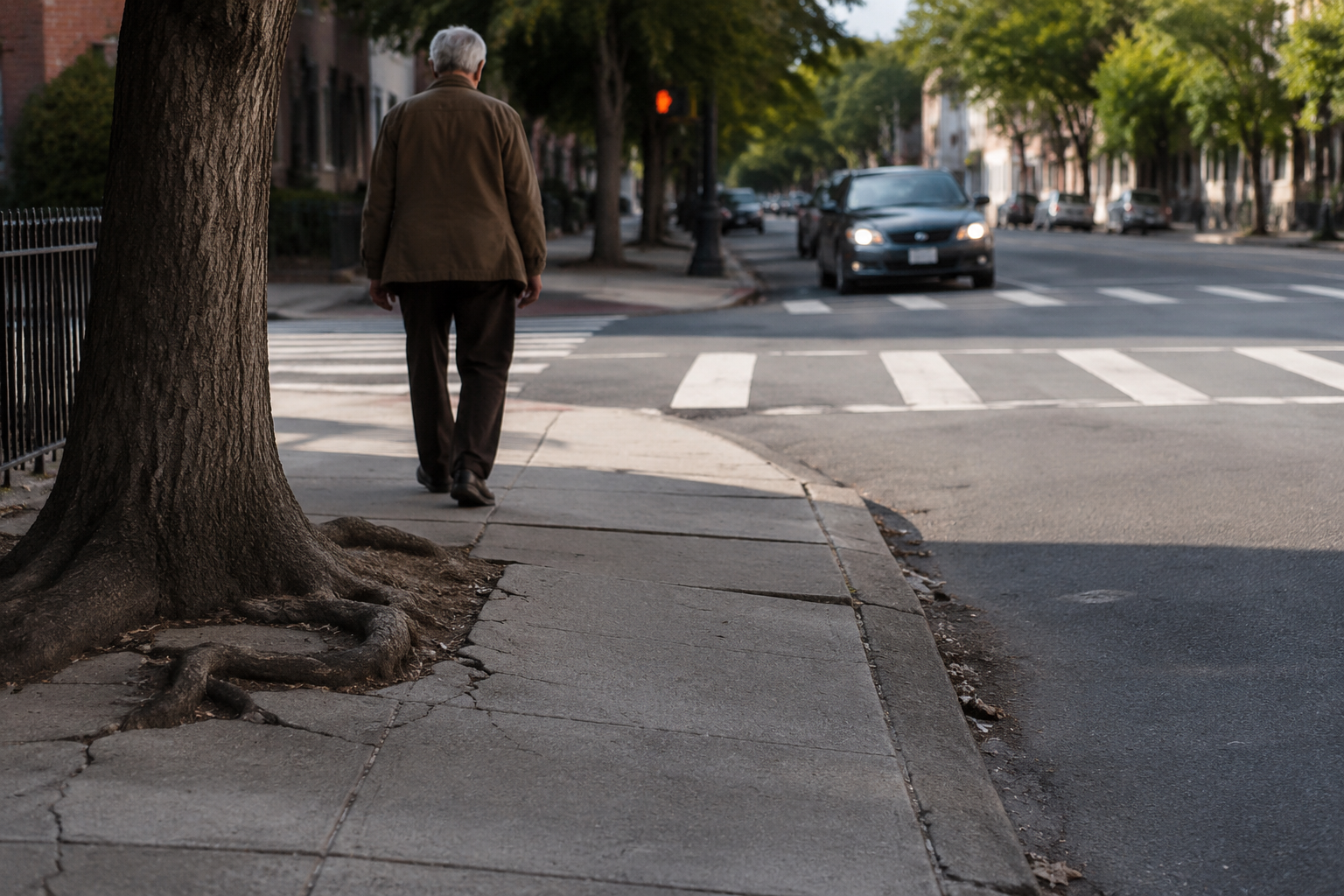
The Sidewalk Safety Checklist
Use this as a walking-order checklist, not a lecture. The point is to make the next ordinary trip—to the mailbox, pharmacy, bus stop, or corner store—less risky without turning every outing into an ordeal.
| Part of the walk | What to do | Why it matters |
|---|---|---|
| Before leaving | Wear secure shoes, bring needed glasses or a walking aid, and choose daylight when possible. | Small equipment choices affect both balance and visibility. |
| Route choice | Prefer sidewalks, lower-traffic streets, familiar crossings, and better lighting. | A safer route reduces the number of decisions that must be made under pressure. |
| Sidewalk surface | Look ahead for cracks, lifted slabs, tree roots, wet leaves, gravel, ice, and curb changes. | Trip hazards are easier to avoid before they are underfoot. |
| Intersections | Wait for a fresh walk signal, scan with the whole body, and watch for turning vehicles. | Crossing risk rises when footing, timing, and driver behavior overlap. |
| Visibility | Use retroreflective material, bright outer layers, and a flashlight after dark. | Drivers need enough distance to notice and react. |
| Weather and low light | Shorten the route, delay the trip, or ask for company when conditions change. | Rain, snow, glare, and darkness can turn a familiar route into a different route. |
Before Leaving: Set Up the Walk, Not Just the Walker
The best sidewalk safety habit often happens at the door. Shoes should stay firmly on the foot, have nonskid soles, and feel stable enough for a curb edge or sloped driveway apron. Outdoor walking is a poor time for loose slippers, smooth soles, or shoes kept only because they are easy to slide on.
Vision belongs in the same conversation as footwear. The National Council on Aging notes that people with vision problems are more than twice as likely to fall as those without vision problems, and its neighborhood fall-prevention guidance puts eye care, proper footwear, walking aids, and scanning for hazards in the same practical checklist.[3] That grouping makes sense outside, where a shadow, a raised slab, and a curb cut can look flatter than they are.
If a cane, walker, trekking pole, or rollator is part of the walk, it should be the aid the person actually uses well—not the one stored in the closet for “bad days.” A walking aid that is adjusted poorly or used only after fatigue sets in can create its own awkward moments at curbs and crossings. If the aid feels wrong, that is a reason to ask a clinician or therapist to check height and fit, not a reason to abandon the walk.
Choose the Route That Gives More Time
The shortest route is not always the safest route. A slightly longer walk with continuous sidewalks, calmer traffic, visible crossings, and fewer driveways can be the better bargain. Brown University Health’s pedestrian safety guidance for older adults emphasizes using well-lit, lower-traffic routes and choosing familiar areas when possible.[4]
Route choice is also a way for caregivers to help without hovering. Instead of saying, “Be careful,” walk the route together once and notice the practical details: where the sidewalk narrows, where a hedge blocks the driver’s view, which crossing gives a longer signal, which side of the street has fewer broken slabs, and where there is a bench or store entrance if a rest is needed.
When there is no sidewalk, the decision becomes more serious. NHTSA advises pedestrians who must walk where there is no sidewalk to walk facing traffic and as far from vehicles as possible.[5] That is not as safe as having a sidewalk, but it lets the walker see oncoming vehicles rather than depend entirely on drivers approaching from behind.
Manage the Surface Before It Manages You
Uneven pavement is not a minor nuisance for someone whose recovery from a fall is measured in confidence as much as in bruises. Cracks, raised tree roots, broken curb cuts, wet leaves, sand, gravel, snow, and ice all ask for the same first response: look farther ahead than the next shoe.
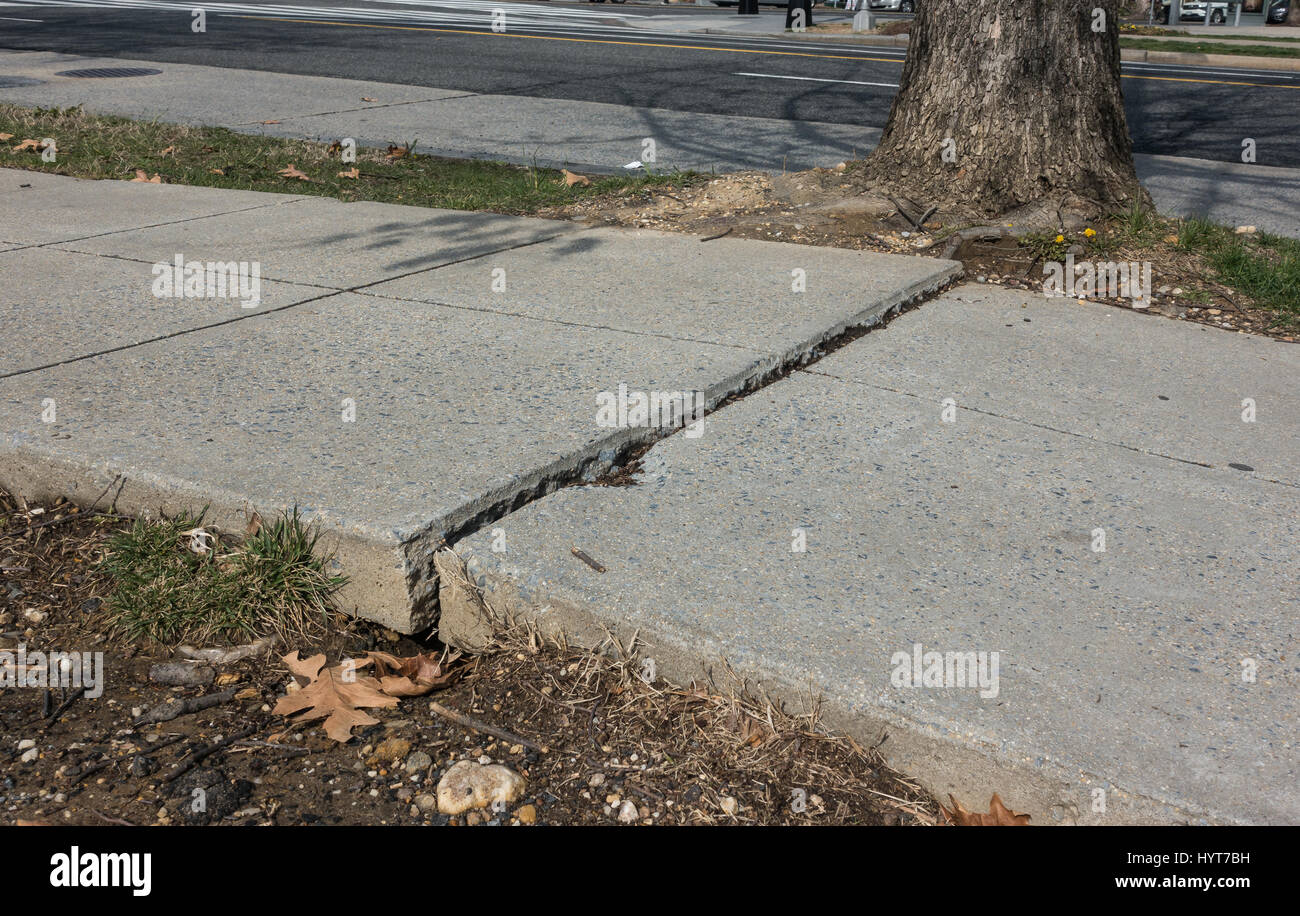
A useful rhythm is “scan, step, rescan.” Look several feet ahead for the next surface change, step through the area already checked, then lift the eyes again. Staring at the feet the whole time can hide turning cars and other pedestrians; looking only at traffic can leave a raised slab invisible until the toe catches it. The work is in alternating attention, not choosing one hazard and ignoring the other.
The NCOA neighborhood checklist specifically calls out cracks, curbs, uneven pavement, and tree roots as outdoor hazards to notice before they cause a fall.[3] Harvard Health gives similar outdoor fall-prevention advice, including watching for uneven pavement, using shoes with nonslip treads, and being careful with walking aids on outdoor surfaces.[6]
- At a raised slab, slow down before reaching it rather than trying to correct mid-step.
- At a curb cut, watch the slope as well as the curb edge; water, gravel, and leaves often collect there.
- Near tree roots, give the feet more clearance and avoid carrying items that block the view of the ground.
- On wet or icy stretches, shorten the stride and consider turning back if the surface is worse than expected.
- If a sidewalk defect is on a regular route, report it to the city, property manager, or local public works office.
Reporting a hazard is not a substitute for watching the next step, but it matters. A broken slab near a pharmacy or bus stop is not just one person’s problem. It is a repeated trap for every slower walker, stroller, cane, and grocery cart that has to pass over it.
Crossings: Wait for the Best Start, Not the Nearest Gap
Intersections are where sidewalk safety stops being only about balance. The walker has to judge the signal, the curb, the turning lane, the driver’s attention, and their own pace at nearly the same time. That is a lot to ask, especially when the signal is already flashing or a driver is nudging forward.
NHTSA’s older-adult pedestrian guidance recommends waiting for a fresh green or walk signal instead of stepping into the crosswalk late in the cycle.[5] That one habit removes a common pressure point: trying to decide whether there is still enough time while already committed to the street.
Walking speed is one reason this matters. A 2007 AAA Foundation for Traffic Safety study found that older pedestrians walked 0.5 to 0.8 feet per second slower than younger pedestrians, and that older walkers at the 15th percentile were not accommodated by the older 4-feet-per-second signal-timing assumption discussed in that study.[7] Signal standards and local timing practices can change, so that study should not be used to judge a specific intersection in 2026. It still supports a practical habit: start with the full crossing interval whenever possible.
Turn the Body, Not Just the Neck
A quick glance left and right is not always enough. NHTSA advises older pedestrians to turn the whole body to scan for traffic, because neck stiffness can limit how much a person actually sees when only the head turns.[5] This is especially useful before stepping off the curb and again while crossing, because turning vehicles can enter the crosswalk after the pedestrian has already started.
- Stop at the curb or curb cut with both feet stable.
- Wait for a fresh walk signal when there is one.
- Turn the body to scan left, right, and left again, then check for turning vehicles.
- Make eye contact when possible, but do not rely on it as proof the driver will yield.
- Cross steadily without rushing; rushing raises fall risk at the exact moment traffic risk is highest.
For adult children, this is the place where tone matters. “Wait for the fresh signal” lands better than “You’re too slow for that crossing.” The safety behavior is the same; one protects dignity and the other turns the walk into a test.
Visibility Is a Walking Tool
Darkness changes a familiar sidewalk. The uneven patch is harder to read, the curb edge blends into the road, and drivers may notice a pedestrian later than either person expects. NHTSA tells older pedestrians to increase visibility with a flashlight and retroreflective materials, especially in low light or darkness.[5]
Bright clothing helps in daylight, but retroreflective material is the better tool after dark because it returns light from headlights back toward drivers. Put it where movement is visible: shoes, ankles, wrists, a cane, a walker, a jacket zipper pull, or a shopping bag. The goal is not to look like a road crew. The goal is to give drivers more time to recognize a person, not just a shape.
A small flashlight also helps the walker, not only the driver. It can reveal the raised lip of a slab, the edge of a curb ramp, or wet leaves pressed flat against concrete. If carrying a flashlight interferes with a cane or balance, a clip-on light may be safer than adding one more thing to hold.
Weather and Low Light Deserve a New Plan
A route that is reasonable at 10 a.m. in dry weather may be a poor choice at dusk after rain. Outdoor fall prevention advice from NCOA and Harvard Health both treats weather and surface conditions as practical reasons to adjust the walk, not as excuses to stop walking altogether.[3][6]
The adjustment can be modest: leave earlier, use the side of the street with better lighting, skip the block with poor drainage, choose the store entrance without the sloped driveway, or ask someone to come along for the icy stretch. If the purpose of the walk is transportation rather than exercise, the safest option may be a ride, delivery, or postponement. Independence is not measured by taking the riskiest version of the trip.
For Caregivers: Help Without Shrinking the World
After a fall or near-miss, it is tempting to solve the problem by discouraging walks. Sometimes rest, medical evaluation, or temporary accompaniment is exactly right. But when the person can walk, the better long-term question is usually, “How can this walk be made safer?” not “How can we remove it?”
Caregivers can do a quiet route audit: walk the usual path, note the broken pavement and difficult crossings, check lighting at the actual time the person goes out, and look for a safer alternative. If the older adult walks alone, agree on simple expectations such as carrying a phone, sharing the route, or calling after a longer errand. Those supports should feel like a guardrail, not a leash.
When offering advice, make it specific enough to repeat: start on a fresh walk signal, turn the body to scan, wear the shoes with traction, bring the cane before fatigue starts, use the better-lit side, avoid the lifted tree-root block after rain. Those details are easier to accept than a vague warning to be careful.
No checklist removes all risk. Safer sidewalk walking comes from combining the habits that reduce it: eyes moving between pavement and traffic, enough time at crossings, visibility after dark, route choices that lower exposure, and support that protects independence instead of quietly taking it away.
References
- Pedestrian Safety, CDC
- Dangerous by Design 2026, Smart Growth America, 2026
- 5 Steps to Avoid Falls in Your Neighborhood, NCOA
- Pedestrian Safety in Older Adults, Brown University Health
- Stepping Out as an Older Adult — Be Healthy, Walk Safely, NHTSA
- Protect Yourself from Falls Outside the Home, Harvard Health
- Pedestrian Signal Safety for Older Persons, AAA Foundation for Traffic Safety, 2007
Questions to bring to a clinician or OT
This is not medical, legal, or a family's final decision — only a framework. Bring these questions to a clinician, occupational therapist, or your local Area Agency on Aging.
Find Local HelpRelated reading
Noticed something outdated or inaccurate on this page? Flag a correction. We review every report against CDC, NIA, and AARP HomeFit guidance before updating a page.