
Caregiver decision guide
Why Falls Are Different for Polio Survivors Aging at Home
Polio survivors fall at roughly four times the rate of other older adults, yet most standard fall-prevention advice misses their unique physical and psychological challenges. This guide helps caregivers understand why falls happen differently for polio survivors and what condition-specific steps to take.
When a parent who had polio decades ago starts falling more often, the usual fall-prevention handout can feel oddly beside the point. Yes, the loose rug matters. So does the dim hallway. But if her knee suddenly gives way at the kitchen counter, or she has stopped walking outside because she is afraid she will not make it back, a room-by-room checklist is only catching the easiest part of the problem.
Falls are different for polio survivors aging at home because many of these bodies have spent a lifetime compensating. A 2025 narrative review reports that polio survivors fall at roughly four times the rate of the general older adult population; it also notes that 64% report at least one major fall and 35% sustain fractures, often involving the hip or distal femur. The same review found that falls occur most often indoors and in the afternoon, which should make caregivers pause before assuming that the main danger is only the front steps or the icy driveway. [1]
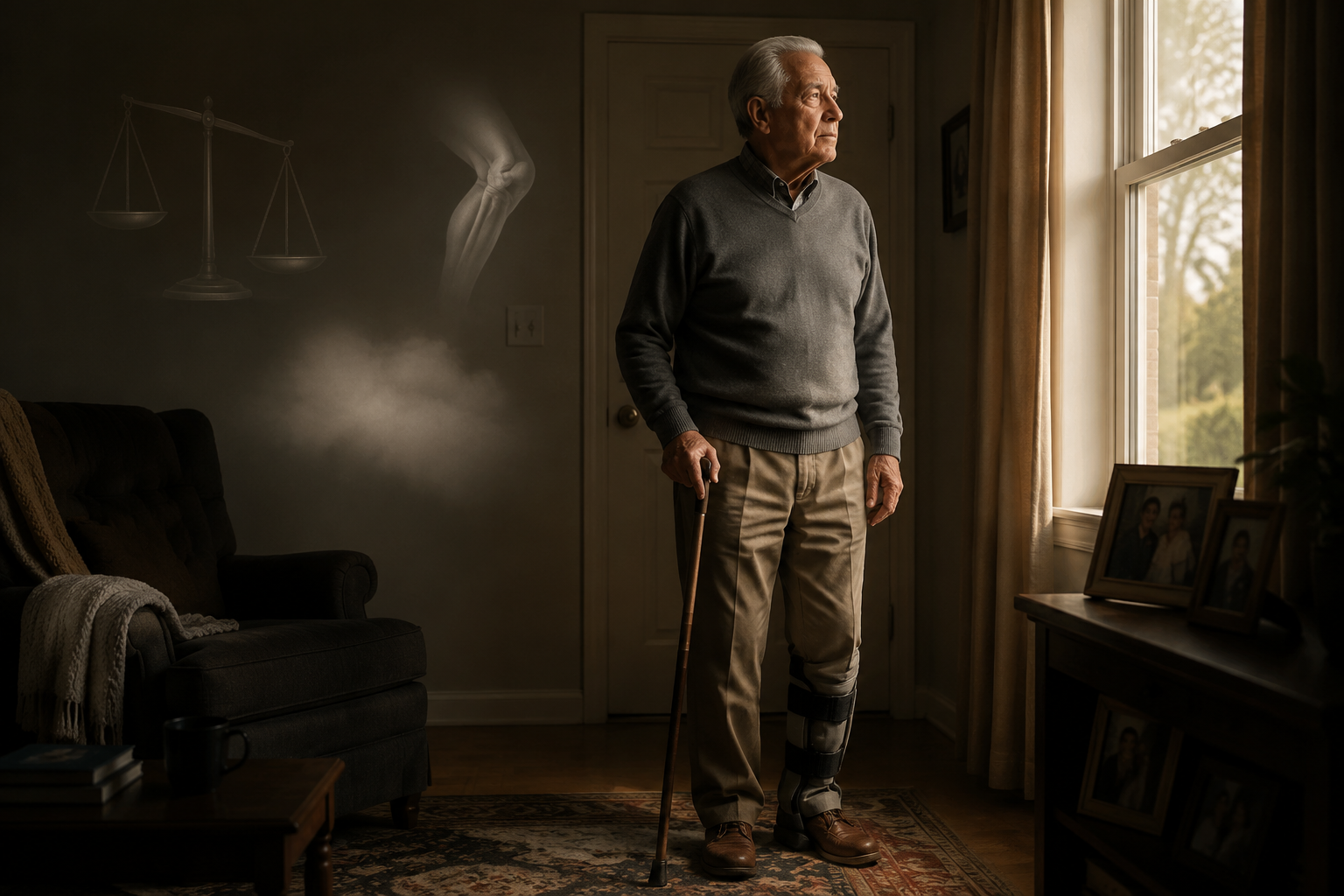
The more useful question is not simply, “How do we prevent falls in an older adult?” It is, “What changes when the older adult is a polio survivor whose strength, gait, joints, and confidence have been shaped by decades of adaptation?” Research highlighted by the British Polio Fellowship identifies three fall predictors that caregivers should learn to recognize: balance problems, knee-extension weakness, and fear of falling. [2]
Why the ordinary checklist does not go far enough
Standard home safety steps still belong in the plan. Clear walking paths. Secure rugs or remove them. Improve lighting. Add grab bars where they are actually needed. Make stairs and bathrooms less punishing. If the house has not been reviewed in years, a practical room-by-room home modification guide can help families stop guessing which changes come first.
But home modification is not the same thing as condition-specific fall prevention. A polio survivor may fall in a tidy, well-lit room because the supporting leg cannot hold the knee straight at the wrong moment. She may avoid the stairs not because the railing is missing, but because she no longer trusts the leg that used to be reliable. She may refuse a cane or brace not out of vanity, but because the suggestion lands like an instruction to return to childhood equipment she fought hard to leave behind.
That is why the care needs of aging polio survivors should be approached through function, history, and identity together. A safer house helps. A better-matched brace may help more. A walker introduced with respect may preserve more independence than another lecture about being careful.
Balance deficits: watch where and when falls are happening
“Poor balance” is too vague to be useful at home. Caregivers need to notice the pattern around it. Does the fall happen during a turn in the hallway? While reaching into a cabinet? When stepping away from a chair after sitting for a while? Does the person seem steadier in the morning and less reliable later in the day?
The detail that falls are reported most often indoors and in the afternoon matters because many families still picture fall risk as an outdoor hazard problem: uneven sidewalks, bad weather, porch steps. Those risks are real, but an afternoon indoor fall often points the caregiver toward daily movement patterns: fatigue, repeated transfers, turning, carrying objects, and walking short distances that everyone in the house has stopped treating as “mobility.” [1]
Useful observation is not surveillance. It is the difference between saying, “Mom keeps falling,” and being able to tell a clinician, “She has fallen twice when turning from the sink toward the table,” or “She is steady walking straight, but loses balance when she reaches across her body.” That level of detail can change the assessment from general aging advice to a mobility review that fits the actual problem.
What to bring to a physical therapy or medical visit
- The time of day when falls or near-falls happen.
- The exact activity: turning, reaching, standing up, stepping down, carrying laundry, getting to the bathroom.
- Whether the fall happened indoors or outdoors.
- Whether the person was using a cane, walker, brace, furniture, or no support.
- Any recent change in walking distance, confidence, or willingness to leave the house.
This is also where home changes should be chosen carefully rather than purchased in a burst of panic. A grab bar that supports the wrong side, a rail that encourages twisting, or a bathroom layout that assumes the “strong” leg will always be strong may not solve the risk the family is actually seeing. If cost becomes the obstacle, use a home modification cost and funding guide before spending money on changes that have not been matched to the person’s movement.
Knee-extension weakness: when the leg suddenly does not hold
Knee-extension weakness deserves plain language because families often recognize it before they can name it. The knee “gives out.” The leg “collapses.” The person catches herself on the counter and says she tripped, even when there was nothing on the floor. A caregiver may notice a quick hand to the wall, a new habit of locking the knee before taking a step, or a reluctance to stand without pushing hard through the arms.
For polio survivors, this is not a minor detail. Knee-extension weakness is one of the specific predictors identified in mobility research on aging polio survivors, and knee buckling changes the whole fall-prevention conversation. [2] A person can do everything “right” in a clean hallway and still fall if the knee cannot reliably support weight during stance, turning, or descent.
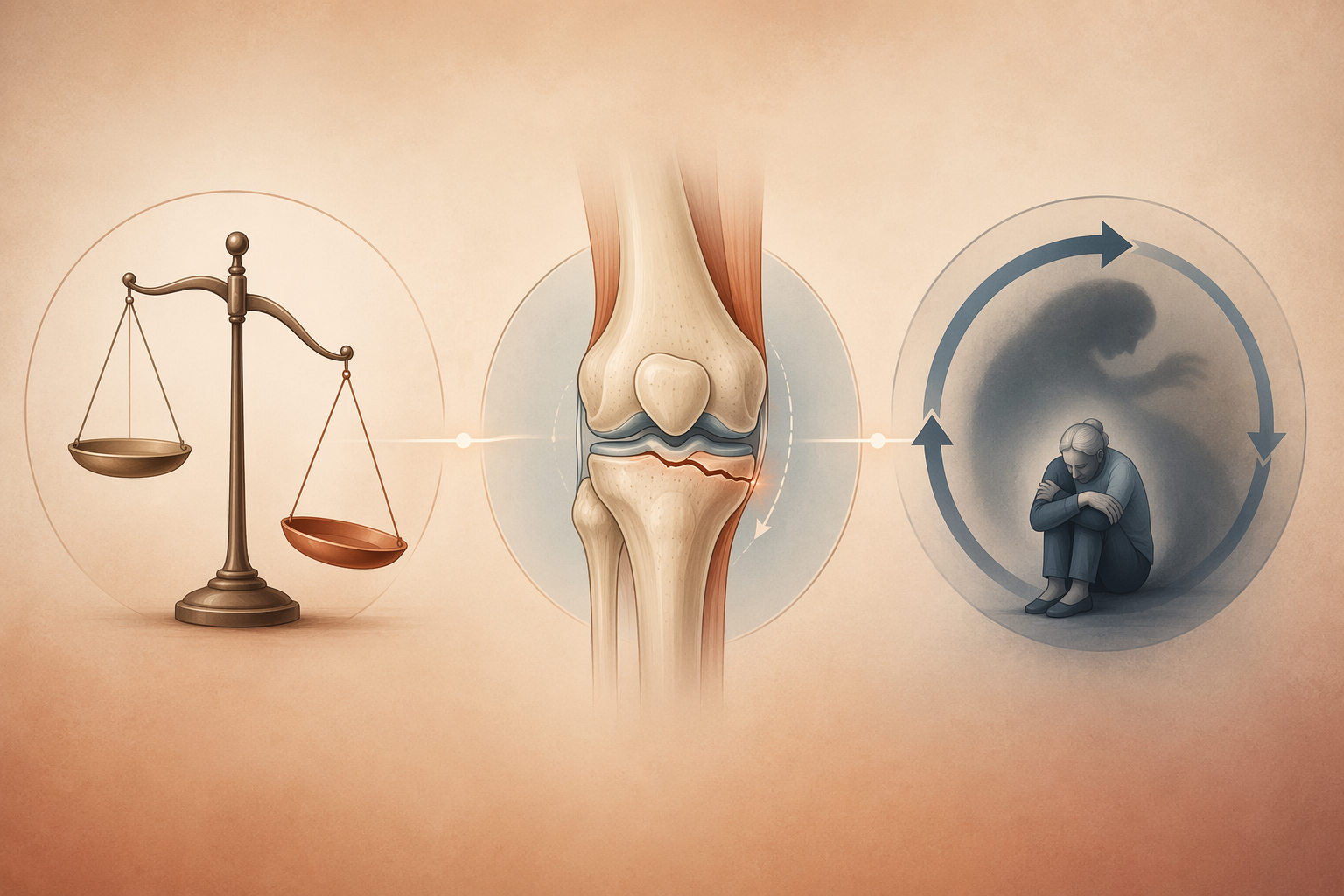
This is the moment for reassessment, not blame. Many survivors have used braces, orthoses, shoe modifications, canes, crutches, or careful gait strategies for years. Some are still using orthoses supplied decades earlier, and the British Polio Fellowship’s clinical pathway warns that outdated equipment can increase fall risk. [2] A brace that once made walking possible may no longer fit the person’s current strength, joints, weight, skin tolerance, or daily routine.
The caregiver’s job is not to prescribe a device across the kitchen table. It is to press for the right evaluation: a clinician, physical therapist, orthotist, or post-polio-informed rehabilitation professional who can look at knee control, gait, fatigue, footwear, current bracing, and the way the person actually moves at home. “Use a cane” is too casual when the problem is a buckling knee. The wrong aid, used on the wrong side or at the wrong height, can add another problem instead of solving the first.
How to raise equipment without making it sound like defeat
Mobility equipment carries history. Post-Polio Health International notes that some survivors resist adaptive equipment because it feels psychologically connected to childhood polio and “going back to braces.” [3] Treating that reaction as stubbornness misses what is at stake. Many survivors built adult lives around pushing past the visible signs of polio. A new brace or walker can feel like losing ground, even when it is meant to protect independence.
A better conversation starts with control: “I want you to have more choice about where you can go safely,” not “You have to use this now.” It helps to separate evaluation from commitment. The first step can be, “Let’s find out whether the brace still fits what your leg needs,” or “Let’s ask whether a different device would reduce the knee giving way.” That leaves room for dignity and still takes the risk seriously.
| What the caregiver notices | Why it matters | Next conversation |
|---|---|---|
| Knee gives way without a clear trip hazard | May suggest knee-extension weakness or poor knee control | Ask for gait, strength, brace, and mobility-aid reassessment |
| Parent grabs furniture during turns | May reflect balance deficits, unsafe compensation, or fatigue | Describe the turn, location, and time of day to the clinician or therapist |
| Old brace causes rubbing, slipping, pain, or avoidance | Equipment that no longer fits can increase risk instead of reducing it | Request orthotic review rather than simply abandoning the brace |
| The “good leg” is now painful | The unaffected or less-affected side may have carried decades of extra load | Ask whether transfer, stair, and home-modification plans are overusing that side |
The “good side” may not be able to keep paying the bill
Families often talk about the polio-affected side and the “good side” as if one is the problem and the other is the solution. That can be a dangerous simplification. Polio Place’s Aging Well series describes overuse injuries on the unaffected side from decades of compensatory gait. [4] In daily caregiving terms, that means the arm used for every push-off, the leg trusted on every stair, and the shoulder used for every transfer may also need protection.
This matters when planning the house. A grab bar is not automatically helpful just because it is sturdy. A stair plan is not automatically safe just because there are rails on both sides. The question is whether the setup asks one limb or one joint to do the same punishing job over and over. If mobility decline starts increasing the amount of hands-on help needed, families may also need to look at what paid help can cover; a current guide to senior home healthcare funding can help frame that conversation before the spouse or adult child becomes the only transfer device in the home.
Fear of falling is not just an emotion; it changes behavior
Fear of falling is one of the clearest places where ordinary advice can do harm by being too brisk. “Don’t be afraid” is not a plan. “You need to walk more” is not enough, either, when the person has good reason to remember what a fall cost the last time.
Post-Polio Health International reports survey data in which 54% of respondents had fallen within six months, 86% were concerned about falling, and 82% restricted activity because of that fear. Because these figures come from a self-selected support-group population, they should not be treated as a population estimate for all polio survivors. Still, they describe a pattern caregivers commonly see: fear leads to less activity, less activity contributes to deconditioning, and deconditioning can raise fall risk further. [5]
The restriction can be quiet. A parent stops going to the mailbox. Then she stops using the basement laundry. Then she stops accepting invitations that require steps or long hallways. From the outside, it may look like preference or mood. Sometimes it is fear doing its work in the background.
Breaking that cycle usually requires pacing, not pressure. The caregiver can help by making the feared activity smaller and more specific: practicing one transfer safely, reviewing one walking route, asking for therapy goals that preserve meaningful activity rather than generic exercise. The aim is not to argue someone out of fear. It is to reduce the reasons the fear keeps being confirmed.
A more useful way to ask about fear
- Instead of “Are you afraid of falling?” ask, “Which part of the day feels least safe now?”
- Instead of “Why won’t you use the walker?” ask, “What would using it mean to you?”
- Instead of “You need more exercise,” ask the therapist, “What activity can she do without increasing knee buckling or exhaustion?”
- Instead of “You’re giving up,” say, “I want to protect the things you still want to do.”
Do not ignore fatigue and sleep
Fatigue is not a side issue when falls are clustering later in the day. One factor caregivers should not miss is sleep-disordered breathing. Post-Polio Health International describes both obstructive and central sleep apnea as common among polio survivors, and undiagnosed apnea can worsen fall risk through fatigue. [6]
This does not mean every fall is caused by sleep apnea. It does mean that loud snoring, witnessed pauses in breathing, morning headaches, daytime sleepiness, unusual exhaustion, or a clear afternoon drop-off should be discussed with a clinician. A fall plan that ignores fatigue may keep adjusting the house while missing a treatable contributor.
What to do differently this week
Caregivers do not need to become post-polio specialists before taking useful action. They do need to move past the idea that an aging polio survivor’s falls are explained by age plus clutter. Start with a short, condition-specific record and use it to ask better questions.
- Write down the last few falls or near-falls: location, time of day, activity, footwear, device used, and whether the knee buckled.
- Ask for a mobility reassessment that specifically addresses balance, knee-extension weakness, gait, fatigue, current orthoses, and mobility aids.
- Review home changes through the person’s actual movement pattern, not just a generic safety list.
- Protect the less-affected side from becoming the permanent workhorse for transfers, stairs, and reaching.
- Treat fear of falling as a fall-risk factor, not a character flaw.
- Bring fatigue and possible sleep-disordered breathing into the medical conversation if symptoms are present.
If the family is deciding whether to invest in ramps, bathroom work, stair changes, or paid help, it is worth looking at the broader cost and savings context for aging-in-place modifications. But the spending decision should follow the mobility assessment, not replace it. A polished bathroom remodel will not correct a brace that no longer supports the knee.
The central shift is simple but important: falls in aging polio survivors are often built from long-term compensation, specific neuromuscular weakness, equipment that may no longer match the body, and fear-shaped behavior. That calls for safer rooms, yes, but also better questions, better reassessment, and conversations that protect independence instead of treating every new support as surrender.
References
- PMC Narrative Review. PMC. 2025.
- Managing Mobility Challenges in Aging Polio Survivors. British Polio Fellowship.
- Adaptive Equipment. Post-Polio Health International.
- Aging. Polio Place.
- Caregivers. Post-Polio Health International.
- Sleep Apnea. Post-Polio Health International.
Questions to bring to a clinician or OT
This is not medical, legal, or a family's final decision — only a framework. Bring these questions to a clinician, occupational therapist, or your local Area Agency on Aging.
Find Local HelpRelated reading
Noticed something outdated or inaccurate on this page? Flag a correction. We review every report against CDC, NIA, and AARP HomeFit guidance before updating a page.