
Caregiver decision guide
How to Find Homeless Prevention Funding for Your Aging Parent
Many older adults face housing instability as fixed incomes fall short of rising rents. This guide walks family caregivers through federal, state, and local funding programs that can prevent homelessness, including eligibility criteria and how to access them.
Last reviewed: July 22, 2026.

The moment usually does not look like a policy problem. It looks like a lease renewal, a utility shutoff warning, a prescription receipt, and a parent saying, “I thought I could catch up next month.” If the rent, Social Security or SSI check, and overdue bills no longer line up, the question is not only whether your parent can afford housing long term. The first question is whether there is homelessness prevention funding for seniors that can keep this from becoming an eviction, a shelter stay, or a night in the car.
There is help, but it is scattered. Some money sits in federal housing programs. Some runs through a county Adult Protective Services office. Some is a small local arrears payment that disappears when the grant is spent. The practical task is to match your parent’s situation to the right door before the crisis decides for you.
The urgency is real. In 2024, about 146,000 adults age 55 and older experienced homelessness, a 6% increase from 2023; 46% of people in that age group experiencing homelessness were unsheltered, and older adults are described as the fastest-growing age group among people experiencing homelessness.[1] HUD’s 2023 report counted 2.35 million older adult households with “worst case housing needs,” meaning they had very low incomes, received no rental assistance, and either paid more than half their income toward housing or lived in severely inadequate housing.[2] Those numbers matter because they describe the edge many families are already standing on.
Start by naming the stage of the housing crisis
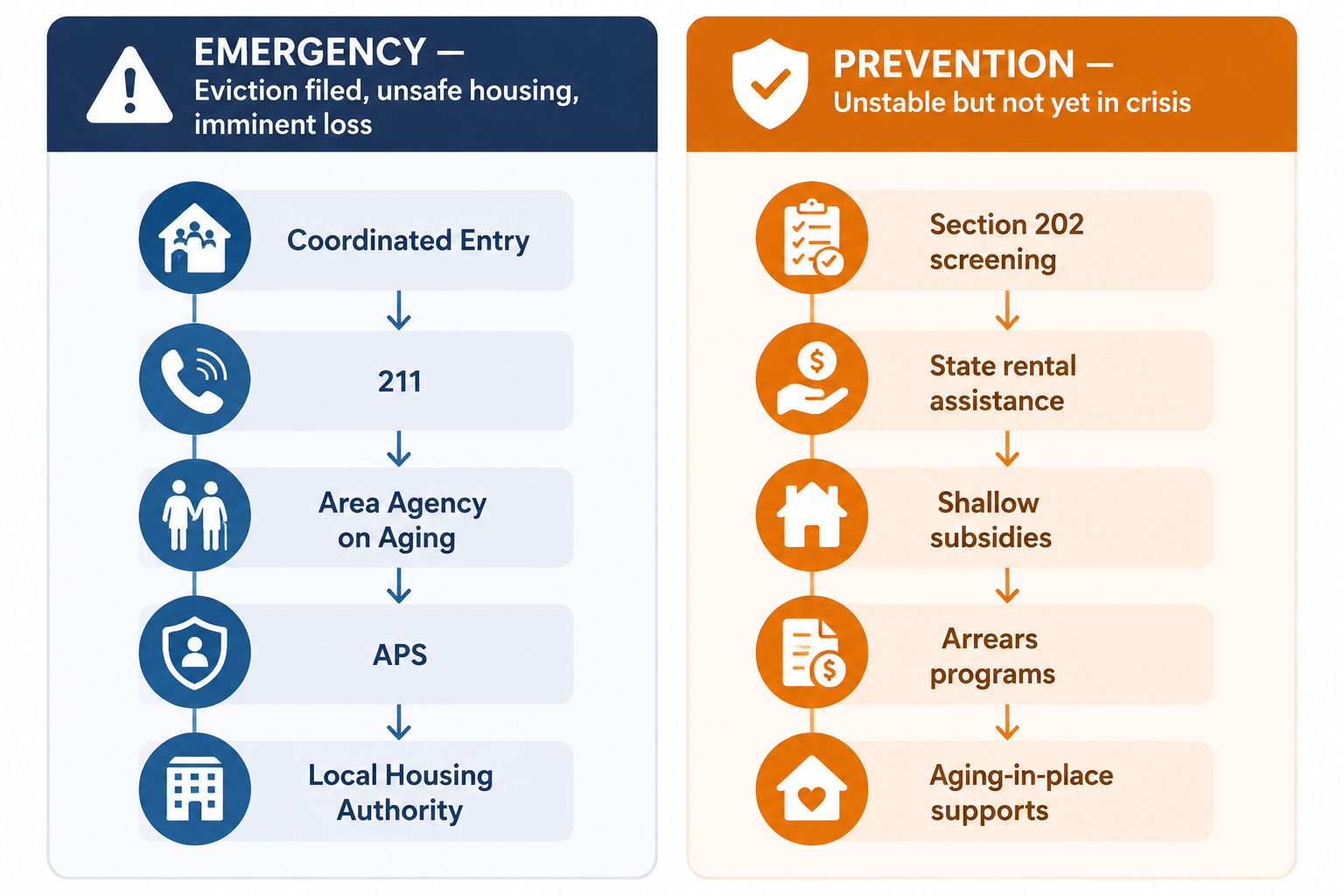
Before calling every agency in town, sort the problem into one of two lanes. The emergency lane is for eviction, homelessness, unsafe housing, or a housing loss that could happen in days or weeks. The prevention lane is for a parent who is still housed but can no longer make the rent math work.
| What is happening | First doors to try | What to ask for |
|---|---|---|
| Eviction notice, lockout threat, already homeless, sleeping in a car, unsafe housing, or imminent loss of housing | Local coordinated entry system, 211, Area Agency on Aging, Adult Protective Services if abuse, neglect, self-neglect, or exploitation may be involved, and the local housing authority | Homelessness prevention, emergency rental assistance, landlord mediation, shelter diversion, rapid rehousing, Permanent Supportive Housing screening, or APS-linked housing stabilization |
| Still housed but falling behind, rent increase is coming, SSI or Social Security no longer covers basic bills, or family is covering rent temporarily | Local housing authority, subsidized senior housing properties, Area Agency on Aging, county human services office, state rental assistance portals, and trusted nonprofit housing agencies | Section 202 senior housing, affordable senior housing waitlists, shallow rental subsidy, arrears assistance, utility assistance, home-modification help, or aging-in-place supports |
If the situation belongs in the emergency lane, do not spend the first week researching every senior housing option. Call 211 and ask for the local coordinated entry access point for homelessness assistance. Then call the Area Agency on Aging and say plainly: “My parent is at risk of homelessness. I need housing stabilization or eviction prevention resources for an older adult.” If there are signs your parent cannot safely manage housing, is being exploited, or is self-neglecting in a way that threatens housing, ask whether Adult Protective Services can screen for housing-related support.
If the situation is unstable but not yet at the door of eviction, use the extra time carefully. Get on waitlists, screen for senior-specific housing, and ask about local prevention money before arrears grow large enough that a landlord stops negotiating.
The federal programs: what they actually do
Federal housing language can make everything sound similar. For a caregiver, the useful distinction is simpler: subsidized senior housing lowers the monthly rent, homelessness assistance responds to a crisis or near-crisis, and supportive housing combines rent help with services for people who need more stability than a lease alone can provide.
Section 202 Supportive Housing for the Elderly
Section 202 is the clearest senior-specific federal housing lane. It serves very low-income older adults, generally with a head of household, spouse, or sole member who is at least 62 years old, and household income typically below 50% of area median income. For eligible residents, rent is generally capped at 30% of adjusted income.[3]
That 30% cap is why Section 202 matters so much for a parent living on a fixed income. It does not hand the family a one-time check. It changes the monthly rent burden. If your parent is 62 or older and the rent gap is permanent, not temporary, this should be on the list early.
- Call the local public housing authority and ask for “Section 202 Supportive Housing for the Elderly” and other subsidized senior housing properties.
- Search for individual Section 202 or subsidized senior properties in your parent’s county; many properties keep their own waiting lists.
- Ask each property whether the waitlist is open, how applications are accepted, whether there is a preference for local residents or homelessness risk, and what documents are required.
- Do not assume “senior apartment” means subsidized. Ask whether rent is income-based, below-market, or simply age-restricted.
The frustrating part is availability. Section 202 can be the right answer and still not be immediately reachable if local waitlists are closed or years long. That does not make the call wasted. It tells you whether you are solving a short-term arrears problem, a long-term rent burden, or both.
Continuum of Care, coordinated entry, and Permanent Supportive Housing
HUD’s Continuum of Care system is the main local planning and funding structure for homelessness assistance. For families, the important phrase is “coordinated entry.” Justice in Aging describes coordinated entry as the front door for many HUD-funded homeless assistance programs, including Permanent Supportive Housing in many communities.[4]
Coordinated entry is not the same as a senior housing application. It is a crisis-access system. A worker may ask where your parent slept last night, whether an eviction is pending, what disabilities or health risks are present, and whether your parent can be safely diverted from shelter. Some communities use coordinated entry for prevention or diversion; others mainly use it once homelessness is already happening or imminent.
Permanent Supportive Housing is usually for people with serious, ongoing barriers to housing stability, often including disability and a history of homelessness. It can be life-changing when it fits, but it is not a quick rent-gap program for every older tenant. If your parent is still housed and the problem is a manageable monthly shortfall, ask about prevention and shallow subsidy first. If your parent is already homeless, repeatedly losing housing, or has health and functional needs that make ordinary housing unstable, ask coordinated entry whether Permanent Supportive Housing screening is appropriate.
Housing Choice Vouchers and public housing
Housing Choice Vouchers and public housing are not senior-only programs, but older adults may qualify based on income, disability, local preferences, or homelessness risk. The access point is usually the local public housing authority. Ask whether voucher or public housing waitlists are open, whether there are elderly or disabled preferences, and whether your parent should apply separately to subsidized senior properties.
This is also where age thresholds start to trip families up. Homelessness data often uses age 55 and older, some research and advocacy work uses 50 and older, Section 202 starts at 62, and local “senior” housing may use 55 or 62 depending on the property. Always ask, “What age rule does this specific program use?” before filling out a long application.
State and local money: ask for the function, not just the program name
State and local programs are where prevention can become concrete: one arrears payment, a short rent subsidy, a landlord mediation call, a security deposit, or a utility payment that keeps the lease from collapsing. The catch is that these programs are local, time-limited, and often described in language no family would guess.
California’s Home Safe program is a strong example of what to ask about, not a program every reader can use. California describes Home Safe as a homelessness prevention program connected to Adult Protective Services, with services that can include housing-related case management, eviction prevention, landlord mediation, short-term rental or utility assistance, and other supports. The state reported $200 million for Home Safe and availability across all 58 counties, with program funding described through June 2026.[5] Because that funding window has reached its end as of this review date, California families should confirm current county availability before relying on it.
The useful caregiver script is: “Does our county have an APS-linked homelessness prevention program like Home Safe, or any housing stabilization funds for older adults at risk of eviction?” That wording matters. If you only ask for “senior housing,” you may be sent to a waitlist. If you ask for eviction prevention, landlord mediation, and housing stabilization, you are naming the tools that can solve this month’s problem.
San Diego’s Shallow Rental Subsidy Pilot shows another important idea: some older adults do not need a full voucher to avoid homelessness. The program provided $500 per month for up to 18 months, and the local homelessness agency cites survey evidence that 70% of Californians who experienced homelessness believed a $300 to $500 monthly subsidy would have prevented their homelessness.[6] That does not prove the same amount works for every family in every market, but it explains why a modest subsidy is worth asking about when the gap is specific and recurring.
Oregon’s General Assistance program is a reminder to read the age line closely. Oregon describes General Assistance as support for adults with severe disabilities who are experiencing homelessness or at risk of homelessness, including up to $649 per month in housing assistance; the program is for people ages 18 through 64, so it may help an adult approaching older age but not a parent who is already 65 or older.[7]
Small nonprofit programs can also matter, but they should be treated honestly. CoAction in Indiana described a limited homelessness prevention effort offering up to $2,000 in arrears assistance for only seven households in specific counties, with a stated program period through November 2025.[8] That is not a broad safety net. It is a model for what may exist locally under names like “eviction prevention,” “arrears assistance,” “housing stabilization,” or “diversion.”
| If you hear this program type | What it may pay for | Best first question |
|---|---|---|
| Eviction prevention or homelessness prevention | Past-due rent, fees, court-related costs, landlord negotiation, or short-term rent help | “Can this help before my parent enters shelter, and what notice or arrears proof do you need?” |
| Shallow rental subsidy | A smaller monthly rent amount for a limited period | “Is there a senior, disabled, or fixed-income rent-gap subsidy in this county?” |
| APS-linked housing stabilization | Case management, landlord mediation, emergency payments, moving costs, or safety-related supports | “Does Adult Protective Services have housing funds for older adults at risk of homelessness?” |
| Aging-in-place or home-modification funds | Repairs, accessibility changes, ramps, grab bars, or safety fixes | “Could the housing crisis be prevented by making the current home safe enough to stay?” |
| Utility assistance | Electric, gas, water, or shutoff prevention | “Can utility help free up income for rent or stop a lease violation?” |
If your parent owns the home but cannot safely remain there without repairs or accessibility changes, the funding search changes. Rent assistance may not be the right lane. Look for home-modification, weatherization, property tax relief, utility assistance, and aging-in-place supports. For a broader map, see 7 Funding Sources for Home Modifications When Medicare Won't Pay and Aging in Place: A Comprehensive Guide for Families and Caregivers.
Build the document folder before the agency asks
The same documents get requested again and again, but rarely in the same order. If you are helping from work, from another city, or between medical appointments, create one folder before the calls begin. A missing award letter can turn a one-day application into a two-week delay.
- Proof of identity: driver’s license, state ID, passport, or other accepted ID.
- Proof of age: ID, birth certificate, Medicare card if accepted, or another document showing date of birth.
- Proof of income: Social Security award letter, SSI letter, pension statement, pay stubs if still working, or bank statements if requested.
- Proof of housing cost: lease, rent ledger, rent increase notice, mortgage statement, lot rent bill, or written landlord statement.
- Proof of crisis: eviction notice, pay-or-quit notice, utility shutoff notice, arrears balance, court papers, unsafe housing photos, or a written timeline.
- Health and disability documents: Medicare or Medicaid card, disability award letter, medication list, doctor letter if housing risk is tied to health, or proof of functional limitations.
- Consent: a signed release allowing you to speak with the landlord, housing authority, Area Agency on Aging, APS, or nonprofit provider.
For income-based housing, do not guess at income. Use current benefit letters and ask whether the program counts gross income, adjusted income, medical deductions, or household members differently. Section 202’s rent cap is based on adjusted income, which is one reason medical expenses and household composition can matter.[3]
For arrears or eviction prevention, the landlord’s paperwork often matters as much as your parent’s. Ask for a current ledger showing the amount owed, months covered, late fees, and whether the landlord will accept payment to stop the eviction. If the landlord is willing to participate, get that in writing. Many programs need to know that their payment will actually preserve the housing.
Use plain scripts when you call
Agency calls go better when you lead with the housing risk, age, income source, and deadline. You do not need to tell the whole family history first. Start with the facts that route the call.
- For 211: “My parent is an older adult at risk of homelessness. We need eviction prevention, rental arrears help, landlord mediation, or a coordinated entry assessment. The deadline is [date].”
- For the Area Agency on Aging: “I’m helping my parent stay housed. Are there older-adult housing stabilization funds, case management, legal aid referrals, or benefits screening programs?”
- For Adult Protective Services: “There may be self-neglect, exploitation, or health-related risk that is putting housing in danger. Can APS screen for services or housing stabilization resources?”
- For a housing authority: “Which waitlists are open for elderly, disabled, subsidized, public housing, Section 202, or voucher programs? Are there preferences for homelessness risk?”
- For a nonprofit housing agency: “Do you have prevention funds for arrears, a shallow subsidy, diversion, security deposit help, or utility assistance for older adults?”
Keep a call log with the date, agency, phone number, person’s name, what they said, next step, and deadline. If someone says no, write down whether the reason was age, income, immigration status, geography, closed funding, missing documents, or the crisis not being severe enough. A “no” for one reason can point to the next right door.
When the first answer is no
Closed waitlist does not mean no housing strategy. It means you need a short-term and long-term track at the same time. Put your parent on every appropriate subsidized senior housing list that is open, then keep working the prevention side for arrears, utilities, mediation, and temporary rent help.
If the eviction clock is moving, add legal aid early. A rental assistance application does not automatically stop a court case. Legal aid may be able to help negotiate more time, review whether the notice is valid, or connect the case to local eviction diversion if that exists.
If your parent is embarrassed or defensive, keep the request concrete. “I’m not taking over everything. I’m trying to see whether there is a program that can pay the arrears or lower the rent before this becomes harder.” Many older adults hide the problem until the notice is serious. The paperwork may tell you more than the conversation does.
If the housing problem is tied to care needs, widen the search beyond rent. A parent may be at risk because stairs are unsafe, bathing is impossible, hoarding has triggered a lease violation, or unpaid utilities are making the home unlivable. In that case, ask the Area Agency on Aging about care management, home-delivered meals, in-home supports, chore services, benefits screening, and home safety programs. If assisted living is being discussed only because the current home is failing, compare less expensive support models first through When Assisted Living Is Still Too Expensive: 5 Affordable Alternatives for Senior Care.
A practical order of operations
You do not have to solve the whole housing system this week. You do need to keep the next preventable loss from happening. Work in this order:
- Write down the deadline: eviction court date, pay-or-quit date, rent increase date, lease end date, utility shutoff date, or move-out demand.
- Decide the lane: emergency coordinated entry and crisis help, or prevention funding while your parent is still housed.
- Screen age and income: 62+ for Section 202, possibly 55+ or 62+ for senior housing, different age rules for local programs, and income limits that may use area median income.
- Gather the document folder before applications begin.
- Call the named front doors: 211, coordinated entry, Area Agency on Aging, APS when relevant, housing authority, legal aid, and local housing nonprofits.
- Ask for functions, not vague help: arrears assistance, eviction prevention, landlord mediation, shallow subsidy, senior subsidized housing, utility assistance, home modification, or housing stabilization.
- Track every answer and escalate when the risk changes.
The broader financial picture may include Medicaid, SNAP, Medicare Savings Programs, property tax relief, utility programs, and veterans benefits. If you need a wider benefits map beyond housing, use Beyond Medicaid: A Complete Map of Financial Assistance Programs for Senior Care in 2026 alongside the housing calls.
Federal agencies and advocates increasingly describe older adult homelessness as a crisis that requires prevention, housing assistance, and aging-service coordination rather than shelter alone.[9] That is the right frame, but a caregiver still needs the phone number, the eligibility rule, and the document list. Start where the risk is today. Name the program lane. Ask for the payment or housing function that would actually keep your parent housed.
References
- Paint by Numbers: Older Americans and Homelessness — National Alliance to End Homelessness
- Worst Case Housing Needs: 2023 Report to Congress — U.S. Department of Housing and Urban Development
- Who Qualifies for HUD's Section 202 Supportive Housing? — National Council on Aging
- HUD Homeless Assistance Programs: A Basic Primer for Aging Advocates — Justice in Aging
- Home Safe Program — California Department of Social Services
- Shallow Rental Subsidy Program — San Diego Regional Task Force on Homelessness
- General Assistance Program — Oregon Department of Human Services
- Homelessness Prevention Assistance — CoAction
- Homelessness Prevention Series: Spotlight on Older Adults — United States Interagency Council on Homelessness
Questions to bring to a clinician or OT
This is not medical, legal, or a family's final decision — only a framework. Bring these questions to a clinician, occupational therapist, or your local Area Agency on Aging.
Find Local HelpRelated reading
Noticed something outdated or inaccurate on this page? Flag a correction. We review every report against CDC, NIA, and AARP HomeFit guidance before updating a page.