
Caregiver decision guide
How Political Health Secrets Mirror Your Family's Health Talks
Use the national debate over health transparency for aging politicians as a natural entry point to start conversations with your aging parents about sharing health information, with practical steps for follow-through.
Sen. Lindsey Graham’s sudden death on July 11, 2026, did not stay inside the usual boundaries of a political obituary. Within days, the public conversation widened into a familiar unease: who knew what, when did they know it, and why does serious health information about powerful older people so often arrive only after everyone else has been left reading clues? AP News framed the questions around Graham’s death alongside broader concerns about aging politicians and health transparency, a debate already sharpened by Sen. Mitch McConnell’s guarded hospitalization in June 2026 and President Biden’s visibly diminished 2024 debate performance.[1]
The phrase health transparency for aging politicians sounds like it belongs to Washington: public trust, press offices, succession rules, voters’ rights to know. But the discomfort underneath it is not only political. It is the same discomfort that sits at a family table when an aging parent says, “Everything is fine,” while an adult child notices unopened medication bottles, missed appointments, new dents in the car, or stories that no longer line up.
No source directly says that political health disclosure and family caregiving are the same problem. They are not. A senator’s health can affect public representation; a parent’s health belongs first to that parent. Still, the parallel is useful because both settings collide with the same human facts: autonomy, pride, fear of being treated as diminished, and the quiet cooperation of everyone around the older person who does not want to start a fight.

The public pattern feels private for a reason
What makes these political episodes unsettling is not simply age. Older people can lead, work, parent, negotiate, remember, decide, and adapt. The more troubling pattern is the choreography around decline or possible decline: vague reassurance, delayed disclosure, aides or relatives managing the story, outsiders piecing together fragments, and then a crisis forcing everyone to admit there should have been a process earlier.
McConnell gave unusually plain language to one part of that pattern when he acknowledged in July 2026 that “folks of my generation often hesitate to share the vulnerability that comes with growing older.”[1] That sentence travels well beyond politics. Many adult children have heard its family version: “I don’t want to be a burden,” “I can handle it,” “You’re making too much of this,” or the most efficient conversation-ender of all, “I said I’m fine.”
The adult child hears risk. The parent hears loss of status. That mismatch is why a direct opening often fails. “I’m worried about your memory” may be meant as care, but it can land as a vote of no confidence. “I need access to your medical information” may be practical, but it can sound like an administrative takeover of someone who has spent decades being the competent one.
The political debate offers one gentler doorway. Instead of beginning with accusation, an adult child can begin with the news: “All this talk about older leaders and health disclosure made me realize our family does not have a plan for emergencies. Can we talk about what you would want shared, and with whom, before anyone is under pressure?”
Borrow the structure, not the surveillance
A 2024 Harvard Gazette report found that 75 percent of voters supported mandatory cognitive testing for aging politicians, a number that shows broad appetite for some kind of structured standard.[2] It does not prove that mandatory testing is simple, fair, or sufficient. It does suggest that many people understand the problem with improvising health disclosure only after something visible goes wrong.
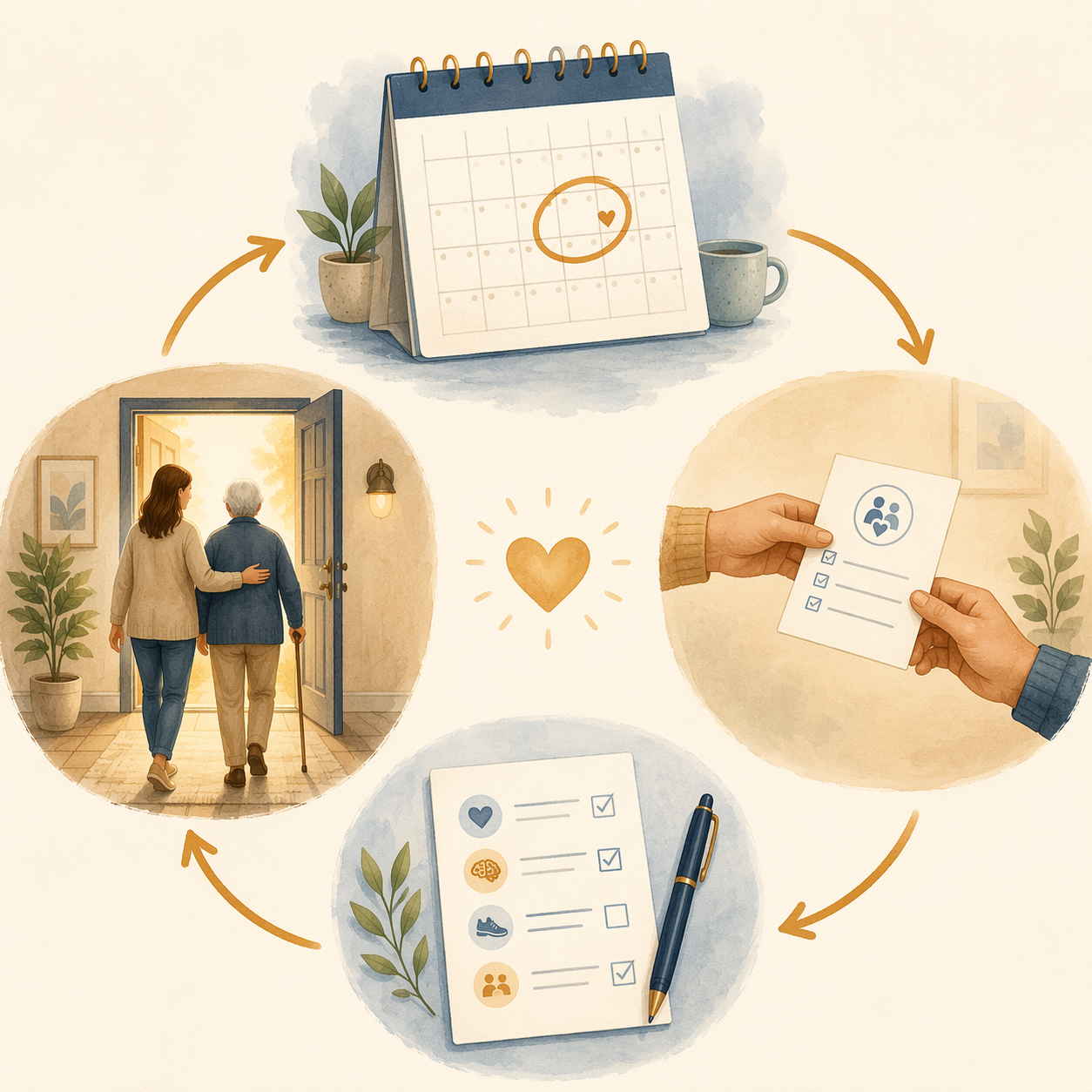
Families do not need to copy Washington’s demand for disclosure. A parent is not a public official answering to voters. The better idea to borrow is procedural: make health conversations scheduled, universal, non-punitive, and agreed on before a crisis. The goal is not to catch someone failing. The goal is to prevent one person’s silence from becoming everyone else’s emergency.
| Part of the family framework | What it means at home |
|---|---|
| Scheduled | The conversation happens at a predictable time, such as once or twice a year, not only after a frightening incident. |
| Universal | Adult children can participate too: medication lists, emergency contacts, and key documents are not framed as an aging-parent-only issue. |
| Non-punitive | The check-in does not automatically lead to taking away driving, finances, or privacy. |
| Trigger-based | The family agrees which changes should prompt a doctor visit, medication review, or broader planning conversation. |
| Permission-based | The parent names what can be shared, with whom, and under what circumstances. |
| Follow-through oriented | Someone leaves with a task: update a contact, find a document, schedule an appointment, or confirm a form. |
The word “universal” matters more than it first appears. If the only person being asked to disclose information is the older parent, the conversation becomes a competence test no matter how lovingly it is phrased. A family check-in works better when everyone brings something: current medications, allergies, doctor names, insurance information, emergency contacts, preferred hospital, and the name of the person who should be called first if something happens.
A first conversation that does not sound like a takeover
Timing does half the work. Do not open this conversation in the emergency room, after a parent repeats a story, or while siblings are already irritated. Choose a neutral moment and make the reason external and practical. The national debate can help because it gives everyone something to look at besides each other.
A useful opening is calm and slightly boring: “The news about older leaders and health privacy made me realize we have never talked through what any of us would do if one of us were hospitalized. I’m not asking because I think you can’t manage. I’m asking because I would not know who to call or what you would want me to say.”
That sentence does three things. It names the trigger without making the parent the trigger. It defines the child’s problem as lack of information, not lack of trust. And it preserves the parent’s authority by asking what they would want, not announcing what the child intends to do.
Start with information that is obviously useful in an emergency and least likely to feel like surveillance:
- Names and phone numbers for primary care doctors, specialists, preferred pharmacy, and nearby neighbors or friends.
- Current medication list, including dosage, prescribing doctor, and any medications stopped recently.
- Insurance cards, Medicare or supplemental plan information, and preferred hospital.
- Allergies, major diagnoses, recent procedures, and any medical devices.
- Where key documents are kept, even if the parent is not ready to share copies.
If the parent resists, the next move is not to press harder. It is to reduce the size of the ask. “Could we just make a one-page emergency contact sheet?” is easier to accept than “I need to know everything about your health.” Once a parent sees that sharing one piece of information does not lead to immediate control, the next conversation becomes less loaded.
What counts as concern, and what does not
Families need a way to talk about changes without turning every lapse into evidence. One poor night of sleep, one forgotten name, one confused story, or one bad performance in public is not a diagnosis. Even cognitive screening has limits. High-functioning adults may compensate for a long time, sometimes scoring normally on brief tools while daily functioning has begun to change in ways family members notice first.[2]
That is why patterns matter. Julie Brody Magid, a clinical neuropsychologist at Harvard Medical School and McLean Hospital, made one useful distinction in the Harvard Gazette: “Rapid forgetting with repetitive questions is not usually an age-appropriate memory change.”[2] The phrase is careful. It does not say every repeated question means dementia. It says rapid forgetting plus repetitive questioning is different from the ordinary experience of walking into a room and needing a moment to remember why.
For a family, the practical question is not “Can I diagnose this?” The answer is no. The better question is “What am I observing, across which parts of life, and is it changing?” A 2024 academic discussion of cognitive decline and political leadership points to several domains that can be watched in public figures: executive function, attention, language, memory, and social cognition.[3] At home, those same categories can organize observations without pretending to replace a clinician.
| Domain | What a family might notice |
|---|---|
| Executive function | Trouble sequencing familiar tasks, managing bills, following a recipe, handling appointments, or adapting when a plan changes. |
| Attention | Losing track of conversations more often, missing important details, or being unable to stay with a task that used to be manageable. |
| Language | Increasing word-finding problems, vague substitutions, or difficulty following complex conversations. |
| Memory | Rapid forgetting, repeated questions, missed medications, or repeated purchases that cannot be explained by normal distraction. |
| Social cognition | Uncharacteristic misreading of social cues, reduced judgment in interactions, or behavior that feels markedly out of character. |
Behavior can matter too. Ira Hyman has written about inhibitory control failures as possible early behavioral markers observable in public interactions before a formal diagnosis.[4] In family life, that might mean a parent who was always measured becomes unusually impulsive, socially inappropriate, or unable to stop a behavior even after consequences are clear. Again, the point is not to label the behavior from the kitchen table. The point is to know when “that was odd” has become “we should ask a doctor.”
The fairest observations are specific and dated. “Mom seems off” is too vague to help a clinician and too easy for a parent to reject. “She asked the same medication question four times in one hour on Tuesday, then did not remember the conversation the next morning” is different. Specificity lowers the emotional temperature because the conversation can stay with events rather than character.
When to move from check-in to medical conversation
A more serious medical conversation is justified when changes are new, repeated, worsening, or affecting safety and daily function. That includes missed medications, getting lost on familiar routes, unpaid bills from confusion rather than choice, falls that are minimized, repeated emergency visits, sudden personality changes, or memory gaps that interfere with ordinary independence.
A parent may still refuse. Unless there is an immediate safety emergency or legal incapacity, refusal matters. The next step may be asking permission to attend one appointment, sending a brief written concern to the clinician, or suggesting a medication review rather than leading with memory. Many cognitive-looking problems can be affected by sleep, infection, medication side effects, depression, pain, alcohol, hearing loss, or vision problems. A careful medical visit protects the parent from both neglect and overreaction.
Permissions are not the same as paperwork, but both matter
Health privacy law is often invoked in families as if it were a locked door with only one key. It is more nuanced than that. Dr. Leslie Kernisan of Better Health While Aging explains that HIPAA can allow clinicians to share relevant information with family through verbal consent, and in some care situations through reasonable inference from the patient’s involvement of that family member. If a patient is incapacitated, written authorization is not always required for clinicians to use professional judgment in sharing information with involved family.[5]
That does not mean families can skip documents. HIPAA permissions, durable powers of attorney, health care proxies, advance directives, and state-specific forms do different jobs. A clinic’s permission form may let a doctor speak with an adult child. It may not let that child make decisions. A financial power of attorney may help pay bills. It may not authorize medical choices. State requirements vary, so families should verify the forms that apply where the parent lives.
This is where political comparisons can mislead if taken too literally. Members of Congress have access to the Office of the Attending Physician, described by The American Prospect as a concierge-style clinic costing members $650 per year.[6] Most families do not have anything like that standing infrastructure. If an older parent lands in an unfamiliar hospital, the adult child may be reconstructing the medication list from a purse, a pill organizer, and a sibling’s memory while a nurse waits for answers.
A workable follow-through plan can stay modest:
- Ask the parent whom clinicians may speak with in an emergency and during routine care.
- Confirm whether each doctor’s office has its own HIPAA release or contact permission process.
- Locate existing health care proxy, durable power of attorney, advance directive, and will documents without assuming they are current.
- Check whether the named agents are still appropriate, alive, willing, and reachable.
- Store emergency information somewhere accessible to the parent and the agreed-upon helper.
- Put a date on the calendar to review the plan again.
The calendar date is not decoration. It changes the meaning of the conversation. A scheduled review says, “This is how our family prepares.” A crisis-only conversation says, “Something is wrong with you.”
The sibling problem arrives quickly
Health transparency rarely involves only one parent and one child. If there are siblings, the parent may tell each child a different amount, not always out of manipulation. One child may feel safer. One may live closer. One may ask fewer questions. One may be the person the parent still sees as needing protection rather than capable of helping.
A family framework should name roles before resentment hardens. Who is the medical-note person? Who handles transportation? Who updates siblings after appointments? Who has authority to speak with doctors? Who is backup if the primary helper is traveling? These questions are dull until the night they are not.
The parent should be included in deciding what gets shared. “Dad said I can update you after cardiology appointments, but he does not want every lab result discussed in the sibling thread” is a boundary. It may frustrate the adult child who wants full visibility, but it also preserves dignity. Transparency does not require turning a parent’s body into family property.
A script for the second conversation
The first conversation may only produce a doctor’s name and an agreement to talk later. That is still progress. The second conversation can be more concrete, especially if framed around reducing confusion for everyone rather than expanding control.
Try something like: “Last time we talked about emergency contacts. Could we do one more practical piece? If you were in the hospital and sleepy or in pain, what would you want me to know before I talked with the nurses? And who would you want me to update?”
Then stop talking long enough for the parent to answer. Adult children often over-explain because they are anxious and because structure feels like safety. But too much structure delivered too quickly can sound like a closing argument. The parent’s first response may be defensive, incomplete, or sentimental. That does not mean the conversation failed. It may mean the parent is discovering, in real time, that accepting help requires imagining a version of themselves they do not want to meet.
If the parent says, “You’re trying to take over,” answer the fear directly: “I am not asking to make decisions you can make yourself. I am asking what you want me to do if you cannot speak for yourself or if doctors need information quickly.”
If the parent says, “I don’t want to burden you,” answer the hidden consequence: “Not knowing would be harder. Having your instructions would help me respect what you want.”
If the parent says, “I’m fine,” do not argue with the word “fine.” Move to logistics: “I’m glad. This is exactly why I want to do it now, while we are not in a crisis.”
What the political debate can and cannot teach a family
Public officials occupy a different ethical space from private parents. Voters may have legitimate interests in whether leaders can perform demanding duties, and ethicists have long debated how to balance privacy, capacity, and public interest in high office. A family has a different obligation: to protect safety while honoring the older adult’s personhood, privacy, and right to make unwise choices when they still have capacity.
That distinction matters because health transparency can become coercive when it is treated as a right to know everything. Adult children do not need every detail of a parent’s body to be useful. They need enough information to respond appropriately, avoid preventable harm, and follow the parent’s wishes when the parent cannot explain them.
A good family plan leaves room for privacy. A parent might agree that an adult child can know medication changes and emergency diagnoses, but not routine test results. They might want one child to attend appointments and another to handle finances. They might allow a doctor to speak with family only if hospitalization, anesthesia, confusion, or a major medication change is involved. Those boundaries are not obstacles to transparency. They are what make transparency tolerable.
The mistake is waiting until the parent’s fear and the child’s fear meet in the worst possible room: a hospital bay, a rehab discharge meeting, a bank lobby, a car after a near-miss, a sibling call at midnight. By then, every question sounds urgent because it is urgent.
Families cannot remove vulnerability from aging. They can remove some of the improvisation around it. The best lesson from the debate over aging politicians is not that older people owe everyone proof of competence. It is that health conversations work better when they are routine, shared, and agreed upon before a crisis decides the terms.
References
- After Lindsey Graham's death, questions linger about aging politicians and health transparency, AP News, July 14, 2026.
- Should aging politicians have to take cognitive tests?, Harvard Gazette, 2024.
- Cognitive decline and political leadership, Politics and the Life Sciences, Cambridge University Press, 2024.
- Is Your Political Candidate Showing Early Signs of Dementia?, Psychology Today, 2024.
- HIPAA: Questions and Answers for Family Caregivers, Better Health While Aging.
- Congress’s Secret Health Care, The American Prospect, 2025.
Questions to bring to a clinician or OT
This is not medical, legal, or a family's final decision — only a framework. Bring these questions to a clinician, occupational therapist, or your local Area Agency on Aging.
Find Local HelpRelated reading
Noticed something outdated or inaccurate on this page? Flag a correction. We review every report against CDC, NIA, and AARP HomeFit guidance before updating a page.