
Caregiver decision guide
What Seniors Need to Know About Power Outage Causes
Not all power outages threaten seniors the same way. This guide explains how each cause — from storms to equipment failure — creates distinct risks for older adults and helps caregivers tailor preparation to the specific scenarios most likely in their area.
A winter storm outage, a heat-wave outage, a tree-related outage, and an equipment failure outage may all turn off the same lights. They do not threaten an older adult in the same way.
For seniors and caregivers, the cause matters because it changes the warning time, the likely duration, the temperature risk, and which dependency fails first: oxygen, refrigeration, stair access, phone service, heat, cooling, or a medical alert base station.
Weather now deserves special attention, but it is not the whole story. Climate Central reports that 83% of major U.S. power outages are weather-related, and that weather-related outages doubled between 2000–2009 and 2014–2023.[1] The American Public Power Association looks through a different lens: sustained outage causes reported by public power utilities. In its 2023 data, tree-related incidents were the top reported cause, with 8,503 events, followed by equipment failure at 8,205 and squirrels at 7,196.[2] Those numbers should not be blended into one ranking. One is about major outages; the other is about sustained outage causes. For a caregiver, both are useful because they point to different kinds of preparation.
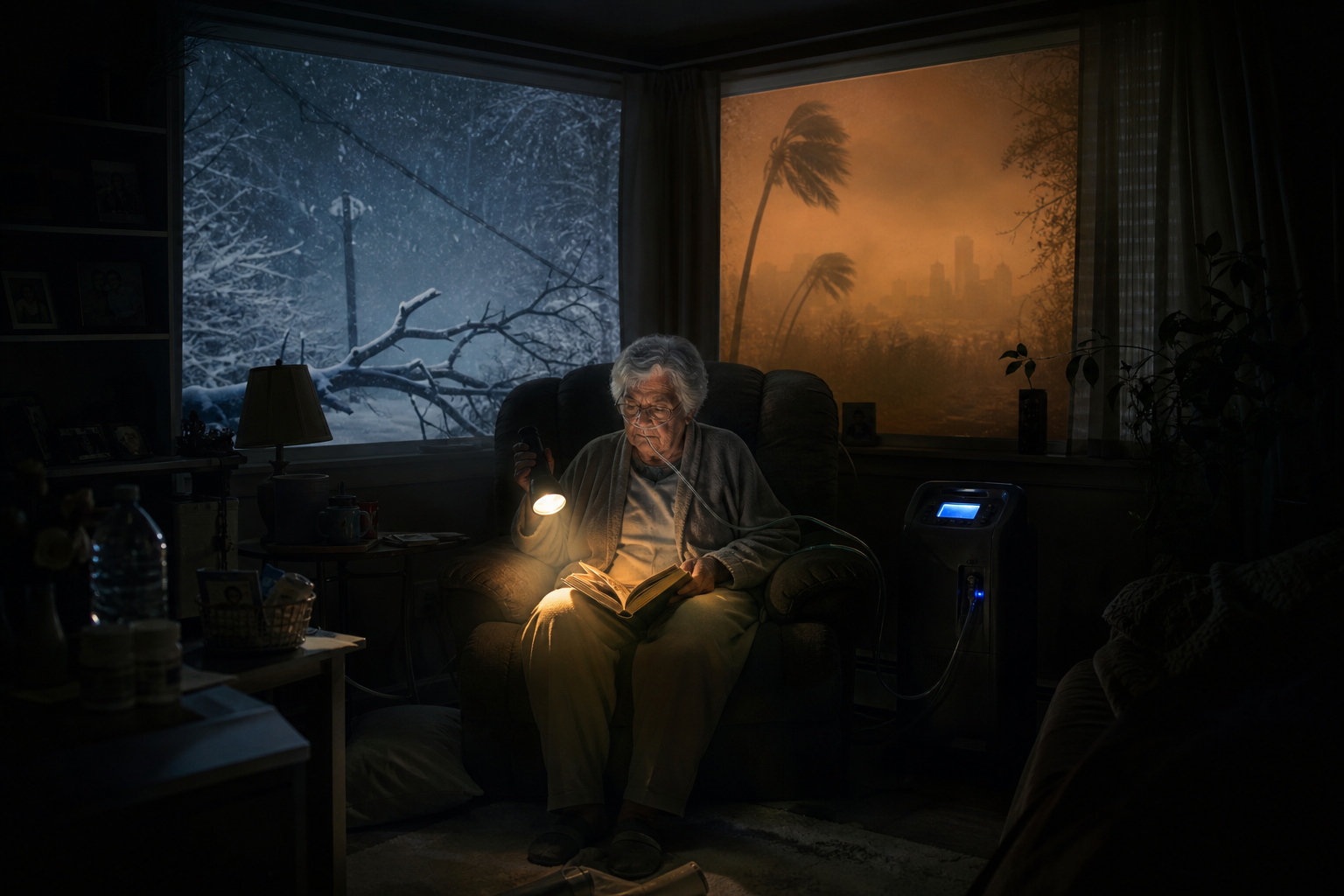
The Cause Changes the First Thing That Goes Wrong
Most households notice the same first signs: the refrigerator hum stops, the Wi-Fi drops, the room goes dark. In an older adult’s home, the more important question is what quietly depended on that power before anyone noticed.
| Likely cause | What changes for a senior | Caregiver priority |
|---|---|---|
| Winter storm | Cold exposure, blocked travel, unsafe heating attempts, longer time before help arrives | Warmth plan, safe relocation threshold, charged phone, CO detectors |
| Heat wave or hot-weather grid stress | Indoor heat, dehydration risk, medication temperature problems, cooling-center access | Cooling plan, medication storage verification, transportation plan |
| Tree-related outage | Often tied to wind, storms, or ice; repairs may require clearing debris before restoration | Longer-duration battery and device backup planning |
| Equipment failure | Little or no warning; routine charging and refrigerator timing matter immediately | Keep devices charged; know who to call and what fails first |
| Animal-related outage | Sudden interruption that may be brief, but still disruptive for alert systems and powered equipment | Short-gap readiness: lights, phone, device battery, neighbor check |
The table is not a forecast. It is a sorting tool. A parent living alone in a tree-heavy neighborhood with overhead lines has a different problem than a parent in a high-rise apartment during a heat wave. A spouse who can drive at noon may not be able to move someone safely at 2 a.m. A cordless phone that seemed fine during a one-hour flicker may be useless when a medical device battery is also running down.
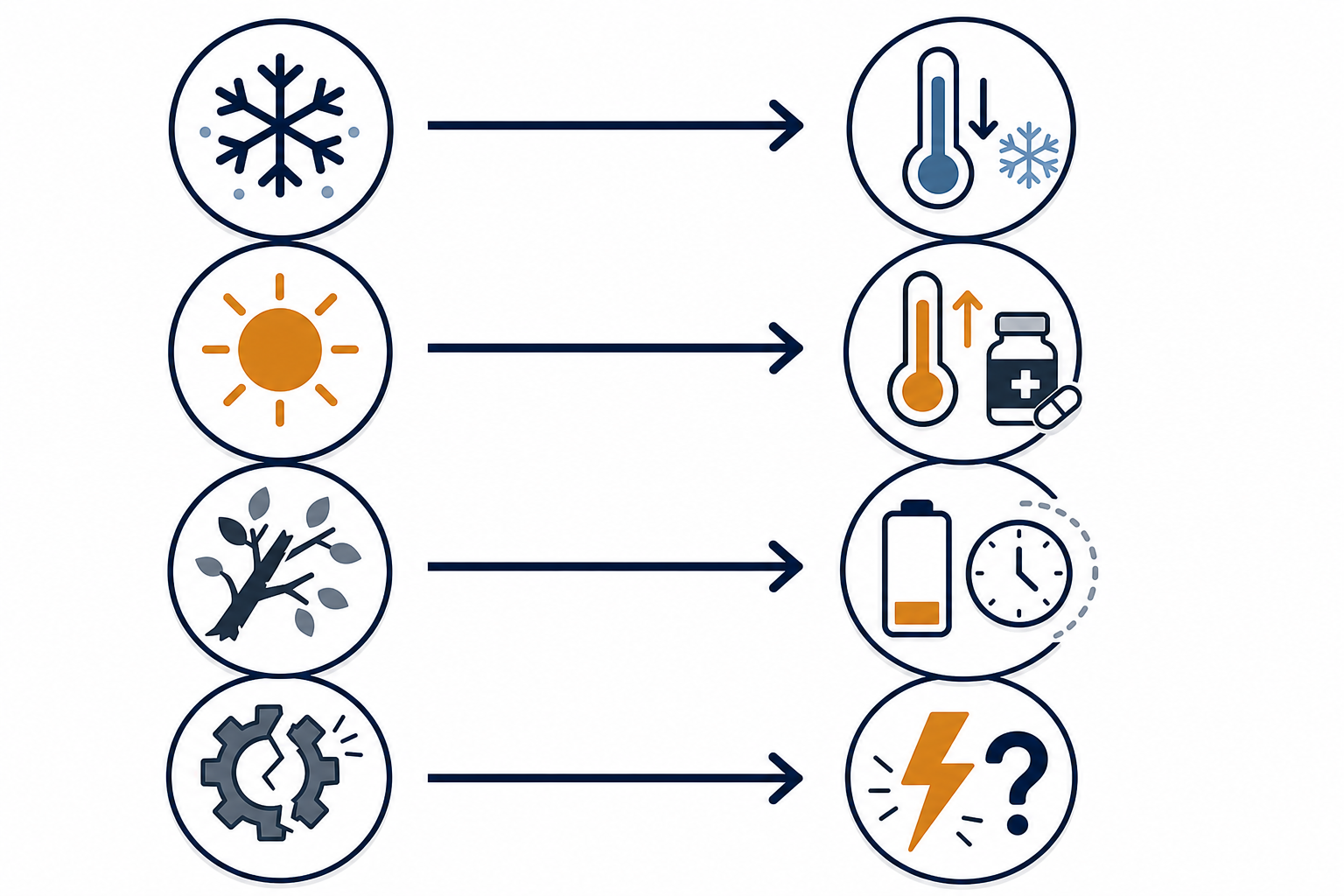
Weather Outages: Temperature Is Often the Emergency
A storm outage is not just an electrical problem. It can become a temperature problem, a transportation problem, and a communication problem at the same time. That combination is what makes weather-related outages harder for older adults than a short, isolated interruption.
In winter, the danger can arrive before the house feels “dangerously” cold to a younger visitor. A frail older adult in a 60°F home after a winter outage can develop mild hypothermia overnight, and medications used for depression, pain, and Parkinson’s disease can increase vulnerability.[4] This is where a family plan has to be more specific than “use blankets.” Who checks the thermostat? At what indoor temperature does the family move the parent? Is there a relative, neighbor, warming center, or accessible hotel that can actually receive someone with a walker, oxygen equipment, or dementia-related confusion?
Unsafe heat sources deserve the same seriousness as the cold itself. A narrative review of power-outage health consequences found that more than 48% of reviewed studies focused on carbon monoxide poisoning. The same review reported that more than 95% of severe carbon monoxide poisoning cases after an ice storm in North Carolina occurred in households without CO detectors.[3] Generators, grills, camp stoves, and cars do not become safer because the furnace is out. The CDC advises keeping generators outdoors and at least 20 feet from doors, windows, and vents.[8]
In hot weather, the early failure may be cooling rather than lighting. Heat can turn an upstairs bedroom into the wrong place for an older adult with limited mobility. It can also complicate medication storage. The CDC states that insulin can be kept at room temperature for up to 28 days, but should be kept as cool as possible and away from direct heat and sunlight; insulin that has been exposed to temperatures above 86°F should be discarded.[8] That is not a reason for caregivers to improvise medication decisions. It is a reason to ask the pharmacist, before the outage, how the parent’s specific insulin or other temperature-sensitive medication should be handled.
Tree Outages: The Battery Clock May Be the Real Clock
Tree-related outages are not just common in APPA’s reporting; they also tend to be physically messy. A branch on a line, a downed pole, ice-loaded limbs, blocked streets, and crews waiting for safe access can all stretch the time before restoration. For a healthy household, that may mean inconvenience. For a parent using powered medical equipment, it can mean the battery clock starts to matter more than the utility’s estimated restoration time.
This is the gap that catches families. Research highlighted by the University of Tennessee Knoxville Center for Transportation Research found that most home medical device backup batteries last only 3 to 8 hours, while more than half of U.S. counties experienced at least one outage exceeding 8 hours between 2018 and 2021.[5] A device that looks “prepared” on paper can still fail before the lights return.
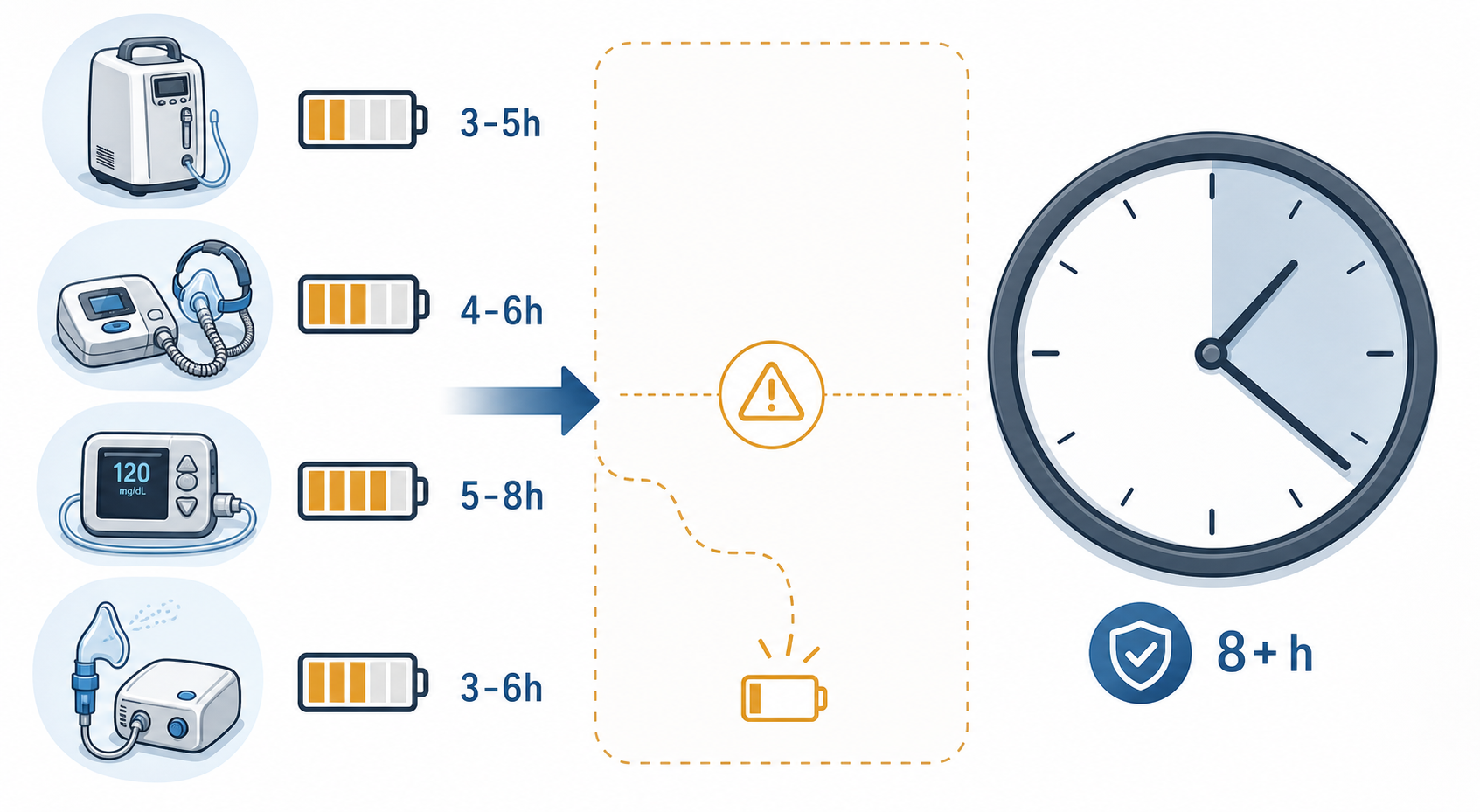
The affected population is not small. NPR and the American Lung Association reported that an estimated 4.5 million Medicare recipients use electricity-dependent durable medical equipment, a figure that does not include every privately insured person or every possible device user.[6] Oxygen concentrators, CPAP machines, nebulizers, ventilators, powered beds, stair lifts, and some feeding or medication systems do not all fail in the same way. Some stop immediately. Some switch to battery. Some need a supplier’s backup plan. Some create a transportation problem because the device is not easy to move.
Hurricane Sandy showed what that looks like after the battery cushion is gone. After the storm, emergency department visits for respiratory device failure peaked the day after landfall, and emergency department use among patients age 80 and older rose 114%.[6] That pattern should change how caregivers read a restoration estimate. “Power expected back tonight” may not be reassuring if the concentrator battery expires this afternoon.
The useful pre-outage work is direct: write down the exact device model, the actual battery duration under normal use, the charging time, the supplier’s emergency number, and whether the local utility has a medical baseline, life-support, or priority-notification program. These programs vary by utility and state; enrollment is not the same as a guarantee of immediate restoration. For medical decisions, the plan belongs with the physician, pharmacist, device supplier, or oxygen provider, not with an online checklist.
Equipment Failure: No-Warning Readiness Matters
Equipment failure sits near the top of APPA’s 2023 sustained-outage causes, just behind tree-related incidents.[2] The senior-safety issue is not drama; it is surprise. There may be no storm watch, no snowfall, no heat advisory, and no adult child thinking, “I should call Mom before this hits.”
No-warning outages punish habits. A phone left at 22%, a stair lift parked on the wrong floor, a flashlight without batteries, a medical alert pendant whose base station depends on household power, or a refrigerator opened repeatedly in the first hour can turn a routine outage into avoidable trouble.
For equipment-failure risk, preparation is less about watching the sky and more about the daily baseline. Keep phones and backup batteries charged. Store a flashlight where the older adult can reach it from the bed and favorite chair. Make sure the person knows which phone works when household power and internet are down. If a stair lift, lift chair, adjustable bed, or garage door opener is part of safe movement, learn the manual release or backup procedure before someone is stuck.
Animal-Related Outages: Short Does Not Mean Harmless
Squirrels were the third-largest reported cause in APPA’s 2023 data, with 7,196 events.[2] Many animal-related outages are localized and may be shorter than a major storm outage, but they can happen without warning. That distinction matters for seniors who live alone.
A 45-minute outage can still create a fall risk in a dark hallway, interrupt a cordless phone, silence some internet-dependent communication, or frighten someone with cognitive impairment. It may not require evacuation. It does require the basics to be reachable: light, phone, medication list, device instructions, and a person who checks in if the outage happens after dark.
The Three Dependencies to Check Before the Next Outage
A caregiver does not need to build a disaster binder before doing anything useful. Start with the three dependencies most likely to fail quickly in an older adult’s home.
- Electricity-dependent health needs: oxygen concentrator, CPAP, nebulizer, ventilator, powered bed, stair lift, lift chair, dialysis-related equipment, charging medical devices, or any device the parent cannot safely go without.
- Refrigerated medication and food: insulin, other temperature-sensitive medications, perishable food, and the refrigerator or freezer habits that affect how long contents stay safe.
- Communication and alert systems: cell phone, landline, cordless phone, internet phone, medical alert base station, wearable alert device, building intercom, and the neighbor or relative who can physically check the home.
Food safety has clearer public thresholds than many families realize. Ready.gov states that a refrigerator will keep food cold for about 4 hours if the door stays closed, and a full freezer will hold temperature for about 48 hours if the door remains closed.[7] The CDC gives similar guidance and advises throwing away perishable food that has been at temperatures above 40°F for 4 hours or more.[8] The practical consequence is simple: during an outage, the refrigerator is not a browsing cabinet. Decide what is needed, open it briefly, and close it.
Medication is more individual. Some drugs tolerate short room-temperature periods; others do not. Insulin guidance depends on product, storage history, and temperature exposure. The caregiver’s job is to know whom to call and what information to provide: medication name, how long power has been out, whether the refrigerator stayed closed, the approximate room temperature, and whether the medication was exposed to heat.
Communication deserves more respect than it usually gets. A medical alert pendant may still have its own battery, while the base station may depend on household power or a phone/internet connection. A cordless landline can fail when the base has no power. A cell phone can work until it is uncharged or the network is stressed. A parent who “has a phone” may still be unreachable unless someone has tested the setup during a normal day.
Public Health Evidence Is a Warning, Not a Script
Large outages show why this planning is not overcautious. During the 2003 New York City blackout, all-cause mortality rose 25% and accidental mortality rose 122%, with the largest increases among adults 75 and older.[3] That does not mean every neighborhood outage carries the same danger. It does mean older adults can be harmed by the secondary effects of an outage: heat, falls, medical-device interruption, carbon monoxide, spoiled food, delayed help, and the strain of moving when routines collapse.
Preparedness also has an access problem. The same Casey review reported that only 58% of surveyed New York City residents were prepared for a disaster, dropping to 45% among households earning less than $30,000.[3] Advice that assumes a generator, private caregiver coverage, a hotel room, a large battery system, or a second refrigerator misses many real households. A lower-cost plan can still be serious: utility alerts, a neighbor keyholder, written device instructions, a charged phone, a cooling or warming destination, a pharmacist conversation, and a clear threshold for calling emergency services.
How to Match Preparation to the Likely Cause
The most useful question is not “Are we prepared for outages?” It is “Which outage is most likely here, and what would fail first for this person?”
- If winter storms are common, set an indoor-temperature threshold for leaving, confirm safe heating rules, test CO detectors, and identify a warm destination that can handle mobility or medical equipment needs.
- If heat waves are common, identify a cooling destination, plan transportation before the hottest part of the day, and ask the pharmacist how to handle temperature-sensitive medications.
- If the neighborhood has many overhead lines and trees, assume some outages may outlast small device batteries and build the plan around the longest electricity-dependent need.
- If outages arrive without warning, treat routine charging, reachable lighting, and tested communication as daily safety habits, not emergency extras.
- If the older adult lives alone, decide who checks in physically when calls do not go through, especially after dark or during extreme temperatures.
The American Red Cross recommends keeping phones and other electrical equipment charged when severe weather is expected and using flashlights rather than candles during outages.[9] Those are good basics, but the senior-specific plan has to go one layer deeper: which device, which medication, which room temperature, which phone, which neighbor, which utility program, which supplier number.
Start with the local utility’s outage map, alert options, and medical or life-support notification programs. Then confirm the medical-device and medication plan with the clinician, pharmacist, supplier, or oxygen provider. The goal is not to prepare equally for every possible outage cause. It is to know which causes are most likely where your parent lives, and which senior-specific dependency would fail first.
References
- Weather-related Power Outages Rising, Climate Central, https://www.climatecentral.org/climate-matters/weather-related-power-outages-rising
- What Causes Electrical Outages?, American Public Power Association, https://www.publicpower.org/periodical/article/what-causes-electrical-outages
- Power outages and community health: a narrative review, PMC, https://pmc.ncbi.nlm.nih.gov/articles/PMC7749027/
- Effect of Power Outages On Older Adults, Medical Guardian, https://www.medicalguardian.com/medical-alert-blog/senior-safety/how-power-outages-affect-older-adults
- Power Outages, UT Knoxville Center for Transportation Research, https://ctr.utk.edu/power-outages/
- How to prepare for power outages if your health depends on home medical devices, NPR, July 11, 2024, https://www.npr.org/sections/shots-health-news/2024/07/11/nx-s1-5035514/power-outage-safety-medical-devices-equipment
- Power Outages, Ready.gov, https://www.ready.gov/power-outages
- What to Do to Protect Yourself During a Power Outage, CDC, https://www.cdc.gov/natural-disasters/response/what-to-do-protect-yourself-during-a-power-outage.html
- Power Outage Safety, American Red Cross, https://www.redcross.org/get-help/how-to-prepare-for-emergencies/types-of-emergencies/power-outage.html
Questions to bring to a clinician or OT
This is not medical, legal, or a family's final decision — only a framework. Bring these questions to a clinician, occupational therapist, or your local Area Agency on Aging.
Find Local HelpRelated reading
Noticed something outdated or inaccurate on this page? Flag a correction. We review every report against CDC, NIA, and AARP HomeFit guidance before updating a page.