
Caregiver decision guide
How to prevent foodborne illness when cooking for an older adult
Learn the specific food safety practices caregivers need to adopt when cooking for an older adult at home, from understanding medication interactions to adjusting kitchen routines for a declining sense of smell and taste.
The refrigerator is usually where preventing foodborne illness in older adults becomes real: a container of soup with no date, sliced turkey that still “smells fine,” a carton of broth opened sometime last week, and a caregiver trying not to waste food that cost too much. The basic food safety words — clean, separate, cook, chill — still matter. They just are not enough when the person eating is 70, 80, or 90.
Adults 65 and older do not simply get a slightly worse version of the same stomach bug younger adults get. CDC says nearly half of adults 65 and older with laboratory-confirmed foodborne infections are hospitalized.[1] FoodNet data cited by CDC found that adults 65 and older accounted for 9% of foodborne illnesses but 55% of deaths from major enteric pathogens.[2] Listeria is a particular warning sign: USDA FSIS says adults 65 and older are four times more likely than the general population to get a Listeria infection, and more than half of all Listeria cases occur in people 65 and older.[3]
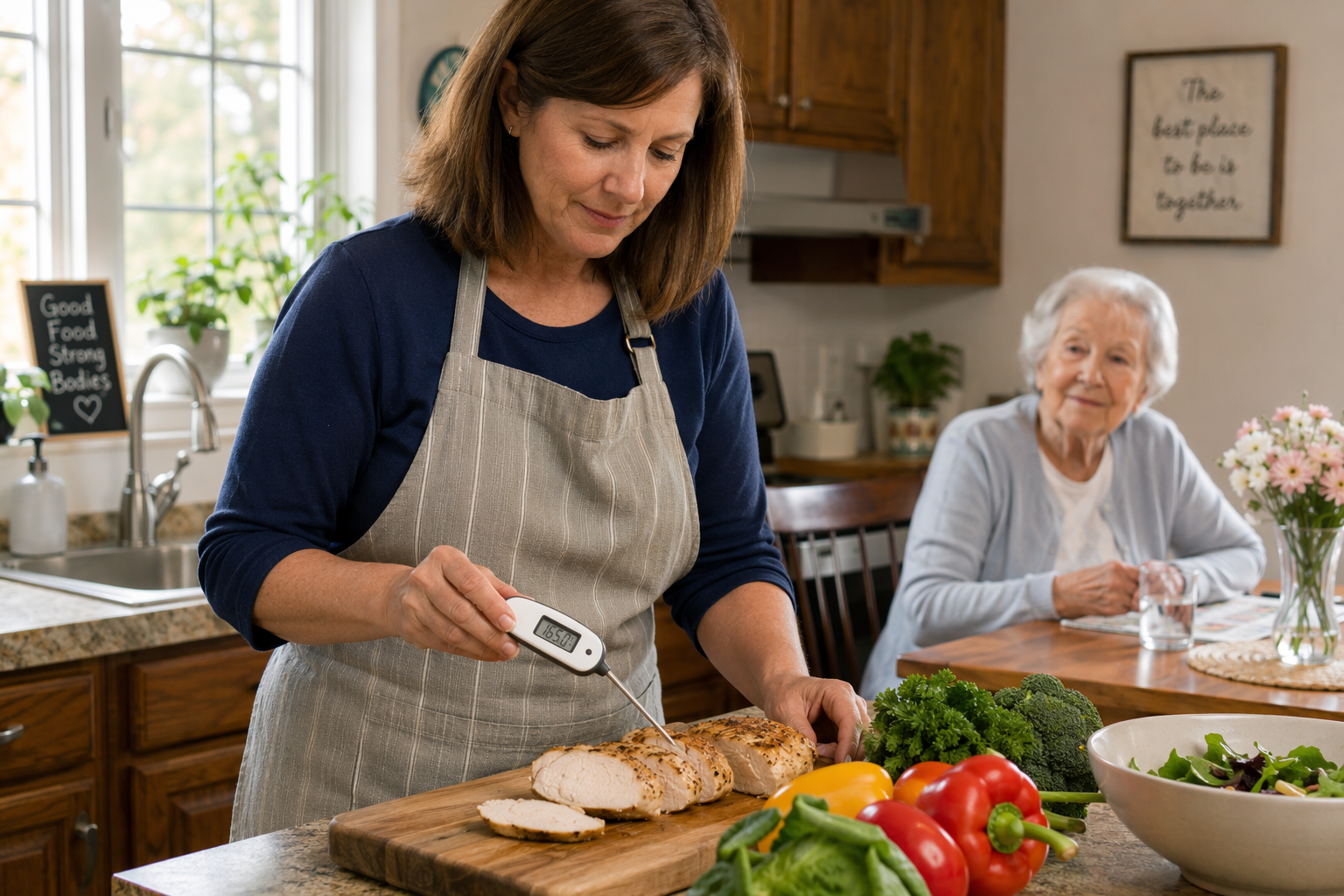
Those numbers are not a reason to run the kitchen like a hospital. They are a reason to stop using smell, thrift, and habit as the final judge. For an older adult, the safer kitchen is built around earlier decisions: what you buy, how much you buy, how quickly you chill it, whether you verify temperature, and whether leftovers are labeled before everyone is tired.
Why the older adult’s kitchen needs a stricter version of ordinary food safety
Three changes make the home kitchen less forgiving with age. First, the body’s defenses change. FDA guidance for older adults notes that aging can reduce stomach acid, which is one of the body’s natural barriers against swallowed bacteria.[4] Second, many older adults have health conditions or treatments that make infection harder to fight. Third, the senses people often rely on to reject spoiled food may be less reliable.
Taste and smell commonly decline with age, especially after age 60, according to Mayo Clinic.[5] That matters at the counter. A younger adult may open milk, smell sourness, and stop. An older adult may not notice the same warning. Even when smell is intact, dangerous bacteria do not always announce themselves with a bad odor or strange taste. The caregiver’s job is to make the date, temperature, and storage history more important than the sniff test.
Medications add another layer. North Dakota State University Extension notes that proton pump inhibitors, or PPIs, reduce stomach acid and that stomach acid helps kill bacteria that cause foodborne illness.[6] H2 blockers also reduce stomach acid. That does not mean every person taking an acid reducer needs a separate rulebook, and it does not prove that one medication alone changes the risk from every food. It does mean a caregiver should treat safe storage, thorough cooking, and prompt chilling as less negotiable when the eater already has fewer natural defenses.
Shopping: buy for the week you actually have
Food safety for an older adult starts before anything reaches the cutting board. The safer shopping trip is not necessarily the most expensive one. It is the one that avoids high-risk shortcuts, buys realistic quantities, and leaves less food sitting half-used in the refrigerator.
- Choose smaller packages when the older adult eats slowly or lives alone; a cheaper bulk pack can become expensive waste if it cannot be used safely.
- Check sell-by, use-by, and best-by dates before buying, especially on dairy, deli items, refrigerated prepared foods, and packaged salads.
- Keep raw meat, poultry, seafood, and eggs separate from produce and ready-to-eat foods in the cart, shopping bags, and refrigerator.
- Make deli foods an occasional, deliberate purchase rather than an open-ended refrigerator staple when the eater is over 65.
- Pay attention to recalls and outbreak notices instead of assuming one bad item will be obvious by sight or smell.
Recalls deserve their own habit. If a current outbreak names a food, brand, lot code, or region, follow that outbreak-specific advice rather than trying to wash, trim, or cook your way around it. For a recent example of how recall guidance changes the day’s food decisions, see Safety Tips for Seniors During the Cyclospora Food Recall.
Storage: make the safe choice visible
A refrigerator can look full and still be unsafe. The problem is rarely that a caregiver does not care. It is that nobody remembers whether the chicken broth was opened Tuesday or Friday, whether the rice cooled quickly, or whether the turkey slices came from this week’s grocery run or last week’s.
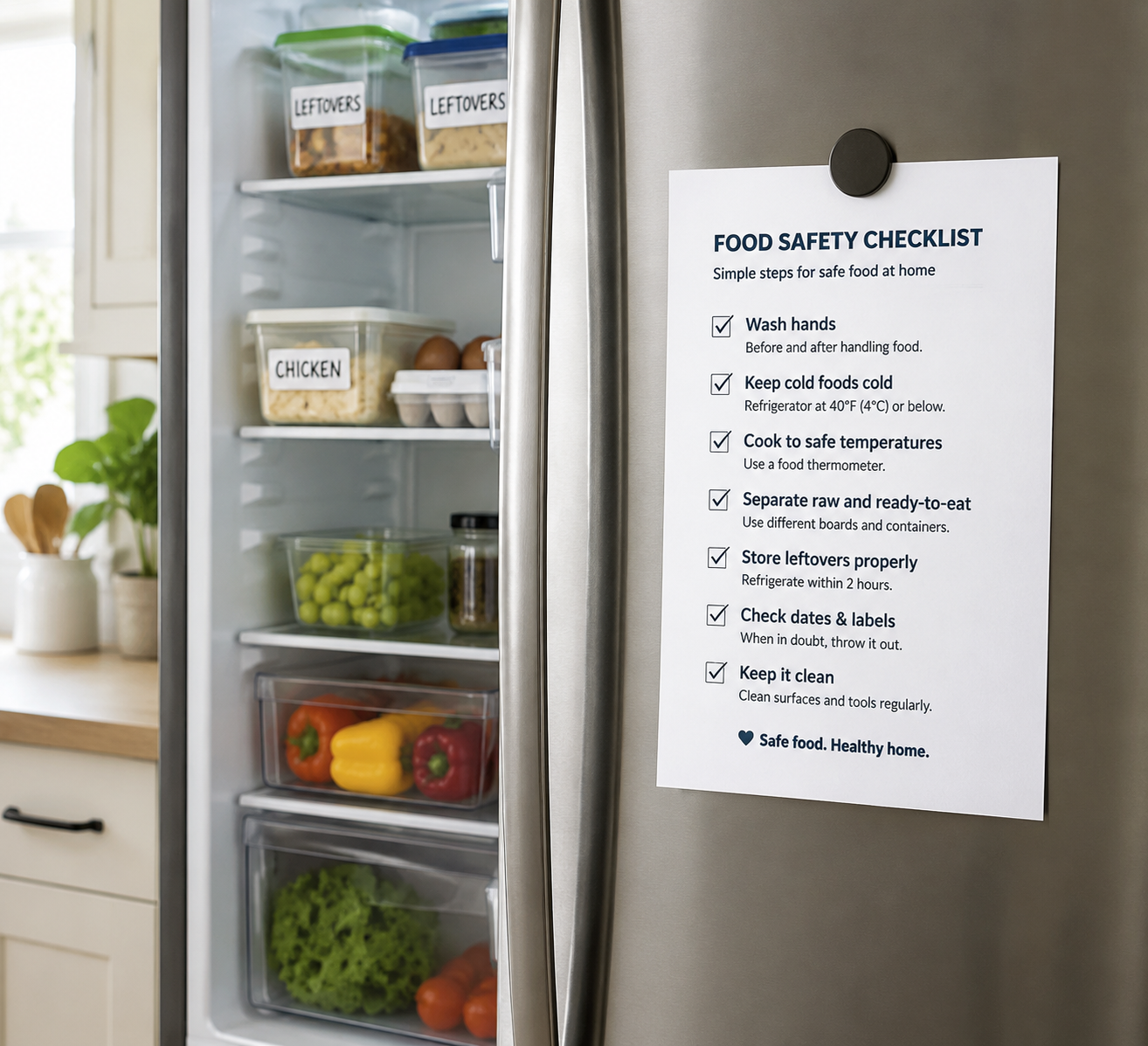
For an older adult’s household, dating food is not fussiness. It is a substitute for unreliable memory and unreliable smell. Put a roll of painter’s tape and a marker near the refrigerator, not in a drawer across the kitchen. Label opened foods and leftovers with the date they were opened or cooked. If more than one caregiver visits, use the same system so the Saturday caregiver does not have to decode the Wednesday caregiver’s containers.
| Refrigerator habit | What changes when cooking for an older adult |
|---|---|
| Opened cartons, jars, and broths | Write the open date on the package before putting it back. |
| Leftovers | Use shallow containers so food cools faster, and label the cooked date. |
| Raw meat, poultry, and seafood | Store below ready-to-eat foods so leaks cannot drip onto food that will not be cooked. |
| Deli meats and soft refrigerated foods | Buy smaller amounts and avoid letting them become “emergency food” with no clear date. |
| Shared caregiving | Keep one visible fridge rule sheet so every helper follows the same system. |
The older adult who hates waste may push back hardest here. A date label can feel like a countdown to throwing money away. The kinder answer is to prevent the waste earlier: split soup into single-meal containers, freeze part of a cooked batch right away, and buy the smaller package of cheese or deli meat when history says the larger one will linger.
Preparation: stop raw food from touching ready-to-eat food
Preparation is where one careless motion can undo a careful shopping trip. Raw chicken on a cutting board, a hand on the faucet, then the same hand reaching for lettuce: that is the ordinary chain that matters more when the person eating is older.
Use separate cutting boards or wash the board, knife, counter, and hands before moving from raw meat, poultry, seafood, or eggs to produce or cooked food. If the caregiver is cooking several dishes at once, prepare foods that will not be cooked first, then raw animal foods later. That order removes one opportunity for raw juices to move into salad, fruit, bread, or a plate of medication-time snacks.
Do not ask the older adult to be the final smell tester. If milk, meat, soup, or deli food is questionable, the safer question is not “Does this smell all right to you?” It is “Do we know when this was opened, and has it been kept cold?”
Cooking: use the thermometer, not the family habit
Many experienced cooks learned doneness by color, firmness, clear juices, or time in the pan. Those cues are not good enough for an older adult’s plate. A digital food thermometer is one of the few kitchen tools that turns a guess into a check.
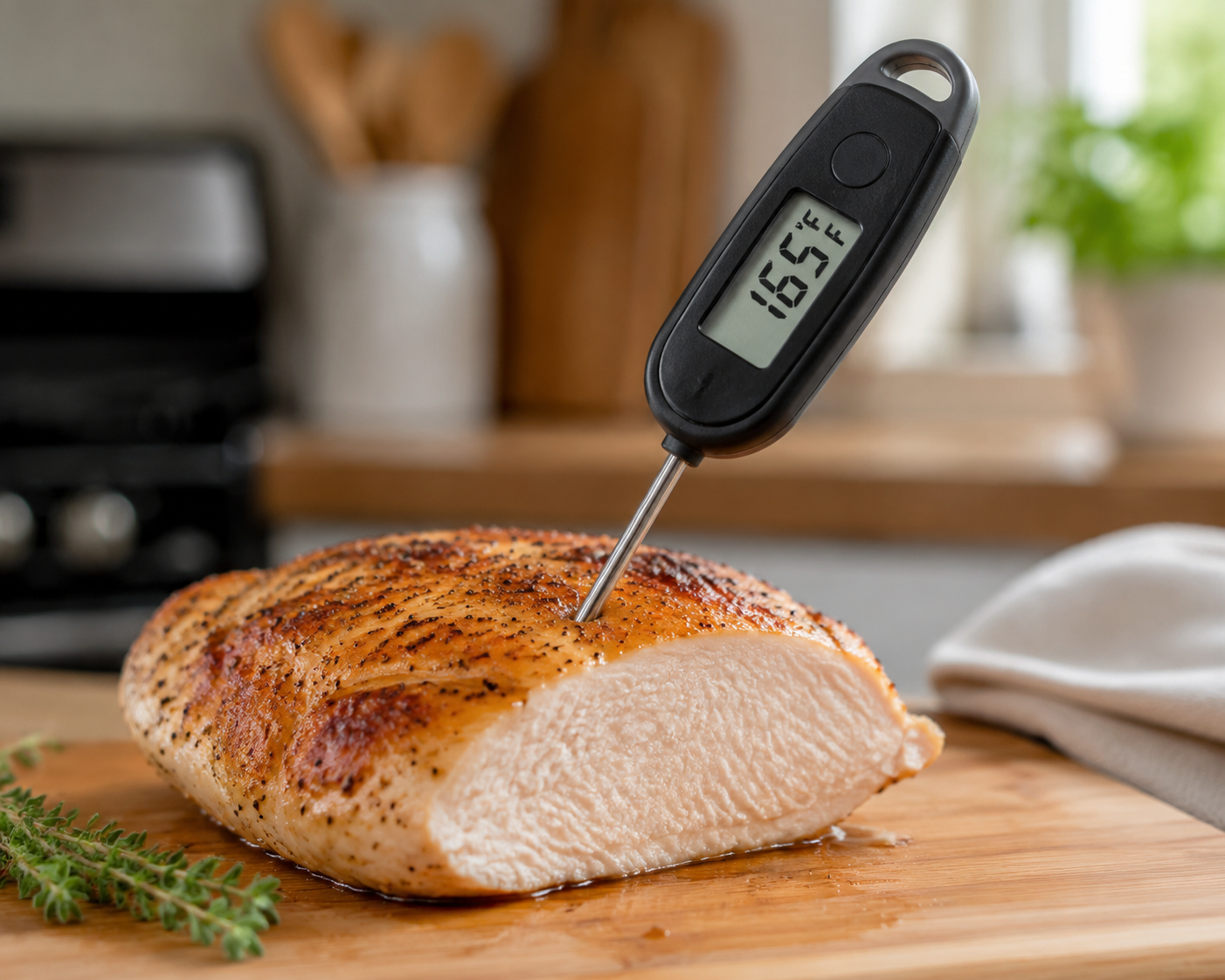
USDA’s safe minimum internal temperatures give caregivers a short list worth taping inside a cabinet: poultry to 165°F, ground meats to 160°F, and whole cuts of beef, pork, lamb, and veal to 145°F with rest time.[7] The thermometer should go into the thickest part of the food, away from bone, fat, or the pan.
| Food | Minimum internal temperature |
|---|---|
| Chicken, turkey, and other poultry | 165°F |
| Ground beef, pork, lamb, and veal | 160°F |
| Whole cuts of beef, pork, lamb, and veal | 145°F, then rest |
Ground meat deserves special attention because bacteria can be mixed through the meat during grinding. A browned hamburger is not the same as a verified 160°F hamburger. Poultry deserves the same bluntness: if the chicken breast looks done but the thermometer has not reached 165°F, it is not done for this purpose.
Batch cooking needs the same standard. If Sunday dinner becomes Monday lunch, Tuesday soup, and Wednesday casserole, each cooked component still needs to reach a safe temperature before it becomes a leftover. Cooking more food at once does not make thermometer use less important; it makes the consequences of one undercooked batch larger.
Serving and leftovers: the clock starts sooner than people think
Home meals stretch. A neighbor stops by, the older adult eats slowly, someone needs help getting to the bathroom, and the casserole sits on the counter because everyone is still “sort of eating.” This is where the clean kitchen can still lose control of the meal.
FoodSafety.gov gives the rule plainly: refrigerate perishable food within 2 hours, or within 1 hour if the temperature is above 90°F.[8] For caregivers, the practical move is to serve smaller amounts and put the rest away earlier. A second helping can come from the refrigerator or a covered pot kept safely hot, not from a full serving dish that has been sitting out through conversation and dessert.
Leftovers should go into shallow containers, not one deep pot that stays warm in the middle. Label the cooked date before the container goes into the refrigerator. If the caregiver is packing lunches for the week, divide portions immediately instead of reopening the same large container every day.
This is also where fixed-income reality belongs in the plan. “When in doubt, throw it out” is medically sensible, but it can sound cruel when groceries are tight. The better routine is to make doubt happen less often: cook smaller batches, freeze earlier, date everything, and keep a visible leftovers shelf so food is eaten while it is still clearly within the household’s safe-use plan.
The medication-aware kitchen
Caregivers often track pills carefully and food safety separately. For older adults, those two routines sometimes meet. Acid-reducing medicines are common, and reduced stomach acid can weaken one natural defense against bacteria. Diabetes treatments, immunosuppressants, cancer treatments, and other therapies may also be part of a larger picture in which the older adult has less margin when exposed to contaminated food.
The right response is not to invent medication-specific food rules at home. It is to raise the floor for everyday practices: fewer high-risk refrigerated ready-to-eat foods, more thermometer checks, faster chilling, cleaner separation of raw and ready-to-eat foods, and less reliance on smell. If a clinician has already told the older adult they are immunocompromised or need to avoid certain foods, that medical advice should override a general household routine.
Medication reviews are a good time to ask one practical question: “Are there foods this person should avoid because of infection risk, not just drug interaction?” The answer may be no. But asking connects the pill organizer to the refrigerator, which is where many real decisions are being made.
When a parent moves in, set up the kitchen before the habits settle
A newly shared household is the easiest time to decide where raw meat goes, which shelf holds leftovers, where the thermometer lives, and who labels food. Once everyone has a habit, changing it takes more negotiation. If an older parent is moving in, the kitchen belongs in the same conversation as bathrooms, medications, driving, and privacy; this guide to 7 Conversations to Have Before an Aging Parent Moves In can help frame that setup.
This article is about home kitchens. Long-term care facilities operate under separate food safety rules, staffing patterns, inspection systems, and reporting responsibilities. If your parent is in a nursing home and you are worried about meals, illness, or unsafe handling, the question shifts from home prevention to monitoring and advocacy; see How to Monitor and Advocate for Your Mother in a Nursing Home.
Printable fridge-door checklist
- Buy smaller amounts of deli foods, dairy, prepared foods, and perishables if they usually sit unfinished.
- Keep raw meat, poultry, seafood, and eggs away from produce and ready-to-eat foods in the cart, bags, refrigerator, and prep area.
- Label opened packages and leftovers with the date before they go back into the refrigerator.
- Use shallow containers for leftovers so food chills faster.
- Do not use smell or taste as the deciding test for questionable food.
- Cook poultry to 165°F, ground meats to 160°F, and whole cuts to 145°F with rest time.
- Put perishable food away within 2 hours, or within 1 hour when the temperature is above 90°F.
- Ask during medication or care reviews whether infection-risk food precautions apply.
- Check recall notices before using foods named in an outbreak.
- Freeze extra portions early instead of waiting until the food is almost too old to keep.
References
- Food Safety for Older Adults, Centers for Disease Control and Prevention.
- FoodNet Surveillance Report, Centers for Disease Control and Prevention.
- People at Risk: Older Adults, USDA Food Safety and Inspection Service.
- Food Safety for Older Adults, U.S. Food and Drug Administration.
- Loss of taste and smell: Natural with aging?, Mayo Clinic.
- Food Safety for Older Adults, North Dakota State University Extension.
- Safe Minimum Internal Temperature Chart, USDA Food Safety and Inspection Service.
- Keep Food Safe! Food Safety Basics, FoodSafety.gov.
Questions to bring to a clinician or OT
This is not medical, legal, or a family's final decision — only a framework. Bring these questions to a clinician, occupational therapist, or your local Area Agency on Aging.
Find Local HelpRelated reading
Noticed something outdated or inaccurate on this page? Flag a correction. We review every report against CDC, NIA, and AARP HomeFit guidance before updating a page.