
Caregiver decision guide
What the PROMISE Act and 2032 Insolvency Mean for Seniors
The PROMISE Act aims to force Congress to address Social Security's 2032 insolvency, but doesn't change benefits today. Learn what the 22% cut would actually cost your parent and three steps to prepare now.
The PROMISE Act does not change your parent’s Social Security check today. It does not cut benefits, raise payroll taxes, change claiming ages, or alter eligibility. It is a procedural bill, introduced on July 14, 2026, that would create a faster path for Congress to consider a future Social Security solvency package, with the Social Security Advisory Board first drafting legislation that meets specific targets such as 50-year solvency and protection for vulnerable beneficiaries.[1]
That is the calming part. The uncomfortable part is that the reason this bill exists is not imaginary. The 2026 Social Security Trustees projection puts the Old-Age and Survivors Insurance trust fund, the retirement and survivor benefit side of Social Security, on track for depletion in the fourth quarter of 2032. If Congress does nothing, payable benefits would be cut by 22% across the board under that projection.[2]
For a family caregiver, the distinction matters. The PROMISE Act is not the cut. The 2032 insolvency projection is the risk. One is a proposed process in Washington; the other is the math that could show up in a parent’s checking account.

What the PROMISE Act Actually Does
The PROMISE Act’s job is to force a solvency discussion into a defined legislative lane. Under the bill summary, the Social Security Advisory Board would be required to draft legislation that keeps Social Security solvent for 50 years, improves the program’s long-term outlook, and protects vulnerable beneficiaries. That draft would then receive expedited consideration in the Senate, where it would still need 60 votes.[1]
That last number is not a small procedural detail. A 60-vote threshold means the bill does not let a narrow majority quietly rewrite retirement income rules. It also means passage is not guaranteed. The PROMISE Act can create a lane; it cannot make senators agree on the destination.
The bill also includes a decennial review cycle, meaning Social Security’s finances would not be treated as a once-in-a-generation emergency and then ignored again. Serious policy groups have endorsed the approach because it tries to turn an avoided problem into a scheduled one.[1]
But for your parent’s household budget, the immediate answer remains simple: no current benefit changes flow from the PROMISE Act itself. If your father receives $2,100 this month, the bill does not turn that into a smaller deposit next month. Any actual benefit, tax, or eligibility change would have to come through later legislation.
Why the 2032 Date Still Deserves Attention
The number to put on the kitchen table is not “insolvency.” It is the missing monthly dollars.
CRFB’s June 2026 state analysis estimated that an average retiree benefit of $2,071 per month would fall by roughly $500 per month under its insolvency scenario. Its state-by-state estimates ranged from a $459 monthly cut in Mississippi to a $556 monthly cut in Connecticut.[3]
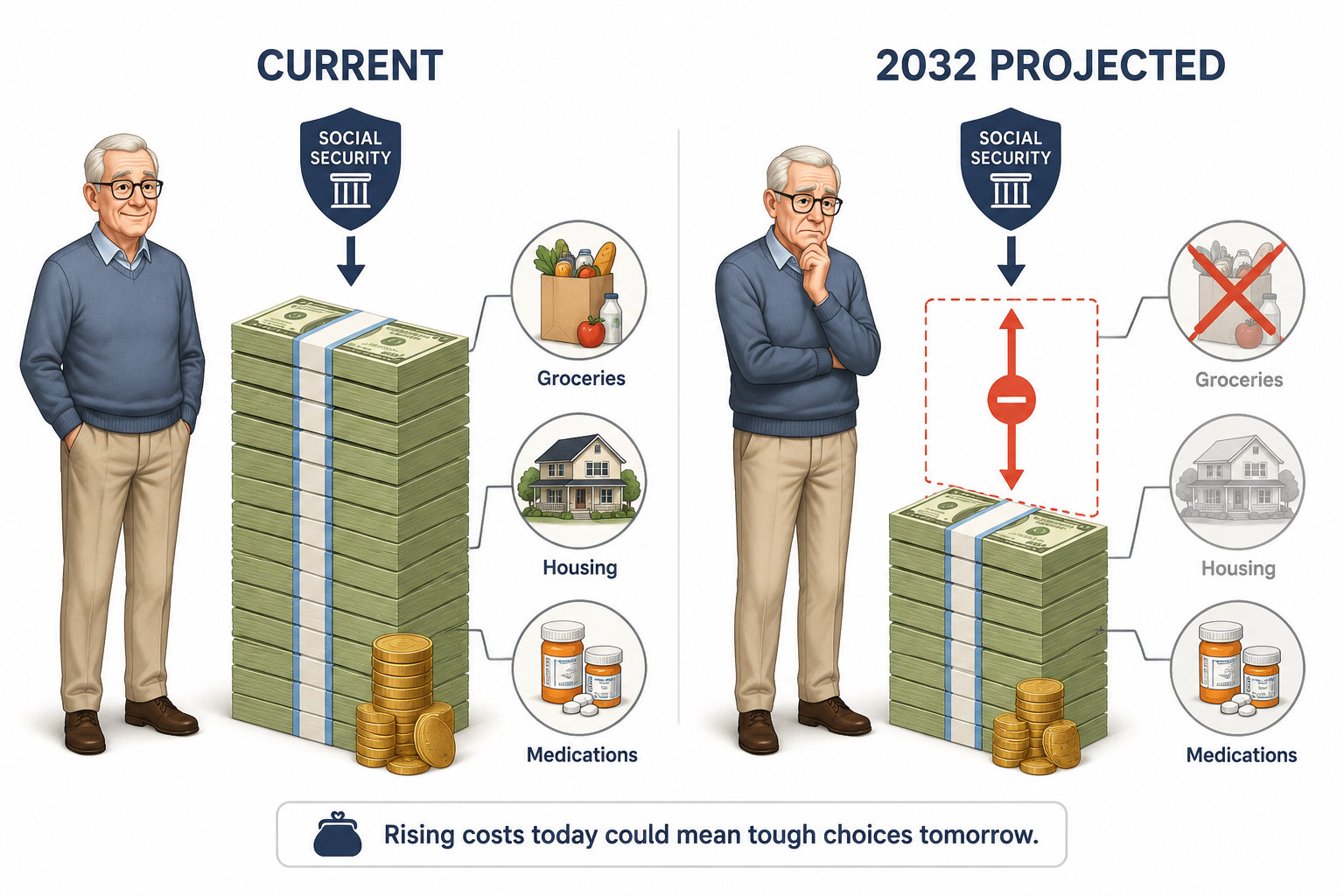
There is a technical wrinkle behind that estimate. The 2026 Trustees Report points to a 22% cut for the OASI trust fund in 2032, while CRFB’s “No State Spared” state analysis used a 24% cut assumption based on 2024 beneficiary data projected forward.[2][3] For household planning, that is why a 20% to 24% stress test is more useful than pretending there is one exact dollar figure for every family.
A $458 to $500 monthly loss is not a Washington abstraction. It is the grocery order, the Medicare supplement premium, the property tax escrow shortage, the utility bill in a hot month, or the paid help that lets a parent stay safely at home. If your parent’s plan to age in place already depends on a thin monthly margin, the insolvency projection belongs in the same conversation as housing, transportation, and care support. That is also why related planning around whether Social Security reform could endanger your parent’s home is not a side issue.
| Monthly Social Security benefit | 20% stress test | 22% stress test | 24% stress test |
|---|---|---|---|
| $1,500 | $300 less per month | $330 less per month | $360 less per month |
| $2,071 average benefit | About $414 less per month | About $456 less per month | About $497 less per month |
| $2,500 | $500 less per month | $550 less per month | $600 less per month |
| $3,000 | $600 less per month | $660 less per month | $720 less per month |
The table is deliberately blunt. It does not try to forecast COLAs, taxes, Medicare premiums, or future reform. It answers the question a caregiver can actually work with this month: if the check were 20% to 24% smaller, what breaks first?
The 22% Versus 17% Confusion
You may see another date and another cut: 2034 and 17%. That is not necessarily someone being careless, but it is often presented without enough context.
The 22% figure refers to the Old-Age and Survivors Insurance trust fund by itself. That is the retirement and survivor benefit trust fund, and the 2026 Trustees projection places its depletion in the fourth quarter of 2032.[2] The 2034 date generally refers to the combined OASI and Disability Insurance trust funds, which produces a smaller projected cut when the two programs are discussed together.[4]
For a retired parent’s monthly check, the OASI-only number is the one many caregivers will want to stress-test against because it is the retirement-benefit trust fund directly tied to that check. That does not mean the 17% figure is fake. It means the two figures measure different trust fund combinations.
Why Waiting Makes the Household Math Worse
Most families cannot fill a $500 monthly hole overnight. That is especially true when the person affected is already retired, has limited work flexibility, or is depending on adult children for rides, paperwork, repairs, or unpaid care.
Kiplinger, citing PensionBee’s 2026 Shortfall Index, reported that a 61-year-old would need to save $1,772 per month to fully offset a 22% Social Security cut, while a 55-year-old would need to save $824 per month.[5] Those figures rely on planning assumptions, including 5% investment returns and a 4% withdrawal rule, so they are not guarantees. They are still useful for one reason: they show how expensive delay becomes.
This is where panic headlines do damage. If they make the situation sound hopeless, families stop looking at the numbers. If they make every introduced bill sound like an immediate cut, families waste energy reacting to the wrong thing. The useful middle ground is to plan as if Social Security could deliver less than the scheduled benefit, while not pretending it will disappear altogether.
The same discipline matters with COLA expectations. A cost-of-living adjustment can raise the nominal check, but it does not automatically keep up with the care costs that many older adults actually face. If your parent’s budget is already tight after housing, prescriptions, insurance, and support services, it is worth reading the 2032 risk alongside the 2027 Social Security COLA forecast rather than treating each headline separately.
Run the 2032 Stress Test With Your Parent’s Actual Check
Start with the real benefit amount, not the national average. Pull your parent’s Social Security statement or current benefit record and write down the monthly deposit. If there is a spouse, surviving spouse, divorced spouse, or disabled adult child benefit in the picture, do not guess. The household risk may depend on survivor benefits as much as the main retirement check.
Then calculate three numbers: 20%, 22%, and 24% of the current monthly benefit. The 22% figure comes from the 2026 Trustees projection for OASI depletion; the 24% figure appears in CRFB’s state-by-state insolvency analysis; the 20% figure gives you a slightly lower planning case that is still severe.[2][3]
- If your parent receives $1,800 per month, a 22% cut is $396 less per month.
- If your parent receives $2,200 per month, a 22% cut is $484 less per month.
- If your parent receives $2,700 per month, a 22% cut is $594 less per month.
After that, do not jump straight to investment solutions. Walk the household budget first. Which bills are fixed? Which are flexible in theory but not really flexible for an older adult? Groceries can be reduced only so far. Transportation may already be pared down. Medical costs may rise exactly when income flexibility falls. Paid help may be the thing keeping an adult child from losing work hours.
For senior couples, this stress test should also include what happens after the first spouse dies. A household that can absorb a cut while both checks are coming in may be much more fragile after one benefit changes or disappears. If you are already coordinating benefits, Medicare costs, and monthly cash flow for both parents, fold this into broader financial planning for a senior couple rather than treating Social Security as a separate file.
Use State Estimates Carefully
CRFB’s state numbers are helpful because they make the risk feel local. A caregiver in Mississippi can see an estimated $459 monthly average cut; a caregiver in Connecticut can see an estimated $556 monthly average cut.[3] But those are state averages, not your parent’s exact future benefit. Your parent’s work history, claiming age, survivor status, and household expenses matter more than the state average once you sit down with the bank statement.
Have the Conversation Before It Becomes a Crisis
The best conversation is not “Social Security is going broke.” That phrase is too vague and too frightening to be useful. A better opening is concrete: “If your check were about $500 lower one month, what would we change first?”
That question does not predict that the cut will happen. Congress may act before 2032. The PROMISE Act may pass, stall, or be changed. A future solvency package could include tax changes, benefit formula changes, revenue increases, protections for lower-income seniors, or some mix that is not yet knowable from this bill alone.
The point is to reduce surprise. A parent who resists abstract planning may be willing to talk about the electric bill, the homeowners insurance renewal, the prescription copay, or whether the adult child would be expected to cover a shortfall. If dementia or cognitive decline is also part of the household picture, the money conversation should happen even earlier because financial flexibility and decision-making capacity can both narrow over time. Caregivers in that situation may need to consider the hidden financial toll of dementia alongside any Social Security planning.
For this month, the practical work is limited and specific.
- Pull the current Social Security benefit amount and confirm whether survivor or spousal benefits could matter later.
- Calculate what a 20%, 22%, and 24% reduction would mean in monthly dollars.
- Compare that dollar gap with fixed expenses first: housing, insurance, utilities, prescriptions, food, transportation, and paid care.
- Ask your parent which expense they would least want to lose, then identify what would have to change to protect it.
- Separate today’s action from tomorrow’s politics: monitor the PROMISE Act, but do not treat it as a current benefit cut.
That is enough for now. The PROMISE Act may or may not become law. The 2032 projection may be changed by Congress before it reaches your parent’s account. But you can know the number, test the budget, and begin the conversation while there is still time to make choices instead of scrambling around a missing deposit.
References
- Fact Sheet: The PROMISE Act, BPC Action.
- Analysis of the 2026 Social Security Trustees' Report, Committee for a Responsible Federal Budget.
- No State Spared: Mapping the Impact of Social Security's Insolvency, Committee for a Responsible Federal Budget, June 2026.
- Social Security's Trustees Project Shortfall in 2034, AARP.
- How Much Would Social Security's 2032 Shortfall Cost You?, Kiplinger.
Questions to bring to a clinician or OT
This is not medical, legal, or a family's final decision — only a framework. Bring these questions to a clinician, occupational therapist, or your local Area Agency on Aging.
Find Local HelpRelated reading
Noticed something outdated or inaccurate on this page? Flag a correction. We review every report against CDC, NIA, and AARP HomeFit guidance before updating a page.