
Caregiver decision guide
What to Do When Your Elderly Parent Is in a Flood Zone
A timeline-sequenced action plan for adult children whose elderly parent lives in a flood zone, covering insurance enrollment, medical continuity, evacuation decisions, and post-flood health surveillance.
If your parent’s address is in a flood zone, the first uncomfortable fact is not about sandbags. It is about time. Flood insurance through the National Flood Insurance Program generally does not take effect until 30 days after purchase, so a policy bought after a threatening forecast may arrive too late for that storm.[1]
That changes what to do when an elderly parent is in a flood zone. The work has to start before the weather report becomes urgent, and it has to account for the parent who uses a walker, forgets a second blood pressure pill, depends on oxygen or CPAP, cannot hear an alert tone, or will not leave home just because an adult child says it is time.
| When | What to do |
|---|---|
| Today | Confirm the flood risk, check whether flood insurance is active, identify the parent’s county emergency contacts, and write down medical dependencies another person could use at 2 a.m. |
| This week | Build the parent-specific go-bag, refill or request medication backups where possible, copy documents, confirm device power needs, and ask the county about special-needs evacuation registration. |
| Before the season peaks | Renew county registry information if required, line up transportation, choose realistic evacuation destinations, and assign who calls, drives, packs, and follows up. |
| When a flood watch, warning, or evacuation order appears | Decide early whether sheltering or evacuation is safer based on the parent’s function, destination, road conditions, medical equipment, and caregiver availability. |
| After water recedes | Monitor for injuries, skin problems, medication interruption, respiratory symptoms, confusion, pain, and delayed complications during cleanup and the following weeks. |
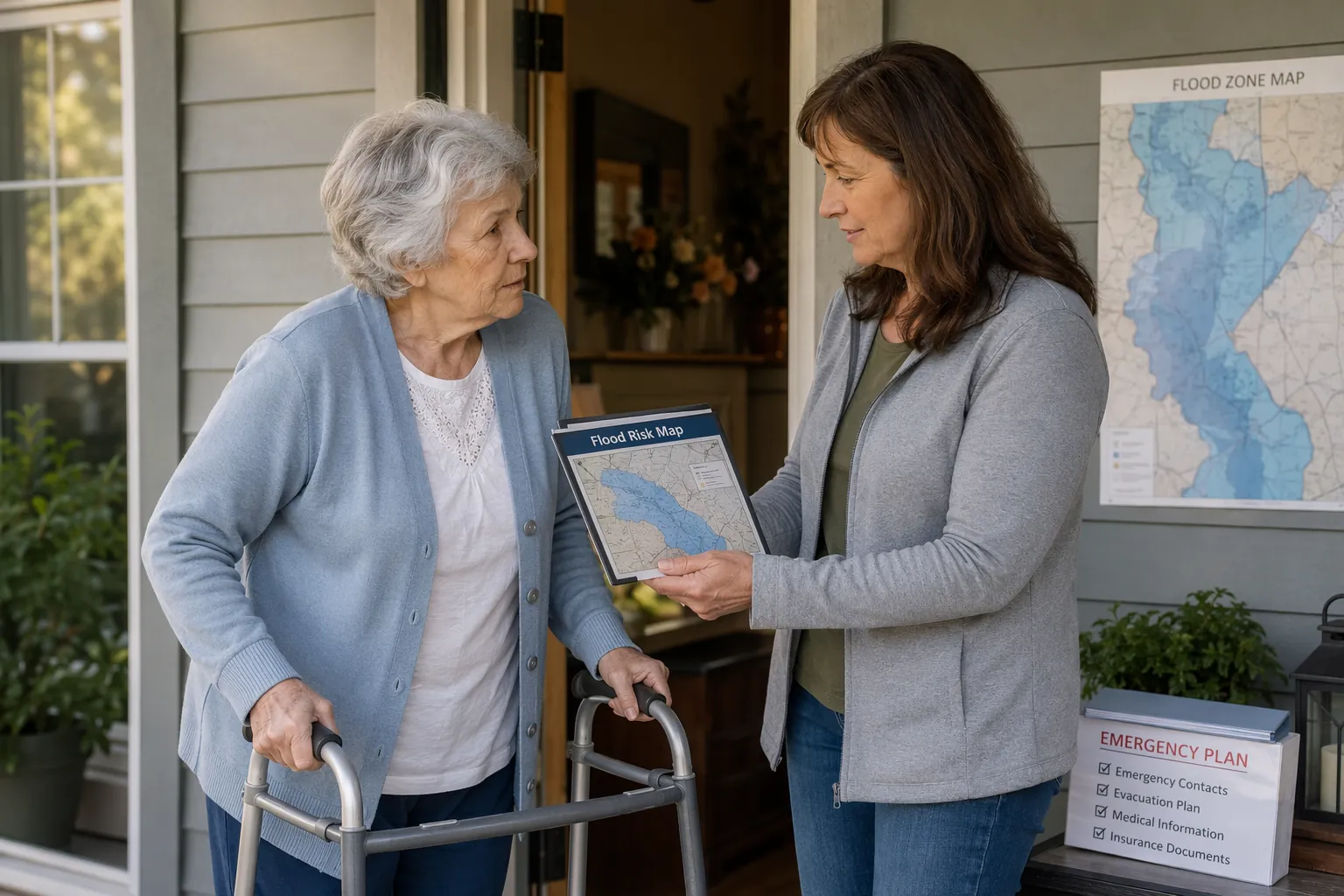
Today: Verify the Risk and the Insurance Before the Forecast Forces Your Hand
Start with the address, not the family debate. Confirm whether the home is in a FEMA-designated flood zone or another locally recognized flood-prone area. Then find the insurance paperwork and answer one plain question: is there an active flood policy now?
A homeowners policy is not the same thing as flood insurance. The NFIP is the federal program most families encounter when buying flood coverage, and its 30-day waiting period is the reason this task belongs at the top of the list.[1] FEMA’s flood insurance information also directs consumers to understand flood risk and coverage before damage occurs, not during recovery.[2]
If your parent has a mortgage, do not assume coverage is current. Ask to see the declarations page, premium due date, policy number, insurer or agent contact, and named insured. If your parent owns the home outright, the absence of a lender requirement may mean no one has checked the policy in years.
This is not a small gap. AARP reports that only about 1 in 3 older adults have flood insurance.[3] That number is a warning to adult children: many parents who are careful about Medicare cards, pill bottles, and property taxes may still be financially exposed to flood damage.
There is also a 2026 policy detail to verify. As of Q3 2026, the NFIP is set to expire on September 30, 2026 unless Congress reauthorizes it. If you are buying or renewing coverage near that date, ask the insurance agent or check FEMA/NFIP updates for any lapse-related effect on new policies or renewals.[2]
What to collect before you end the insurance call
- Policy number, carrier, agent phone number, and effective date.
- Whether the policy covers building only, contents, or both.
- How to file a claim if the parent evacuates and cannot access the home.
- Photos or video of the home’s condition before a storm, stored somewhere the caregiver can reach.
- A waterproof paper copy for the go-bag and a digital copy shared with the person handling recovery.
If you live far away, this is the point where distance stops being an inconvenience and becomes part of the plan. The person who can review a policy online may not be the person who can move a recliner off a wet floor. A broader long-distance caregiving plan should name the local neighbor, friend, relative, church contact, building manager, or paid aide who can physically check on your parent when roads are still open.
This Week: Turn Medical Details Into Instructions Someone Else Can Use
An emergency plan for an older parent is only useful if a tired person can use it in poor light with bad cell service. The goal is not a perfect binder. The goal is a short, current record that keeps medication, equipment, and diagnoses from depending on one person’s memory.
Ready.gov’s older-adult guidance tells older adults to plan around medical, transportation, and communication needs, including assistance with evacuating and maintaining supplies.[4] The caregiver version is more direct: write down what your parent needs to stay medically stable, who provides it, and what fails first if power, transportation, pharmacy access, or routine disappears.
- Current diagnoses, including memory problems, heart or lung disease, diabetes, kidney disease, seizure history, swallowing problems, and fall risk.
- Medication list with dose, timing, prescribing clinician, pharmacy, and which medications cannot be skipped safely.
- Allergies, including medication allergies and serious food or latex reactions.
- Medical devices: CPAP, oxygen, nebulizer, insulin supplies, glucose monitor, hearing aids, pacemaker information, wheelchair, walker, hospital bed, lift chair, or catheter supplies.
- Power needs: which devices require electricity, battery duration if known, charger location, backup battery status, and whether the parent can operate the device without help.
- Clinician, pharmacy, home health agency, oxygen supplier, durable medical equipment vendor, and emergency contacts.
Medication deserves its own check. AARP and Ready.gov materials note that roughly 1 in 3 adults 50 and older have no extra prescription medication stored for emergencies.[5] Some insurers and pharmacies limit early refills, but the call is still worth making before a storm: ask whether the pharmacy can provide an emergency supply, synchronize refills, print a medication profile, or help transfer prescriptions if evacuation becomes necessary.
Do not rely on the pill organizer alone. A filled organizer tells you what was prepared, not always what was prescribed, stopped, or changed. Keep the printed medication list with the go-bag, take a photo of each current bottle, and update the list after doctor visits.
Register for Local Assistance Before Anyone Is Ordering Evacuations
Many counties maintain special-needs, medical-needs, or transportation-assistance registries for residents who may need help during evacuation or sheltering. These systems are local, and they are not all the same. Some are for transportation; some identify people who may need medical support in a shelter; some share information with emergency management. They are not a private ambulance reservation, and they do not remove the family’s responsibility to plan.
The useful principle is simple: ask your parent’s county emergency management office now, complete the local application before hurricane or flood season peaks, and renew it as required. First Contact’s disaster-preparedness hub describes county-level special-needs shelter registration and notes representative county examples such as Pinellas County at 727-464-3800 and Hernando County at 352-754-4083.[6] NOLA Ready also provides a local access point for seniors and people with medical needs.[7]
Annual renewal matters because a parent’s needs change. A person who could transfer from bed to wheelchair last year may now need two-person help. A person who once used a cane may now depend on a walker. A new oxygen order, dialysis schedule, dementia diagnosis, or catheter changes the shelter and transportation discussion.
Questions to ask the county
- Does my parent qualify for a special-needs, medical-needs, or transportation registry?
- How often must the registration be renewed?
- Does registration include evacuation transportation, shelter placement, wellness checks, or only planning information?
- Can a caregiver complete or update the form, and what consent is needed?
- What medical equipment, caregiver support, bedding, food, medications, and supplies must the family bring?
- Are pets allowed, and if not, what is the county’s pet shelter process?
A county registry is not a promise that someone will appear exactly when your parent needs help. It is one layer. The second layer is your own named backup: the person who checks whether your parent actually answered the phone, found the go-bag, and can get to the pickup point.
Build a Go-Bag Around the Parent You Actually Have
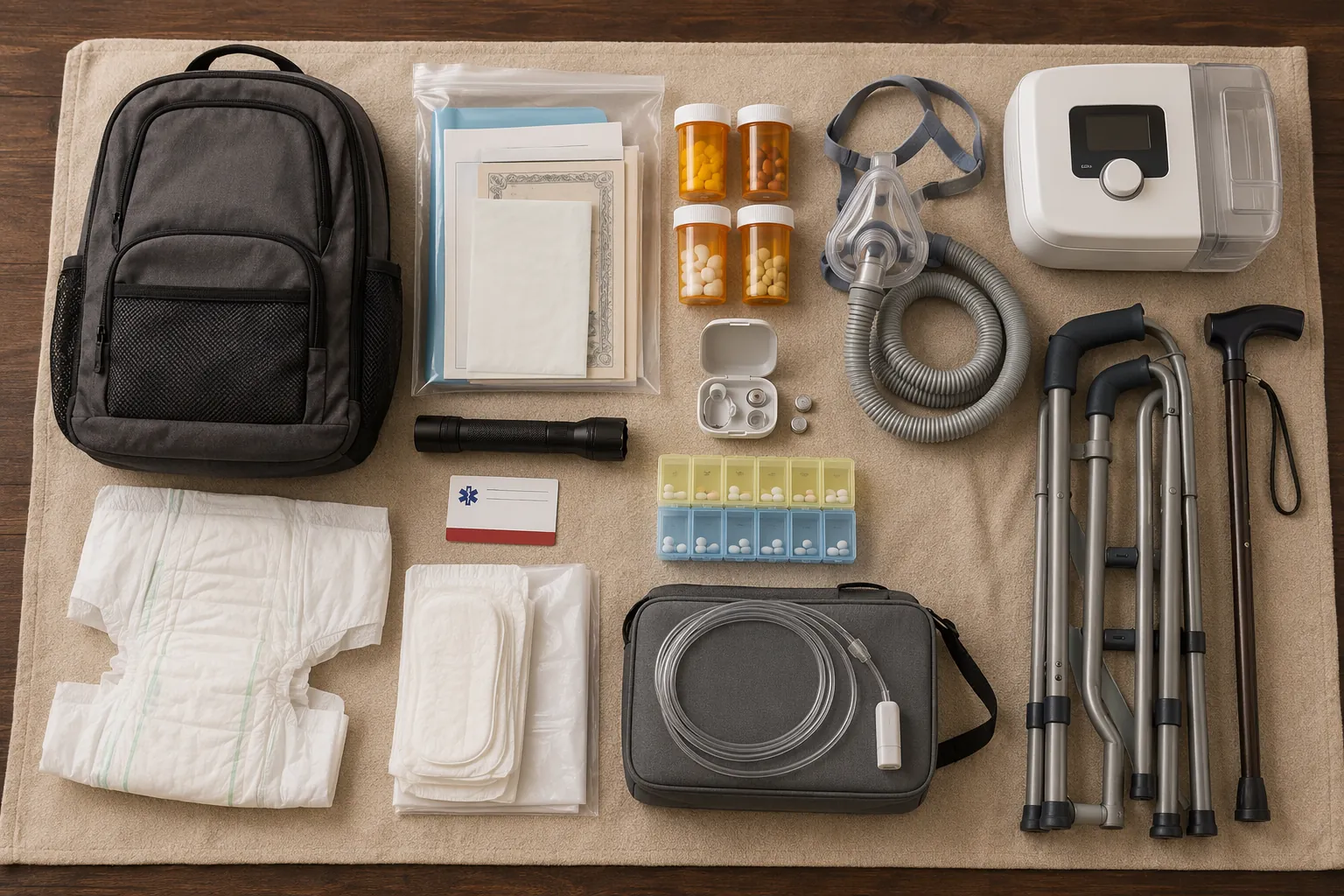
A generic emergency kit is a start, but it often misses the things that make an older parent safe enough to function away from home. Water and flashlights matter. So do dentures, hearing aid batteries, CPAP tubing, incontinence supplies, and the one charger that fits the mobility scooter.
Pack the bag as if your parent might spend a night somewhere noisy, crowded, unfamiliar, and short-staffed. That means the bag should reduce confusion for your parent and reduce guesswork for whoever is helping.
| Need | What to pack or document |
|---|---|
| Medications | Current medication list, several days of essential medications if allowed, pill organizer, pharmacy contact, prescriber contact, and photos of prescription labels. |
| Breathing support | CPAP or BiPAP machine, mask, tubing, filters, distilled-water plan if needed, extension cord, backup battery if available, oxygen supplier contact, and oxygen prescription details. |
| Hearing and vision | Hearing aid case, spare batteries or charger, glasses, magnifier, written communication card, and large-print emergency contacts. |
| Mobility | Walker, cane, wheelchair cushion, transfer belt if used, spare rubber tips if available, lightweight blanket, and a note describing transfer assistance needs. |
| Continence and catheter care | Incontinence briefs, wipes, barrier cream, disposable bags, catheter supplies, drainage bags, gloves, and written instructions if a caregiver normally helps. |
| Diabetes or other monitoring | Glucose meter, strips, lancets, batteries, insulin storage plan, snacks appropriate to the parent’s diet, and hypoglycemia instructions. |
| Cognition and behavior | Dementia diagnosis note if applicable, calming routine, preferred name, emergency contacts, photo ID, and a brief script explaining what helps when the parent is frightened or disoriented. |
| Documents | Insurance cards, flood policy information, Medicare or Medicaid card, photo ID, health care proxy or power of attorney if available, advance directive if available, and a waterproof folder. |
Put a second copy of the essential medical page on the refrigerator or inside the front door if local responders recommend that practice. Keep another copy with the adult child or designated caregiver. If the parent resists a large bag by the door, start smaller: a folder, medication list, device list, and phone numbers are still progress.
The home setup matters too, especially when wind, water, darkness, and rushed movement combine. Clear the path from bed to bathroom, keep shoes and walker within reach, and think through lighting during outages. A storm-specific fall-prevention checklist can help with the indoor hazards that appear before the water ever reaches the door.
Do Not Assume the Warning Will Reach Your Parent First
Emergency systems often speak as if every resident receives the same message at the same time. Families know better. The adult child may see the county alert, the neighbor may hear the siren, and the parent may still be watching an old movie with the phone in another room.
AARP’s Disaster Resilience Tool Kit reports that only about 12% of adults 50 and older follow local emergency authorities on social media.[8] That does not mean older adults are careless. It means a warning plan that depends on Facebook, X, or a county post reaching your parent directly is not a plan.
- Sign up for county emergency alerts yourself and, with permission, on your parent’s phone.
- Identify one non-digital warning source your parent actually uses, such as local TV, radio, NOAA weather radio, building announcements, or a neighbor.
- Create a call order: adult child, local contact, neighbor, building manager, home health aide, or faith-community contact.
- Use short instructions during an event: answer the phone, put on shoes, take the folder, take the medication bag, unlock the door if help is coming.
- Decide in advance what happens if your parent does not answer.
The last item is the one families avoid until it happens. If your parent misses calls, will the neighbor knock? Does anyone have a key or lockbox code? Can the building manager do a wellness check? Which emergency number is appropriate in that county? These decisions are easier to make on a clear afternoon than during rising water.
When a Watch or Order Appears: Decide Early, Not Perfectly
Evacuation is not automatically safer for every older adult in every situation. That sentence matters. Moving a frail person can cause falls, delirium, medication interruption, exhaustion, and distress. AARP’s toolkit notes research on nursing home residents showing that hurricane evacuations caused more deaths than the storms themselves in some events, a transfer-trauma concern that applies most directly to institutionalized residents.[8]
That evidence should make families careful, not passive. A community-dwelling parent with a safe destination, a prepared medication supply, working transportation, and a familiar caregiver may be safer leaving early than waiting until elevators stop, roads flood, or emergency responders are stretched thin. NOLA Ready describes shelters as a last option for seniors, which is a useful reminder to prioritize familiar, accessible destinations when they are available.[7]
A practical evacuation decision frame
| Question | Why it matters |
|---|---|
| Can the parent safely transfer, walk, toilet, and take medications at the destination? | A safer building is not enough if the parent cannot function there. |
| Is the destination accessible? | Stairs, low toilets, narrow bathroom doors, loose rugs, and no backup power can turn a relative’s home into a hazard. |
| Will essential equipment work? | CPAP, oxygen concentrators, nebulizers, electric beds, lift chairs, refrigerated medications, and charging-dependent devices need a power plan. |
| How long is the drive, and can the parent tolerate it? | Pain, urinary urgency, dementia-related agitation, oxygen needs, and fall risk during rest stops can change the answer. |
| Who is physically doing the transfer and driving? | A plan that says “evacuate” but names no driver, helper, vehicle, or pickup time is not operational. |
| What happens if the parent refuses? | Refusal needs a calm script, an escalation plan, and a boundary for when danger overrides delay. |
| What is the road and timing situation? | Leaving earlier may reduce the hazards created by darkness, congestion, flooded roads, closed bridges, and unavailable transportation. |
For many families, the strongest plan is not “shelter” or “evacuate” in the abstract. It is a preselected first destination, a backup destination, and a shelter option only if the first two fail. The first destination might be the adult child’s home, a sibling’s accessible guest room, a hotel outside the flood area with an elevator and generator questions answered, or a friend’s single-story home. The backup might be a county-designated shelter or medical-needs shelter if the parent qualifies.
Resistance deserves respect without letting time disappear. An older parent may hear evacuation as loss of control: strangers, noise, dependence, fear of never returning, fear of being placed somewhere permanently. Try concrete language: “We are leaving early so you can bring your walker, your machine, and your own medications. Waiting means other people may have to move you in a hurry.”
If the flood-zone issue exposes that your parent can no longer respond safely to ordinary emergencies, it may be part of a larger independence discussion. In that case, the flood plan should sit alongside the broader warning signs that a parent can no longer live alone, rather than being treated as a one-time storm problem.
Why Older-Adult Flood Planning Cannot Be Generic
The numbers behind this are sobering, but they are most useful after the action path is already visible. AARP’s Disaster Resilience Tool Kit reports that 50% of Hurricane Katrina deaths were among people age 75 and older, even though that group made up 6% of New Orleans’ population. It also reports that 61 of 87 Hurricane Ian fatalities were people age 60 and older.[8]
More older adults are also living where coastal flood and storm risk matters. Climate Central, using U.S. Census data, reported that the age-65-and-older population in coastal areas grew 89% from 1970 to 2010.[9] That growth does not prove any one parent is unsafe in any one house. It does mean that adult children are increasingly likely to be coordinating care across flood exposure, aging bodies, and long-established homes their parents do not want to leave.
The planning burden lands in the space between independence and dependence. A parent may still cook, pay bills, and live alone, yet be unable to lift a go-bag, read a small-print medication label in dim light, climb shelter stairs, hear a phone alert, or wait in a long line without a bathroom plan. That is why the plan has to name functions, not just supplies.
After the Water Recedes, Keep Watching
Families often relax when the flood warning ends. For an older parent, the health risk may be moving into its next stage: cleanup, disrupted routines, damp air, contaminated surfaces, unstable flooring, missed medications, and pain from doing too much too soon.
A July 2025 Harvard T.H. Chan School of Public Health news summary described an underlying study of 4.5 million hospitalizations over 17 years and found increased hospitalization risks for older adults after flooding. Skin disease hospitalizations rose 3.1%, peaking at 4.5% during the flood event; nervous system disease hospitalizations rose 2.5%, peaking at 4.0% in week 3; musculoskeletal disease hospitalizations rose 1.3%, peaking at 5.6% in week 4; and injury hospitalizations rose 1.1%, peaking at 1.7% in week 4.[10]
The same Harvard summary reported that respiratory hospitalizations initially decreased but rose 8 to 12 weeks later, a pattern linked in the summary to mold exposure.[10] That delayed timing is important because a parent may appear to have “gotten through it” and then develop coughing, wheezing, shortness of breath, fatigue, or worsening COPD weeks after cleanup begins.
The study summary also noted inequities: communities with higher proportions of Black residents experienced exacerbated effects for skin diseases, up 6.1%, and mental health impacts, up 3.0%.[10] For caregivers, that is not an abstract footnote. It is a reason to watch more closely when the parent’s neighborhood already has fewer cleanup resources, weaker housing conditions, limited transportation, or slower access to care.
What to monitor in the weeks after a flood
- Skin: redness, swelling, wounds, rashes, pressure areas, foot problems, or any cut exposed to floodwater.
- Injuries and mobility: new pain, limping, falls, weakness, back strain, difficulty transferring, or fear of walking.
- Nervous system and cognition: new confusion, dizziness, worsening tremor, severe headache, medication errors, or unusual sleepiness.
- Respiratory symptoms: cough, wheeze, shortness of breath, chest tightness, increased inhaler use, or symptoms that appear weeks later.
- Medication and chronic disease control: missed doses, lost pills, insulin storage problems, blood sugar changes, blood pressure changes, or delayed dialysis or oxygen supply.
- Mood and behavior: withdrawal, panic, agitation, poor sleep, grief over damaged belongings, or refusal to return home.
If the home flooded, do not send a frail parent back into cleanup as a test of resilience. Wet flooring, debris, extension cords, mold, heat, and displaced furniture are fall and respiratory hazards. The adult child or local helper should photograph damage, contact the insurer, separate salvage decisions from health decisions, and keep the parent away from unsafe work whenever possible.
Assign the Work Before the Weather Assigns It for You
The final plan does not need to be elegant. It needs names next to tasks.
| Task | Named person |
|---|---|
| Checks flood insurance and stores policy documents | Adult child, parent, or financial helper |
| Updates medication, diagnosis, allergy, and device list | Adult child, parent, nurse, aide, or primary caregiver |
| Registers or renews county special-needs or transportation assistance | Adult child or parent, depending on consent and local rules |
| Maintains go-bag and device supplies | Person who visits most often |
| Receives emergency alerts and calls the parent | Primary caller plus backup caller |
| Physically checks on the parent if calls fail | Local contact with access plan |
| Drives or arranges evacuation | Named driver plus backup transportation option |
| Monitors health after return or cleanup | Adult child, local caregiver, clinician, or home health contact |
Flood preparedness for an elderly parent is not one checklist. It is care coordination under weather pressure: buy or verify insurance early, document medical dependencies, register for local assistance before the storm, decide evacuation based on the parent’s actual function and destination, and keep watching health after everyone else says the flood is over.
References
- NFIP, Floodsmart.gov
- Flood Insurance, FEMA.gov
- How Caregivers Can Build Emergency Plans for Loved Ones, AARP
- Older Adults, Ready.gov
- Disaster Preparedness Guide for Older Adults, FEMA/Ready.gov, 2023
- Disaster Preparedness for Older Adults & Caregivers, First Contact
- Seniors & People with Medical Needs, NOLA Ready
- Disaster Risks to Older Adults, AARP Disaster Resilience Tool Kit
- Climate Change Impacts Seniors Living Near the Coast, Climate Central
- Flooding increases hospitalization risks in older adults, Harvard T.H. Chan School of Public Health, July 2025
Questions to bring to a clinician or OT
This is not medical, legal, or a family's final decision — only a framework. Bring these questions to a clinician, occupational therapist, or your local Area Agency on Aging.
Find Local HelpRelated reading
Noticed something outdated or inaccurate on this page? Flag a correction. We review every report against CDC, NIA, and AARP HomeFit guidance before updating a page.