
Caregiver decision guide
How Self-Driving Cars Are Helping Seniors Stay Mobile Now
Self-driving car services are already available in select cities, and older adults are using them for greater independence. This guide covers where they operate, how seniors can access them, and what limitations to consider before trying.
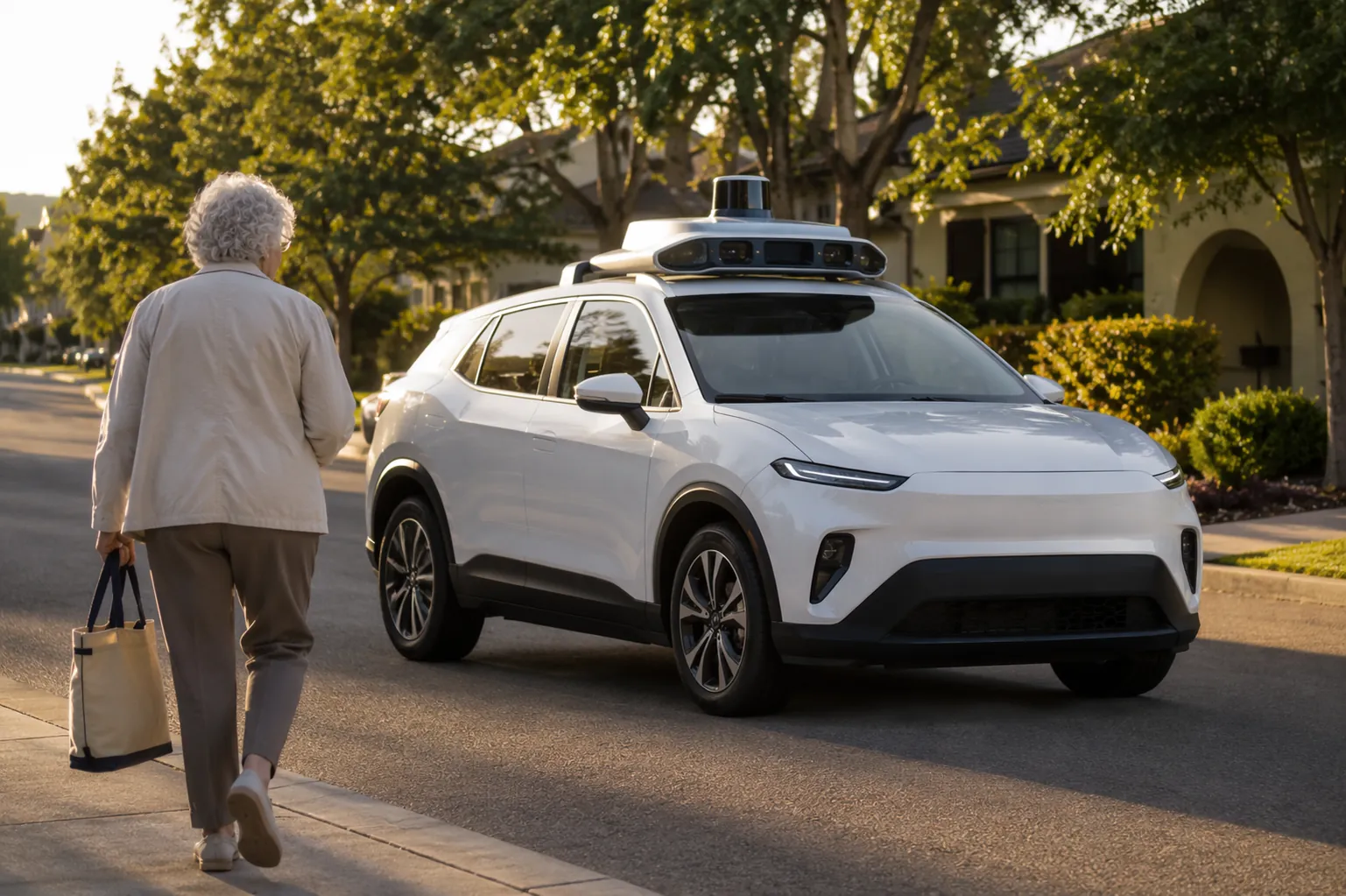
Julie Finger’s first Waymo ride was not a test-track demonstration or a keynote video. She was 90, leaving bingo at the Fairfax Senior Center in Los Angeles, and she used the self-driving service to get home. Later, she used it for day trips to the beach. That is the part of self-driving cars' benefits for elderly mobility that matters most: a real trip, on an ordinary day, without waiting for a daughter, son, neighbor, or paratransit window to open up. Waymo described Finger’s rides and the Fairfax Senior Center partnership in its community coverage of older Angelenos using the service.[1]
The other half of the story is that this is not just one charming anecdote. Waymo reported more than 14 million trips in 2025, tripling from 2024, and said it was providing more than 450,000 trips per week across six cities.[1] That does not mean a self-driving car is available on every suburban street, or that an older adult with a walker can manage every ride alone. It does mean the question has changed. For some families, the question is no longer “Will this exist someday?” It is “Can my parent use it where they live, this month, safely enough to be useful?”
What “available now” really means
For older adults, availability is more than a service-area map. It includes whether the ride can be summoned without confusion, whether the pickup spot is close enough, whether the vehicle can handle the rider’s mobility equipment, whether payment is already set up, and whether someone can help if the first ride goes sideways emotionally or practically.
Still, the first filter is blunt: location. Current self-driving ride services are concentrated in specific operating zones, mostly dense urban areas. If an older adult lives inside one of those zones, a robotaxi may be a real option for errands, social visits, appointments, and short recreational trips. If they live outside it, the service may be irrelevant for now, even if the same company is expanding somewhere nearby.
That distinction matters because many older adults are not living in the easiest places to serve. AARP data cited by The Hartford says 80% of the 45 million Americans over 65 live in car-dependent areas.[2] Another summary of senior transportation needs reports that 20% of Americans over 65 do not drive at all.[3] Put those two facts together and the pressure on families becomes obvious: a large group of older adults either cannot drive or may soon stop driving, while many live in places where every useful destination was planned around a car.
The main ways seniors can try autonomous rides
There is not one single self-driving transportation model for seniors. The practical choices fall into a few buckets, and each one answers a different problem.
| Model | Who it may help | What to check first |
|---|---|---|
| Commercial robotaxi service | Older adults inside an active service zone who can manage curbside pickup and app-based ride hailing | Exact coverage area, app setup, payment method, pickup/drop-off locations, and whether the rider can get in and out without hands-on help |
| Municipal or community shuttle | Residents served by a city, nonprofit, or public-private program, especially seniors and people with disabilities | Eligibility, hours, service area, wheelchair or mobility-device access, booking method, and whether rides are free or subsidized |
| Pilot program | Communities testing whether autonomous rides can fill transportation gaps, including rural or mobility-isolated areas | Program duration, who qualifies, vehicle accessibility, booking support, and what happens when the pilot ends |
Commercial robotaxis: useful if the map reaches the door
A commercial robotaxi is closest to what most people imagine: open an app, request a ride, walk to the pickup point, and ride in a driverless vehicle. For a confident older adult inside the service area, that can be enough. A ride home from bingo or a trip to the beach does not need to be revolutionary to be valuable. It just needs to arrive, unlock, follow the route, and drop the rider in a place they can manage.
The weak point is usually not the vehicle driving itself. It is the chain around the ride. Can the rider read the pickup instructions? Can they find the car if it stops across the street? Can they identify the right vehicle? Can they fasten the seat belt, place a cane or bag safely, and get out at the destination without rushing? If the answer is yes, a commercial robotaxi can reduce how often a family member becomes the automatic driver. If the answer is no, the ride may still work only with a companion.
Detroit’s Accessibili-D: a city service built around eligibility
Detroit’s Accessibili-D is a different kind of answer. Launched in June 2024, the free on-demand autonomous shuttle is for Detroit residents who are 65 and older and for people with disabilities. It is operated by May Mobility and Via, according to a review of self-driving vehicle applications in aging populations.[4] The fact that it is free and eligibility-based changes the conversation. This is not just a private ride-hailing product that older adults may happen to use. It is a municipal mobility service aimed directly at people who are more likely to lose transportation options.
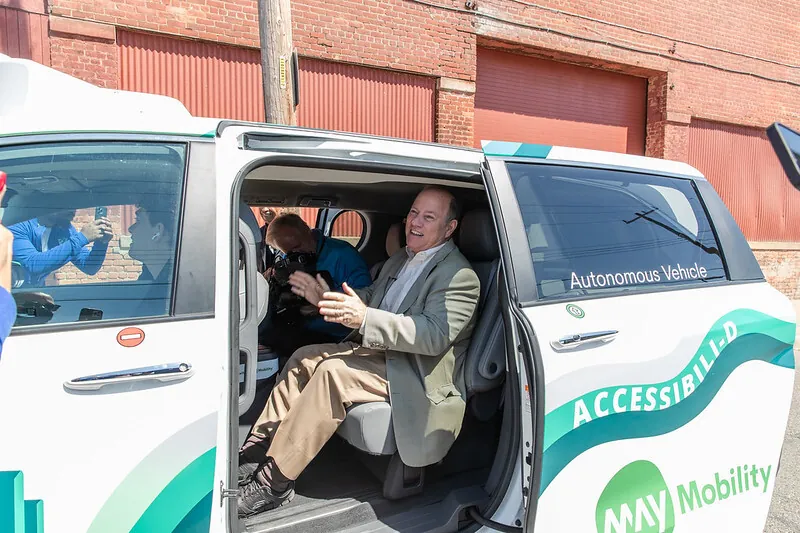
That model is important because cost, booking support, and disability access are not afterthoughts for many older riders. A free service does not remove every barrier, but it can remove the first one. A shuttle designed around older residents and people with disabilities is also more likely to be judged by whether it solves actual access problems, not just whether the technology performs well on a clean route.
goMARTI: why a rural pilot deserves attention
The goMARTI pilot in Grand Rapids, Minnesota, matters for a quieter reason: it tested free, on-demand, ADA-compliant autonomous rides outside the usual dense urban core. The same review describes it as the first rural pilot of its kind for mobility-isolated residents.[4] A rural pilot is not the same as a nationwide rural solution. It does, however, test the problem many families know too well: the parent who does not live in a downtown service zone, does not have easy transit nearby, and cannot rely forever on neighbors and relatives.
Pilots should be read honestly. They can prove that a community is trying a model, that some riders can use it, and that specific accessibility features can be built into the service. They do not prove that every similar town will get the same service, at the same price, with the same reliability. For a family making decisions today, a pilot is worth watching and worth using if eligible, but it should not be treated as guaranteed infrastructure.
The first ride is partly a technology lesson
The Fairfax Senior Center did something more useful than hand out optimism. Its Tech Tuesday classes gave older adults a place to learn the Waymo app with peer support.[1] That is the right level of practical. Many older adults are capable of learning a ride-hailing app. Many also need repetition, a calm setting, and someone nearby who will not sigh at them for taking too long.

Digital literacy should not be treated as a personal defect. If a service requires an app, then the app is part of the transportation system. So are the account setup screens, the payment method, the vehicle identification step, the support button, and the instructions for what to do if the car stops somewhere unexpected. A senior center class, a caregiver practice session, or a staff-supported booking process can turn a confusing product into a usable ride.
For a first attempt, the best trip is boring on purpose. Pick a familiar destination, daylight hours, good weather, and a route where being dropped at the curb is acceptable. Have the older adult open the app if they will be the one using it later. Let them watch how the vehicle is matched, how the pickup spot appears, how the doors unlock, and how in-ride support is reached. If a caregiver does everything silently, the ride may succeed once and still leave the older adult unable to repeat it.
A readiness check before putting a parent in the car alone
Before deciding that self-driving rides are a practical option, work through the parts of the trip that happen before and after the vehicle moves.
- Location: Is the home, senior center, clinic, grocery store, or social destination inside the active service area, not just near it?
- Account setup: Can the older adult sign in, request a ride, confirm the destination, and handle payment, or does a caregiver need to help?
- Pickup confidence: Can the rider find the vehicle, cross safely if needed, identify the correct car, and wait without becoming anxious?
- Physical access: Can the rider get from the door to the curb, enter the vehicle, stow a cane or walker, fasten the seat belt, and exit at the destination?
- Assistance level: Does the rider need curb-to-curb transportation, or door-through-door help that a driverless service does not provide?
- Backup plan: If the rider cancels by mistake, loses phone battery, feels frightened, or is dropped off at a difficult curb, who can intervene?
That curb-to-curb question is not small. A self-driving car may solve the driving portion of the trip and still fail the whole outing if the rider cannot manage the front steps, the walker, the apartment lobby, the parking lot, or the bags after a grocery run. Transportation and care overlap, but they are not the same service.
A caregiver riding along the first time is not a sign that the technology has failed. It is how families usually test a new mobility arrangement. The caregiver can watch where confusion happens: choosing the destination, reading the license plate or vehicle display, opening the door, understanding in-car prompts, or deciding where to stand at pickup. Those observations are more useful than asking later, “Did you like it?”
Why researchers think the upside could be large
The reason this subject keeps coming back is not that self-driving cars are novel. It is that transportation loss narrows a life quickly. Medical appointments become negotiations. Social visits disappear first because they look optional. A weekly card game, a worship service, or a trip to the beach may be treated as less urgent than a doctor’s visit, even though isolation has its own cost.
Research reviews and simulations suggest shared autonomous vehicles could increase daily trip rates for older adults, with adults 75 and older potentially showing the largest gains because the service can reduce dependence on private driving. That conclusion should be read carefully: it is based on modeling, stated-preference work, and review evidence, not proof that today’s services have already produced those gains everywhere.[5]
Even so, the logic is sound enough to take seriously. If a person stops driving before losing the desire or ability to go places, a reliable ride option can preserve trips that would otherwise be dropped. The biggest benefits are likely to show up in the ordinary places: a pharmacy run without asking a nephew, lunch with friends without waiting for a facility van, a follow-up appointment scheduled for the patient’s convenience instead of a relative’s lunch break.
Comfort is still a real barrier
Families should not assume that an older adult will welcome a driverless car just because it solves a transportation problem on paper. A 2025 AAA survey cited in Lloyd Alter’s analysis found that 66% of Americans remained nervous about robotaxis, and Pew/Globe data cited there found that only 13% of adults 75 and older felt comfortable with fully autonomous cars.[6] Those are attitudes, not ride outcomes, but attitudes shape whether someone will try the service in the first place.
Nervousness is not irrational. Older riders may worry about getting stranded, being watched, losing control, needing help during the ride, or not understanding what the car is doing. A family member may worry about putting a parent in a vehicle with no human driver to notice confusion, pain, or panic. Those concerns do not automatically rule out a ride, but they do call for a slower introduction than a younger, app-comfortable rider might need.
The first successful ride also does not settle every use case. A healthy 90-year-old going from a senior center to home is different from a rider with moderate dementia, low vision, severe arthritis, or a wheelchair that requires specific securement. The word “senior” covers too many bodies and too many needs to make one rule.
Wheelchair access and the next wave
Physical accessibility is where the future still has work to do. Toyota’s Autono-MaaS concept, described in ASA Generations, points toward wheelchair-accessible autonomous vehicles designed for mobility services.[7] That is encouraging, but development is not the same as broad availability. A caregiver deciding what to do this month still has to ask what the local service can handle today.
This is also where public and nonprofit models may matter as much as vehicle engineering. A wheelchair-accessible autonomous vehicle is useful only if it can be booked, afforded, maintained, routed to the rider, and supported when something goes wrong. For many older adults, the strongest service will not be the most futuristic one. It will be the one that understands the full trip.
How to decide whether to try it now
Start with the local reality. Search for active autonomous ride services in the older adult’s city, then confirm the exact service area through the provider or city program. Do not rely on headlines about expansion. A service that operates across a metro area may still exclude the parent’s neighborhood, clinic, senior center, or grocery store.
If service exists, match it to the rider’s actual assistance needs. A person who walks steadily, uses a smartphone, and wants rides to familiar places is a very different candidate from someone who needs help locking the door, descending steps, folding a walker, or finding the correct medical office. The first person may gain independence from a robotaxi. The second may need paratransit, a caregiver, a senior shuttle with support, or a combination.
Then practice before a crisis. Set up the account while the older adult is still calm and capable of learning. Take a short ride together. Try a senior center class if one exists. Write down the steps in plain language. Save support numbers. Decide which destinations are approved for solo trips and which still require a companion. That preparation is less dramatic than taking away the keys after an incident, and kinder to everyone involved.
Self-driving cars are already helping some seniors stay mobile. They are not yet a universal substitute for driving, family rides, paratransit, or hands-on care. The useful middle ground is enough: check whether the service exists locally, test the whole trip rather than just the vehicle, and build familiarity before transportation becomes an emergency.
References
- Riding into the Golden Years, Waymo Community
- Self-driving cars, The Hartford
- Self-Driving Vehicles: The Future of Inclusive Transportation, Senior Community Services
- Applications of Self-Driving Vehicles in an Aging Population, Mayo Clinic/PMC
- Shared autonomous vehicles and older people: reviewing opportunities and challenges, Transport Reviews
- Will self-driving cars save older people?, Lloyd Alter
- How Self-Driving Cars Can Empower Older Adults, ASA Generations
Questions to bring to a clinician or OT
This is not medical, legal, or a family's final decision — only a framework. Bring these questions to a clinician, occupational therapist, or your local Area Agency on Aging.
Find Local HelpRelated reading
Noticed something outdated or inaccurate on this page? Flag a correction. We review every report against CDC, NIA, and AARP HomeFit guidance before updating a page.