
Caregiver decision guide
Packing for a Senior Cruise? Start with Medication and Safety
A priority-based cruise packing list for elderly travelers that starts with medication, documents, and mobility aids — not clothes. Prevent falls and ensure medication safety with this senior-specific checklist.
Most cruise packing lists begin with dinner clothes, swimsuits, sunscreen, and a reminder not to forget a passport. For an elderly traveler, that order is backwards. The first question is not what looks nice on board. It is what would create the highest-risk problem if it were sitting at home after the ship has left port.
That means the suitcase starts with medication, medical documents, mobility support, and cabin safety. Clothing still matters. So do comfort items. But an older adult who takes daily prescriptions, uses a cane or walker, wakes at night to use the bathroom, or gets tired on long boarding days needs a different packing sequence.
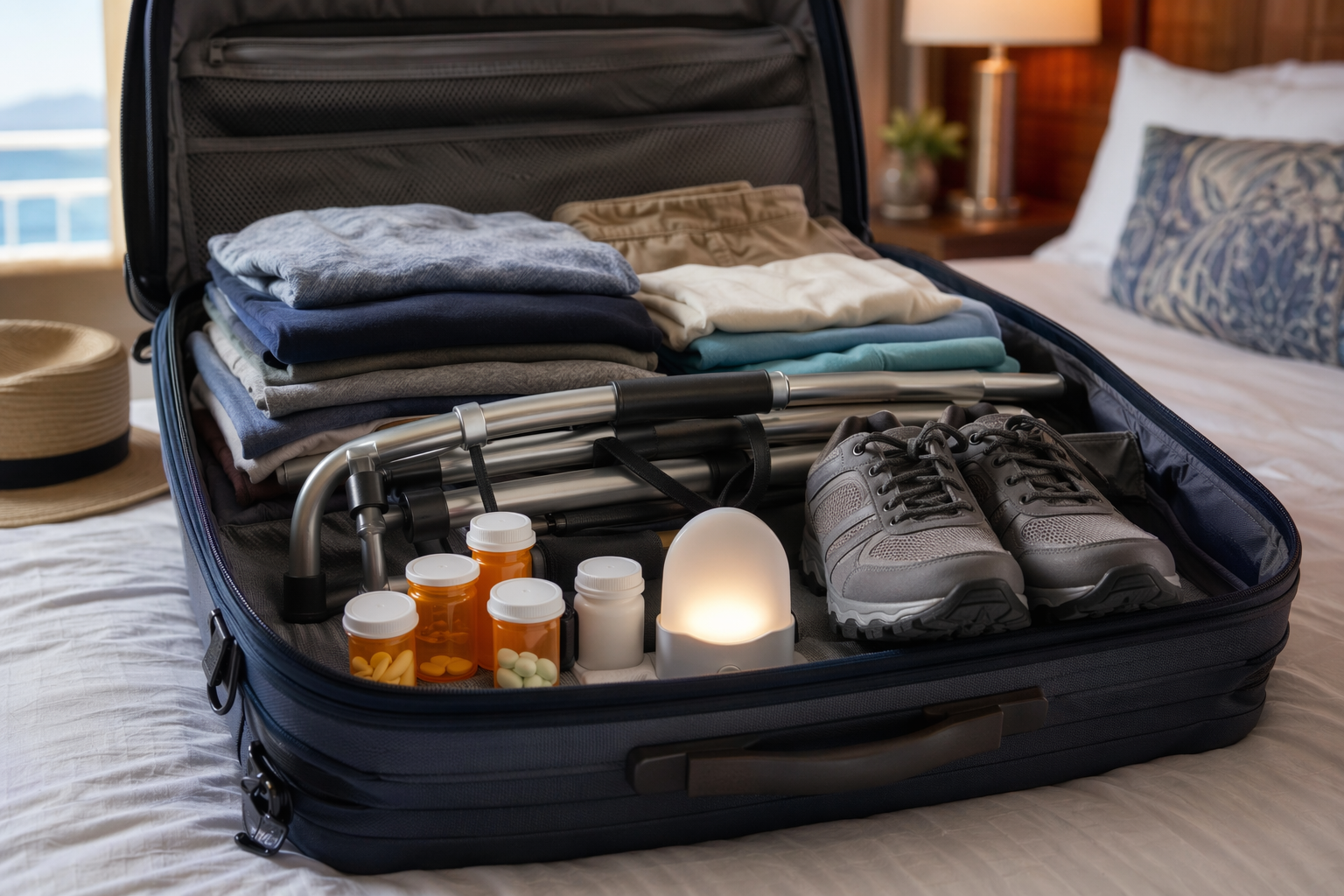
Pack in the Order of Consequence
A practical cruise packing list for elderly travelers should move in this order:
- Medication and medical documents.
- Mobility aids, fall-prevention items, and footwear.
- Cabin setup items for nighttime safety, organization, and power.
- Cruise-line rules, assistance requests, and prohibited-item checks.
- Clothing, toiletries, entertainment, and comfort extras.
This is not about making the packing list longer. It is about putting the least replaceable items first. A forgotten sweater can be bought. A missing blood pressure medication, a scooter charger, or the only pair of shoes that do not slip on a wet deck can become everyone’s problem very quickly.
Medication Goes in the Carry-On, Not the Checked Bag
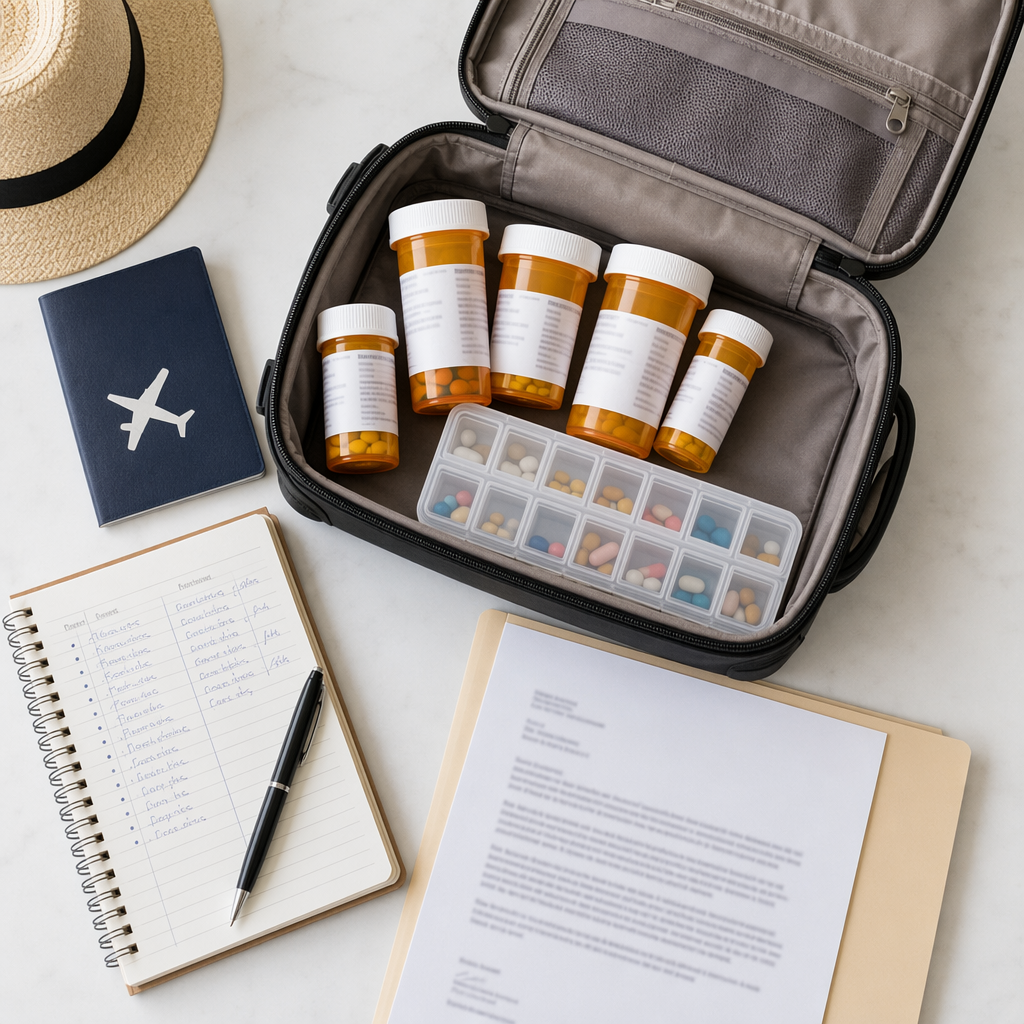
Medication is the first packing category because it is the hardest to fix at sea. The CDC advises travelers to pack medicines in carry-on luggage, bring enough for the whole trip plus extra in case of delays, keep medicines in original labeled containers, and carry copies of prescriptions when traveling, especially internationally.[1] Cruise-specific CDC guidance also recommends bringing extra medicine for several days beyond the planned trip because itinerary changes, delayed returns, or medical isolation can extend travel unexpectedly.[2]
That turns into a simple family rule: do not check the medications. Not in the large suitcase. Not in the bag handed off at the pier. Not in the luggage that might arrive at the cabin hours later. Daily prescriptions, rescue medications, insulin supplies, inhalers, eye drops, pain medication cleared by the doctor, and any time-sensitive doses belong in the personal bag that stays with the traveler or caregiver.
Cruise Critic notes a practical reason for being strict here: cruise ships do not operate like full neighborhood pharmacies and cannot be counted on to replace most prescriptions during a sailing.[3] A ship medical center may help with urgent medical problems, but that is not the same as walking into a pharmacy and refilling a specific maintenance medication under a familiar prescription plan.
For an older traveler, the medication packet should include:
- All prescription medications in original labeled bottles or packaging.
- At least 3 to 7 extra days of medication beyond the itinerary, depending on the traveler’s health needs and the doctor’s advice.[2]
- A written medication list with dose, schedule, prescribing doctor, pharmacy, and generic names.
- Copies of prescriptions, especially for international travel.
- A doctor’s letter for controlled substances, injectable medications, medical devices, or anything that may raise questions at security or customs.
- Supplies that go with the medication: syringes, alcohol wipes, testing strips, pill splitter, pill organizer, cooling case if needed, and backup batteries for medical devices.
The pill organizer can be useful once the traveler is settled, but it should not be the only medication container on the trip. Original packaging matters because labels connect the medication to the person carrying it. If a caregiver fills a weekly organizer before departure, the labeled bottles should still travel in the carry-on.
The medication list deserves more than a rushed note on the morning of travel. It should be readable by someone outside the family: ship medical staff, an emergency clinician in port, or an adult child answering questions over the phone. Generic names are useful because brand names can vary by country and by formulary. A list that says only “small white blood pressure pill” is not a plan.
Keep the Medication Bag Boring and Obvious
The best medication bag is not clever. It is easy to find, easy to open, and boringly organized. Put the written list in the same pouch as the bottles. Add the doctor’s letter and prescription copies in a folder or zip pouch. If the older traveler manages their own medication, pack it in a way that protects that independence instead of turning every dose into a search party.
If more than one adult is traveling, one trusted person should know exactly where the medication packet is. That does not mean taking control away from the older traveler. It means no one is tearing apart a cabin at 10 p.m. looking for a bottle that should have been in the carry-on.
Shoes, Walkers, Canes, and Scooters Are Safety Gear
After medication, the next priority is safe movement. Cruise ships are not one flat, familiar living room. They have long corridors, changing surfaces, thresholds, wet pool decks, crowded dining areas, gangways, and sometimes tender boats between ship and shore. Senior travel resources and cruise-line packing guidance repeatedly flag stable walking shoes, gangways, decks, and tender transfers as practical fall-risk points for older passengers.[4][5][6]
That is why the most important pair of shoes may not be the dressiest pair. Pack broken-in walking shoes with real traction. Not new shoes bought the week before. Not backless sandals for long walking days. Not slick-bottom formal shoes that are fine in a carpeted dining room but questionable on a damp deck. If the traveler needs dress shoes, choose the safest acceptable pair rather than the most elegant one.
For a cane, walker, rollator, wheelchair, or scooter, packing means more than remembering the device. It means making sure the device can survive the trip.
- Label mobility aids with the traveler’s name, phone number, ship name, and cabin number if available.
- Pack chargers for scooters, power wheelchairs, hearing aids, and other rechargeable devices in the carry-on or another protected bag.
- Carry a copy of battery specifications for powered mobility equipment, since cruise-line and transport rules can vary by operator and equipment type.
- Bring small repair basics where appropriate: extra cane tips, a compact tool approved for travel, zip ties, Velcro straps, or spare screws recommended by the equipment provider.
- Check whether the mobility aid can fit through the cabin door and be stored safely without blocking exits.
Cruisebound notes that accessible cabins make up a limited portion of cruise inventory, with accessible cabins often representing only about 3% to 5% of a fleet, so families should not assume that accessibility features will be easy to add late in the process.[7] U.S. Department of Transportation guidance also treats accessible cruise travel as a planning issue rather than something to improvise at the pier.[8]
If a wheelchair, scooter, oxygen equipment, or other mobility-related accommodation is needed, contact the cruise line well before sailing and read the specific policy for that ship and itinerary. Policies can vary by cruise line and sometimes by vessel. Tender ports are especially important to check because some ports require passengers to transfer to smaller boats, and mobility rules for those transfers may be more restrictive than movement around the ship.
Boarding and Disembarkation Need Their Own Plan
The long day at the beginning and end of a cruise can be harder than any single day on board. There are lines, luggage, ramps, security, waiting areas, buses, taxis, and unfamiliar terminals. Squaremouth’s 2026 senior traveler survey found that priority boarding and disembarkation was the most valued cruise feature among senior travelers who purchased insurance through its platform.[9] That sample is not the entire senior cruising population, but it is a useful reminder: the transition points matter.
If the traveler needs wheelchair assistance, request it in advance according to the cruise line’s procedure. When the cruise line allows it, making the request at least 48 hours before embarkation is a practical planning benchmark. Do not wait until the family is standing in a terminal with luggage and a tired parent who is trying not to complain.
Set Up the Cabin Before the First Tired Night
Cabin safety does not require turning the room into a hospital room. It means making the space easier to navigate when the ship is unfamiliar, the lighting is low, and the traveler is half-awake. The first hour in the cabin is the time to fix that, not after someone has already stumbled on the way to the bathroom.

A small nightlight is one of the least glamorous and most sensible things to pack. ElderTrip’s senior cruise packing guidance specifically recommends a nightlight to reduce nighttime disorientation and bathroom-related fall risk in the cabin.[6] Anyone who has helped an older parent through an unfamiliar hotel room at night understands why this belongs near the top of the list.
The cabin setup kit can be compact:
- Plug-in or battery-powered nightlight for the bathroom path.
- Non-slip mat for use where allowed and where it does not create a trip edge.
- Portable grab bar only if it is appropriate for the surface and the traveler understands its limits.
- Magnetic hooks for hats, lanyards, small bags, and frequently used items on metal cabin walls.
- A small pouch or basket for glasses, hearing aids, room key, phone, and medications taken at night.
- Non-surge power strip or approved multi-port charger, after checking the cruise line’s electrical rules.
Cruisebound notes that portable grab bars and other bathroom supports may help compensate when a cabin bathroom lacks the assistive features a traveler uses at home.[7] That does not make every portable device safe in every cabin. Suction grab bars, for example, depend on the surface and installation. Treat them as balance reminders, not as structural supports unless the product and setting clearly allow that use.
The easiest cabin mistake is leaving everything in bags until bedtime. Set out the nightlight. Put shoes where they will not become a trip hazard. Place the cane or walker within reach. Choose one charging area. Put the bathroom-route essentials in the same place every night. A cabin is small, but a small room can still become confusing in the dark.
Check the Cruise Line Rules Before Packing Helpful-Looking Items
Some things that look useful at home are not allowed on ships. Irons, clothes steamers, and many extension cords are commonly prohibited because of fire risk, and both cruise-line and senior cruise packing guidance warn travelers not to pack them.[5][6] If formal clothing needs wrinkle control, use wrinkle-release spray if allowed, hang garments in the bathroom during a shower, or use the ship’s laundry or pressing services where available.
Electrical items deserve special attention. A non-surge power strip may be allowed on some lines, while surge-protected power strips and extension cords are commonly restricted. The safe move is to check the current prohibited-items page for the specific cruise line before packing. Rules change, and a confiscated cord does not help anyone charge a scooter, phone, hearing aids, and medical device overnight.
| Item | Packing decision |
|---|---|
| Iron or clothes steamer | Leave at home; commonly banned because of fire risk. |
| Extension cord | Check the cruise line; many are restricted or prohibited. |
| Surge-protected power strip | Do not assume it is allowed; many cruise lines prohibit surge protection. |
| Non-surge multi-port charger | Often the better option, but still check the line’s rules. |
| Mobility scooter battery documents | Pack a copy and confirm the cruise line’s battery policy before sailing. |
Documents Should Be Easy to Hand Over
The document folder should sit with the medical packet or right next to it in the carry-on. At minimum, include government ID or passport as required by the itinerary, cruise boarding documents, travel insurance information, emergency contacts, medical list, physician contacts, pharmacy contacts, copies of prescriptions, and accommodation confirmations from the cruise line.
If an adult child is helping but not traveling, that person should have copies of the medication list, insurance information, itinerary, and cruise line contact details. If a spouse is traveling as the main helper, make the folder simple enough that someone else could use it in an emergency. A beautiful binder is optional. A clear, current, readable set of papers is not.
Only Now Pack Clothing and Comfort Items
Once medication, mobility, cabin safety, rules, and documents are handled, clothing becomes much easier. Pack for the itinerary, climate, dining requirements, and personal comfort, but do not let outfits crowd out safety gear. For many older travelers, a light layer for cold dining rooms, a brimmed hat, easy-on clothing, compression socks if recommended by a clinician, and a swimsuit cover-up that is simple to manage may matter more than extra formal options.
Toiletries should include familiar products rather than assuming the ship or port shops will carry the same brands. Add glasses, spare glasses if available, hearing aid supplies, denture care items, sunscreen, lip balm, and a small laundry bag. If the traveler has sensitive skin or a strict routine, pack enough for the full trip instead of relying on onboard shops.
Comfort is not frivolous. A favorite cardigan, a book, a simple crossbody bag, a water bottle if allowed, or a cushion for long excursions can make the trip feel manageable. The difference is that these items come after the things that protect health and mobility.
Final Senior Cruise Packing Check
- Medication is in the carry-on, in original labeled containers, with 3 to 7 extra days packed, a written medication list, prescription copies, and any needed doctor’s letter.
- Mobility aids are labeled, in working order, and paired with chargers, battery information, and small repair basics where appropriate.
- Grip-sole walking shoes are packed and already broken in; unsafe dress shoes have not replaced the shoes needed for decks, gangways, terminals, and excursions.
- Cabin safety items are packed: nightlight, approved power solution, bedside essentials pouch, non-slip mat if appropriate, and portable supports only where safe to use.
- Cruise-line restrictions have been checked for electrical items, prohibited appliances, mobility equipment, batteries, accessible cabin rules, and tender-port limitations.
- Wheelchair assistance, priority boarding help, accessible cabin needs, or other accommodations have been requested in advance according to the cruise line’s procedure.
- Documents are together and readable: ID or passport, boarding documents, insurance, emergency contacts, prescriptions, medical list, and cruise-line accommodation confirmations.
- Clothing, toiletries, and comfort items are packed after the higher-risk categories are complete.
That is the packing order that respects both safety and independence. Start with what would be hardest to replace at sea, then pack everything else.
References
- Older Adults and Healthy Travel, CDC.
- Cruise Ship Travel, CDC.
- Cruise Packing Tips, Cruise Critic.
- Cruise Travel Tips for Seniors, AgingCare.
- Ultimate Cruise Packing Tips for Seniors, Carnival.
- Cruise Packing List for Seniors, ElderTrip.
- Cruising with Mobility Aids, Cruisebound.
- Accessible Cruise Ships, U.S. Department of Transportation.
- 2026 Senior Traveler Survey, Squaremouth, 2026.
Questions to bring to a clinician or OT
This is not medical, legal, or a family's final decision — only a framework. Bring these questions to a clinician, occupational therapist, or your local Area Agency on Aging.
Find Local HelpRelated reading
Noticed something outdated or inaccurate on this page? Flag a correction. We review every report against CDC, NIA, and AARP HomeFit guidance before updating a page.