
Caregiver decision guide
Preparing Seniors in Boston for Severe Thunderstorms
Learn how to create a Boston-specific severe thunderstorm safety plan for an aging parent. This guide covers medical equipment registries, cooling centers, communication backups, and local resources that address the unique risks seniors face during storms.
Severe thunderstorm safety for seniors in Boston starts before the warning tone sounds. The hard part is not understanding that storms can be dangerous; it is knowing whether an aging parent can receive the alert, keep medical equipment running, keep insulin cold, avoid the stairs, and reach someone who can actually help when the power goes out.
Massachusetts has recorded 45 billion-dollar weather disasters since 1980, including 15 classified as severe storms. NOAA’s data through 2024 also shows the annual frequency rising from an average of 1.0 events during 1980–2024 to 2.8 during 2020–2024, though later 2025–2026 events may change the count when updated datasets are released. [1]
That trend matters, but the more immediate number for families is local and personal: 29.2% of Massachusetts older adults live alone, based on 2018 ACS data cited by Mass.gov DPH. [2] A storm that is merely inconvenient in one household can become a medical, mobility, or communication emergency in another.
Start With the Failure Points, Not the Flashlight
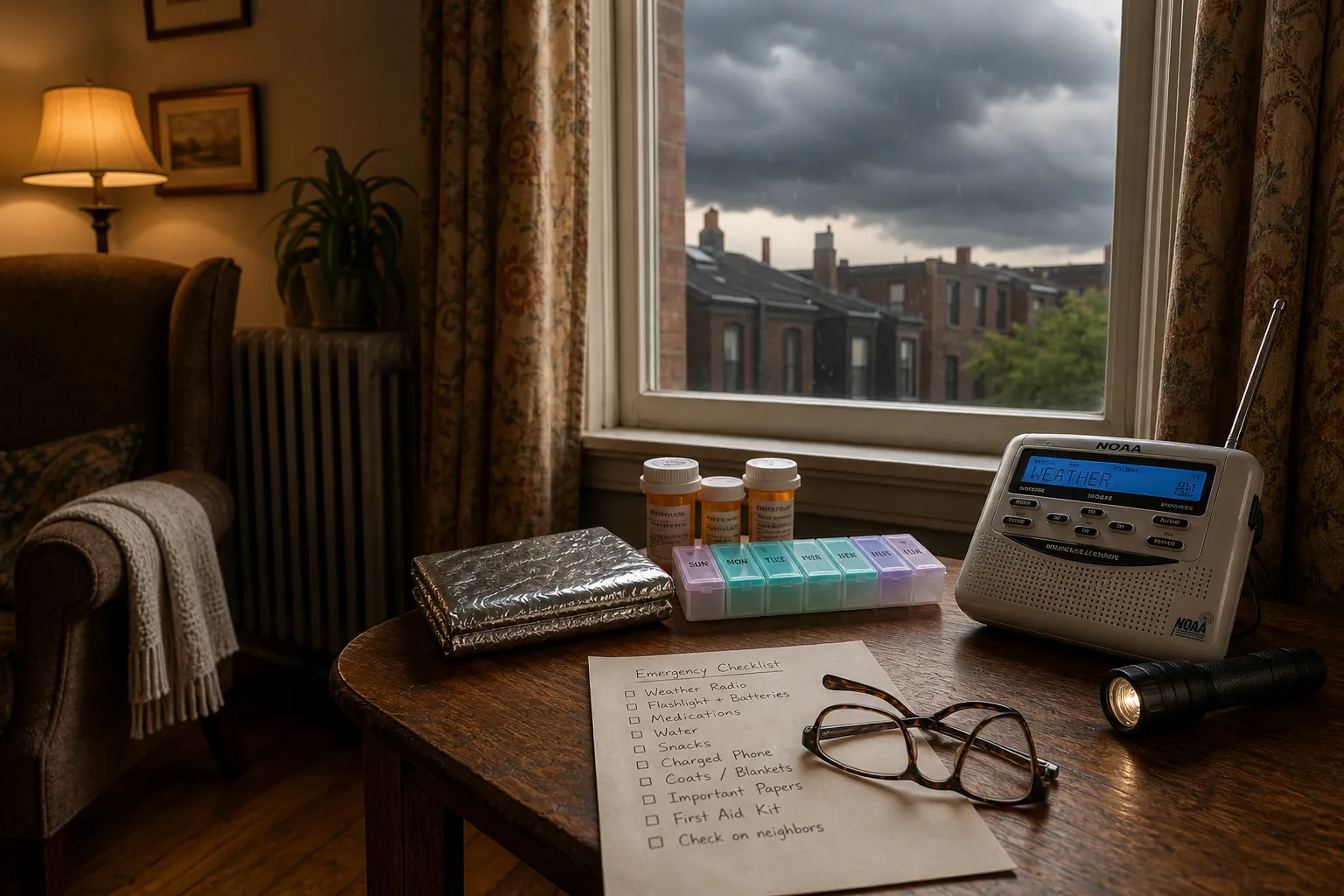
A flashlight belongs in the plan. It just should not be the center of the plan. For many Boston seniors, the first dangerous failure is quieter: the stair lift stops, the CPAP battery is not charged, the phone dies, the hearing aid is out, the refrigerator warms, or the person who says “I’m fine” cannot describe what is actually happening.
Before the next severe thunderstorm watch, write down the senior’s actual dependencies. Include medical devices, mobility equipment, medication temperature needs, hearing or vision limitations, cognitive changes, elevator or stair access, and whether they can safely open windows, lift supplies, or leave the building without help.
- If the senior uses CPAP, oxygen, home dialysis, a power wheelchair, a stair lift, or other powered medical equipment, treat the storm plan as a power plan first.
- If the senior uses insulin or other refrigerated medication, treat the storm plan as a cooling plan, not only a food-safety plan.
- If the senior has hearing loss, treat the storm plan as an alerting plan that cannot depend only on a phone chime or television crawl.
- If the senior lives alone, assign a real check-in person and a backup, not a vague “someone should call.”
For a deeper device-by-device audit, use a power outage preparedness plan for elderly people with medical equipment to list wattage, battery runtime, charging locations, and what happens if backup power runs out.
Register Life-Sustaining Equipment Before the Outage
Boston families should check the actual electric bill first. Some addresses are served by National Grid, some by Eversource, and some Massachusetts communities use municipal utilities. The registry path depends on the utility, not on what anyone assumes serves the neighborhood.
National Grid has a Life-Sustaining Equipment program for customers who rely on electrically powered medical equipment. National Grid lists 1-800-322-3223 as the phone number and provides a downloadable PDF form that is mailed to PO Box 960, Northboro, MA; families should verify the current form, address, and instructions directly with National Grid at the time they apply. [3]
Eversource lists a priority reconnection process for customers with medical needs, with 1-800-592-2000 as the contact number. [4] This is the kind of phone call to make on an ordinary Tuesday, not while a caregiver is standing in a hallway listening to a battery alarm.
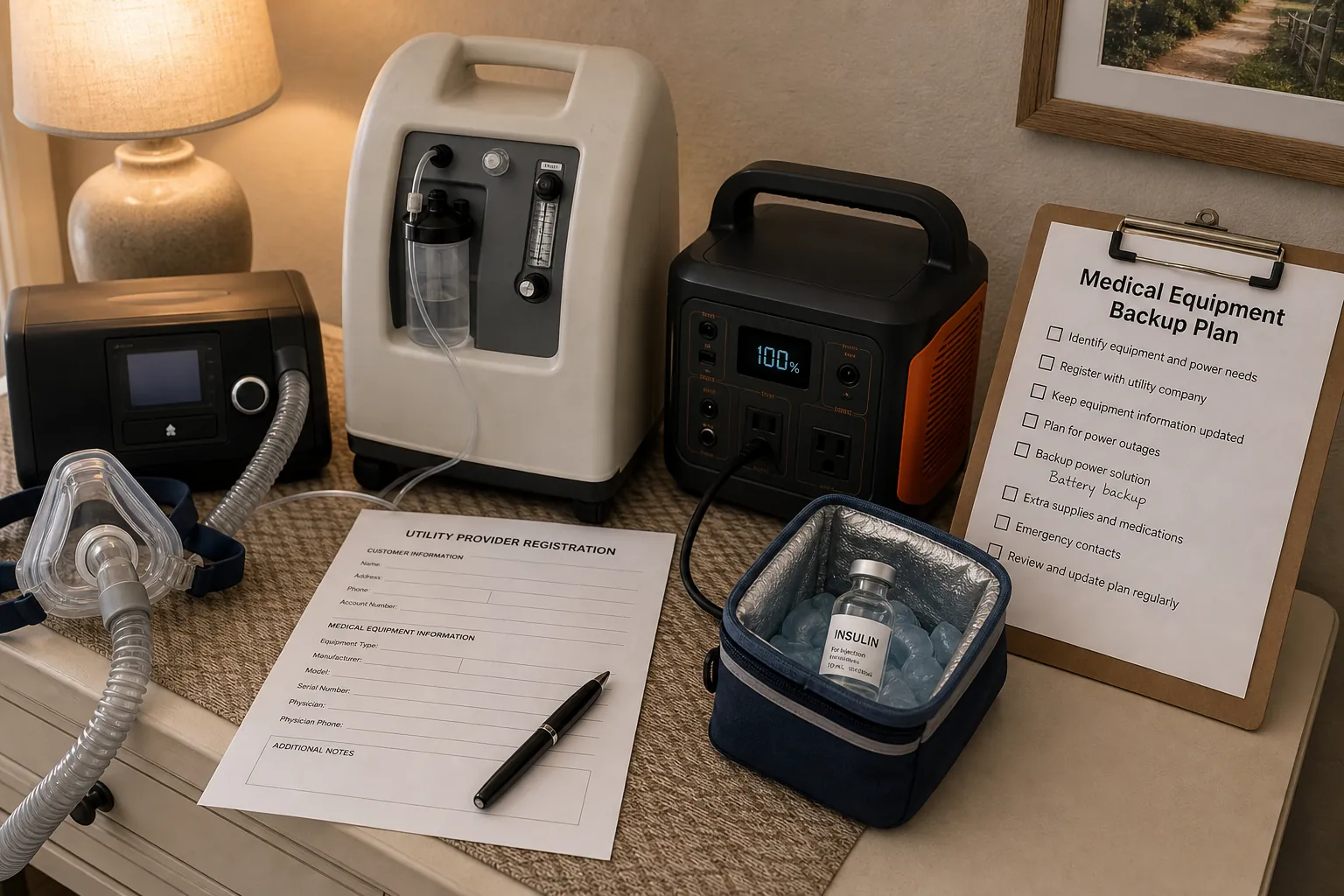
Registration should not be treated as a promise that power will stay on or return first. It is a way to tell the utility that the household has a medical dependency, receive relevant notices, and support restoration prioritization where the utility offers it. The backup plan still needs enough battery capacity, a relocation option, and a decision point for when to leave.
| Question to Answer | Why It Matters Before a Thunderstorm |
|---|---|
| Which utility serves the address? | The medical registry, outage reporting number, and restoration communications depend on the account provider. |
| What equipment must stay powered? | CPAP, oxygen, dialysis, powered mobility devices, and stair lifts may create different backup needs. |
| How long can each device run on backup? | Battery labels and caregiver guesses are not enough; record tested runtime where possible. |
| Where can the senior go if power is not restored? | A hotel, relative, cooling center, or medical setting may be safer than waiting in a hot apartment. |
| Who makes the relocation decision? | The senior, spouse, adult child, building staff, or clinician should not be negotiating this for the first time during an outage. |
The respectful version of this conversation is not “I’m putting you on a list.” It is “If the power goes out, I want the utility and the people checking on you to know what equipment you depend on.” That distinction matters with parents who value independence and do not want to feel monitored.
Build an Alert System They Can Actually Receive
Many storm plans assume the alert will be heard. That is a weak assumption for older adults. NIH/NIDCD reports that about 22% of adults ages 65–74 and 55% of adults 75 and older have disabling hearing loss. [5] A phone alert in another room, a television warning without the volume up, or a siren outside closed windows may not be enough.
At minimum, sign the senior up for Alert Boston, the City of Boston’s multilingual emergency notification system. [6] Add at least one caregiver phone number if the system allows the household to configure multiple contacts, and confirm the senior knows what the alert sounds or looks like on their device.
A NOAA Weather Radio is a sensible backup because it does not depend on the senior scrolling through a phone or noticing a television alert. For seniors with significant hearing loss, pair alerts with visual or tactile signals where appropriate: a flashing strobe accessory, bed shaker, vibrating phone setting, smart light routine, or a designated call from a neighbor. The point is redundancy, not gadgets.
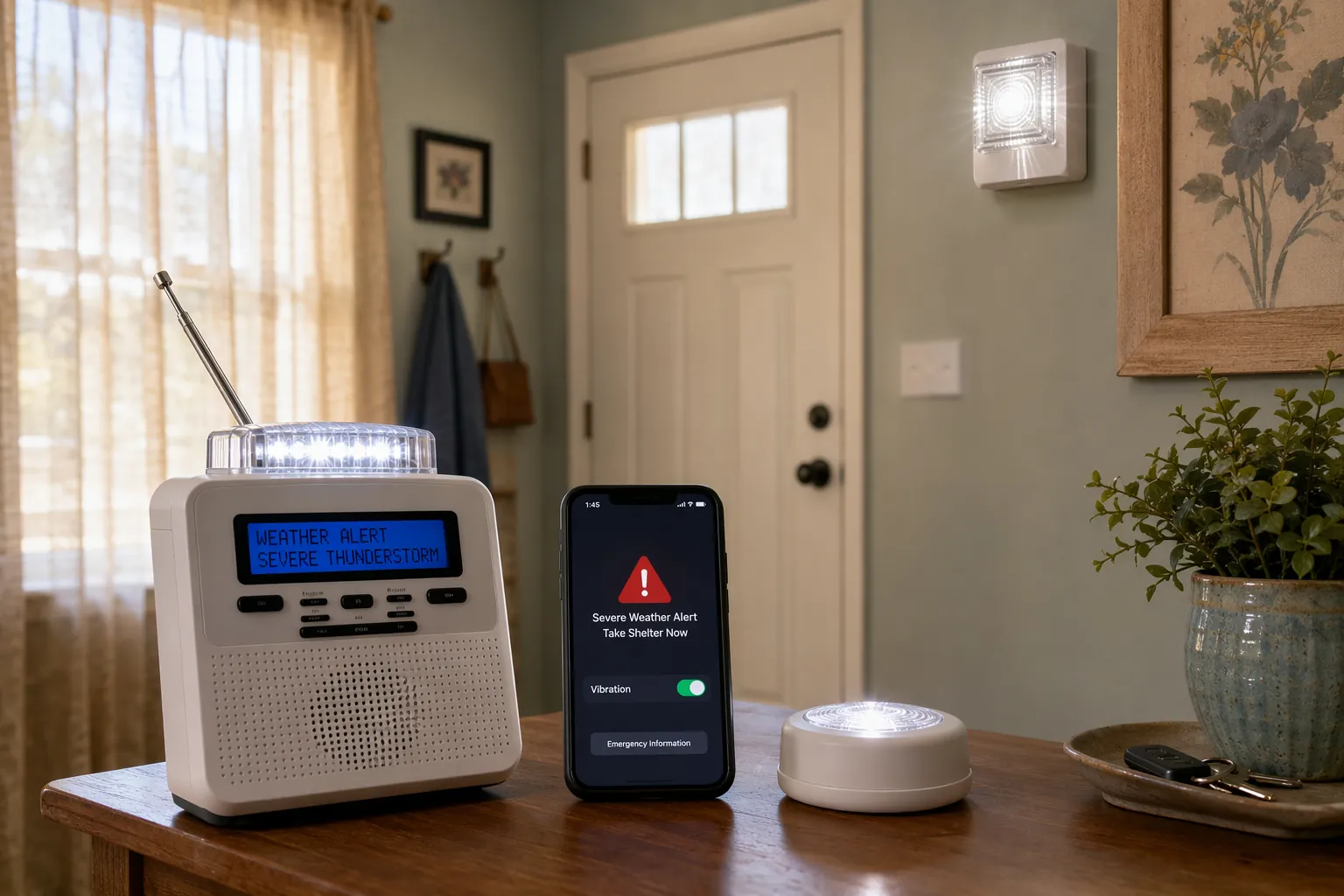
Caregivers should also agree on alert language in advance. “Severe thunderstorm warning” should mean the senior moves away from windows, stops bathing or washing dishes, avoids elevators if power is unstable, and keeps the charged phone nearby. “Watch” should mean supplies, batteries, medications, and transportation options are checked while there is still time.
Plan for Heat, Medication, and a Refrigerator That Stops Helping
A summer thunderstorm outage can become a heat emergency inside a Boston apartment, especially on an upper floor. If the senior has diabetes, the refrigerator is also part of the medical plan. The research materials note that insulin can degrade above 77°F, so the question is not only whether food spoils; it is whether medication remains usable. [7]
Mass.gov and MEMA guidance says a refrigerator keeps food cold for about 4 hours if unopened, while a full freezer can hold temperature for about 48 hours. [2] Those windows are useful only if everyone knows them before the door is opened repeatedly to “check.” Tape a simple note to the refrigerator during storm season: keep closed, move medication to cooler only when needed, and call the pharmacist or clinician if temperature safety is uncertain.
- Keep an insulated medication bag and cold packs ready, but do not freeze medication unless the prescribing instructions allow it.
- Write the pharmacy phone number and prescriber contact on paper, because a locked phone with a dead battery is not a plan.
- Ask the pharmacist how long each refrigerated medication can be outside its normal range and what signs mean it should be replaced.
- Decide where the medication goes if the apartment becomes too hot: a relative’s home, a staffed building office with power, a cooling center, or another prearranged location.
Boston lists BCYF cooling center locations through its keeping-cool resources, and families should check current hours, addresses, and activation status during heat events. [8] For older residents, the Age Strong shuttle may help with transportation to cooling centers when available; confirm eligibility and scheduling before a storm is approaching. [9]
If the outage is already underway, use the MEMA power outage map to see wider restoration conditions, call 211 for shelter and recovery information, and use BOS:311 for non-emergency city reporting. [10][11][12] Emergency symptoms, downed wires, fire, or immediate medical danger still belong with 911.
For broader outage safety decisions, keep a separate guide to keeping older adults safe during a power outage with the senior’s printed paperwork. The storm plan should be short enough to use under pressure; the outage guide can hold the longer details.
Make the Apartment Safer Before the Wind Arrives
The National Weather Service office in Boston/Norton warns that most straight-line thunderstorm injuries come from falling trees and flying debris. [13] That makes pre-storm outdoor securing more than a neatness chore, especially for seniors who cannot move quickly once thunder starts.
- Bring in or tie down balcony furniture, planters, trash bins, umbrellas, and lightweight decorations before the warning.
- Move the senior away from windows and glass doors during active thunder and high wind.
- Keep shoes, cane, walker, glasses, phone, flashlight, and medications within reach in the safer room.
- Avoid elevators if the building is losing power or lights are flickering.
- Do not shower, bathe, wash dishes, or use plumbing during active lightning; lightning can travel through plumbing. [13]
Inside the home, the best storm room is usually an interior room away from windows, with a charged phone and a place to sit safely. If the parent uses a walker or has fall risk, the route to that room matters as much as the room itself. A CDC STEADI fall prevention checklist for the home can help catch loose rugs, poor lighting, cords, and clutter before storm season makes them urgent.
Assign the Calls Before Everyone Starts Calling
Communication plans fail when every sibling assumes someone else checked in. Pick one primary caller, one backup caller, and one nearby person who can knock on the door if phones fail. For seniors in apartment buildings, include the building manager, concierge, or trusted neighbor if the senior agrees.
The check-in script should be specific. “Are you okay?” often gets an automatic “yes.” Better questions are: Do you have power? Is your phone charging? Are you away from the windows? Is your medical equipment running? Is the apartment hot? Have you opened the refrigerator? Do you need me to call the utility, 311, 211, or 911?
| Need | Boston-Area Contact or Resource |
|---|---|
| Emergency alerts | Alert Boston |
| Life-sustaining equipment registry | National Grid or Eversource, depending on the utility bill |
| Cooling during heat events | BCYF cooling centers and Age Strong shuttle, when active and available |
| Outage awareness | MEMA power outage map and the electric utility outage line |
| Non-emergency city reporting | BOS:311 |
| Shelter and recovery information | 211 |
| Immediate danger | 911 |
Put this contact list on paper in the apartment and in the caregiver’s phone. If the senior resists a posted list, keep it in a labeled folder near the medications or on the inside of a cabinet door. The plan should feel like support they can use, not a notice that their home has been taken over.
The Pre-Storm Checklist That Actually Belongs on the Fridge
A complete severe thunderstorm plan for a Boston senior should fit on one page. The longer binder can exist, but the page on the fridge is what people use at 7 p.m. when the sky turns green-gray and the phone starts buzzing.
- Confirm the electric utility on the bill and register eligible life-sustaining equipment with National Grid, Eversource, or the correct municipal utility.
- Test backup power for CPAP, oxygen, dialysis equipment, power chairs, stair lifts, phones, and hearing-assistive devices.
- Enroll in Alert Boston and add alert backups the senior can see, hear, or feel.
- Prepare a medication cooling plan for insulin and other refrigerated prescriptions, including pharmacy instructions.
- Identify the cooling destination, transportation option, and decision point for leaving a hot apartment.
- Secure outdoor items, choose the interior safe room, and clear the route to it.
- Assign the primary caller, backup caller, and nearby door-knock contact.
- Print a room-by-room severe storm safety checklist for seniors as the quick-reference companion.
The anxiety does not disappear because Boston storms become harmless. It drops because the plan names the exact weak points: power, alerts, cooling, medication, mobility, transportation, and post-storm check-ins. Once those are assigned to real people and local systems, a severe thunderstorm warning becomes a checklist instead of a scramble.
References
- U.S. Billion-Dollar Weather and Climate Disasters: Massachusetts State Summary, NOAA National Centers for Environmental Information
- Extreme weather events, Mass.gov
- Life Sustaining Equipment, National Grid
- Medical Protection, Eversource
- Quick Statistics About Hearing, NIH National Institute on Deafness and Other Communication Disorders
- AlertBoston, City of Boston
- Insulin Storage and Switching Between Products in an Emergency, PowerOutage.us
- Keeping cool in the heat, City of Boston
- Age Strong Commission, City of Boston
- Massachusetts Emergency Management Agency Power Outage Map, MEMA
- Mass 211, Mass 211
- BOS:311, City of Boston
- Severe Weather Safety, National Weather Service Boston/Norton
Questions to bring to a clinician or OT
This is not medical, legal, or a family's final decision — only a framework. Bring these questions to a clinician, occupational therapist, or your local Area Agency on Aging.
Find Local HelpRelated reading
Noticed something outdated or inaccurate on this page? Flag a correction. We review every report against CDC, NIA, and AARP HomeFit guidance before updating a page.