
Caregiver decision guide
How the Three-Bucket Strategy Structures Retirement Income
Learn how the three-bucket retirement income strategy organizes cash, bonds, and stocks into a replenishing system that protects near-term spending from market downturns while keeping long-term growth on track.
The hard part of retirement income is not naming the accounts. It is making sure this year’s groceries, prescriptions, utilities, insurance premiums, and property taxes do not depend on selling stocks in a bad market week. That is where cash holding strategies for retirement income become practical: cash is not the whole plan, but it can be the part that keeps a retiree from making rushed withdrawals when markets are down.
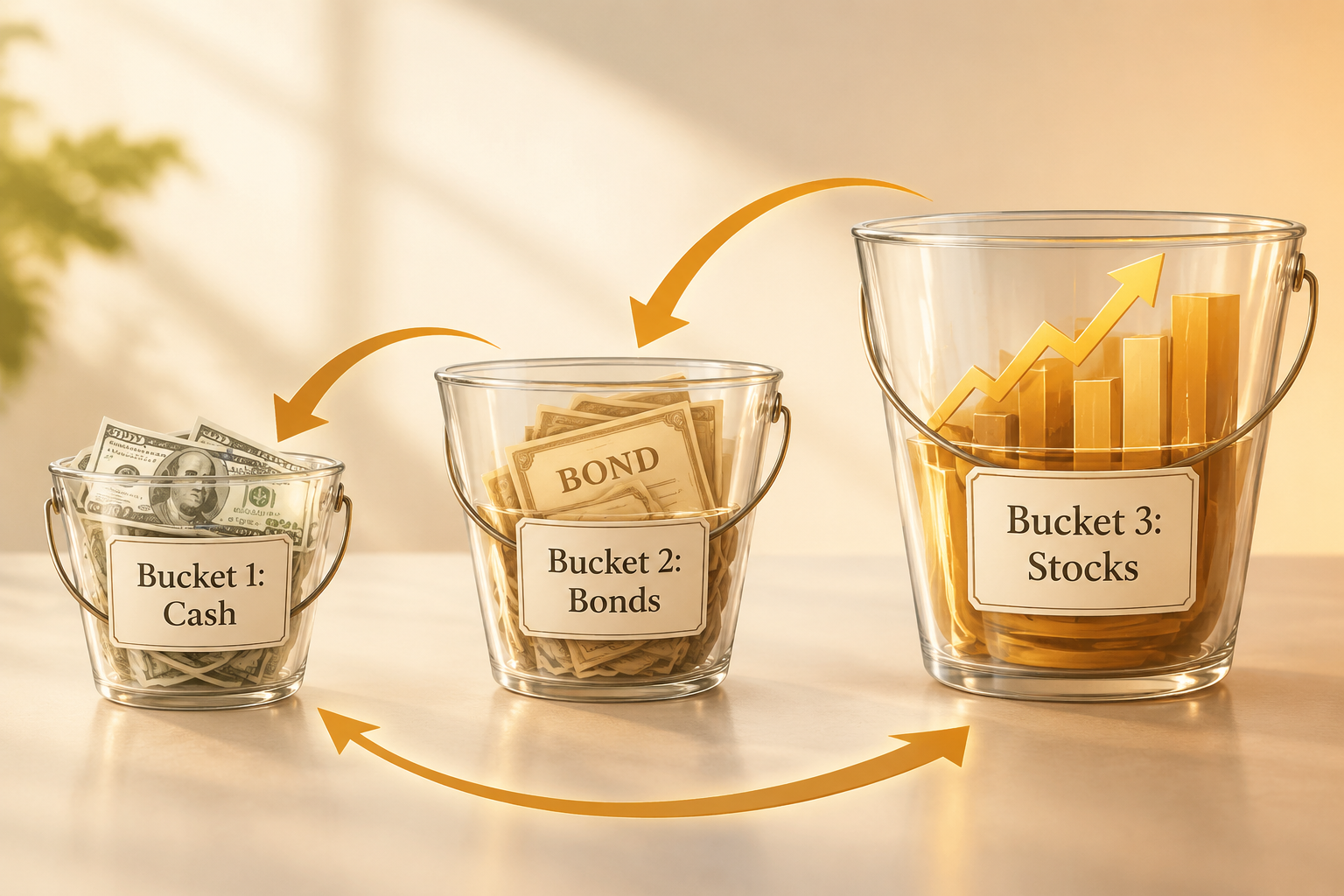
The three-bucket strategy gives that cash a job. Instead of treating a retirement portfolio as one pile of money, it separates assets by time horizon: money needed soon, money needed later, and money that should be left invested long enough to grow. Christine Benz’s widely used Morningstar framework describes Bucket 1 as at least one year of expenses in cash, Bucket 2 as five to eight years of expenses in fixed income, and Bucket 3 as equities for longer-term growth.[1]

The Three Buckets in Plain Terms
The point is not to create three decorative labels on a statement. Each bucket has a different assignment, and the assignments matter most when a retiree is nervous.
| Bucket | Typical role | Common holdings | Main question it answers |
|---|---|---|---|
| Bucket 1 | Near-term spending | Cash, checking, savings, money market funds, Treasury bills or other cash equivalents | Can the retiree pay bills without selling investments right now? |
| Bucket 2 | Medium-term stability and replenishment | Short-term bonds and investment-grade fixed income | Where does the next round of cash come from? |
| Bucket 3 | Long-term growth | Stock funds, equity mutual funds, diversified equity ETFs | What helps the portfolio keep up with a retirement that may last decades? |
The National Council on Aging frames this as a way to manage the “liquidity-vs-longevity dilemma”: retirees need liquid money for near-term living costs, but they also need enough growth potential to avoid running out of money later.[2] That phrase is a little formal for a kitchen-table conversation, but the problem is familiar. A parent wants the checking account to feel safe. The adult child looking at the whole picture knows that making everything cash can create a different danger.
Harold Evensky is commonly credited with pioneering the bucket approach, with Evensky & Katz Wealth Management applying the strategy since 1985 and the approach later becoming associated with his 1997 work on retirement income planning.[3] The history is useful mainly because it shows this is not a new social-media trick. The real test is whether the system can be run consistently when headlines are ugly and family members are tired.
Bucket 1: Cash That Buys Time
Bucket 1 is the spending reserve. It usually holds one to two years of essential living expenses in cash or cash equivalents. The exact amount depends on the retiree’s pension income, Social Security, predictable expenses, health needs, taxes, and tolerance for seeing account values move. A parent with a reliable pension covering most bills may need a different reserve than someone drawing heavily from investments every month.
This bucket is not meant to win a performance contest. Its job is to make withdrawals boring. If the market falls in March, the April electric bill still comes from cash. If the retiree needs a dental bill paid or quarterly estimated taxes sent, the money is already set aside. That small operational fact can prevent a large emotional mistake: selling long-term investments because a bill arrived at the same time as a market drop.
In mid-2026, cash equivalents may yield meaningfully more than they did during the near-zero-rate years, so the opportunity cost of holding cash can feel less painful. That does not make cash harmless. Inflation still erodes purchasing power, and one cited estimate shows that at 3% inflation, $100,000 held in cash loses roughly 26% of its purchasing power over 10 years.[4] Cash is protection for near-term spending, not a decade-long growth plan.
For a family helping a parent, Bucket 1 should be visible and specific. “There is enough cash” is too vague. A better version is: “This account covers the next 12 months of essential withdrawals, property taxes are included, and we review it every quarter.” The clearer the label, the less likely everyone is to argue from memory during a stressful week.
Bucket 2: The Refill Source
Bucket 2 is where the strategy becomes more than a cash cushion. In Morningstar’s version, this middle bucket generally holds five to eight years of expenses in fixed income.[1] That may include short-term bonds and investment-grade bond funds designed to provide more stability than stocks, while still offering a potential return above plain cash.
The important word is “replenish.” Bucket 2 is not just sitting between cash and stocks as a compromise. It is the reservoir that can refill Bucket 1 after the retiree spends down cash. If markets are normal, the family or advisor may refill Bucket 1 from bond income, maturing bonds, dividends, interest, or planned sales from appreciated assets. If stocks have done well, some gains from Bucket 3 may be trimmed and moved into Bucket 2 or directly into cash.
Families that want to understand this middle layer can use bond funds, individual bonds, certificates of deposit, Treasury securities, or other conservative vehicles depending on the parent’s circumstances. The details are not interchangeable, especially when taxes, interest-rate risk, and liquidity matter. For a deeper look at this part of the portfolio, a caregiver can use a practical guide to bond ETFs for retirement income as a starting point before discussing implementation with an advisor.
Bucket 3: The Part That Has to Be Left Alone
Bucket 3 is the growth bucket. It generally holds equities, often through diversified stock mutual funds or ETFs. This is the bucket many worried families are tempted to shrink too aggressively, especially after a parent has been widowed or after a market decline has already happened.
That instinct is understandable. It can also be dangerous. A retirement portfolio may need to support withdrawals for many years, and living costs rarely stay frozen. If too much money sits in cash for too long, inflation can quietly do what a market downturn does loudly: reduce what the money can buy. Bucket 3 exists because a retiree needs some assets with a chance to outpace inflation over time.
The operating rule is that Bucket 3 should not be the first place a retiree turns for monthly income during a bear market. It is there to recover and compound. When markets are strong, it can help refill the safer buckets. When markets are weak, the safer buckets give it time. Families choosing funds for this long-term sleeve can pair the bucket conversation with a review of retirement mutual funds for aging parents, especially if an older account still holds concentrated or high-cost investments.
How Replenishment Works in Normal Markets
A bucket plan should have written refill rules. Without them, the family is left deciding under pressure when to sell, what to sell, and whether a market decline is “bad enough” to change course. That is exactly when vague plans fail.
A simple refill process might look like this: Bucket 1 pays the retiree’s monthly withdrawal. On a set schedule, often quarterly or annually, the retiree or advisor checks whether Bucket 1 has fallen below its target. If it has, Bucket 2 refills it. If stocks have risen enough to push the portfolio away from its target allocation, some Bucket 3 gains can be harvested and moved into Bucket 2 or Bucket 1.
- Set the Bucket 1 target in dollars, not just months, so the family knows what “full” means.
- Choose a review calendar before markets get volatile: monthly for bill-paying, quarterly or annually for portfolio refills.
- Decide which income sources refill cash first, such as bond interest, dividends, maturing securities, or scheduled portfolio sales.
- Write down when Bucket 3 may be trimmed, such as after strong equity returns or during regular rebalancing.
- Keep tax-sensitive decisions with a qualified professional, especially for taxable brokerage accounts and inherited assets.
The calendar matters as much as the allocation. A parent who checks stock prices every morning may still feel anxious, but a written schedule gives the family something concrete to return to: the next refill review is already planned, and this month’s spending is not waiting on a market rebound.
What Changes During a Downturn
During a downturn, the bucket system changes the source of withdrawals, not the reality of market losses. Stocks can still fall. Bonds can still fluctuate. Cash can still lose purchasing power to inflation. The difference is that the retiree does not have to sell the most depressed assets first just to meet ordinary expenses.
In that period, Bucket 1 keeps paying bills. Bucket 2 becomes the next line of support. Bucket 3 is given time to recover, if the retiree’s broader plan allows. This is the practical defense against sequence-of-returns risk, where poor market returns early in retirement can do more damage because withdrawals are happening at the same time.
The evidence often cited for this logic comes from a 2013 Financial Planning Association study by Shaun Pfeiffer, John Salter, and Harold Evensky. The study found that a one-year cash reserve strategy improved retirement plan survival rates by up to 6 percentage points over 30 years compared with systematic liquidation, and reduced transaction costs by roughly 88% by year 30.[3]
Those numbers deserve respect, but not blind copying. The study is more than a decade old, and its assumed returns of 8.75% for stocks and 4.75% for bonds are not a promise about today’s forward-looking returns.[3] The useful takeaway is directional: a cash reserve can reduce forced selling and trading costs in the modeled conditions. It does not guarantee that every retiree with a cash bucket will avoid running out of money.
A More Conservative Version for Anxious Families
Some families want more near-term protection than the basic Morningstar-style layout. Schwab describes a bucket drawdown approach that includes one year of expenses in cash plus three to five years in high-quality cash equivalents.[5] That is a more conservative variation, and for some retirees it may make the plan easier to live with.
The trade-off is straightforward. More cash and cash-like assets can reduce the chance of selling volatile investments at an awkward time. It can also lower long-term growth if too much of the portfolio avoids equities for too long. In 2026, higher cash yields may soften that trade-off, but they do not remove it. A retiree still needs the total plan to handle inflation, taxes, health costs, and longevity.
This is where family temperament matters. A technically efficient allocation that the retiree abandons during the first serious downturn is not efficient in real life. At the same time, a very large cash reserve chosen only to avoid discomfort may create a slower problem later. The right version has to be one the retiree can follow and one the math can support.
The Portfolio Has to Be Large Enough
The three-bucket strategy works best when the portfolio is large enough to fund roughly 10 or more years of withdrawals. That condition is not a small detail. If Bucket 1 holds one to two years of expenses and Bucket 2 holds another five to eight years, the retiree needs enough assets left over for Bucket 3 to do its growth job. Otherwise, the “three buckets” may simply divide a too-small pool into pieces that cannot each function properly.
For example, if most of a parent’s retirement money is needed for the next few years of living expenses, a layered bucket system may add complexity without adding much protection. A balanced fund, a professionally managed retirement income portfolio, or an advisor-managed withdrawal plan may be more realistic. Families that cannot maintain the calendar, rebalancing, tax review, and refill decisions may also be better served by a simpler structure or by comparing managed options such as robo-advisors for seniors.
This is also the point where Social Security, pensions, annuity income, home equity, long-term care risk, and family support enter the conversation. The bucket strategy organizes invested assets; it does not answer every retirement finance question. Caregivers looking at the broader picture may need to step back into investing guidance for aging parents or review other financial resources for family caregivers before assuming portfolio withdrawals are the only lever.
Questions to Bring to a Financial Advisor
A family does not need to become a portfolio committee to use the bucket idea well. It does need enough structure to ask better questions. Before moving money, changing funds, or setting withdrawal rules, bring the actual account statements, spending needs, tax situation, and income sources to a qualified financial advisor.
- How many years of essential withdrawals can the current portfolio realistically cover?
- What dollar amount belongs in Bucket 1 after Social Security, pensions, and other reliable income are counted?
- Which assets should refill Bucket 1 first, and on what schedule?
- How will the plan change during a stock market downturn or a period of rising living costs?
- Which withdrawals should come from taxable, tax-deferred, or Roth accounts?
- Would a simpler balanced fund, managed account, or retirement income solution be safer than a family-maintained bucket system?
The best version of the three-bucket strategy is not the one with the neatest diagram. It is the one that tells a retiree where this month’s money comes from, when cash gets refilled, which investments should be left alone during a downturn, and whether the household has enough assets for the structure to make sense.
References
- The Bucket Approach to Retirement Allocation, Morningstar
- What is the 3-Bucket Retirement Plan?, National Council on Aging
- The Benefits of a Cash Reserve Strategy, Financial Planning Association
- Langan Financial Group cash and inflation example, Langan Financial Group
- Phasing Retirement with a Bucket Drawdown Strategy, Schwab
Questions to bring to a clinician or OT
This is not medical, legal, or a family's final decision — only a framework. Bring these questions to a clinician, occupational therapist, or your local Area Agency on Aging.
Find Local HelpRelated reading
Noticed something outdated or inaccurate on this page? Flag a correction. We review every report against CDC, NIA, and AARP HomeFit guidance before updating a page.