
Caregiver decision guide
Which Tornado Shelter Type Works Best for an Elderly Parent?
Comparing above-ground and underground tornado shelters for older adults with mobility challenges, this guide helps family caregivers choose a shelter that balances protection and accessibility when a parent uses a walker, cane, or has balance concerns.
Start with the warning, not the shelter
A tornado warning at 2 AM changes the whole problem. If your parent uses a walker, cane, or just moves carefully because balance is no longer automatic, the right question is not which shelter sounds strongest on paper. It is which one they can actually reach before the warning window closes. FEMA P-361 and ICC 500 are the protection benchmark either way, and Texas Tech researchers have not documented an above-ground safe room failure in a tornado event.
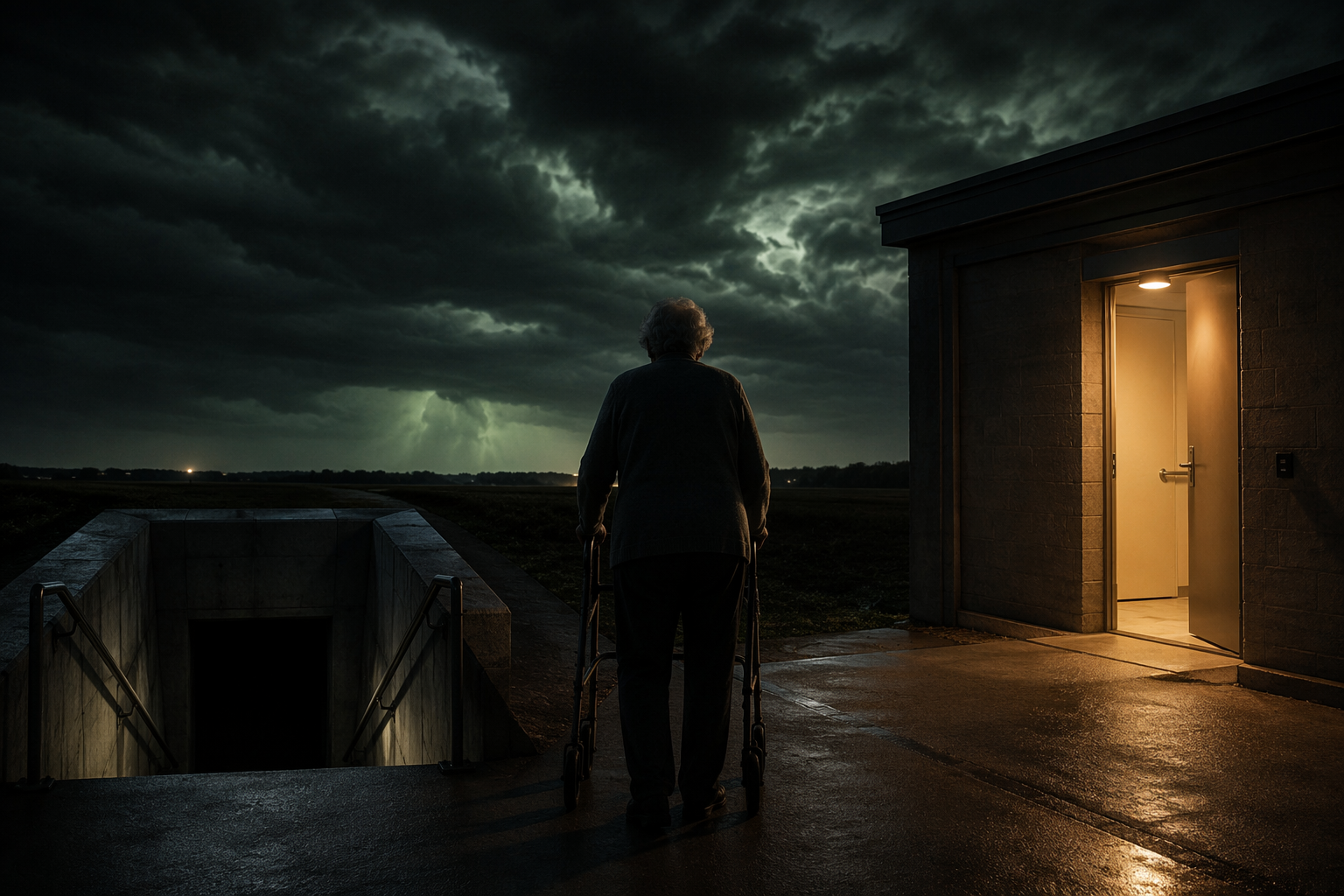
That matters because underground shelter plans often fail at the part families underestimate: stairs, darkness, and the speed required to get down them safely. For a parent who cannot hurry without losing balance, stairs are not a minor inconvenience. They are the barrier that decides whether the shelter is used at all.
Where underground loses older adults
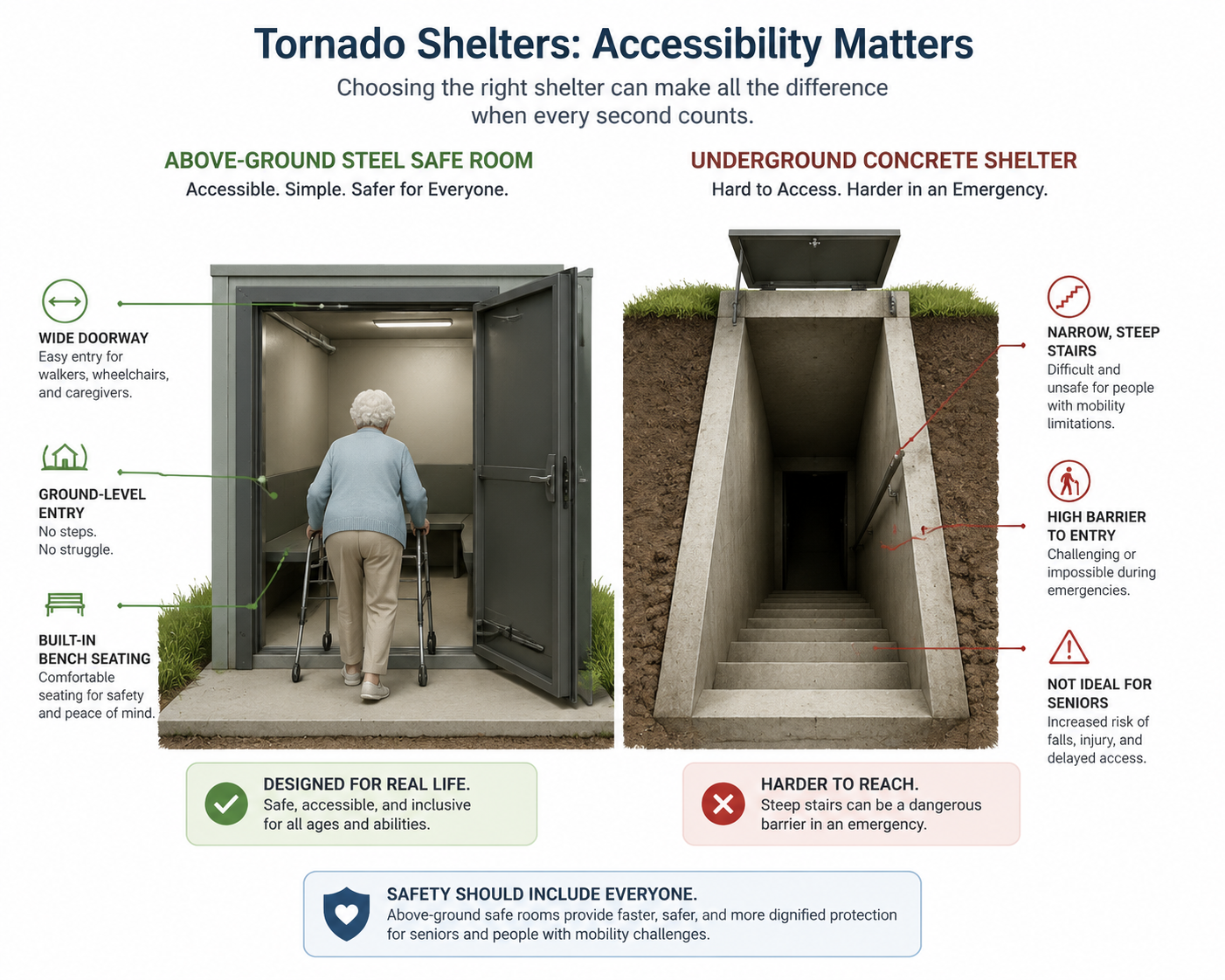
Underground shelters still have a place, but they ask more of the person entering them. A short flight of steps can become a real problem when someone is carrying a cane, guiding a walker, or trying not to fall in the dark. Steadfast Storm Shelters says that walker and cane users struggle with underground stairs, and that is exactly the kind of issue that gets worse when the warning comes late and the body is already stiff from sleep [2].
Above-ground shelters avoid that barrier. That does not make them safer only in theory; it makes them usable in the moment that matters. If the storm warning gives you 10 to 15 minutes, the shelter that sits at ground level, close to the sleeping area, and does not require a careful descent is often the one that actually gets used.
What senior-friendly shelter design actually looks like
The design details that matter are practical and easy to check. Refuge Shelters highlights zero-step entry, 36-inch doorways, and a 60-inch turning radius as the kinds of measurements that make a shelter workable for older adults [1]. Oklahoma Shelters adds two more features that reduce fall risk during entry: non-slip flooring and built-in seating [4].
Those are not luxury details. They are the difference between a shelter a caregiver can imagine using and one a parent can enter independently, or with only minimal help, when the house is dark and the weather has already turned.
| Factor | Above-ground safe room | Underground shelter |
|---|---|---|
| Entry | Ground-level or zero-step access is possible | Usually requires stairs or a hatch descent |
| Walker and cane use | Usually easier to manage | Stairs create a meaningful barrier |
| Fall risk | Lower when the route is flat and well lit | Higher during descent, especially in the dark |
| Best fit | Older adult who cannot move quickly | Older adult who can manage stairs safely |
Ground Zero Shelters makes the same basic point in manufacturer comparison language: the access path matters as much as the shelter shell itself [3]. That is useful guidance, but it is still commercial guidance, so it should be read as a practical checklist rather than neutral research.
Accessibility is the real shelter gap
The bigger problem is not just individual house design. A Center for Public Integrity investigation found that people with disabilities are often left unsheltered in Tornado Alley, which is a reminder that access is a systemic issue, not a niche concern [5]. For a family caregiver, that means the shelter choice has to solve the real-world barriers first, not just the wind rating.
Placement can make a good shelter fail
Even a technically accessible shelter can be the wrong choice if it is too far from the path your parent can actually travel at night. A garage-mounted or immediately adjacent above-ground unit may be a better fit than an underground shelter that sits across a yard, behind a locked gate, or down a route with uneven ground. An interior closet can also work if it is truly close to the bedroom and there are no steps, clutter, or tight turns on the way.
This is where the warning window matters. In a 10 to 15 minute alert, every extra decision adds delay: finding shoes, turning on lights, opening a hard door, steering a walker across a threshold, or helping a parent down to a lower level. The best shelter is the one that fits the route your parent can still manage when they are sleepy, stressed, and moving slowly.
Cost matters, but later
Price still belongs in the decision, just not before access. NerdWallet's July 2025 cost guide, drawing on Angi data, put above-ground steel shelters at about $2,600 to $15,000 and underground concrete shelters at about $4,000 to $20,000 or more, with an average around $7,643 [6]. Those figures are useful for budgeting, but they may not match 2026 pricing exactly.
Rebates and assistance can exist, but they vary widely by state and program. Do not count on financial help until eligibility is confirmed locally.
Questions to ask on a tour
- Can my parent enter without steps?
- Is the doorway wide enough for a walker or cane without a sideways squeeze?
- Is there enough turning space to get inside, turn around, and sit if needed?
- How close is the shelter to the path my parent can actually travel at night?
- What is the route in the dark if the warning comes while my parent is already in bed?
- What happens if my parent needs help on the way in?
- Does the shelter meet FEMA P-361 and ICC 500 performance standards?
For an older adult who cannot move quickly, that usually means an above-ground FEMA-rated safe room or steel shelter placed where your parent can reach it fast, safely, and without help.
References
- Storm Shelters for Seniors: Key Features for Safety and Accessibility — Refuge Shelters
- Best Storm Shelter for Elderly Homeowners in Kentucky — Steadfast Storm Shelters
- Above Ground vs In-Ground Tornado and Storm Shelters — Ground Zero Shelters
- Safe Haven for Seniors — Oklahoma Shelters
- People with disabilities unsheltered in Tornado Alley — Center for Public Integrity
- How Much Does a Storm Shelter Cost in 2026? — NerdWallet
Questions to bring to a clinician or OT
This is not medical, legal, or a family's final decision — only a framework. Bring these questions to a clinician, occupational therapist, or your local Area Agency on Aging.
Find Local HelpRelated reading
Noticed something outdated or inaccurate on this page? Flag a correction. We review every report against CDC, NIA, and AARP HomeFit guidance before updating a page.