
Caregiver decision guide
Locate your elderly parent's evacuation zone map before the next storm
Most caregivers don't know their aging parent's hurricane evacuation zone — and confusing it with a FEMA flood zone can delay life-saving decisions. This guide walks you through state-specific address lookup tools and explains why having the conversation now is critical, especially for older adults living alone.
The first thing to get straight is that an evacuation zone map for elderly residents is not the same thing as a FEMA flood map. A FEMA flood zone tells you about flood risk for insurance and floodplain purposes. A hurricane evacuation zone tells local officials which areas may be ordered to leave because of storm surge. Same address, two different maps, two different decisions.
That distinction matters when you are trying to make a call for a parent who moves slowly, uses oxygen, no longer drives at night, or insists they are “probably fine” because the house has never flooded before. The question during a storm is not “What does the FEMA flood zone say?” It is “Is this address in the evacuation zone named in the current order?”
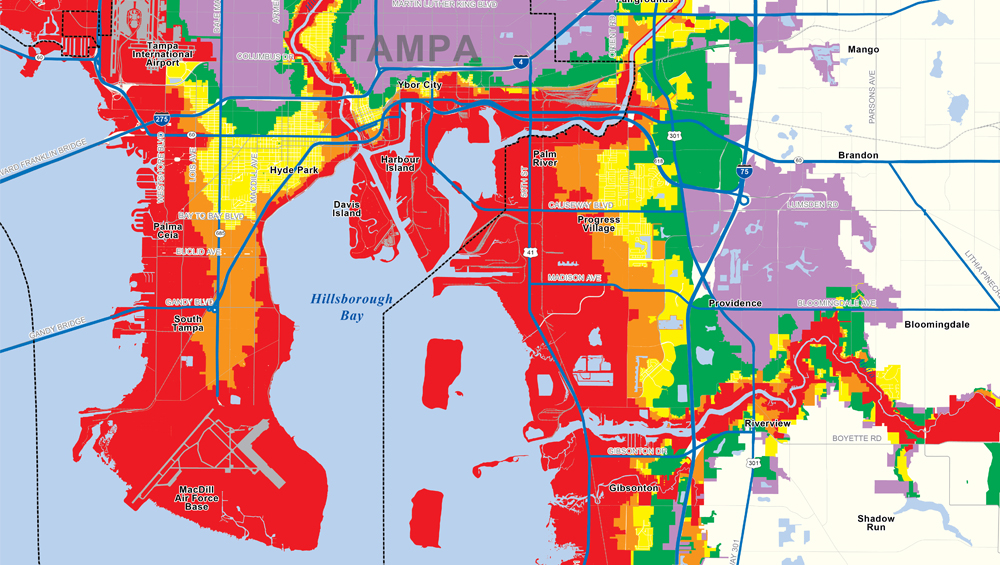
Start with the state or county evacuation lookup, not the FEMA map
For a hurricane evacuation decision, open the official evacuation-zone lookup for the state or county where your parent lives. Florida’s “Know Your Zone” page uses an address search and shows evacuation zones A through F, with Zone A described as the most vulnerable to storm surge.[1] Virginia’s “Know Your Zone” tool uses evacuation zones A through D.[2] South Carolina also directs residents to a “Know Your Zone” address lookup for hurricane evacuation planning.[3]
If your parent’s county sends you to a platform branded Genasys Protect, use it if it is linked from the official local emergency-management page. Some jurisdictions use third-party mapping software, but the source of the instruction still matters. A map reached from a county or state emergency page is different from a random search result with a similar-looking color map.
Use FEMA’s Map Service Center only when you are trying to look up FEMA flood maps, not when you are deciding whether an evacuation order applies to your parent’s address.[4] FEMA flood zones such as A, V, or X are easy to confuse with evacuation-zone letters, which is exactly why the lookup source should be checked before anyone starts packing medications or arguing about whether to leave.
| If you need to know... | Use this type of map | What the result is for |
|---|---|---|
| Whether an evacuation order may apply to your parent’s address | State or county storm-surge evacuation-zone map | Hurricane evacuation decisions |
| Whether the property is in a FEMA flood-risk area | FEMA flood map or FEMA Map Service Center | Flood insurance and floodplain information |
| What to do tonight as a storm approaches | Local emergency-management orders and alerts | Real-time instructions for specific zones or areas |
How to look up your parent’s evacuation zone
Do this with the exact address where your parent sleeps, not a mailing address, not the name of a senior community, and not the nearest intersection. If your parent lives in an apartment, assisted-living building, manufactured-home park, or continuing-care community, use the street address that local emergency services would use to find the building.
- Search for the official state or county evacuation-zone page. Add the state name and “know your zone” or “evacuation zone lookup.”
- Confirm you are on a government or official emergency-management page before entering the address.
- Enter the full address, including apartment or unit information if the tool accepts it.
- Read the result exactly as shown: for example, “Zone A,” “Zone D,” “not in an evacuation zone,” or another local label.
- Print the result, save a screenshot, or write it in the notebook or folder you would grab during a storm.
- Check the same address again if your parent moves, the county updates its system, or you are planning for a new hurricane season.
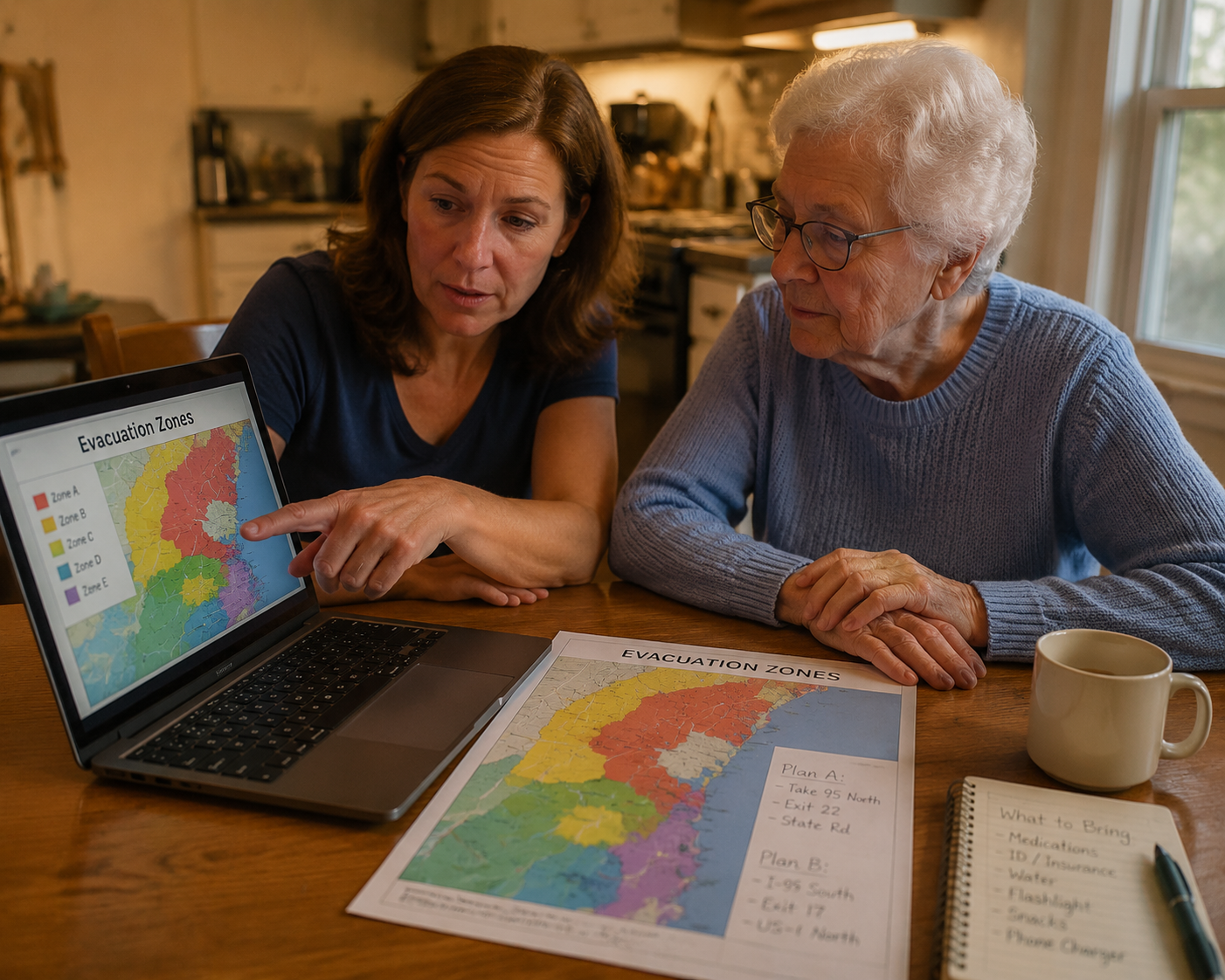
The printout is not busywork. It prevents the classic family phone call where one sibling says “they’re in Zone A,” another says “I found Zone X,” and nobody realizes they are looking at two different systems. Put the evacuation-zone result somewhere boring and findable: the refrigerator, the inside cover of the medication binder, the emergency folder, or a shared family note.
Read the zone letter in that state’s system
Zone letters are not universal. Florida uses A through F for evacuation zones, with A most vulnerable to storm surge.[1] Virginia uses A through D.[2] Maryland uses A through C.[5] Those letters are not interchangeable with FEMA flood-zone letters, and they are not a national ranking that works the same way everywhere.
A parent in Florida Zone C and a parent in Virginia Zone C are not necessarily facing the same level of evacuation priority. A parent in a FEMA flood zone marked X may still need to follow a local evacuation order if their address is in a storm-surge evacuation zone. The only safe reading is local: what does this state or county say this address is, and what zones are named in the current order?
Also notice when the lookup says the address is not in an evacuation zone. That does not mean “no storm risk.” It means the address is not assigned to that particular storm-surge evacuation-zone system. Local officials may still issue other instructions because of wind, flooding, bridge closures, power outages, or conditions specific to the storm.
Turn the map result into a parent-specific decision
For an independent, healthy adult, “wait for the order” can sound simple. For an older parent, the practical deadline may arrive earlier. If they need help getting down stairs, transferring into a car, charging medical devices, refilling prescriptions, calming confusion, or arranging pet transport, the evacuation-zone result is only the starting line.
Ready.gov’s older-adult preparedness guidance tells older adults to plan for their specific medical, mobility, communication, and support needs.[6] The American Red Cross also emphasizes planning around medications and the realities of older-adult emergency needs.[7] The clinical concern is not theoretical: the American Association for Geriatric Psychiatry notes that older adults can face disproportionate disaster risk because of medical illness, cognitive impairment, mobility limitations, social isolation, and dependence on caregivers or services.[8]
That is why the same zone can mean different work in two families. A parent who drives, hears alerts, and can carry a bag may only need an early phone call and a destination. A parent with oxygen equipment may need backup power, transport that can carry equipment, and confirmation that the destination can handle the device. A parent with dementia may need a familiar person in the car before traffic and sirens make the situation harder.
| If your parent... | Treat the zone result as a trigger to... |
|---|---|
| Uses oxygen, dialysis, refrigerated medication, or powered medical equipment | Confirm equipment transport, backup power, medication supply, and the destination’s ability to support the need |
| Uses a walker, wheelchair, stair lift, or needs help transferring | Decide who physically gets them out and how much time that person needs before roads fill |
| Has memory loss, confusion, or poor judgment during stress | Use one clear caller, one written plan, and an earlier departure threshold |
| Lives alone | Do not assume they have discussed evacuation with anyone else; make the plan explicit |
| Lives in a senior community | Ask the building or community what their evacuation procedure is, but still keep your own copy of the address zone |
This is also the place to stop assuming the conversation has already happened. Bell et al. found that, among community-dwelling adults ages 50 to 80 in the United States, older adults living alone had 41% lower odds of having discussed evacuation plans with family.[9] That finding does not cover adults over 80, so it should not be stretched into a claim about every older adult. It is still enough reason not to wait for your parent to bring it up first.
What to ask before a storm is close
Once you know the evacuation zone, the useful conversation is short and specific. It should not start with a debate about whether last year’s storm was overhyped. It should start with the actual result: “Your address is in evacuation Zone B,” or “Your address is not in the county’s storm-surge evacuation zone.” Then move to what happens if local officials name that zone.
- If your zone is ordered to evacuate, where do you want to go first?
- Who is driving, and who is the backup if that person cannot get there?
- What medications, devices, chargers, glasses, hearing-aid supplies, documents, and mobility items must leave with you?
- How much time do you realistically need from the first phone call to being in the car?
- Who has permission to make the call if you disagree or cannot be reached?
For a parent who values independence, the wording matters. The point is not to take over their life in July because a hurricane might come in September. The point is to remove the avoidable argument from the day when the county says Zone A or Zone B needs to leave.
When an evacuation order is issued
A saved zone result does not replace current orders. Storm tracks change, and local officials may order only certain zones, parts of zones, barrier islands, mobile homes, low-lying areas, or other locations depending on the hazard. During the storm, check the county emergency-management office, state emergency-management agency, local alerts, and official public-safety channels.
This is where having the zone written down pays off. If the order says “Zone A evacuates,” you are not starting from a search tab, a half-remembered color, and a parent who says the neighbor is staying. You already know whether the order includes the address, and you can spend the remaining time on transport, medication, pets, keys, and destination.
If the order does not include your parent’s zone, keep watching. Do not erase the plan just because the first order missed their address. The next advisory may expand the order, roads may close, or the parent’s medical situation may make leaving earlier safer than waiting for the last possible instruction.
The small record that prevents a bigger delay
Before the next storm has a name you recognize, look up the exact address in the official evacuation-zone system, write down the result, and tell the parent what it means. Keep the FEMA flood map separate from the evacuation-zone map. Then, when local officials name the zones that need to leave, you are not solving a map question at the same time you are trying to move an older adult safely.
References
- Know Your Zone, FloridaDisaster.org, floridadisaster.org/knowyourzone
- Know Your Zone, Virginia Department of Emergency Management, vdem.virginia.gov/know-your-zone
- Know Your Zone, South Carolina Emergency Management Division, scemd.org/prepare/know-your-zone
- FEMA Flood Map Service Center, FEMA, msc.fema.gov
- Know Your Zone, Maryland, mema.maryland.gov
- Older Adults, Ready.gov, ready.gov/older-adults
- Older Adults, American Red Cross, redcross.org/get-help/how-to-prepare-for-emergencies/older-adults.html
- Older Adults and Disaster Preparedness and Response, American Association for Geriatric Psychiatry, aagponline.org/patient-article/older-adults-and-disaster-preparedness-and-response
- Predictors of Emergency Preparedness among Older Adults in the United States, PMC, PMC7704536
Questions to bring to a clinician or OT
This is not medical, legal, or a family's final decision — only a framework. Bring these questions to a clinician, occupational therapist, or your local Area Agency on Aging.
Find Local HelpRelated reading
Noticed something outdated or inaccurate on this page? Flag a correction. We review every report against CDC, NIA, and AARP HomeFit guidance before updating a page.