
Caregiver decision guide
A Senior Caregiver's Wildfire Preparedness Checklist
This checklist covers the wildfire-specific steps many general emergency guides miss — smoke protection, medical device power during PSPS events, evacuation planning for mobility- or cognitively-impaired seniors, and a senior-specific go-bag.
Why wildfire needs its own checklist
This is not the general emergency-prep page, and it is not the room-by-room severe-storm checklist. Use that companion guide for general home safety basics; this one is for wildfire-specific decisions. Wildfire changes the problem before flames ever reach the house: smoke can make indoor air dangerous, shutoffs can stop the machines a parent depends on, and evacuation has to happen before your parent is too tired or confused to move. Adults 65+ are twice as likely to die in a home fire as the general population, and adults 85+ are four times as likely [1]. AARP reports that wildfire smoke PM2.5 can be up to 10 times more toxic than equal doses of ambient air pollution from fossil fuels [2]. Much of the strongest preparedness infrastructure comes from Western states, especially California, but the smoke problem now reaches well beyond the West.
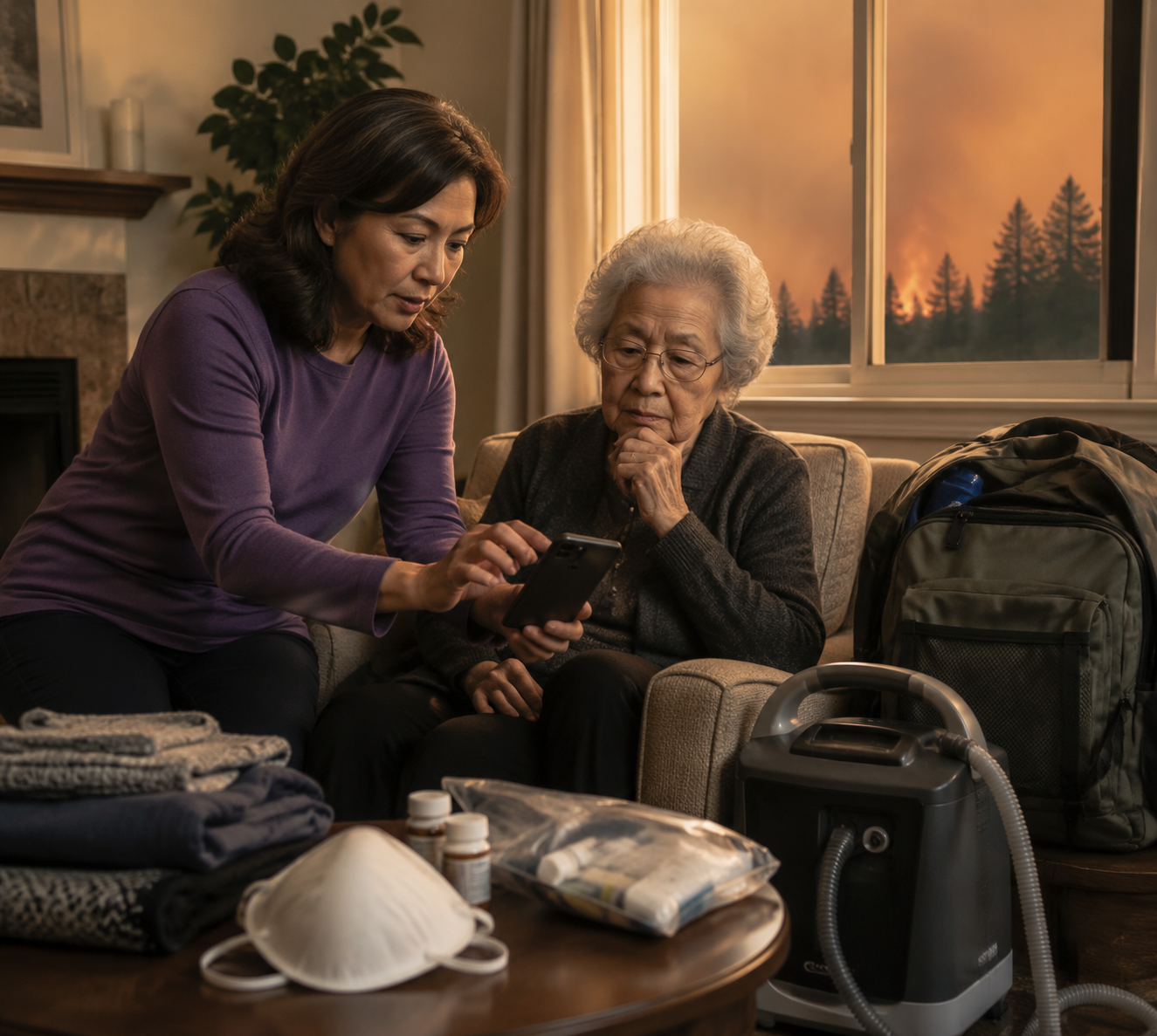
Cut smoke exposure first
If your parent cannot tolerate smoke, do not wait for the house to smell bad. Set up one clean room as soon as the air turns unhealthy: close windows, run a HEPA purifier, keep the door shut, and keep N95 masks where the caregiver can reach them fast. If the parent needs oxygen, has COPD or asthma, or gets panicky in a mask, treat that as a reason to move to cleaner air sooner, not later.
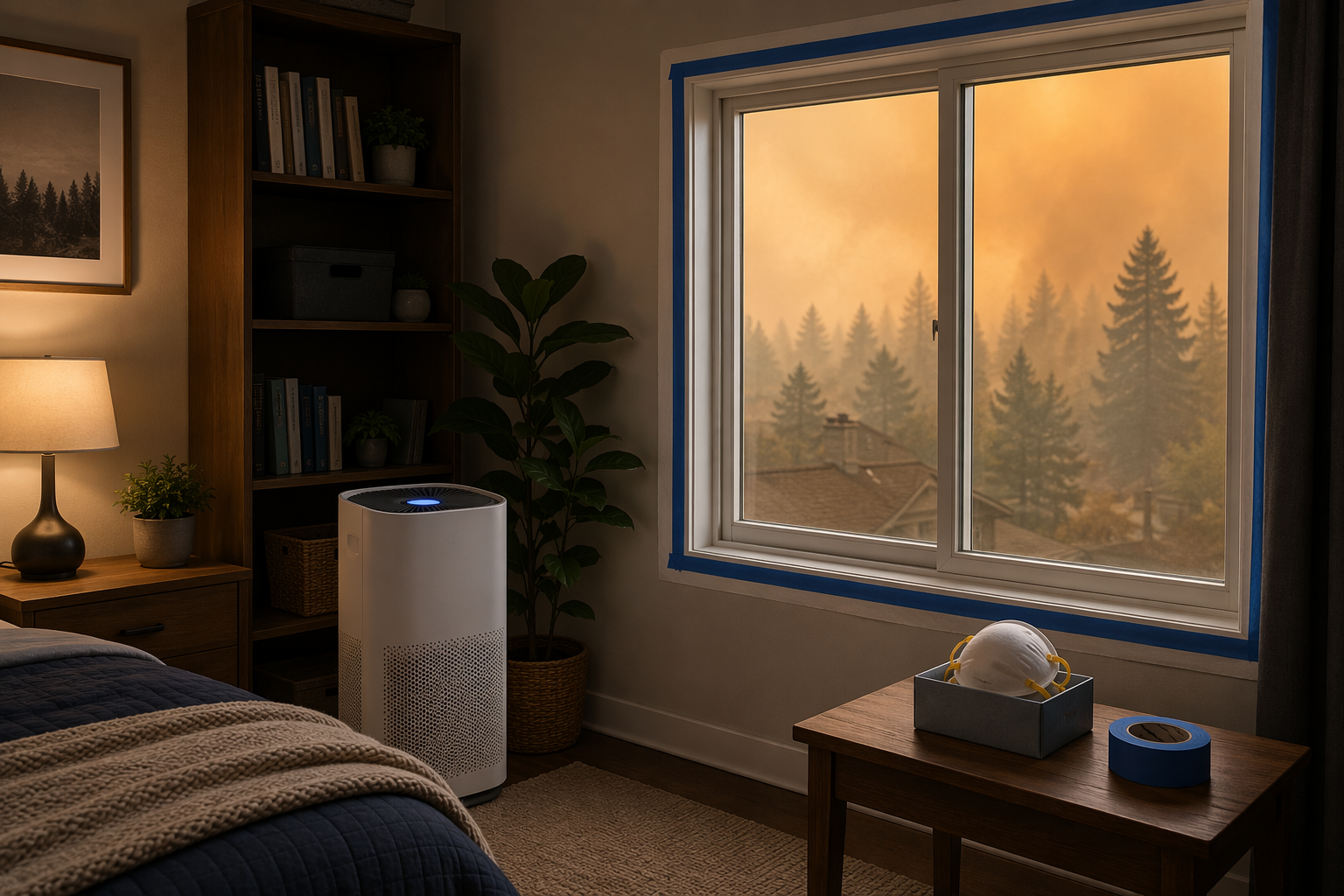
Smoke planning works best when it is boring and already in place.
- Pick one room the parent can stay in for several hours if needed, ideally the room they already use most.
- Run the air purifier before the air gets bad, not after the room already smells smoky.
- Seal obvious gaps around windows and doors if you have the supplies; even a partial seal helps keep one room cleaner.
- Keep N95 masks for both the parent and the caregiver in the same place every time.
- If the parent cannot wear a mask safely or effectively, do not try to force a long indoor stay as the main plan.
Keep power for medical equipment
Electrical dependence is its own emergency. If your parent uses CPAP, oxygen, a nebulizer, or another device that must keep running, register with the local utility for medical baseline or priority restoration before fire season gets serious; California's Department of Aging includes that step in its senior disaster guidance [3]. Then write down how long each device can run on backup power, who can charge it, and what happens if the outage lasts past one night.
- Call the utility now and ask exactly how medical baseline or priority restoration registration works.
- Ask the oxygen or CPAP supplier what backup power they recommend and how long it should last.
- Charge spare batteries and power banks before the alert, not during it.
- Keep device instructions, model numbers, and support contacts with the equipment itself.
- If the parent uses a medical alert device, confirm what happens if the power or cellular network fails.
Leave earlier than a healthy adult would
California's Department of Aging says, "Anyone with medical or physical limitations and the elderly should be evacuated immediately" [3]. That is the right rule for the parent who walks slowly, needs help with transfers, or runs out of steam when the car is not already packed.
- Do not wait for visible flames if smoke or power loss makes the plan unreliable.
- Assign one adult to the parent, not the house.
- If your parent has dementia, never leave them alone during evacuation; FireHelpCenter says caregivers need step-by-step guidance and wandering prevention because leaving is only half the problem [4].
- Decide now who opens the car, who loads the go-bag, who handles the medications, and who stays with the parent.
- Practice the actual route out, including stairs, lifts, walker transfers, and car seating.
Pack a senior-specific go-bag
A standard family go-bag usually misses the things older adults actually need. Put this one together as if you may have to leave in a smoky parking lot, with one hand on the parent and the other on the bag.
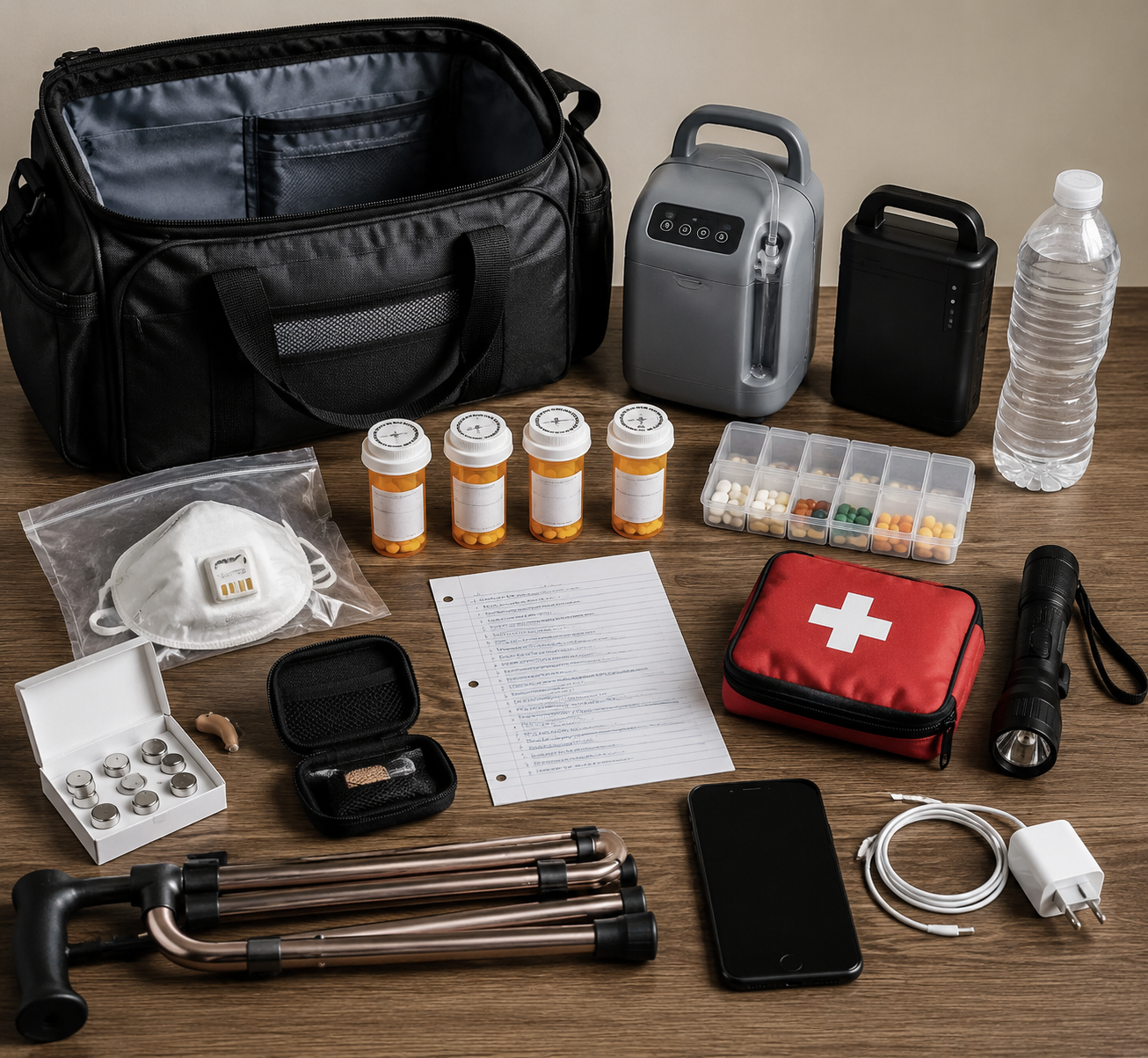
- N95 masks for the parent and caregiver.
- Extra hearing aid batteries.
- Backup power for CPAP or oxygen equipment.
- A written medication list, plus the medications themselves.
- Mobility aid supplies such as cane tips, walker parts, wheelchair charger, or anything else your parent uses daily.
- Glasses, dentures case, charging cables, ID, insurance cards, and water.
- A small pouch for the few items the parent needs within reach, not buried at the bottom of the bag.
After the evacuation
Once you are out, watch for increased confusion, sleep disturbance, agitation, or withdrawal. The scoping review on wildfires and older adults flags these kinds of post-event changes in cognitively impaired seniors [5].
- Keep routines simple and predictable.
- Recheck medications, inhalers, oxygen, batteries, and chargers.
- Tell the receiving caregiver or shelter staff what changed during the evacuation.
- Treat a sudden behavior change as a health issue, not just stress.
For an aging parent, wildfire preparedness is not complete until smoke, power, evacuation timing, and the go-bag all work together. If even one of those pieces still depends on "we'll figure it out when the alert comes," the plan is not ready.
References
- 13 Fire Season Tips for the Elderly and their Family Caregivers — California Caregiver Resource Centers, 2022-07-12
- 8 Ways Wildfire Smoke Affects Your Health — AARP, July 2026
- Disaster Preparedness Tip Sheets for Seniors — California Department of Aging
- Wildfire Preparedness Guide for Seniors & Caregivers — FireHelpCenter, March 2026
- Wildfires and Older Adults: A Scoping Review of Impacts, Risks, and Interventions — PMC, 2023
Questions to bring to a clinician or OT
This is not medical, legal, or a family's final decision — only a framework. Bring these questions to a clinician, occupational therapist, or your local Area Agency on Aging.
Find Local HelpRelated reading
Noticed something outdated or inaccurate on this page? Flag a correction. We review every report against CDC, NIA, and AARP HomeFit guidance before updating a page.