
Caregiver decision guide
How Long Will Wildfire Smoke Last? A Senior Safety Timeline
Wildfire smoke threatens senior health long after the flames are out. This guide breaks down a three-phase timeline — acute smoke event, lingering air quality, and extended health monitoring up to three months — with actionable steps for each phase to protect older adults.
For an older adult, wildfire smoke safety does not end when the flames move away or the sky starts looking normal. A useful caregiver timeline has three windows: the acute smoke event, often planned as a 1-14 day period; the lingering fine-particle period after visible smoke improves, which can last days and sometimes one to two weeks; and a health-monitoring period that may extend up to three months. The CDC’s plain warning is the one families tend to forget first: smoke can stay in the air for days after a wildfire ends.[1]
That does not mean every area is unsafe for the same length of time. Wind, terrain, fire containment, distance from the fire, inversion layers, and local air-quality readings decide the real answer. For day-to-day decisions, AirNow.gov and local public health instructions override any general estimate.
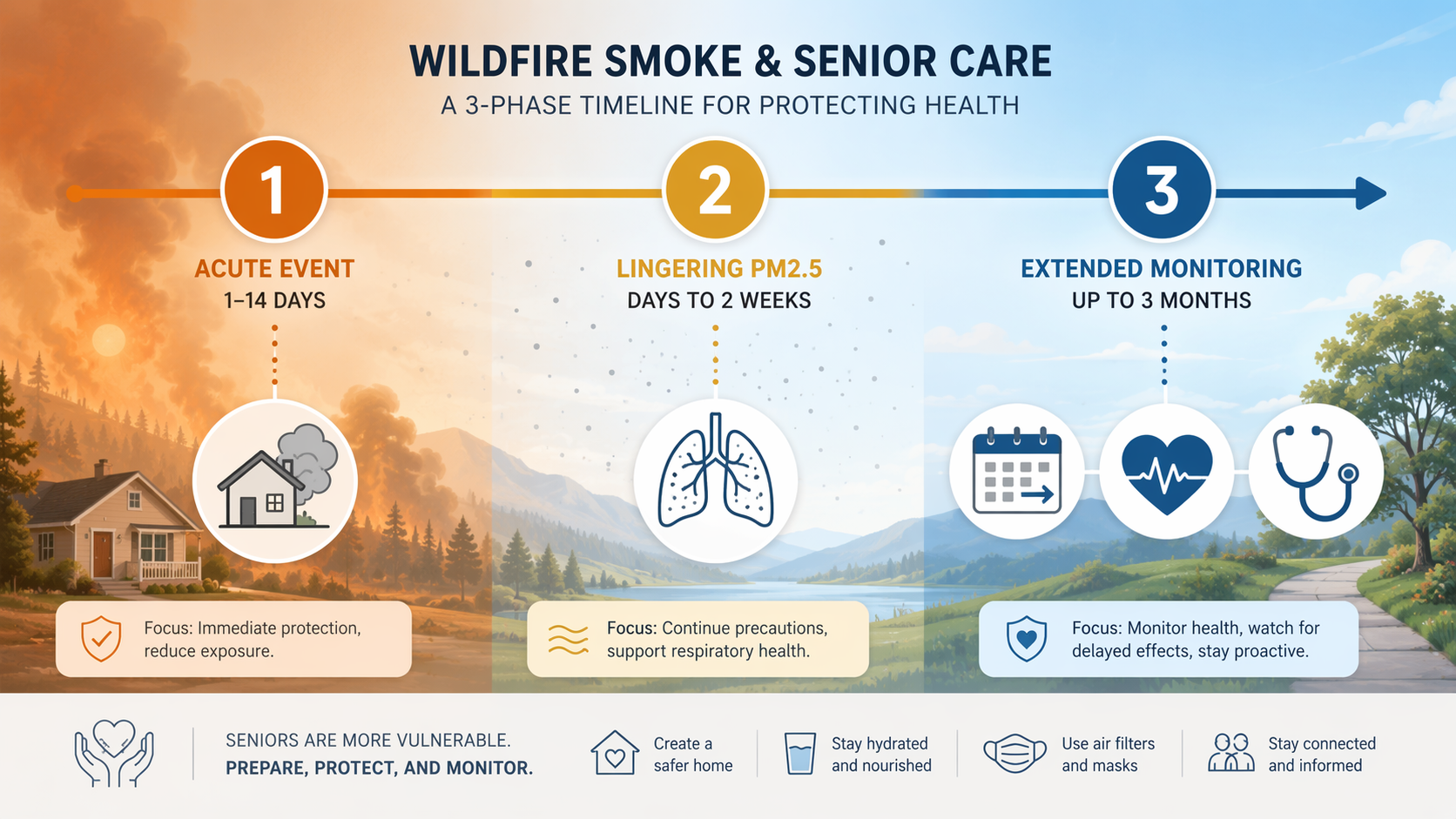
The caregiver timeline at a glance
| Phase | What it means for an older adult | Caregiver action |
|---|---|---|
| Acute smoke event: roughly 1-14 days | Smoke is visible or AQI is elevated; outdoor exposure is the immediate concern. | Check AirNow, keep the older adult indoors when AQI is concerning, close the home as much as feasible, and set up one cleaner-air room. |
| Lingering PM2.5: days to one or two weeks after visible improvement | Fine particles may still be present even when the sky looks better. | Do not reopen windows or resume errands just because haze thins; continue AQI checks and keep the cleaner-air setup running. |
| Extended monitoring: up to three months | Respiratory and cardiovascular effects may appear after the obvious smoke period. | Watch COPD, asthma, heart rhythm, blood pressure, chest pain, shortness of breath, and unusual fatigue; arrange follow-up when symptoms change. |
The table is not a prediction. It is a safety calendar. If your parent has COPD, asthma, heart disease, diabetes, dementia, limited mobility, oxygen, CPAP, insulin that depends on refrigeration, or trouble tolerating a respirator, use the more cautious side of each window.
The next few hours: use AQI, not the color of the sky
Start with the nearest reliable AQI reading. AirNow’s guidance for older adults treats an orange AQI, 101-150, as the point where older adults should avoid all outdoor activity. At red, 151-200, the risk is higher; for a frail parent, even a brief unprotected trip outside can be a health risk.[2]
The first decision is not whether the day looks tolerable. It is whether the older adult needs to go outside at all. Cancel the walk. Move trash, mail, pet care, and porch chores to someone else. If a medical appointment can safely be changed to telehealth or rescheduled, ask. If it cannot, plan the trip like a medical transfer: shortest route, closed vehicle windows, recirculated air, respirator if the person can use one correctly, and no extra stops.
Inside the home, close windows and exterior doors as much as you reasonably can. Turn off systems that intentionally pull smoky outdoor air indoors unless a qualified professional or local guidance says otherwise. If the home has central air, use the best filter the system can safely handle and run the fan if that improves filtration without overheating equipment. For many families, though, the more realistic goal is not a perfectly sealed house. It is one room where the parent can sleep, sit, take medications, and recover.
Stanford’s wildfire smoke guidance gives caregivers a concrete target: a portable air cleaner with a smoke CADR of at least 80 cubic feet per minute can clean a medium bedroom.[3] That is the kind of number that matters during a smoke week, because it turns a whole-house problem into a room-level plan.
- Choose the room your parent can actually use for long stretches, usually a bedroom or den near a bathroom.
- Run the portable air cleaner continuously, following the device’s placement and filter instructions.
- Keep the door closed as much as possible, especially when outside doors open elsewhere in the home.
- Move essentials into the room: medications, water, phone charger, oxygen supplies, inhalers, mobility aids, eyeglasses, hearing aids, and emergency contacts.
- If your parent has dementia, remove the temptation to “air out” the room by placing simple signs on windows and checking latches without making the room feel punitive.
Caregivers who are building a broader home plan can fold this cleaner-air room into an aging-in-place care plan. If the parent has early memory loss, adapt the setup with the same practical mindset used in an early-stage dementia home safety checklist: fewer choices, clearer cues, and less reliance on remembering instructions during stress.
Why the first smoke days are hard on older bodies
Wildfire smoke is not just unpleasant odor. The fine-particle fraction, PM2.5, is small enough to be inhaled deeply. Stanford’s review of wildfire smoke health impacts notes that acute exposure over five to seven days can damage the lungs, blood, and heart, and reports that older adults face a 40% increase in stroke rate during wildfire smoke exposure.[3]
That is why a parent with “stable” COPD or heart disease deserves extra caution before symptoms escalate. A person can look calm in a chair while working harder to breathe. A caregiver may hear it first as shorter sentences on the phone, a skipped meal, a new nap, confusion that seems like “just being tired,” or reluctance to walk to the bathroom.
Older homes add another problem. Stanford notes that older housing stock tends to have more air leakage, which reduces indoor protection and can limit how well filters perform.[3] In a newer, tight home, “stay inside” may be a strong protective action. In a drafty house with gaps around windows, an old wall heater, and a door that opens often for pets or caregivers, staying inside still helps, but it is not the whole plan.
This is also where power planning belongs. If your parent uses oxygen, CPAP, powered mobility equipment, or refrigerated insulin, smoke safety can become outage safety quickly. A scoping review of 75 studies found that older adults who depend on oxygen, CPAP, or insulin need backup power plans during wildfire-related outages.[4] Write down who brings the battery, who checks the oxygen supply, who can transport the parent, and which location has power if the home loses it.
If this is your first time coordinating emergency care for a parent, keep the task list small enough to finish. The same principle applies in a broader first-30-days caregiver roadmap: identify the immediate risk, name the responsible person, and avoid assuming that “someone” will check.
Masks: useful only when they are the right kind and actually wearable
Cloth masks and surgical masks should not be treated as protection from wildfire PM2.5. CDC and AirNow guidance point to N95 or P100 respirators as the relevant face coverings for wildfire smoke particles.[1][2] That does not mean every older adult can safely or successfully use one.
A respirator has to seal to the face. Facial hair, a loose fit, the wrong size, confusion, panic, severe shortness of breath, or inability to remove it independently can all turn a good recommendation into a bad plan. For a parent with advanced COPD, heart symptoms, dementia, or anxiety, ask a clinician for individualized advice rather than forcing a mask because the package says N95.
Use the respirator as a backup for necessary exposure, not as permission to run errands. The safer caregiver move is usually to reduce trips outside, bring supplies in, and keep the cleaner-air room working.
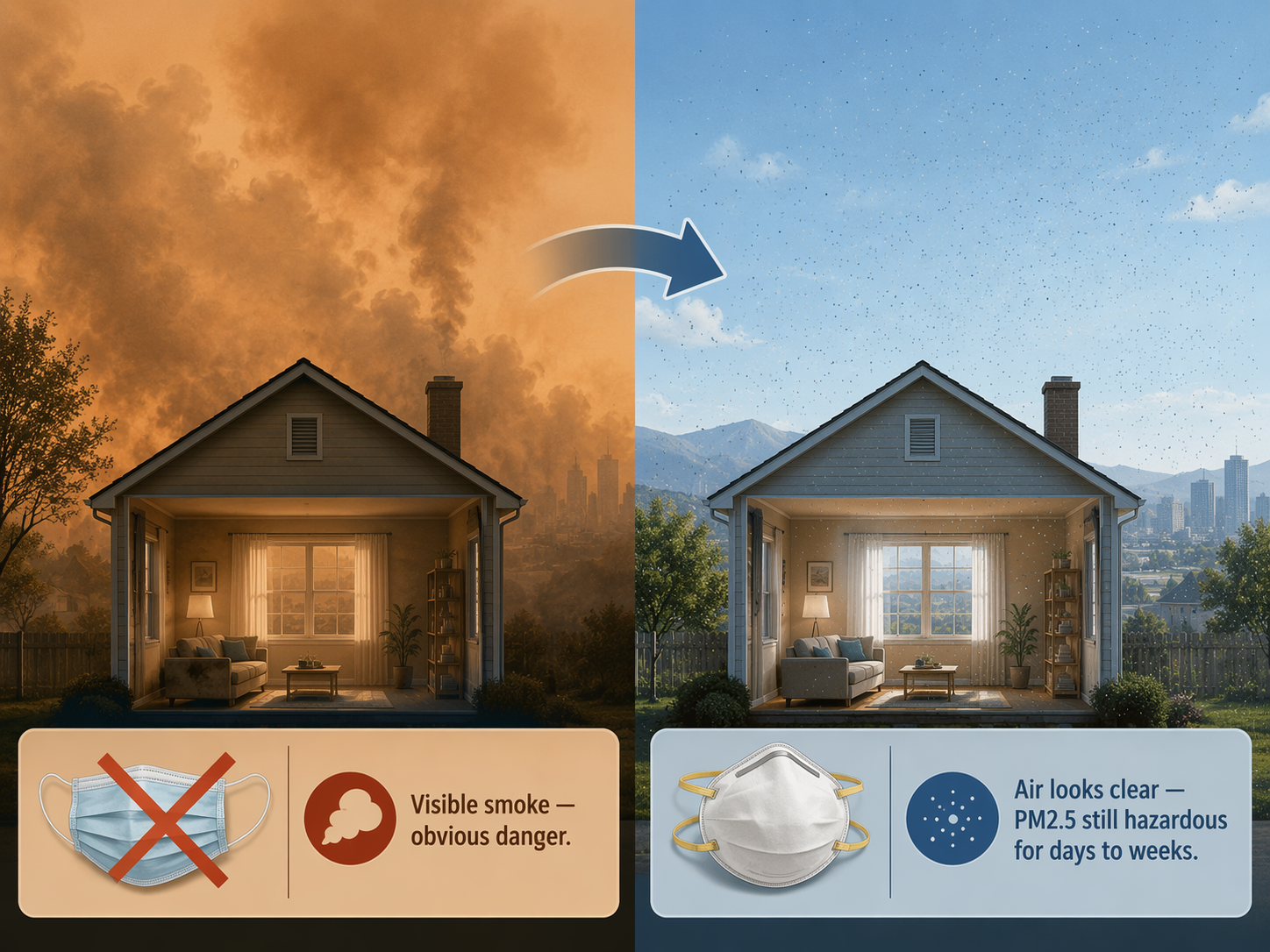
The dangerous relief after the sky improves
The most common mistake comes on the first better-looking morning. The sun is sharper. The street no longer looks orange. Someone opens the windows “just for a bit,” or drives an older parent to the pharmacy because everyone is tired of being stuck inside.
That is exactly when the CDC’s warning matters: smoke can remain in the air for days after the wildfire ends.[1] Fine particles do not need dramatic brown haze to reach unhealthy levels. If AQI is still elevated, the room still needs filtration, outdoor activity still needs to wait, and errands still need a safer plan.
During this lingering window, keep using the same decision rule you used during the acute event. Look at AQI before you change behavior. If the reading is orange, older adults should avoid all outdoor activity under AirNow’s older-adult guidance. If it is red, do not treat a quick trip to the mailbox, garden, or car as harmless for a medically fragile parent.[2]
What to keep doing during the first clear-looking week
- Keep checking AirNow and local public health updates at least daily, and more often if smoke is shifting.
- Keep the cleaner-air room operating until readings and official guidance support easing precautions.
- Delay window-opening, vacuuming without proper filtration, sweeping ash, yard cleanup, and unnecessary outdoor chores.
- Ask delivery drivers, neighbors, or family members to handle errands that would otherwise pull the older adult outside.
- Check inhaler supply, oxygen backup, blood pressure equipment, glucose supplies, and medication refills before the next smoke shift.
If ash is present around the home, do not rush a frail parent into cleanup. CDC after-wildfire guidance emphasizes safety during the return and cleanup period, when hazards can remain even after the immediate fire threat has passed.[5]
The three-month watch: not panic, not dismissal
The extended window is not about keeping a parent sealed indoors for three months. It is about not losing the thread once the smoke week is over.
A May 2025 Harvard T.H. Chan School of Public Health and Icahn School of Medicine at Mount Sinai study in Epidemiology tracked 13.7 million cardiovascular and 7.9 million respiratory hospitalizations across 15 states. The researchers found that medium-term exposure to wildfire smoke PM2.5 was associated with increased hospitalization risks for ischemic heart disease, arrhythmia, hypertension, COPD, and asthma after the fire ended, with effects persisting up to three months. Hypertension showed the greatest increase.[6]
Use that finding carefully. It is serious evidence, especially because it looks beyond the smoke days themselves. It is not a personalized forecast that your father will be hospitalized in month two, or that your mother’s blood pressure change is definitely from smoke. The practical conclusion is narrower and still important: for older adults with respiratory or cardiovascular disease, the follow-up window should be longer than the visible haze.
For the next several weeks, write down symptoms that would otherwise be brushed off as aging or stress: new or worsening shortness of breath, wheezing, chest tightness, chest pain, palpitations, dizziness, faintness, swelling, unusually high blood pressure, increased rescue-inhaler use, worsening cough, new confusion, or fatigue that changes daily function. If your parent has COPD, asthma, heart disease, arrhythmia, hypertension, or diabetes, ask the clinician what change should trigger a call, urgent visit, or emergency response.
This is where a simple log helps. Date, AQI level if known, symptoms, oxygen saturation if your clinician already uses it, blood pressure if you already monitor it, medication changes, and calls to the clinic. The point is not to create a medical record from scratch. It is to make the next conversation with the clinician less dependent on memory.
What broader smoke research adds, and what it does not decide today
There is a larger body of wildfire smoke research behind these precautions. Studies have reported that wildfire smoke PM2.5 may be more toxic than equal doses of ambient PM2.5, partly because of particle characteristics and chemical composition.[7][8] Other research has connected wildfire smoke with long-term population health burdens, including a UCLA-led estimate attributing more than 52,000 premature deaths in California from 2008-2018 to chronic wildfire smoke exposure, with costs of at least $432 billion.[9]
Longer follow-up findings also exist. In one Montana wildfire study published in Toxics in 2020, 33.9% of participants still had detectable lung-function impairment two years after a single wildfire exposure.[10] That kind of result should not be turned into a prediction for one household, but it does argue against treating smoke as a short nuisance for older lungs.
For today’s caregiver decisions, the order still matters: local AQI first, indoor protection second, symptom monitoring third. Population estimates explain why smoke deserves respect. They do not replace the reading in your parent’s ZIP code or the symptoms happening in the next room.
A practical safety calendar for an older adult
| When | What to check | What to do |
|---|---|---|
| Today and tonight | AirNow AQI, local alerts, breathing, chest symptoms, power reliability, oxygen or CPAP needs | Keep the older adult indoors when AQI is concerning, avoid outdoor activity at orange or worse, close the home, and run a cleaner-air room. |
| Each smoke day | AQI trend, medication supply, hydration, heat risk indoors, caregiver coverage | Reduce door opening, cancel nonessential trips, use N95 or P100 only when needed and tolerated, and have someone check in if you cannot visit. |
| First clear-looking week | AQI before opening windows or resuming errands | Keep precautions until readings and local guidance support easing them; do not use visible clearing as the endpoint. |
| Next one to three months | COPD, asthma, blood pressure, chest pain, palpitations, fatigue, confusion, and follow-up needs | Track changes, contact clinicians for worsening symptoms, and keep smoke exposure in the conversation even after the event feels over. |
If your family already keeps emergency supplies for earthquakes, storms, or outages, add wildfire smoke tasks to the same plan instead of making a separate binder no one will open. A senior-focused earthquake preparedness checklist is a useful model: room-by-room supplies, backup power, contact lists, and a clear division of responsibilities.
Keep checking local AQI until authorities and readings support easing precautions. Maintain the cleaner-air setup through the lingering window, especially for COPD, heart disease, asthma, diabetes, dementia, oxygen, CPAP, or frailty. Continue watching respiratory and cardiovascular symptoms for up to three months, because the smoke can stop being visible before it stops mattering.
References
- How to Safely Stay Safe During a Wildfire, CDC
- Older Adults, AirNow
- Health impacts of wildfire smoke, Stanford Woods Institute
- Evidence on the Health Risks Associated with Wildfire Events to Inform Wildfire Mitigation Policies: A Scoping Review, PMC
- How to Safely Stay Safe After a Wildfire, CDC
- Cardiorespiratory effects of wildfire smoke particles can persist for months even after a fire has ended, Harvard T.H. Chan School of Public Health, May 2025
- A systematic review of the physical health impacts from non-occupational exposure to wildfire smoke, Epidemiology, 2017
- Wildfire smoke impacts respiratory health more than fine particles from other sources: observational evidence from Southern California, Nature Communications, 2021
- Mortality burden of wildfire smoke in California from 2008 to 2018, Science Advances, 2024
- The Impact of Wildfire Smoke on Respiratory Health, Toxics, 2020
Questions to bring to a clinician or OT
This is not medical, legal, or a family's final decision — only a framework. Bring these questions to a clinician, occupational therapist, or your local Area Agency on Aging.
Find Local HelpRelated reading
Noticed something outdated or inaccurate on this page? Flag a correction. We review every report against CDC, NIA, and AARP HomeFit guidance before updating a page.