
Caregiver decision guide
How to Plan a Senior-Safe Wildfire Evacuation
This guide provides a step-by-step wildfire evacuation plan tailored to older adults, covering medication preparation, mobility aids, medical documents, and a decision framework for leaving early — because generic checklists miss what seniors need.
A standard go-bag assumes the person can hear the warning, grab the bag, and move fast. For wildfire evacuation planning for seniors, that assumption breaks in predictable ways: a missed dose, a walker left in another room, paperwork spread across two drawers, a car that is not usable, or dementia that turns "leave now" into a crisis. The January 2025 Los Angeles fires made the cost plain: 31 people died, and 26 were over 65 or living with a disability [1]. This is not a new pattern either; the 2018 Camp Fire's average victim age was 72 [2].
Build the plan around the person, not the fire
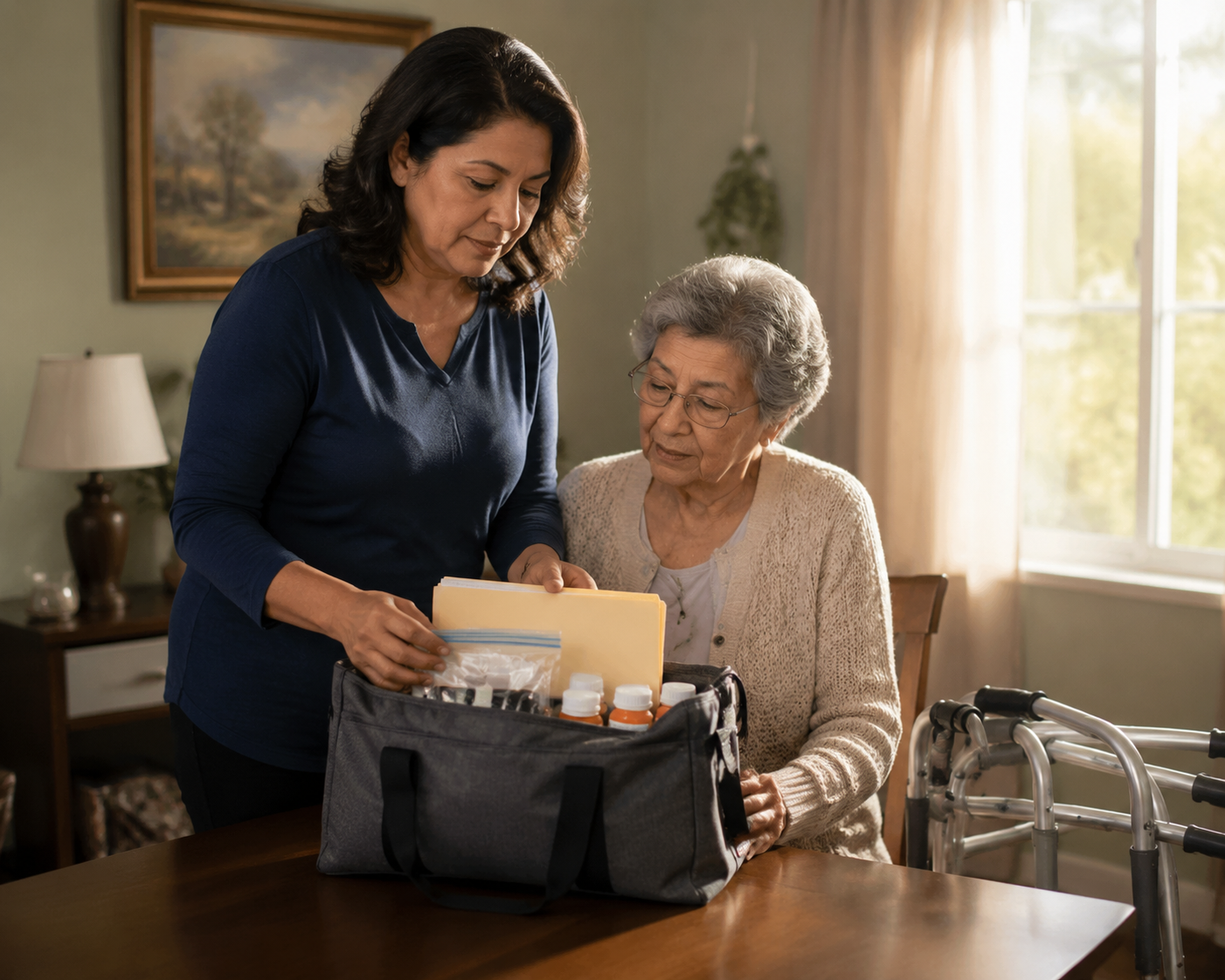
The first move is to decide what "leave early" means before smoke is close enough to force the issue. That decision should already account for how the older adult moves, what they take every day, who can speak for them, and how they will get out if they cannot drive. The workflow is simple on paper and very different in practice:
- Set the leave-now trigger before evacuation orders.
- Keep medications and a current medication list ready to travel.
- Duplicate mobility aids, chargers, batteries, and any transfer gear.
- Gather medical documents, insurance cards, and decision-making papers.
- Write down the transport backup and the place that can actually receive the older adult.
Medication cannot be improvised
Medication is the first place a generic checklist fails. For this guide, keep at least a 14-day supply of every essential prescription on hand; the American Red Cross advises older adults to keep a 30-day supply when possible [3]. That difference matters because displacement is rarely neat. Pharmacies may be closed, refills may not transfer quickly, and the caregiver may need to sort bottles, dosing schedules, and allergies while the evacuation is already under way.
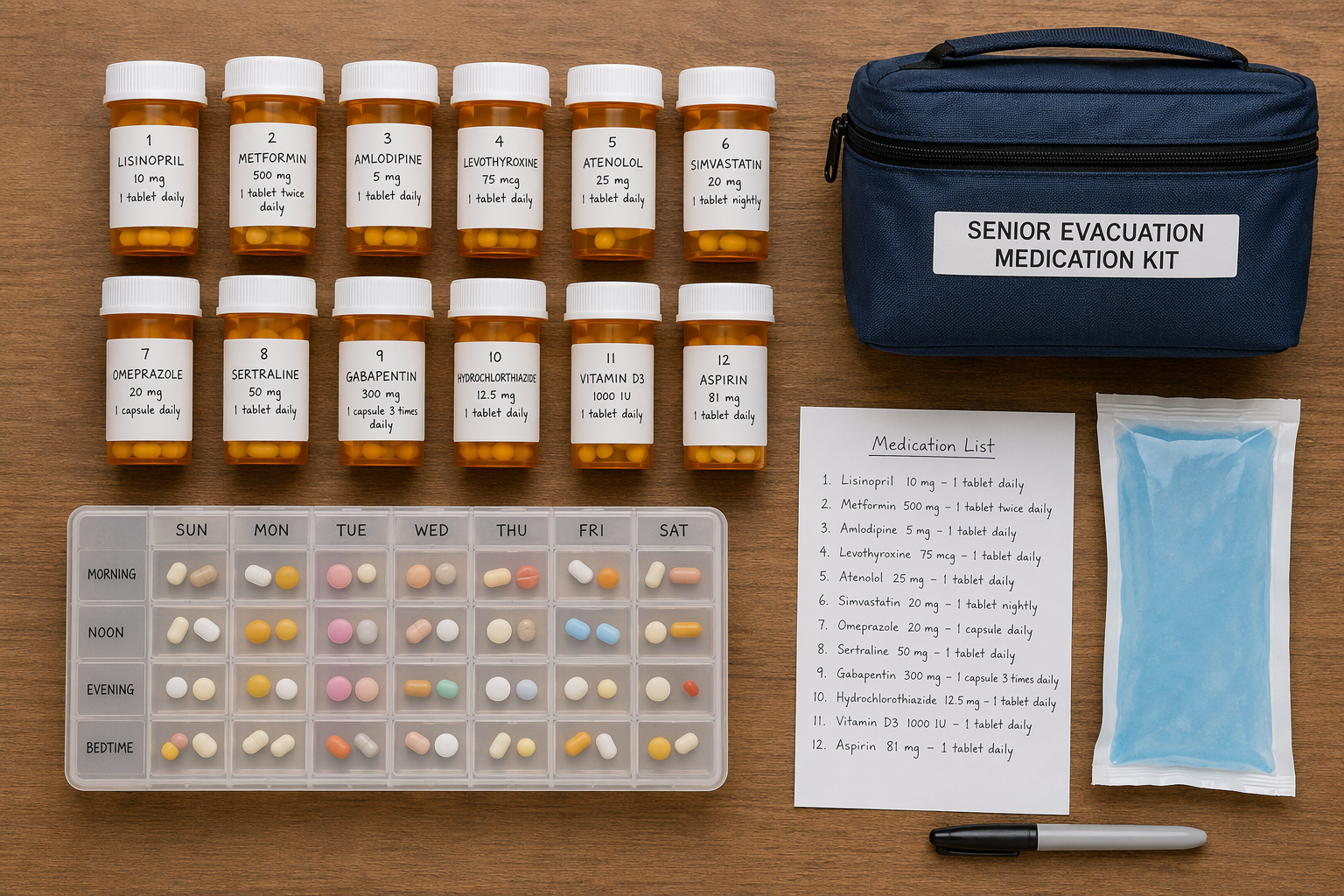
Keep one written medication list in the bag and one on the phone. Include dosage, timing, prescribing doctor, allergies, and what has to stay refrigerated. If the older adult uses insulin, inhalers, oxygen, or other equipment tied to power or temperature, pack the storage piece and the backup piece together instead of assuming they will be easy to reconstruct later. A companion folder like the emergency contact binder guide is useful because the paper trail should travel with the person, not stay behind in a cabinet.
Mobility and transport have to travel with the person
This is where evacuation becomes operational instead of theoretical. If the older adult uses a walker, cane, wheelchair, transfer belt, hearing aid, CPAP, oxygen, or any device that needs charging, the plan needs the device, the charger, the batteries, and the strap or case that makes it portable. If one part stays in the house, the plan is not complete.
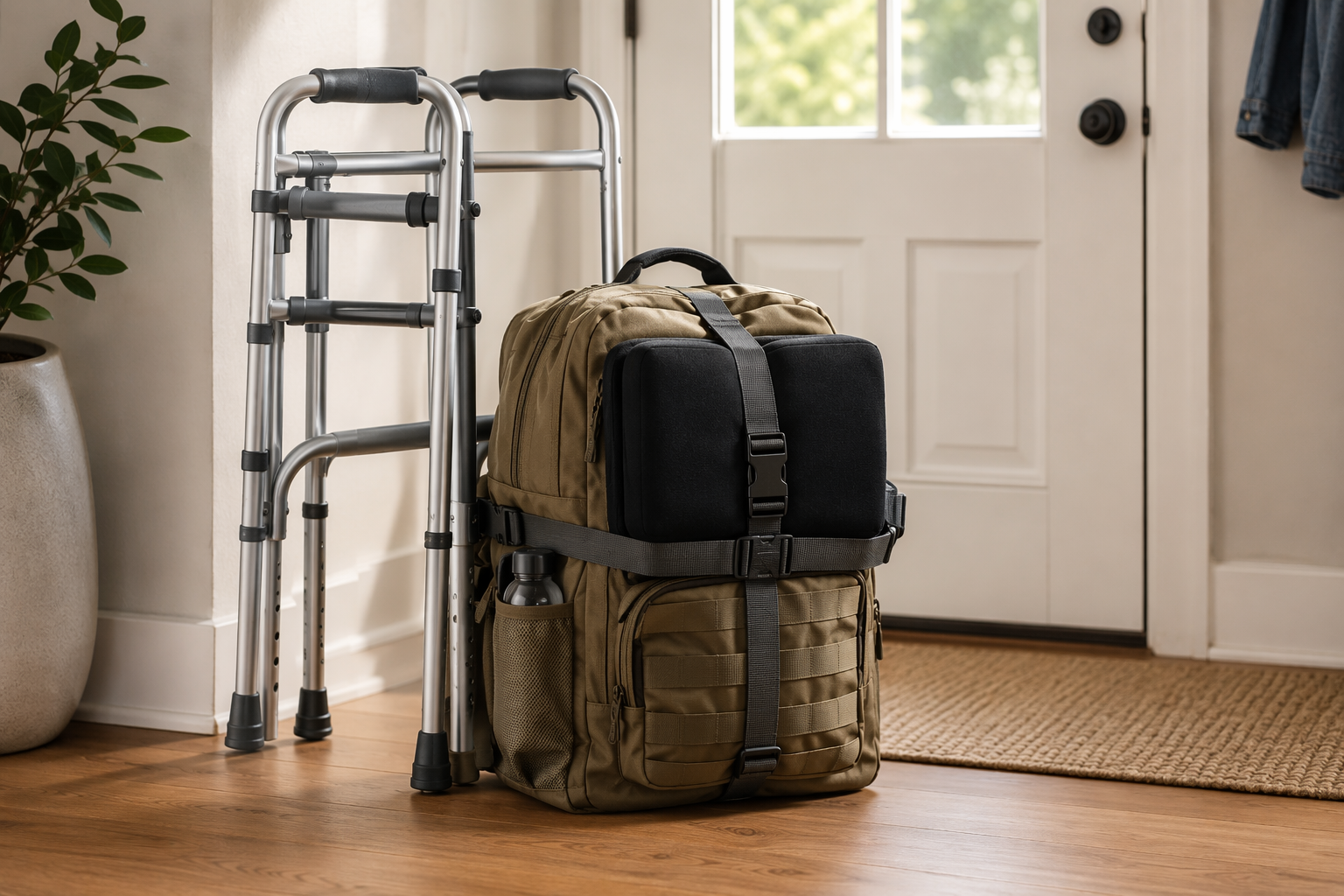
Transportation should be chosen by what the body can tolerate, not by what is most convenient for the person giving the ride. A sedan is not a plan if the older adult needs a wheelchair-accessible vehicle or two adults to transfer safely. If family is not nearby, write down the paratransit, medical transport, taxi, or facility contact before the smoke gets close. In assisted living, ask in advance how transport, medication handoff, and medical records are handled so the caregiver is not trying to negotiate all three at the curb.
Documents decide who can act
Put the papers that unlock care in one place: photo ID, insurance cards, medication list, allergy list, advance directive, health care proxy or power of attorney, and anything that explains mobility limits or medical equipment needs. Different states use different terms, so the goal is not a perfect legal folder; it is a folder that lets someone speak for the older adult when the room is noisy and the clock is short. If you are building that set from scratch, keep it with the rest of the papers in the same binder described in the emergency contact binder guide, not in a drawer that may never be opened again during the evacuation.
Leave for smoke, not just flames
Smoke belongs in the evacuation decision, not outside it. In a scoping review of wildfire smoke studies, PM2.5 exposure was linked to a 7.2% increase in respiratory hospital admissions among Medicare enrollees [4]. That makes transit and the first night away part of the health plan. Keep masks, medications, and a plan for filtered indoor air at the destination; for a fuller transit checklist, use our Wildfire Smoke Safety Checklist for Older Adults as the companion guide.
Dementia changes the rule
Dementia turns wildfire evacuation into a supervision problem, not just a packing problem. The Alzheimer's Association says 60% of people with dementia will wander, and if they are not found in 24 hours, up to half may suffer serious injury or death [5]. That makes "I'll come back for them" a dangerous sentence. One adult needs to stay with the older adult, one person needs to handle medications and documents, and no one should expect the person with dementia to make the departure decision alone or interpret a changing scene under pressure.
Leave while roads are still usable, before the move becomes a rescue. Keep the medication, mobility, and legal papers together so the evacuation can be handled as caregiving, not improvisation.
References
Questions to bring to a clinician or OT
This is not medical, legal, or a family's final decision — only a framework. Bring these questions to a clinician, occupational therapist, or your local Area Agency on Aging.
Find Local HelpRelated reading
Noticed something outdated or inaccurate on this page? Flag a correction. We review every report against CDC, NIA, and AARP HomeFit guidance before updating a page.