
Caregiver decision guide
GPS Trackers for Seniors with Dementia: A Caregiver's Guide to Safety Features and Device Selection
For family caregivers managing dementia wandering risk, choosing a GPS tracker is a capability-matching decision — not a product ranking. This guide explains how GPS trackers work, what six feature dimensions matter most, how to match form factor to a person's resistance profile, and how to integrate tracking into a layered safety approach that includes wandering response services and ethical consent planning.
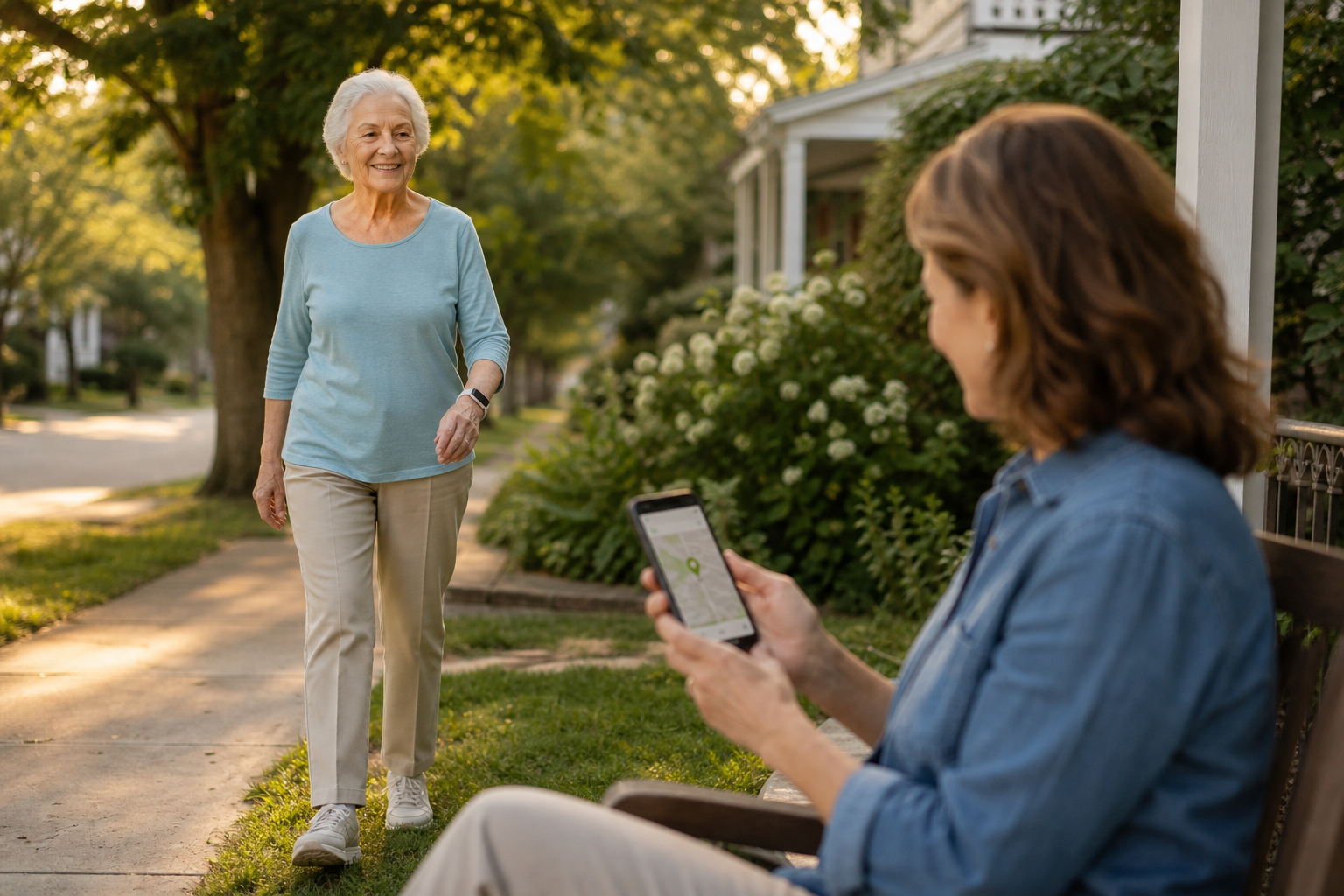
Why Wandering Risk Demands a Prepared Response
According to the Alzheimer's Association, six in ten people living with dementia will wander at least once — and many do so repeatedly. Wandering is not a minor behavioral inconvenience. It is a serious safety event that can result in exposure, injury, or death, particularly when a person leaves home at night, in extreme weather, or into traffic.
For caregivers, the weight of this risk is constant. Research consistently identifies wandering as one of the primary drivers of nursing home placement — not because families stop caring, but because the vigilance required to prevent it becomes unsustainable. A 2024 UK study published in PMC found that GPS trackers reduced caregiver burden scores on the Zarit Burden Interview from a mean of 40.35 at baseline to 35.35 at follow-up (p<.006), and that more than half of people with dementia using trackers reported improved independence in their daily movements.
Most people who wander are found within 1.5 miles of where they disappeared. The difference between a safe recovery and a serious outcome often comes down to how quickly a caregiver can act — and whether they have the tools in place before an incident occurs, not after.
How GPS Trackers Actually Work: Technology Basics for Caregivers
The term "GPS tracker" is slightly misleading for a non-technical audience. Consumer GPS devices use the satellite constellation to determine their location, but they transmit that location to caregivers through cellular or LTE networks — not directly via satellite. This means a tracker needs both a GPS signal and cellular coverage to function in real time. In areas with poor cell service, the device may not be able to report its location reliably.
Here is how the core mechanics work in practice:
- The device calculates its position using GPS satellites and transmits that data to a cloud server via a cellular connection.
- Caregivers access the location through a companion smartphone app or web dashboard, typically updated every few minutes depending on the device's tracking interval setting.
- Geofencing allows caregivers to draw a virtual boundary around a safe area — home, a neighborhood block, a care facility grounds. When the device crosses that boundary, the caregiver receives an alert.
- Two-way voice communication, where available, allows caregivers to speak directly with the person through the device — or for the person to press an SOS button to initiate contact.
Because most devices update location every few minutes rather than continuously, geofencing alerts are not instantaneous. There is typically a delay between when a person crosses a boundary and when the caregiver receives a notification. Caregivers should plan for this gap rather than expect real-time precision.
All GPS trackers require a subscription to a cellular data plan, either bundled with the device or purchased separately. This is an ongoing operational cost, not a one-time purchase. Some devices also store location history; others offer live tracking only. The distinction matters for privacy, as discussed later in this guide.
Six Feature Dimensions That Should Drive Your Decision
Selecting a GPS tracker category is not about finding the highest-rated product. It is about identifying which feature dimensions matter most for your specific situation — the person's dementia stage, their living environment, their behavioral resistance, and your own capacity to manage the device. The six dimensions below are the ones that most reliably differentiate device categories from each other.
| Feature Dimension | What It Means | Why It Matters | Questions to Ask |
|---|---|---|---|
| Geofencing accuracy and alert speed | How precisely the device defines a virtual boundary and how quickly it notifies caregivers when the boundary is crossed | Determines how much lead time you have to respond; slower alert systems reduce the value of the tracker in fast-moving situations | What is the typical delay between boundary crossing and alert? Does the device use GPS only, or does it combine GPS with Wi-Fi and cellular for better indoor-outdoor handoff? |
| Fall detection | Automatic detection of a fall event, triggering an alert without the person pressing a button | People with dementia may not be able to activate an SOS button after a fall; passive detection reduces dependence on their action | Is fall detection automatic or manual? What is the false-positive rate? Does fall detection require a specific form factor (wrist vs. pendant)? |
| Form factor and wear tolerance | The physical design of the device — watch, pendant, clip, shoe insert, lanyard, key fob — and how acceptable it is to the person wearing it | A tracker that is refused or removed provides no protection; form factor is the most common reason devices fail in practice | What form factors does this device category support? Can the form factor be changed if the person refuses one type? Is the device discreet enough to reduce removal attempts? |
| Battery life | How long the device operates between charges, and how charging is managed | A discharged device provides no coverage; caregivers must have a reliable charging routine, which may be difficult with a resistant or confused wearer | What is the realistic battery life under typical tracking intervals? Is charging passive (pad) or active (cable)? What happens to tracking when battery is low? |
| Two-way voice and SOS communication | Whether the device allows the caregiver to speak to the person, the person to speak to the caregiver, or both; whether there is a dedicated emergency button | Verbal reassurance during a wandering event can reduce distress and help orient the person; SOS capability matters if the person can learn to use it | Is voice communication built in or does it require a paired phone? Can the person initiate contact? Is the SOS button easy to find and press with limited dexterity? |
| Subscription cost and data privacy model | The ongoing monthly cost of cellular service and the provider's data handling practices — particularly whether location history is stored | Subscription costs accumulate over months and years; data storage creates privacy implications for a person who may not have consented to a permanent location record | What is the monthly subscription cost? Is location history stored, and if so, for how long? Can live-only tracking be selected without history storage? |
No single device category excels across all six dimensions. A device with excellent geofencing accuracy may have a shorter battery life. A device with passive fall detection may be limited to a wristwatch form factor that some people with dementia refuse. Working through these dimensions against the specific person's situation — before comparing any products — is the most reliable path to a useful decision.
Matching Form Factor to Dementia Stage and Resistance Behavior
The most technically capable GPS tracker is worthless if the person it is meant to protect refuses to wear or carry it. Form factor selection is fundamentally a behavioral question, not a preference question — and it is the most common practical failure point for GPS tracking in dementia care.
A 2024 study of GPS tracker implementation in UK NHS dementia care found that 91% of wearers used a lanyard, key ring, or handbag rather than a wristband. Only 9% of caregivers reported that the device was not practical because the person refused to use it entirely. Importantly, many people who initially rejected the device eventually accepted it — suggesting that persistence and form factor flexibility matter more than first-trial compliance.
| Form Factor | Best Fit | Dementia Stage Considerations | Resistance Profile |
|---|---|---|---|
| Wristwatch style | People who are accustomed to wearing a watch and have not developed strong device-removal behaviors | Early to mid-stage; person retains some habitual routines around wrist accessories | Low resistance; may increase if the device feels unfamiliar or heavy; removal attempts more likely as dementia advances |
| Pendant or clip | People who wear jewelry or who accept items on clothing; caregivers who can introduce the device as a familiar accessory | Early to mid-stage; works well when the person can be given a plausible, non-alarming explanation for the item | Moderate; pendants can be removed; clip-on versions may be forgotten or detached; consistency of wearing depends on daily routine |
| Shoe insert | People who resist wearable devices entirely but consistently wear the same footwear; wandering risk is high | Mid to late-stage; useful when other form factors have been refused; person may not notice the insert | Low active resistance once placed; dependent on consistent shoe use; not useful if the person wanders barefoot or frequently changes footwear |
| Key fob or lanyard | People who habitually carry keys or a bag; caregivers who can attach the device to an existing object the person always takes | Early to mid-stage; works best when the person retains the habit of carrying specific items | Low resistance when attached to a familiar object; risk of the person leaving the object behind; 91% of wearers in the Doyle 2024 study used this approach |
| Handbag or pocket device | People who consistently carry a bag or wear clothing with pockets; particularly relevant for women with dementia | Early to mid-stage; device is less intrusive and does not require the person to accept wearing anything on their body | Low active resistance; dependent on consistent bag or clothing use; risk of bag being left behind or device being found and removed |
- Consider what the person already wears or carries consistently — a watch, a particular bag, a set of keys — and look for a device that can be integrated with that existing habit.
- As dementia advances, the person's awareness of the device tends to decrease, which can reduce active removal attempts — but it also reduces their ability to manage charging or to use SOS features.
- Plan for the device to be worn or carried by the caregiver during charging periods, so that location coverage is not lost when the battery needs replenishing.
- If the person is in a memory care facility or adult day program, check whether the facility has its own tracking infrastructure that could supplement or replace a personal device.
Consent, Dignity, and the Ethical Framework for GPS Tracking
The decision to track a person's location raises genuine ethical questions — about autonomy, privacy, and the line between safety and surveillance. These questions do not have easy answers, but they do have a framework that most caregivers find workable when they engage with it early.
A 2026 online citizens' jury convened in Germany to examine the ethics of GPS tracking for people with dementia reached broad consensus on several practical principles, despite participants holding differing views on the meaning of autonomy. The core recommendations align with what many dementia care specialists and ethicists have advocated: involve the person in the decision as early as possible, use advance directives to record preferences while the person can still express them, and design the tracking approach around the individual's circumstances rather than a one-size-fits-all protocol.
- Involve the person early. If the person is in the early stages of dementia and can still participate in decisions, discuss GPS tracking with them directly. Their preferences — including refusal — should be documented and respected.
- Use advance directives. An advance directive can specify the person's wishes about GPS tracking before cognitive decline makes that conversation impossible. This allows early-stage preferences to guide later-stage decisions. Consult a licensed attorney or healthcare professional for jurisdiction-specific guidance on how to document these preferences legally.
- Prefer live tracking over stored history. The citizens' jury consensus identified live tracking without data storage as the most privacy-respecting approach. When a device stores location history, that data can be accessed, shared, or breached. If a device category offers a live-only option, it is generally preferable from a dignity standpoint.
- Adapt to individual circumstances. The tracking approach should reflect the specific person's living environment, how their dementia manifests, and the practical realities of their care situation — not a generic protocol applied uniformly.
- Frame tracking as enabling, not controlling. The evidence from Doyle et al. 2024 found that 54.5% of people with dementia using GPS trackers reported improved independence — because caregivers felt safe allowing them more freedom of movement. Tracking, when used thoughtfully, can expand rather than restrict a person's world.
GPS as One Layer: Building a Complete Wandering Safety System
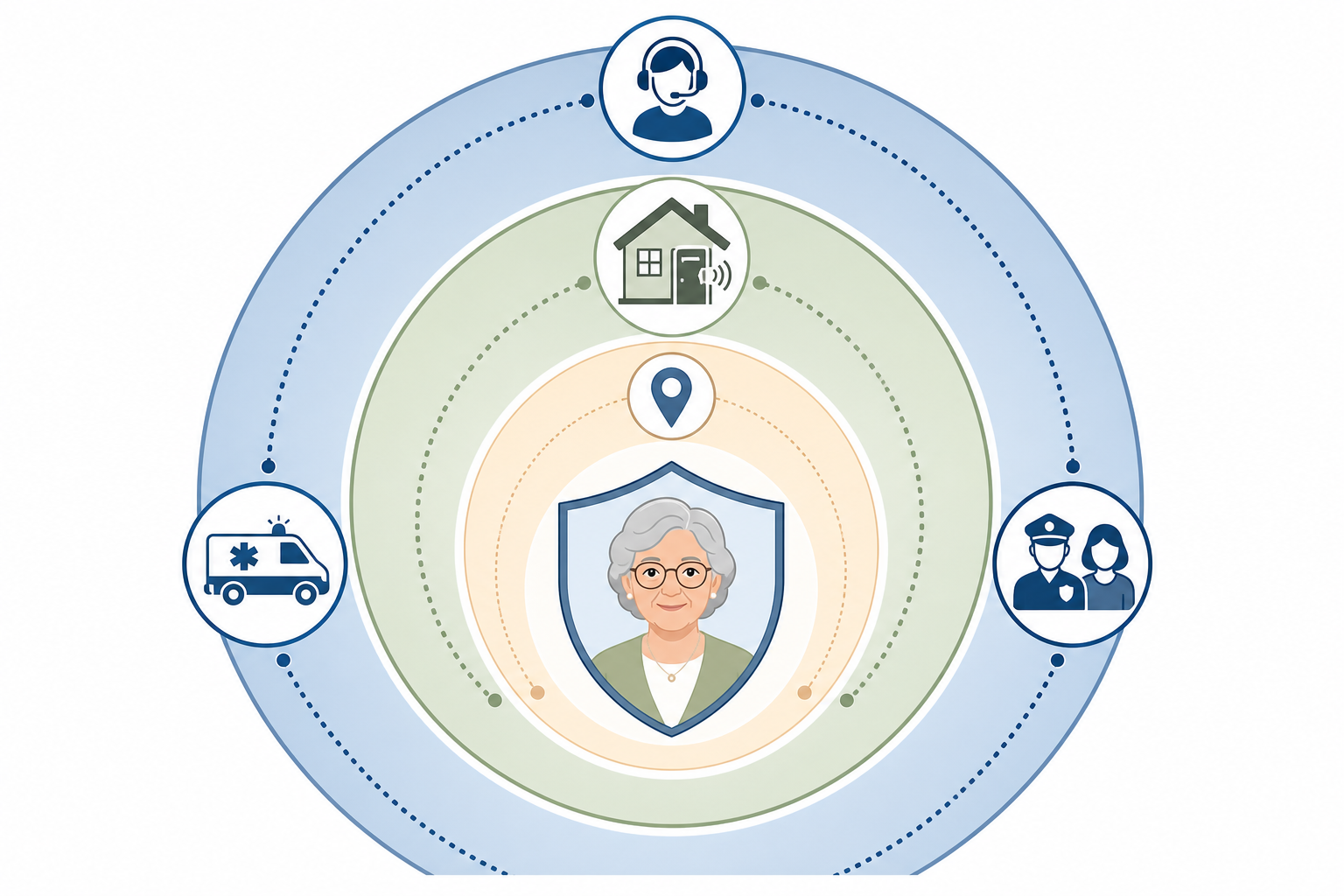
GPS tracking is most effective when it functions as the outermost layer of a safety system — the tool that enables rapid response when other layers have not prevented a wandering event. Treating it as the primary or sole safety measure creates a false sense of security and leaves significant gaps.
A 2025 systematic review of wandering prevention technologies confirmed that GPS tracking, geofencing, and wearable devices are effective components of dementia safety planning, but also noted that usability challenges and ethical barriers remain persistent gaps — and that no single technology addresses all dimensions of wandering risk.
Wandering Response Services
The MedicAlert Safe & Found program — a collaboration between MedicAlert Foundation and the Alzheimer's Association active for more than 15 years — provides 24/7 emergency response coordination when a person with dementia wanders. When activated, the program creates a missing person flyer, relays critical medical and identifying information to emergency medical services, police, and local medical facilities, and coordinates with family contacts. More than 500 people who have wandered are located each year through this program.
Enrollment in a wandering response service should happen before a GPS tracker is selected — not after. If the person is already enrolled, the tracker functions as a location tool that feeds into the response infrastructure. If they are not enrolled, the tracker provides location data but no coordinated emergency response.
Home Safety Modifications
Environmental modifications address the moment a person attempts to leave — before they have gone anywhere a GPS tracker would need to find them. These are the first-line prevention layer:
- Door alarms alert caregivers the instant an exterior door is opened, providing a response window that GPS geofencing alone cannot guarantee. For immediate perimeter monitoring, door alarms are more reliable than GPS.
- Deadbolts and door handle covers can slow exit attempts enough for a caregiver to intervene, particularly at night.
- Visual barriers — such as painted door panels, stop-sign decals, or fabric door covers — can reduce the visual salience of exits for people with dementia who are responding to environmental cues rather than deliberate intent to leave.
- Motion-activated lighting in hallways and near exits can alert caregivers to nighttime movement without requiring the person to trigger an alarm.
Structured Daily Activities
Many wandering events are driven by restlessness, disorientation, or unmet needs — not a deliberate decision to leave. Structured daily activities that provide physical movement, familiar routines, and meaningful engagement can reduce the frequency of wandering attempts. This is not a substitute for environmental and technological safety measures, but it addresses the underlying drivers that other layers do not.
Questions to Ask Before Selecting a Device Category
Before comparing any GPS device categories, work through the following questions. The answers will determine which feature dimensions matter most for your situation — and will help you avoid selecting a device that is technically capable but practically unusable.
- What is the person's current resistance profile? Have they refused medical devices, jewelry, or unfamiliar items in the past? Do they remove watches or bracelets? The answer shapes which form factors are worth considering.
- What is their current dementia stage? Early-stage individuals may be able to use SOS features and understand the device's purpose. Mid-to-late-stage individuals may not — which shifts the priority toward passive features like geofencing alerts and fall detection over interactive features like two-way voice.
- What is the living environment's cellular coverage? If the person lives in a rural area with limited LTE coverage, real-time GPS tracking may not function reliably. Check carrier coverage maps for the specific address before committing to a device category.
- Who will manage charging? If the person cannot manage their own charging, the caregiver must build a daily charging routine into the care plan. If the caregiver is not co-located — long-distance caregiving situations — battery management becomes a significant operational challenge that may favor longer-battery-life device categories.
- What are the privacy preferences? Did the person express preferences about surveillance or tracking before their diagnosis? Does the family have concerns about location history storage? Advance directives can document these preferences if they have not already been recorded.
- Is a wandering response service already in place? If the person is not yet enrolled in a program like MedicAlert Safe & Found, that step should precede device selection. A GPS tracker without a coordinated response infrastructure is a location tool — not a safety system.
- What is the realistic monthly budget for an ongoing subscription? GPS trackers require cellular data subscriptions that add up over months and years. Factor this into the total cost of ownership, not just the upfront device cost.
- What other safety layers are already in place? Door alarms, structured activities, and environmental modifications affect how much work the GPS tracker needs to do. A household with strong first-layer prevention has different GPS requirements than one where the person has already had multiple exit attempts.
Questions to bring to a clinician or OT
This is not medical, legal, or a family's final decision — only a framework. Bring these questions to a clinician, occupational therapist, or your local Area Agency on Aging.
Find Local HelpRelated reading
Noticed something outdated or inaccurate on this page? Flag a correction. We review every report against CDC, NIA, and AARP HomeFit guidance before updating a page.