
Caregiver decision guide
Passive Home Sensors for Senior Monitoring: How Motion, Door, and Stove Sensors Work
For family caregivers considering in-home monitoring for an aging parent, this guide explains how PIR motion sensors, door and contact sensors, and stove sensors each detect activity, what behavioral data they generate, and where each type falls short — so you can set realistic expectations and choose a setup matched to your parent's actual risk profile.
What Passive Monitoring Means — and Why It Matters for Seniors
Passive monitoring refers to sensor-based data collection that requires no action from the older adult. The sensors observe the environment — detecting heat, movement, door states, or heat near a stove — and generate data automatically, without the person needing to press a button, wear a device, or remember to do anything at all.
This is fundamentally different from active or wearable systems, where the older adult must carry a pendant, charge a smartwatch, or initiate a check-in. With passive sensors, the monitoring happens whether or not the person is thinking about it.
That zero-compliance-required quality is what makes passive sensors particularly well-suited for people with dementia, mild cognitive impairment, or low confidence with technology. Someone who cannot reliably remember to charge a wearable device or press a help button can still be monitored effectively through sensors embedded in their everyday environment.
This guide covers the three sensor types most commonly used in senior home monitoring: PIR motion sensors, door and contact sensors, and stove sensors. Each works differently, detects different kinds of activity, and has distinct limitations. Understanding all three helps caregivers set realistic expectations and build a setup that actually matches their parent's daily life and risk profile.
PIR Motion Sensors: Detecting Heat, Not Identity
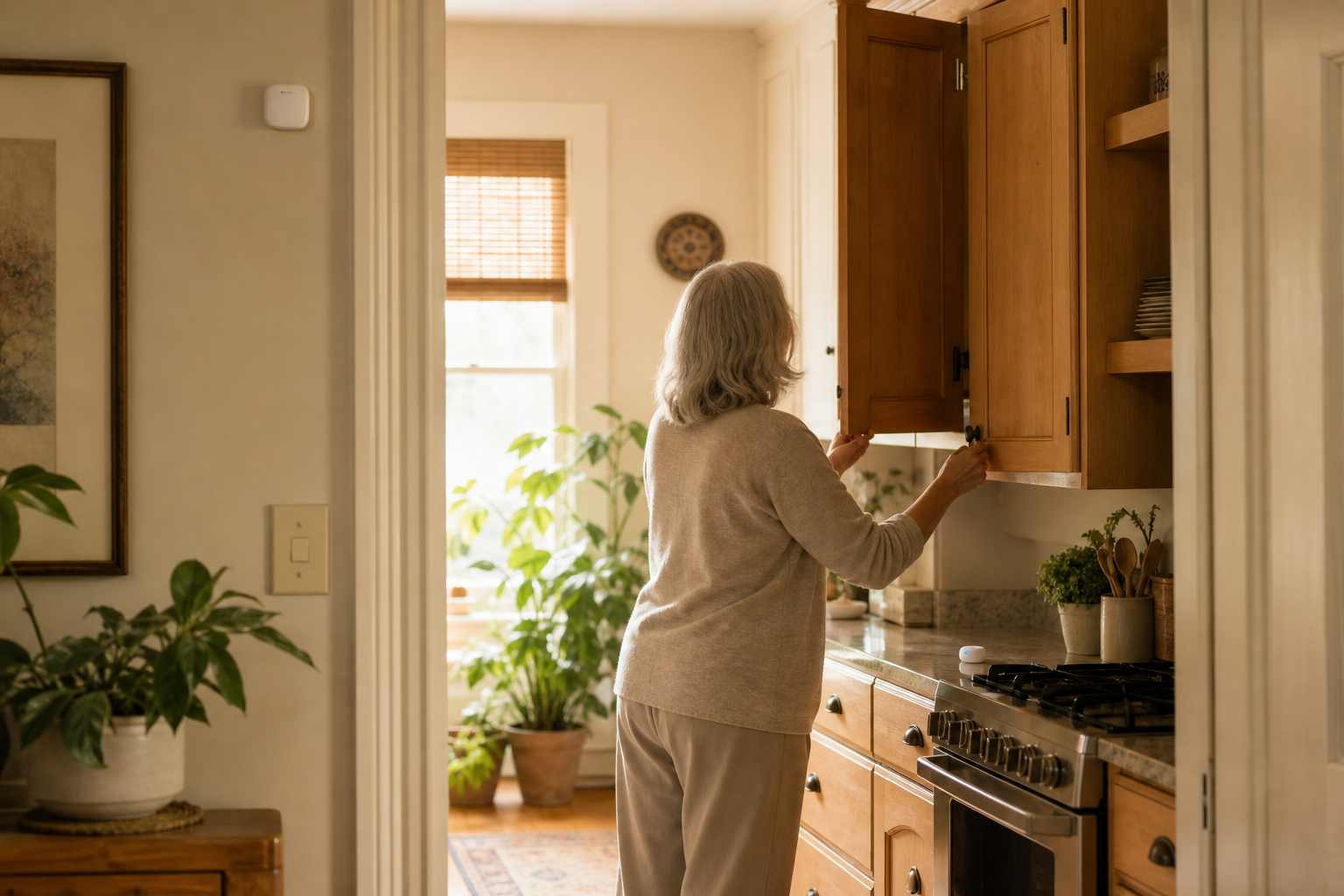
A passive infrared (PIR) sensor detects changes in infrared radiation — heat — emitted by objects in its field of view. When a person walks past a wall or doorframe, the temperature at that point shifts from room temperature to body temperature and then returns. The sensor converts that temperature change into an output signal, registering movement.
The word "passive" in the name is technically precise: the sensor does not emit any energy. It only receives. There is no beam to break, no signal to bounce back, no radiation directed at the person. The sensor is simply listening to ambient heat.
Common PIR models have an effective range of approximately 10 meters (about 30 feet) and a field of view under 180 degrees. Ceiling-mounted models with 360-degree coverage are also available. For senior monitoring, sensors are typically installed high on walls or in corners of rooms — hallways, bathrooms, kitchens, and bedrooms — where they capture room-level presence and absence patterns across the day.
What Motion Sensors Actually Tell You
The monitoring value of a PIR sensor is not in any single motion event. It lies in the pattern of events over time — and in deviations from that pattern. If the bathroom sensor reliably shows activity between 6:30 and 7:30 a.m. every morning, and one day there is no activity by 9:00 a.m., that absence is the meaningful signal, not the individual trigger events themselves.
This longitudinal framing is what distinguishes passive sensor monitoring from a security alarm. The goal is not to alert every time someone moves — it is to detect when a person's routine shifts in a way that warrants attention.
- Hallway sensors track movement between rooms throughout the day and night, giving a broad picture of activity level and sleep patterns.
- Bathroom sensors reveal toileting frequency and duration — changes in either can signal health concerns such as urinary tract infections or dehydration.
- Kitchen sensors indicate when cooking or food preparation activity is occurring and whether it falls within the person's normal time window.
- Bedroom sensors capture when the person wakes and returns to bed, supporting sleep pattern analysis.
Key Limitations of PIR Sensors
- Cooldown periods: After triggering, most PIR sensors have a reset period of roughly 30 to 90 seconds during which continued motion in the same zone will not re-trigger the sensor. This can cause systems to underestimate how long a person has been active in a room.
- No identity detection: PIR sensors detect movement from any heat source. They cannot identify who triggered them — a caregiver, a visiting family member, or a pet will register the same as the person being monitored.
- Pet interference: Dogs and cats can trigger PIR sensors, particularly when sensors are mounted too low. Some sensors are designed with higher sensitivity thresholds or lens configurations that keep the floor out of focus to reduce false positives from pets.
- No fall detection: Standard PIR sensors do not reliably detect falls. A person who has fallen and is lying still on the floor will not generate ongoing motion events. The absence of expected activity may eventually raise a flag, but the sensor itself cannot identify a fall as an event.
Door and Contact Sensors: Simple Switches That Reveal Daily Routines
Door and contact sensors work through a straightforward mechanism: two small magnets, one mounted on a door and one on its frame. When the door is closed, the magnets are close together and a circuit is complete. When the door opens, the magnets separate, the circuit breaks, and a signal is sent to the monitoring system recording the open event.
The same principle applies to cabinet doors, drawers, refrigerators, and medicine boxes. The sensor itself is small and unobtrusive — typically a thin strip or small rectangular device that sits flush against the door edge.
What makes contact sensors useful in a senior monitoring context is not the door event itself but what that event represents as a proxy for daily activity. A refrigerator that opens in the morning suggests eating. A medicine cabinet that opens around the usual medication time suggests adherence. A front door that opens and closes mid-morning suggests the person went outdoors. A bathroom door that remains closed for an unusually long period may warrant attention.
- Front door: Indicates when the person leaves and returns home — useful for tracking outdoor activity and identifying if someone has gone out at an unusual hour.
- Refrigerator: A low-cost proxy for eating behavior. If the refrigerator has not been opened by mid-morning, it may suggest the person has not eaten breakfast.
- Medicine cabinet or medication box: Tracks whether medication access is occurring at expected times, supporting medication adherence monitoring without a dedicated dispenser.
- Bathroom door: Duration of bathroom door closure combined with motion sensor data can help identify prolonged bathroom visits that might indicate a problem.
Stove Sensors: Catching Unattended Cooking Before It Becomes a Fire
Stove sensors occupy a different role in the passive monitoring toolkit. Where motion and door sensors are primarily about behavioral pattern detection, stove sensors are primarily about safety intervention — specifically, catching the conditions that lead to cooking fires before a fire starts.
Stove sensors typically monitor ambient heat levels near the cooking surface and track whether a person is present nearby. When heat is detected at the stove and no human presence is detected in the kitchen — meaning the cook has walked away and not returned — the sensor flags the condition as potentially dangerous.
The scale of the risk this addresses is significant. According to the U.S. Fire Administration, fire departments in the United States responded to approximately 170,000 home cooking fires in 2021, resulting in an estimated 135 deaths, 3,000 injuries, and over $494 million in property damage. The leading factor in nonconfined home cooking fires was unattended equipment, accounting for 37% of ignitions.
For older adults — particularly those with memory concerns who may start cooking and then become distracted or forget — stove sensors address one of the most statistically significant home fire risks in a way that no other passive sensor type does.
- Stove sensors detect heat at the cooking surface, not smoke or flame — making them an early warning system rather than a fire alarm.
- Human presence detection (typically via a nearby PIR element) determines whether someone is attending to the cooking or has left the area.
- When heat is present and no person is detected nearby for a defined period, the sensor triggers an alert to caregivers or a monitoring service.
- Some stove sensor systems can automatically shut off the stove's power supply if a threshold condition is met — though this capability varies by product category and should be evaluated separately.
How the Three Sensor Types Work Together as a System
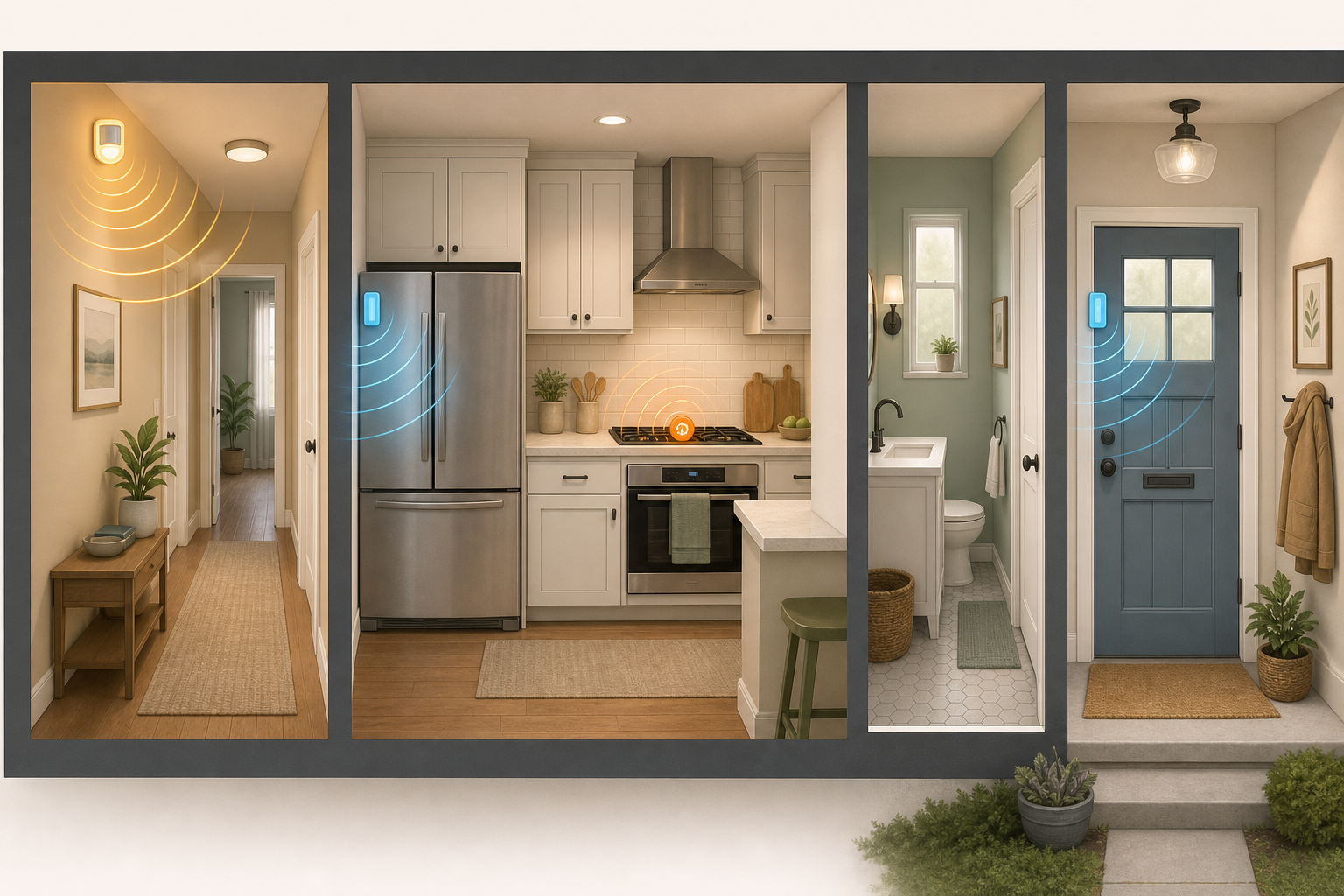
No single sensor type provides a complete picture of how someone is doing at home. Motion sensors can detect that a person is moving through the house but cannot tell you whether they have eaten. Door sensors can tell you the refrigerator was opened but cannot tell you whether the person is moving normally. Stove sensors address kitchen fire risk but say nothing about sleep or mobility patterns.
The real value of passive sensor monitoring emerges when sensor types are combined. Together, PIR motion sensors, door contact sensors, and stove sensors allow a monitoring system to infer the shape of a person's daily routine — when they wake, whether they are eating, whether they are accessing their medications, and whether kitchen activity is occurring safely.
A concrete example: a morning routine might look like hallway motion at 7:00 a.m., bathroom door activity at 7:05 a.m., kitchen motion and refrigerator open at 7:30 a.m., medicine cabinet open at 7:45 a.m., and front door open at 8:30 a.m. Each of those events is individually unremarkable. Together, they constitute a baseline pattern. If the refrigerator does not open until noon, or the medicine cabinet never opens, or the kitchen shows heat activity with no one present — those deviations are what the system flags.
Baseline Establishment: Why the First Weeks Matter
Passive sensor systems require an initial calibration period to define what normal looks like for a specific person before deviation alerting becomes meaningful. Generic thresholds — "no motion for four hours" — are far less useful than personalized baselines derived from observing the actual person's routine over one to two weeks.
During this calibration window, the system learns the typical timing and duration of daily activities. Once that baseline is established, the alerting logic shifts from absolute thresholds to relative deviation — which is both more accurate and less prone to false alarms.
- Expect a calibration period of one to two weeks before alerts are meaningful — alert fatigue from poorly calibrated systems is a common reason families abandon monitoring setups.
- Behavioral changes that occur during the calibration period (illness, a visiting family member, a schedule change) can skew the baseline — note any significant disruptions so the system can account for them.
- Revisit and recalibrate the baseline if the person's routine changes significantly — a new medication, a change in daily schedule, or a seasonal shift in activity level.
What Passive Sensors Cannot Do: Honest Limitations for Caregivers
Understanding the limitations of passive sensors is as important as understanding what they can do. Setting accurate expectations prevents caregivers from over-relying on sensor data for risks the sensors are not designed to address.
- Falls are not reliably detected. Standard PIR and contact sensors cannot identify a fall as an event. A person who falls and remains still will not trigger motion sensors. The extended absence of expected activity may eventually generate an alert, but this is not the same as fall detection. Caregivers who need reliable fall detection should evaluate dedicated wearable or radar-based systems separately.
- Multi-person households complicate pattern attribution. When a caregiver, spouse, or visiting family member also moves through the home and uses the refrigerator or front door, the sensor data reflects all of those activities combined. Isolating the monitored person's behavioral patterns from the household's general activity becomes difficult or impossible.
- Cooldown periods affect duration estimates. PIR sensors that reset every 30 to 90 seconds will not capture every moment of activity in a room. Systems that estimate how long a person has been in the kitchen, for example, are working with sampled data, not continuous observation.
- Pets generate false positives. Dogs and cats can trigger PIR sensors, particularly in homes where pets move freely through monitored areas. This can produce false alerts or distort activity duration estimates.
Privacy, Dignity, and the Consent Conversation
Passive sensor monitoring raises real privacy and dignity questions that caregivers should address directly with their parent — not assume away.
A 2026 scoping review published in Ageing & Society by Mheidly, Dempsey, and Quinn (University of Illinois Chicago) examined 34 studies on older adults' privacy perceptions of passive in-home monitoring technologies. The review found that older adults generally have more comfort with passive motion monitoring than with camera-based systems — activity sensors generated less privacy concern than visual recording. However, comfort was not unconditional: older adults consistently valued having control over what data was collected and who could access it, and several studies found that monitoring acceptance was conditional on feeling that safety benefits outweighed the privacy cost.
The review also identified a meaningful distinction between two types of privacy concern: horizontal concerns (data shared with family members or caregivers) and vertical concerns (data collected and held by technology providers or institutions). Many older adults are more comfortable with family access to their data than with corporate data retention — a distinction worth understanding when evaluating monitoring platforms.
Sensor Type Comparison at a Glance
| Sensor Type | Underlying Technology | What It Detects | Recommended Placement | Key Limitation |
|---|---|---|---|---|
| PIR Motion Sensor | Passive infrared — detects changes in heat emitted by moving bodies | Room-level presence and absence; daily activity patterns and deviations from routine | High on walls or ceilings in hallways, bathrooms, kitchens, and bedrooms | Cannot detect falls; cannot identify who triggered it; cooldown periods affect duration estimates; pet interference |
| Door / Contact Sensor | Magnetic reed switch — circuit opens when magnets separate on door opening | Door open/close events as proxies for eating, medication access, going outdoors, and toileting activity | Front door, refrigerator, medicine cabinet, bathroom door | Cannot distinguish who opened the door; unreliable for pattern attribution in multi-person households |
| Stove Sensor | Ambient heat monitoring combined with nearby presence detection | Unattended cooking conditions — heat at stove with no person detected nearby | Near or above the cooking surface, paired with a presence-detection element in the kitchen area | Addresses kitchen fire risk only; does not provide information on mobility, sleep, or other daily activities |
Five Questions to Ask Before Choosing a Sensor Setup
Before selecting or configuring a passive sensor system, working through these five questions will help clarify what you actually need and whether a given setup is likely to deliver it.
- What specific risks or routines am I trying to monitor? If kitchen safety is the primary concern, a stove sensor is the highest-priority addition. If nighttime wandering or sleep pattern changes are the concern, bedroom and hallway motion sensors are more relevant. Matching sensor type to the actual risk prevents over-building a system that generates noise without adding safety.
- Does my parent live alone or with others who would affect the data? In a single-person household, sensor data maps to one person's routine. In a household with a spouse, a live-in caregiver, or frequent visitors, pattern attribution becomes unreliable. Understand this limitation before drawing conclusions from the data.
- What is my parent's comfort level with being monitored, and have we discussed it together? Monitoring installed without the older adult's knowledge or agreement can damage trust and undermine the relationship. Even for people with cognitive impairment, the conversation matters — and for those with full decision-making capacity, consent is essential. Understanding their specific concerns (cameras vs. motion sensors, family access vs. corporate data storage) helps frame the discussion productively.
- Does the system establish a personalized baseline before alerting, or does it use generic thresholds? Generic thresholds ("no motion for four hours") generate far more false alerts than personalized baselines calibrated to an individual's routine. Ask whether the system includes a calibration period and how that baseline is established and updated over time.
- Who receives the data, and what controls exist over access and retention? Understand who in the family or care network receives alerts, whether the older adult themselves can see their own data, and what the technology provider's data retention and sharing policies are. These questions address both the horizontal concern (family access) and the vertical concern (corporate data use) that research shows matter to older adults.
Questions to bring to a clinician or OT
This is not medical, legal, or a family's final decision — only a framework. Bring these questions to a clinician, occupational therapist, or your local Area Agency on Aging.
Find Local HelpRelated reading
Noticed something outdated or inaccurate on this page? Flag a correction. We review every report against CDC, NIA, and AARP HomeFit guidance before updating a page.