
Caregiver decision guide
The CARE Framework: A Complete Long-Distance Caregiving Coordination Guide
This guide introduces the CARE Framework (Communicate, Assess, Redistribute, Engage) — a repeatable system for long-distance caregivers to organize care, prevent crises, and reduce overwhelm. Learn how to build a central coordination hub, assemble a local team, set up legal tools, and track health trends from afar.

Why Coordination Systems Matter More Than Proximity
More than 50 million family caregivers in the United States provide unpaid care to an adult age 50 or older, according to a 2026 report by A Place for Mom. The average caregiver spends 22.8 hours per week on caregiving duties, and 75% report feeling stressed or anxious at least monthly. Of those, 42% experience emotional strain or burnout at least weekly. When you add distance — living an hour or more away — those numbers climb even higher. Nearly 7 million Americans are now long-distance caregivers, facing the added challenge of coordinating care from a different city or state.
The conventional approach — flying in for a weekend, making a dozen phone calls, and hoping for the best — does not scale. It burns out the primary caregiver, creates gaps in medical communication, and leaves critical tasks undone between visits. The antidote is not a more heroic individual effort. It is a repeatable coordination system that organizes people, information, schedules, and decisions into a shared framework that works whether you are in the same room or a thousand miles away.
This article builds on our general Long-Distance Caregiving: A Complete Guide for Adult Children, which covers the basic challenges and resource landscape. Here, we go deeper into one specific, named system: the CARE Framework — a four-step model for building, populating, and maintaining a long-distance coordination hub that prevents crises rather than reacting to them.
The CARE Framework: Your Four-Step Coordination Model
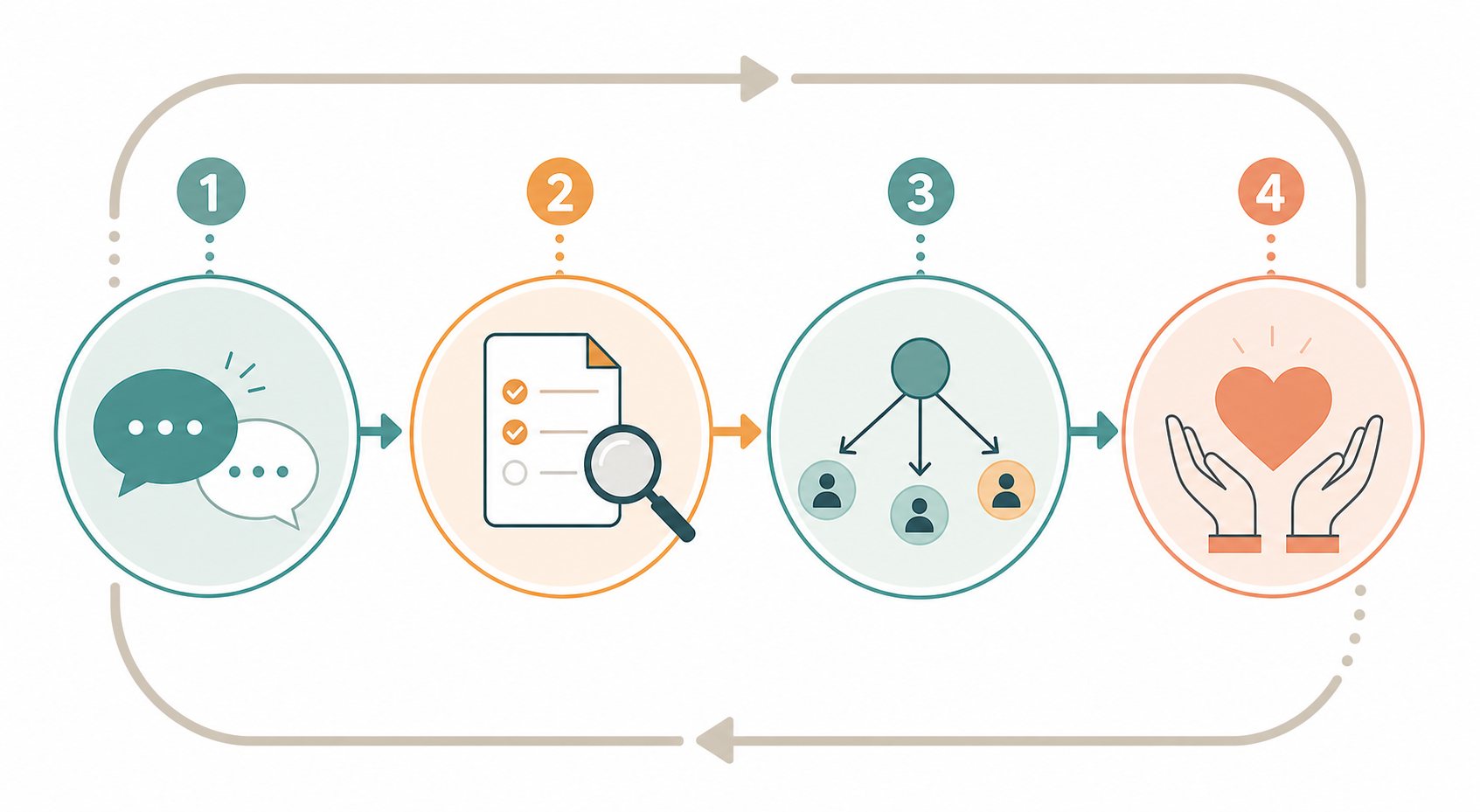
The CARE Framework — developed and popularized by Caring Village — stands for Communicate, Assess, Redistribute, Engage. It is a heuristic, not a product. You can implement it using whatever tools work best for your family. The four steps form a continuous loop that you revisit as your parent's needs change and as your own capacity shifts.
- Communicate: Establish a reliable, secure channel for sharing updates, questions, and decisions among everyone involved in your parent's care — not just family, but also neighbors, doctors, and professional caregivers.
- Assess: Collect and organize a complete picture of your parent's health, home safety, daily needs, and legal standing. This is the audit phase.
- Redistribute: Delegate specific, time-bound tasks to the right people — both local helpers and remote contributors — so no single person carries the load alone.
- Engage: Stay actively involved through meaningful check-ins, health trend tracking, and regular system reviews that catch small problems before they become emergencies.
Each step feeds into the next. You communicate to gather information, assess to identify gaps, redistribute to close those gaps, and engage to ensure the system stays alive. Then you loop back and communicate what changed. The rest of this guide walks you through building each component.
Building Your Coordination Hub: The Single Source of Truth
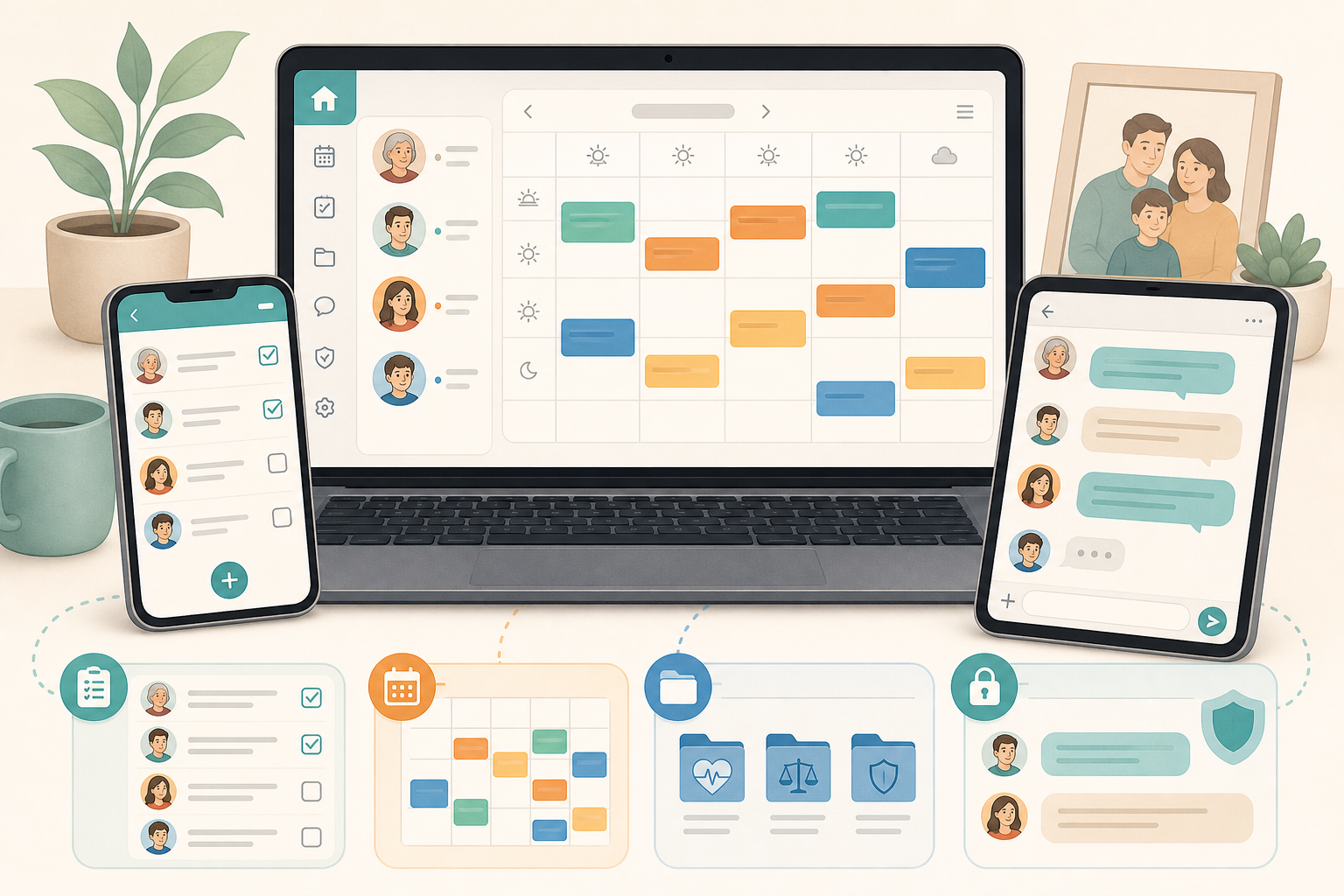
A coordination hub is the single place where everyone — you, your siblings, local helpers, doctors, and your parent — can find the current truth about appointments, medications, tasks, documents, and concerns. Without it, information travels through individual texts, voicemails, and sticky notes, and it gets lost or duplicated. The National Institute on Aging (NIA) recommends creating a shared online calendar and a central document folder as foundational steps for long-distance care.
Your hub should include at least these four core elements:
- Shared calendar — Doctor appointments, home care visits, prescription refills, family check-ins, and any recurring task (e.g., trash pickup, lawn care). Color-code by type or by person.
- Task assignments — A running list of to-dos with assigned owners and due dates. Example: "Pick up weekly medications — Mark (due Thursday)" or "Call insurance about durable medical equipment — Susan (by Friday)."
- Document vault — Scanned copies of legal documents (POA, advance directives), insurance cards, medical records, medication lists, and contacts for doctors, pharmacy, and emergency services. The NIA provides printable caregiver worksheets to help organize this information.
- Secure messaging — A running conversation where family and helpers can post updates, ask questions, and share concerns without clogging personal text threads. Avoid using unsecured SMS for health-related information.
| Tool Type | Core Use | Example Features |
|---|---|---|
| All-in-one coordination app | Hub with calendar, tasks, vault, and messaging | Caring Village, Lotsa Helping Hands, ianacare |
| Shared calendar + task manager | Lightweight option for small families | Google Calendar with shared lists, Cozi |
| Document storage | Secure vault for legal and medical records | Dropbox, Google Drive (with encryption), secure portal |
| Medication management | Reminders and tracking for multiple drugs | Medisafe, MyTherapy (both free tiers available) |
| Health status updates | Daily check-ins and symptom logging | Connected Caregiver, CaringBridge |
| Location sharing | Peace of mind for wandering or driving | Life360 (free tier) |
A practical rule: choose one core hub that includes at least a shared calendar and task assignment, then add one specialist tool (e.g., a medication app) if needed. Avoid the trap of spreading information across five apps — that recreates the fragmentation you set out to fix.
Assembling Your Local Team: Making Specific, Time-Bound Asks
Your coordination hub is only as useful as the people who contribute to it. The most common mistake long-distance caregivers make is asking for help in vague terms — "Can you keep an eye on Mom?" — which yields unreliable results. Instead, build a local team by identifying specific nodes in your parent's life and making concrete, time-bound requests.
- Neighbors or friends — Can they check the trash cans on Monday morning? Can they stop by after snow to ensure walkways are clear? Short, recurring, predictable asks are much easier to accept and to remember.
- Extended family — Assign one-off or rotating tasks: drive to a specialist appointment, pick up a grocery order, handle a prescription refill call. Use the hub's task list so everyone sees what's assigned.
- Professional services — Home care agencies, meal delivery (Meals on Wheels), transportation services, and geriatric care managers (GCMs) can fill gaps that family cannot. GCMs are trained in nursing or social work and can serve as your eyes and ears between visits.
- Eldercare Locator — Call 800-677-1116 to find local aging services, transportation, home health agencies, and legal aid. This is the single most useful phone number for a long-distance caregiver to save.
As your local team grows, assign one person as the primary local contact — often a sibling or a paid care manager. That person's role is to be the on-site decision-maker during routine needs and crises, while you handle coordination, advocacy, and long-term planning from afar. The shifting roles can be emotionally complex; our guide on Navigating Role Reversal with an Aging Parent addresses some of those dynamics directly.
Legal Preparation: Install the System Before the Crisis
The most preventable catastrophe in long-distance caregiving is a delayed emergency response because a legal document is missing. A case study from elder law attorney Kathie Brown Roberts illustrates the scenario: a father falls and is hospitalized in Utah; his son lives in Boston. Without a signed healthcare power of attorney and HIPAA authorization, the son cannot speak to the medical team, authorize treatment, or even get an update. By the time documents are located and accepted, the father's condition has changed.
Every long-distance caregiver should ensure the following documents are executed, digitized, and stored in the coordination hub:
- Financial Power of Attorney (POA) — Authorizes you to manage bank accounts, pay bills, file taxes, and handle insurance. Must include authorization for digital access to online accounts. Some states require a separate digital assets POA.
- Healthcare Power of Attorney — Grants authority to make medical decisions when your parent cannot. Pair it with a HIPAA authorization that specifically names you and any other key family members as authorized to receive medical information.
- Advance Directive (Living Will) — Documents your parent's preferences for life-sustaining treatment. Critical for end-of-life decisions made from a distance.
- Digital Access Roster — A secure list (stored in the document vault) of online accounts, passwords, and two-factor authentication contacts for banking, insurance, Medicare, utilities, and any apps used in care. Modern legal documents should explicitly authorize remote digital monitoring and participation in telehealth visits.
Once documents are signed, keep multiple originals (some attorneys recommend three to five) and digital copies in the coordination hub. Share the digital copies with the primary local contact and with your parent's primary care provider's office. Long-distance caregivers who face legal and financial lockouts regularly cite document absence as the root cause of delayed care.
Tracking Health Trends Without Micromanaging
One of the hardest challenges for long-distance caregivers is distinguishing between a real health decline and a bad day. Without daily proximity, it is easy to overreact to a single piece of information — or to miss a slow decline altogether. The solution is systematic trend tracking, not constant check-ins.
Start with better check-in questions. Instead of "How are you feeling?" (which invites a one-word answer), ask questions that surface concrete information:
| Old Question | Better Question | Why It Works |
|---|---|---|
| How are you feeling? | What felt a little harder this week than last? | Forces a specific comparison; reveals gradual decline. |
| Did you take your pills? | Can you read me what's on your pill bottle right now? | Verifies adherence without accusation. |
| Are you eating OK? | What did you eat for lunch yesterday and today? | Provides concrete data on appetite and nutrition. |
| Have you fallen? | Have you had any near-misses — tripped or felt unsteady? | Captures risk signals before injury occurs. |
| Did you go to the doctor? | What did the doctor say about your blood pressure / blood sugar / weight? | Ensures information is being retained and communicated. |
Pair these conversations with a wellness journal — either a shared digital document or a simple paper log kept in your parent's home that you review during calls. Record weight, blood pressure, mood, falls or near-misses, medication changes, and any new symptoms. The act of tracking creates a shared language between you, your parent, and the local care team.
The goal is trend-spotting, not micromanaging. A single high blood pressure reading is not a crisis; three consecutive high readings after a medication change is a signal worth escalating. If you are tracking Activities of Daily Living (ADLs) — bathing, dressing, toileting, transferring, continence, feeding — note when your parent begins needing assistance with a task they previously handled alone. That is the leading edge of changing care needs.
Emergency Protocols: The 'First-30-Minutes' Plan
When an emergency strikes, you lose precious minutes thinking instead of acting. That is why every coordination hub must contain a First-30-Minutes Plan — a pre-written protocol that answers the five most critical questions before you ever need them.
- Who gets the first call? Not you — you are hours away. The local contact person (neighbor, sibling, or care manager) should be listed first. Their phone number and backup numbers must be easily accessible, ideally on the lock screen of your parent's phone.
- Who has a key? List every person with a key or garage code, plus the location of a spare key if one is hidden. Update this list every time a lock or code changes.
- Who meets the paramedics? If your parent lives alone, identify who can be at the house within minutes to let first responders in, provide medical history, and contact the family.
- Where are medical records? Preferred hospital, recent medication list, primary care doctor, and specialist contacts. Keep these in the document vault and a printed card on the refrigerator.
- What is the fallback communications plan? If phone lines are down (natural disaster, power outage), how do you reach the local team? Agree on a secondary channel — SMS, a neighbor's landline, or a family group chat.
The urgency of this planning is underscored by national emergency statistics. 66 emergency room visits per 100 people aged 75 and older occurred in 2021, according to CDC data cited by The Bristal. For those aged 65–74, the rate was 39 per 100. One in four older adults falls every year, per CDC data reported by Best Care MN. A fall at home is often the first event that reveals a gap in the coordination system.
Maintaining the System: Regular Reviews and Caregiver Self-Care
A coordination system is not a one-time setup. Your parent's health will change. Your local team will shift as people move or burn out. Your own capacity will ebb and flow with work, family, and emotional reserves. That is why the CARE Framework loops back on itself: every quarter, schedule a system review with everyone who participates in the hub.
- Calendar sweep — Are upcoming appointments entered? Have any recurring tasks become unnecessary or need reassignment? Are vacations or travel planned that affect coverage?
- Document check — Are legal documents still current? Have insurance policies changed? Has your parent's primary care doctor changed?
- Task audit — What is falling through the cracks? What tasks are being done by someone who is overwhelmed? Can anything be delegated to a professional service?
- Wellness trend review — Look back at the wellness journal over the last three months. Is there a gradual decline in weight or mobility? Are there new medications that change fall risk?
- Caregiver health check — Ask yourself and every family caregiver on the team: How am I doing? Am I showing signs of burnout? If the answer is yes, use the burnout guide and explore respite care options.
The most important shift a long-distance caregiver can make is to see the coordination system as something that protects their own health, not just their parent's. The 75% of caregivers who report monthly stress and the 42% who hit weekly burnout are not failing at love or loyalty. They are operating without a system. Installing and maintaining the CARE Framework changes the arithmetic of caregiving from a solo performance to a managed operation — one where you can step back, breathe, and still know that your parent is cared for.
Questions to bring to a clinician or OT
This is not medical, legal, or a family's final decision — only a framework. Bring these questions to a clinician, occupational therapist, or your local Area Agency on Aging.
Find Local HelpRelated reading
Noticed something outdated or inaccurate on this page? Flag a correction. We review every report against CDC, NIA, and AARP HomeFit guidance before updating a page.