Caregivers for the Elderly: Types, Duties, and How to Choose the Right Care
For: family caregiverReviewed: 2026-06-27
Caregivers for the Elderly: Types, Duties, and How to Choose the Right Care
Learn about the different types of caregivers for the elderly — from family members and home health aides to hospice caregivers — and how to choose the right care based on your loved one's needs and your family's situation.
By Editorial Team
new caregiver
experienced caregiver
long-distance caregiving
spousal caregiver
working caregiver
daily routines
medication management
personal hygiene
care coordination
first steps
ADLs
IADLs
The word “caregiver” sounds simple until you try to hire one, become one, or explain to a sibling why stopping by with groceries is no longer enough. For an elderly parent, a caregiver might be an adult daughter paying bills and scheduling appointments, a neighbor who checks in, a personal care assistant helping with meals and laundry, a home health aide helping with bathing, a certified nursing assistant taking vitals under supervision, or a hospice caregiver focused on comfort near the end of life.
That difference matters because the wrong label can hide the real workload. AARP and the National Alliance for Caregiving reported in 2025 that about 63 million Americans were family caregivers, roughly 1 in 4 adults, providing an average of 22.8 hours of unpaid care each week.[1] But most family caregiving is not hands-on bathing or toileting at first. In one 2025 caregiver statistics report, family caregivers most often helped with errands or housework, managing healthcare, and managing finances; personal care tasks such as bathing or dressing affected a smaller share of cases.[2]
That is the quiet trap. A family can be doing a lot and still be doing mostly coordination. Then one fall, one hospitalization, or one confused week with medications turns “checking in” into daily physical care.
The main types of caregivers for the elderly
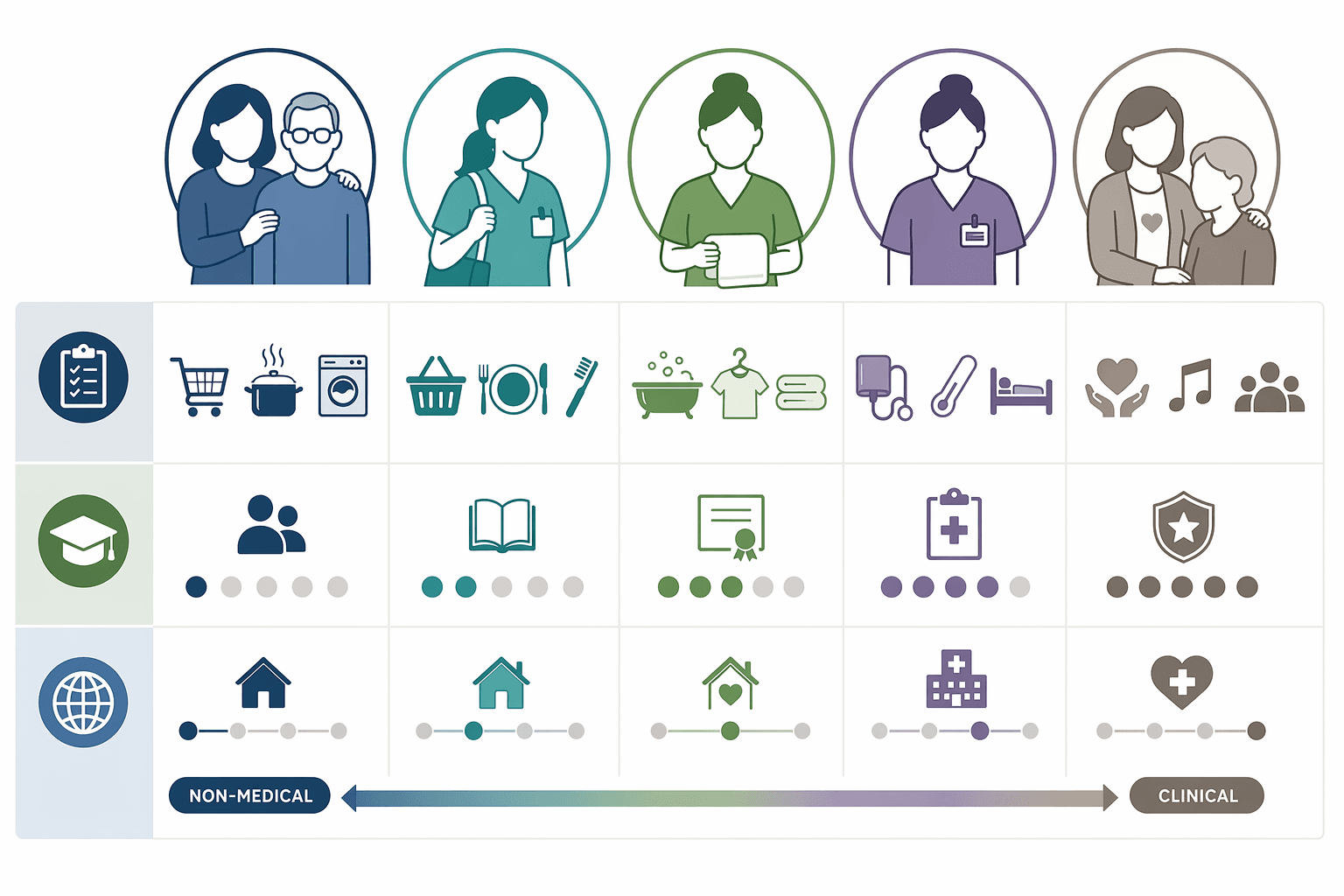
Before choosing anyone, separate the roles by what they are allowed and prepared to do. The names sound interchangeable, but they are not.
Caregiver type
Typical duties
Training or credential level
Medical scope
Best fit
Family caregiver
Errands, meals, transportation, scheduling, healthcare coordination, finances, medication reminders, some personal care depending on ability and comfort
Usually informal; may learn from clinicians, agencies, support groups, or trial and error
Non-medical unless the person is separately trained; should not be expected to replace licensed care
Early or moderate support needs, especially IADLs; also works as part of a mixed care plan
Volunteer caregiver or companion-style support
Social visits, light errands, check-ins, reading, conversation, sometimes transportation depending on the program
Varies by organization; usually not clinical
Non-medical
Loneliness, supervision gaps, light support, or respite for family when hands-on care is not the main need
Personal care assistant or PCA
Meal preparation, housekeeping, laundry, errands, transportation, reminders, companionship; may help with some personal care depending on state rules and agency policy
Often no formal clinical training required; role and requirements vary by state and employer.[4][5]
Non-medical
A parent who mainly needs help keeping the household and daily routine functioning
Often trained for personal care; federal home health aide standards commonly refer to at least 75 hours of training for Medicare-certified home health agencies.[4]
Mostly non-medical personal care, sometimes basic health-related support under a care plan
ADL help at home when the parent needs hands-on assistance but not skilled nursing as the core service
Certified nursing assistant or CNA
Bathing, dressing, toileting, transfers, feeding assistance, vital signs, observation, reporting changes, support under nursing supervision
State certification required; CNA programs are commonly described as more extensive than aide-only roles and may involve around 120 or more hours depending on state requirements.[4][5]
Clinical-adjacent support under supervision; not a substitute for a licensed nurse
Higher physical needs, post-hospital support, facility care, or home situations where supervised clinical observation matters
Hospice caregiver or hospice aide
Comfort-focused personal care, bathing, repositioning, family support, symptom observation and reporting as part of a hospice team
Usually works within a hospice program; aides function under hospice plan-of-care rules and supervision
Comfort-focused, team-based end-of-life care; medical decisions remain with licensed hospice clinicians
A parent with a terminal condition who has shifted from curative treatment goals to comfort and quality of life
The table is not a hiring script. It is a translation tool. If an agency says “caregiver,” ask which of these roles they mean, what tasks are included, what tasks are excluded, who supervises the worker, and what happens if your parent’s needs increase.
Start with IADLs and ADLs, not with job titles
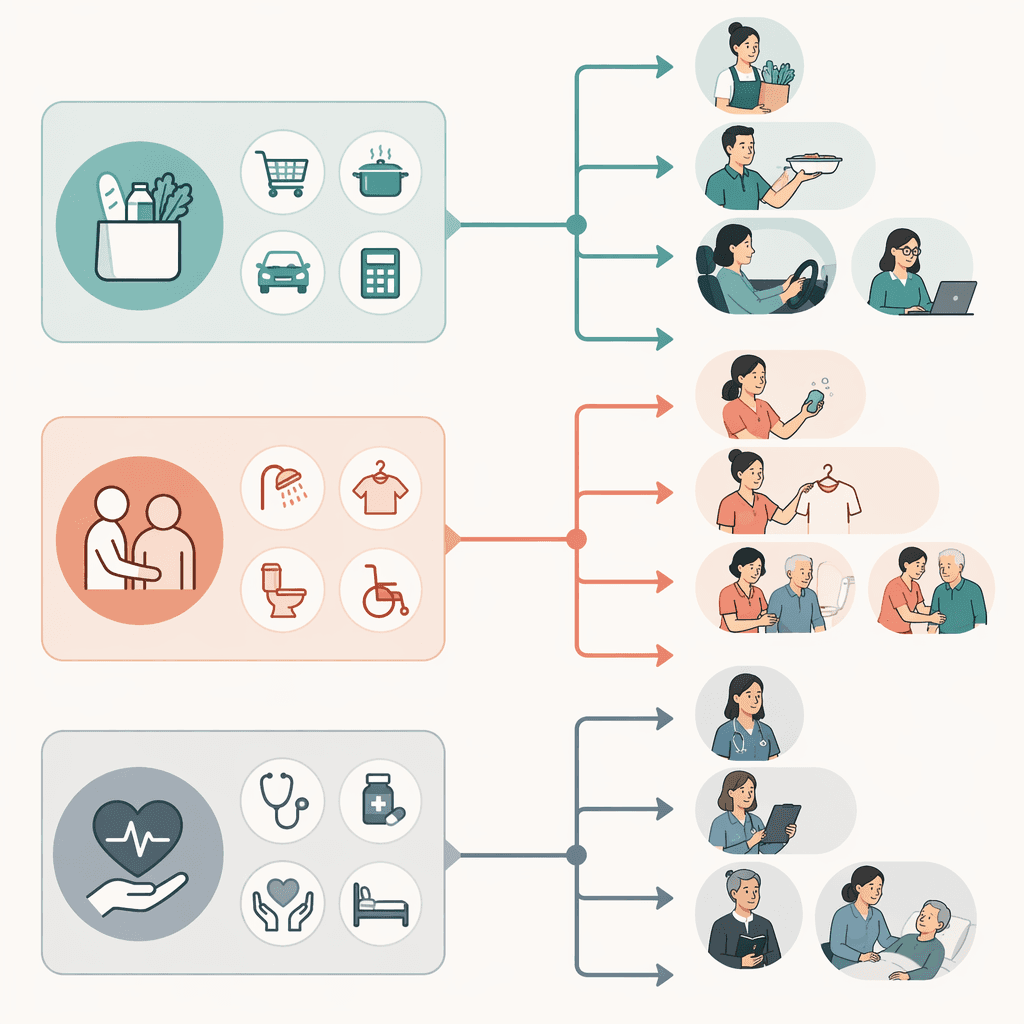
The cleanest way to sort elderly care needs is to divide them into IADLs and ADLs. Instrumental Activities of Daily Living, or IADLs, are the tasks that let someone live independently: shopping, cooking, transportation, housework, managing money, using the phone, and coordinating healthcare. Activities of Daily Living, or ADLs, are more basic body-level tasks: bathing, dressing, toileting, transferring, eating, and moving safely.[3]
Families often begin with IADLs. Someone drives Mom to appointments. Someone else orders groceries. A son handles the insurance calls. A daughter becomes the person every doctor’s office calls back. This can be exhausting, but it is still a different care problem from a parent who cannot shower safely, get off the toilet, or transfer from bed to chair without help.
A useful first sort looks like this:
Mostly IADLs: family caregiver, companion, volunteer support, PCA, or a homemaker-style service may be enough.
Regular ADLs: look at an HHA, CNA, or agency caregiver specifically trained and permitted to provide hands-on personal care.
Medication confusion, frequent changes after hospitalization, wounds, injections, unstable symptoms, or major mobility risk: ask whether skilled home health, nursing oversight, or a CNA/HHA under a formal care plan is needed.
Advanced decline with a comfort-focused goal: ask the physician or care team whether hospice is appropriate.
This is also where family pride can make plans unsafe. A spouse or adult child may be perfectly capable of errands, meals, and advocacy, yet unable to lift safely, manage incontinence overnight, or judge whether a change in breathing needs urgent attention. That is not failure. It is a change in the job.
Family caregivers are not the “before” stage of real care
Family caregivers deserve to be treated as a real category because they are already carrying much of the system. They notice the spoiled food, the missed refill, the second copy of the same bill, the new dent in the car, the way a parent says “I’m fine” while standing beside a pile of unopened mail.
They also tend to start before they know the vocabulary. In the 2025 A Place for Mom caregiver statistics, only 25% of family caregivers said they felt completely prepared when caregiving began.[2] That tracks with the experience many families have: the role arrives first, the instructions arrive later, and sometimes they never arrive unless someone goes looking.
Family care often fits well when the parent’s needs are mostly IADLs. It can be more personal, more flexible, and less disruptive than bringing in a stranger for every task. A daughter may be the best person to sit through a cardiology visit because she knows the history. A son may be the best person to manage online banking because his parent trusts him. A neighbor may be the best person to notice whether the trash cans came back from the curb.
The trouble starts when one person becomes the default because of geography, income, work flexibility, birth order, temperament, or because they answered the first call. Pew Research reported in February 2026 that, among adults with aging parents or spouses age 65 and older, lower-income adults were more likely to be caregivers than upper-income adults, 39% compared with 16%.[6] That finding uses a different caregiver definition from the AARP/NAC research, so the numbers should not be merged. Still, it names something many families recognize: care is not assigned only by love or competence.
If one person is doing appointments, errands, medication reminders, housework, financial oversight, and emergency response, the family does not have a plan. It has a person absorbing the plan. That may work for a while. It usually does not scale quietly.
PCA, HHA, and CNA: the three labels families mix up most often
If you are comparing paid caregivers for the elderly, the most confusing part is usually the middle of the ladder: PCA, HHA, and CNA. Agencies and states do not always use the terms identically, but the practical differences are still worth pinning down before you sign anything.
Personal care assistant: good for routine support, limited for clinical needs
A personal care assistant is often the right fit when the home is becoming hard to manage but the parent does not need skilled medical care. PCAs may help with meals, errands, laundry, light housekeeping, transportation, reminders, companionship, and sometimes personal care depending on the state and agency. The role is generally non-medical, and formal clinical training is not typically the defining requirement.[4][5]
This can be exactly enough for a parent who is lonely, no longer driving, skipping meals, or falling behind on household tasks. It is usually not enough if the main problem is unsafe transfers, complex medication changes, incontinence care that family cannot manage, or symptoms that need clinical monitoring.
Home health aide: hands-on personal care at home
A home health aide is usually a stronger match when ADLs are the issue. HHAs commonly help with bathing, dressing, grooming, toileting, transfers, walking, and basic observation. In Medicare-certified home health settings, federal standards commonly refer to at least 75 hours of aide training.[4]
The word “health” can mislead families. An HHA is not the same as a nurse. The aide may notice and report changes, follow a care plan, and provide personal care, but medication administration, wound care, injections, and clinical judgment depend on state rules, agency policy, and the licensed professionals involved.
Certified nursing assistant: more clinical structure, still not a nurse
A certified nursing assistant has a state-recognized credential and often works under nurse supervision. CNAs help with ADLs, take vital signs, observe changes, document, and support care in nursing homes, assisted living communities, hospitals, and sometimes private homes. CNA training requirements vary by state, but guides commonly distinguish the role from PCA work by its certification requirement and more clinical structure.[4][5]
A CNA may be the better match when a parent has heavier physical needs, is recovering after hospitalization, or needs more structured observation than a companion or PCA can provide. But a CNA is still not a licensed practical nurse or registered nurse. If the care plan requires skilled nursing, ask for that directly.
Hospice caregivers are different because the goal is different
Hospice support is not simply “more caregiving.” It is care organized around comfort when a person is near the end of life and the care goal has shifted away from cure. Hospice teams may include nurses, aides, social workers, chaplains, volunteers, physicians, and bereavement support, depending on the program and plan of care.
A hospice aide may help with bathing, repositioning, skin care, and comfort-focused personal care. The family may still provide many hours of presence and practical support. The difference is that the family is no longer trying to assemble every answer alone; symptoms, medications, equipment, and comfort questions have a team structure.
How much do caregivers for the elderly cost?
Cost matters, but it is a poor first filter. If your parent needs help bathing safely, choosing the cheapest companion-level care may leave the real need uncovered. If your parent mainly needs meals, rides, and company, paying for a higher clinical level may be unnecessary.
For a planning anchor, A Place for Mom’s 2026 Cost of Long-Term Care report lists a national median of $34 per hour for in-home care, with state medians ranging from $25 per hour in Mississippi to $44 per hour in South Dakota.[7] That figure comes from a major industry dataset, not a guarantee of what one agency in your county will quote. Local availability, minimum shift rules, weekend rates, overnight care, dementia experience, and whether the worker is hired privately or through an agency can change the bill quickly.
The local check is not optional. Ask your Area Agency on Aging, hospital discharge planner, physician’s office, senior center, or local caregiver resource organization what families in your area are actually finding. If you are comparing home care with adult day services, assisted living, nursing homes, or other long-term care options, use local prices rather than a national median as soon as you can.
A practical decision path for choosing care
Most families do not choose one pure model. They patch together family help, paid hours, medical appointments, neighbors, delivery services, and backup plans. That is normal. The point is to make the patchwork visible before it tears.
Question
What to look for
Likely direction
What does your parent need help doing?
List actual tasks from the last two weeks: rides, meals, bills, bathing, toileting, transfers, medication reminders, overnight supervision.
IADLs point toward family support, companion care, PCA, or community services. ADLs point toward HHA, CNA, or a trained agency caregiver.
How often does the help need to happen?
Occasional errands are different from daily bathing, meal setup twice a day, or unsafe nighttime wandering.
The more predictable and frequent the task, the more likely paid scheduled help should be considered.
What happens if no one shows up?
Missed trash pickup is one level of risk. Missed insulin, a fall during transfer, or no food intake is another.
Higher consequence tasks need trained backup, not just goodwill.
Who is currently carrying the work?
Name the person doing calls, transportation, physical care, finances, and emergency response.
If one person appears in every column, the plan depends on that person’s health, job, and patience.
What can the family realistically keep doing?
Separate willingness from capacity. Work schedules, distance, finances, and physical ability all count.
Keep family care where it fits best; buy help where the task is unsafe, too frequent, or too specialized.
What can the budget support?
Price the specific number of hours needed, not an abstract hourly rate.
Use paid care strategically: bathing visits, respite blocks, transportation days, or post-hospital periods may be more realistic than full-time coverage.
A hypothetical example: a parent who no longer drives, forgets appointments, and eats poorly when alone may not need an HHA yet. A mix of family scheduling, grocery delivery, companion care, and a PCA for meal prep and errands might cover the gap. If that same parent begins falling in the shower or cannot dress without help, the care level has changed. The old plan may still contain useful pieces, but it no longer answers the hardest part of the day.
Another hypothetical example: after a hospitalization, a parent may need temporary help with transfers, bathing, mobility, medication organization, and symptom watching. That may call for a formal home health plan, an HHA or CNA, and clear nurse or physician instructions. A family member can still coordinate and be present, but “I’ll stop by after work” is not the same as a safe discharge plan.
Where companion care, adult day services, and facility care fit
Not every need has to be solved by a one-on-one caregiver in the home. Companion care can help when the biggest problems are isolation, light supervision, errands, and routine. Adult day services can give structure during the day and relief to family caregivers, especially when the parent benefits from activities and supervision outside the home. Facility-based care may become relevant when needs are too continuous, too physically demanding, or too medically complex for a home plan to hold.
Those are adjacent decisions, not side issues. A family that cannot afford eight hours of daily home care might still afford several shorter paid visits, an adult day program, or a combination of relatives and community services. A parent who is unsafe alone overnight may need a different conversation entirely.
Questions to ask before hiring a paid caregiver
Once you know the level of need, the hiring questions become more specific. Ask them even if the agency seems kind and professional.
Which role are we hiring: companion, PCA, HHA, CNA, nurse, or hospice aide?
Which exact tasks are included: bathing, dressing, toileting, transfers, meal prep, transportation, dementia supervision, medication reminders?
Which tasks are not allowed under your policy or state rules?
What training, certification, background checks, and supervision does the caregiver have?
Who updates the care plan if my parent declines?
Is there a minimum shift length? Are weekends, holidays, overnights, or short visits priced differently?
What happens if the regular caregiver is sick or not a good fit?
How are changes reported to the family?
For private hires, add employment questions: payroll taxes, workers’ compensation, liability coverage, backup coverage, and what happens if the caregiver is injured in the home. Agency care often costs more partly because it may handle some of those structures. Private care may be less expensive per hour, but the family takes on more responsibility.
The lowest sufficient level of help is the target
Choosing caregivers for the elderly is not about buying the most intensive care available. It is about matching the lowest sufficient level of trained help to the real task in front of you.
If the needs are mostly IADLs, family support, companion care, volunteer programs, delivery services, transportation help, or a PCA may be enough. If ADLs are now part of daily life, look for someone trained and permitted to provide hands-on personal care. If symptoms, medications, wounds, rehabilitation, or post-hospital instructions are driving the concern, ask directly about skilled home health and nursing oversight. If the care goal has shifted to comfort near the end of life, hospice should be part of the conversation.
Then look at the family system honestly. Who is already doing the work? Which tasks can they keep doing without losing their job, health, sleep, or marriage? Which tasks are becoming unsafe or too frequent to improvise? The right caregiver arrangement may be a few paid bathing visits each week, a PCA for meals and errands, adult day services twice a week, a CNA after a hospitalization, or hospice support layered around family presence.
The narrowing question is simple enough to write on the refrigerator: are we dealing mostly with IADLs, ADLs, clinical-adjacent support, or end-of-life comfort? Answer that first. Then choose the caregiver role that fits the need without pretending one family member can absorb an expanding job forever.



Comments
Join the discussion with an anonymous comment.