
Caregiver decision guide
11 Signs It's Time for a Senior Citizen Home: A Caregiver's Assessment Guide
Most families wait until a crisis to consider senior living. This evidence-based guide helps you assess your parent's needs across ADLs, safety, nutrition, and medication management, so you can recognize the right time to move and have a confident conversation about it.
Why Most Families Wait Too Long — and Why That Matters
The decision to move a parent into a senior citizen home rarely happens at the right time. It almost always happens at the worst time — after a fall that sends someone to the ER, after a hospitalization that reveals a parent can no longer manage at home, or after the caregiver collapses from exhaustion. Families wait because the idea feels like a betrayal of a promise, or because the parent resists, or because the signs creep in so gradually that no single day feels like the day to act.
But the data shows that waiting has real consequences. Research from NIC/NORC at the University of Chicago, cited by AARP, found that residents in senior housing have lower rates of emergency admissions for injury, COPD, dehydration, and UTIs compared to older adults living in the community. In other words, moving earlier — before a crisis — is associated with better health outcomes, not worse.
This guide is built on a different premise than the typical list of warning signs. Instead of asking "Is it time yet?" it gives you a structured, evidence-based assessment framework — grounded in Activities of Daily Living (ADLs) and Instrumental Activities of Daily Living (IADLs) — so you can evaluate your parent's situation objectively, have a data-informed conversation, and make a decision before a crisis makes it for you.
Understanding the Assessment Framework: ADLs vs. IADLs
Before you can assess whether it's time for a senior citizen home, you need a common language for describing what your parent can and cannot do. That's where the ADL/IADL framework comes in. These two categories are the standard way healthcare professionals measure functional independence, and they give you a much clearer picture than vague observations like "Mom seems to be struggling."
Activities of Daily Living (ADLs)
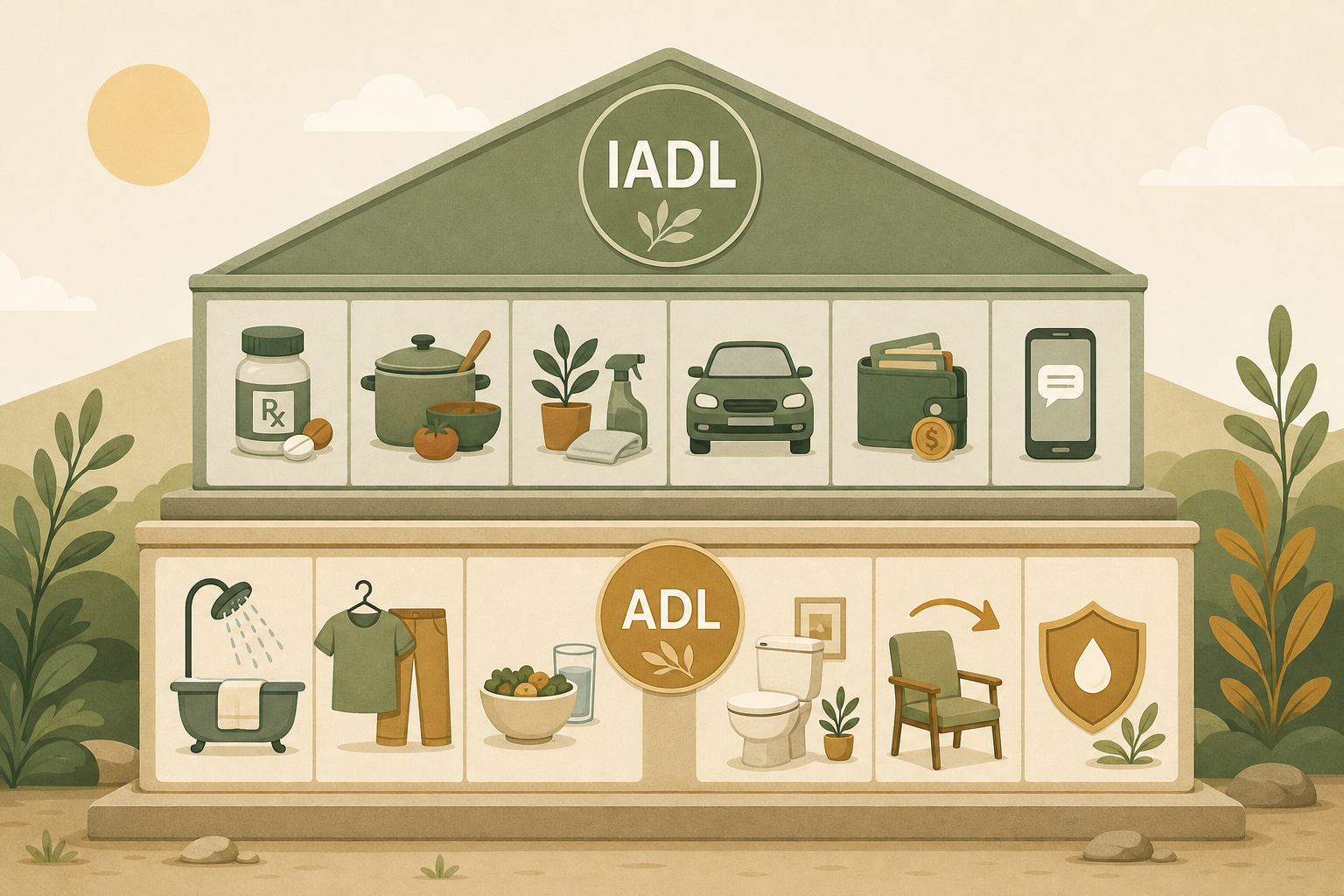
ADLs are the fundamental self-care tasks that a person must be able to perform to live independently. They include:
- Bathing and showering
- Dressing and undressing
- Eating and feeding oneself
- Toileting and maintaining continence
- Transferring (getting in and out of bed or a chair)
When a person needs help with one or more ADLs, it is a strong signal that the current living situation may no longer be safe or sustainable. According to CDC data cited by A Place for Mom, approximately 13.8% of adults aged 75 and older needed personal care assistance in 2024. That number rises sharply with age.
Instrumental Activities of Daily Living (IADLs)
IADLs are more complex tasks that support independent living in the community. They include:
- Managing medications (remembering doses, refilling prescriptions)
- Preparing meals and following a safe diet
- Housekeeping and home maintenance
- Managing transportation (driving, using public transit, arranging rides)
- Managing finances (paying bills, budgeting, avoiding scams)
- Using the telephone or other communication devices
Difficulty with IADLs often appears before difficulty with ADLs. A parent who can still dress themselves but can no longer manage their medications or pay their bills is showing early warning signs that independence is eroding. The key is to track both categories over time, not just in a single moment.
11 Signs It's Time to Consider a Senior Citizen Home
The following 11 signs are organized by domain. No single sign alone means a move is necessary, but when multiple signs cluster together — especially across different domains — it is a strong indication that the current care arrangement is no longer adequate.
1. Trouble with Basic ADLs
If your parent is having difficulty bathing, dressing, toileting, or transferring independently, this is the most direct signal that daily care needs exceed what can be safely managed at home without full-time help. The National Center for Assisted Living (NCAL) reports that the average age of an assisted living resident is 87, and half of all residents are 85 or older — the age at which ADL dependencies become common.
2. Poor Nutrition and Unintended Weight Loss
An empty refrigerator, expired food, or noticeable weight loss can indicate that your parent is no longer able to shop for groceries, prepare meals, or remember to eat. This is an IADL issue that can quickly become a medical emergency. Unexplained weight loss of 5% or more in a month warrants a medical evaluation and a serious reassessment of the living situation.
3. Medication Errors
Medication management is one of the most dangerous IADL failures. CDC data cited by A Place for Mom indicates that medication errors are the leading cause of ER visits among adults 65 and older, sending more than 600,000 seniors to the emergency room each year. Missed doses, double-dosing, or confusion about which pill is which are clear signs that your parent needs supervised medication management.
4. Social Isolation and Withdrawal
If your parent has stopped attending social activities, no longer calls friends or family, or spends most of the day alone, isolation is a serious concern. Social isolation is linked to higher rates of depression, cognitive decline, and mortality. Senior living communities provide built-in social engagement that is difficult to replicate at home.
5. Home Neglect and Safety Hazards
A home that was once well-maintained but is now cluttered, dirty, or in disrepair is a sign that your parent can no longer manage housekeeping — an IADL. Piles of unopened mail, dirty dishes, unwashed laundry, and neglected home maintenance all point to a gap between the demands of the home and your parent's current capacity.
6. Unsafe Home Environment
Beyond general neglect, specific safety hazards — loose rugs, poor lighting, lack of grab bars in the bathroom, cluttered walkways, or an inability to navigate stairs — create a high risk of falls. A single fall can be life-altering for an older adult. If the home cannot be made safe through modifications, or if your parent refuses modifications, a facility move may be the safest option.
7. Caregiver Burnout
This is one of the most overlooked signals. If you — the family caregiver — are experiencing chronic exhaustion, irritability, declining health, or a sense of resentment, your ability to provide safe care is compromised. The personal narrative on AgingCare.com illustrates this pattern vividly: caregivers often delay the decision until they themselves are in crisis. Your wellbeing matters not just for your own sake, but for your parent's safety. If you are burned out, the quality of care your parent receives is already declining.
If this resonates, use our Caregiver Burnout Signs and Symptoms: A Self-Assessment Checklist to evaluate your own stress level.
8. Doctor or Healthcare Provider Recommendation
If your parent's primary care doctor, a hospital discharge planner, or a geriatrician has suggested that a facility move would be safer, take that recommendation seriously. Healthcare providers see the full picture — medical history, medication interactions, fall risk, and cognitive status — that family members may not. A professional recommendation is often the most objective signal available.
9. Care Coordination Breakdown
If your parent is seeing multiple specialists, managing multiple medications, and requires coordination between home health aides, physical therapists, and family members, the complexity can quickly exceed what can be managed at home. Missed appointments, conflicting medication instructions, and gaps in care are signs that a coordinated facility setting — where care is managed under one roof — may be more appropriate.
10. History of Falls or Near-Falls
A single fall that results in a fracture or head injury is a major red flag. But even near-falls — stumbling, grabbing furniture for balance, or feeling unsteady on their feet — indicate that the home environment is no longer safe. Falls are the leading cause of fatal and non-fatal injuries among older adults, and the risk increases exponentially after the first fall.
11. Significant Weight Changes or Dehydration
Unintended weight loss or signs of dehydration (dry mouth, confusion, low urine output) are medical red flags that often point to an inability to manage nutrition and hydration independently. These are especially dangerous in older adults, who may not feel thirst as acutely and may lose muscle mass rapidly. Senior living communities provide regular, nutritious meals and hydration monitoring that can reverse these trends.
How to Conduct a Home Safety Assessment
A home safety assessment is a systematic, room-by-room evaluation of environmental hazards that increase fall risk and limit independence. It is a practical tool that gives you concrete data to bring to the conversation with your parent and their healthcare provider.
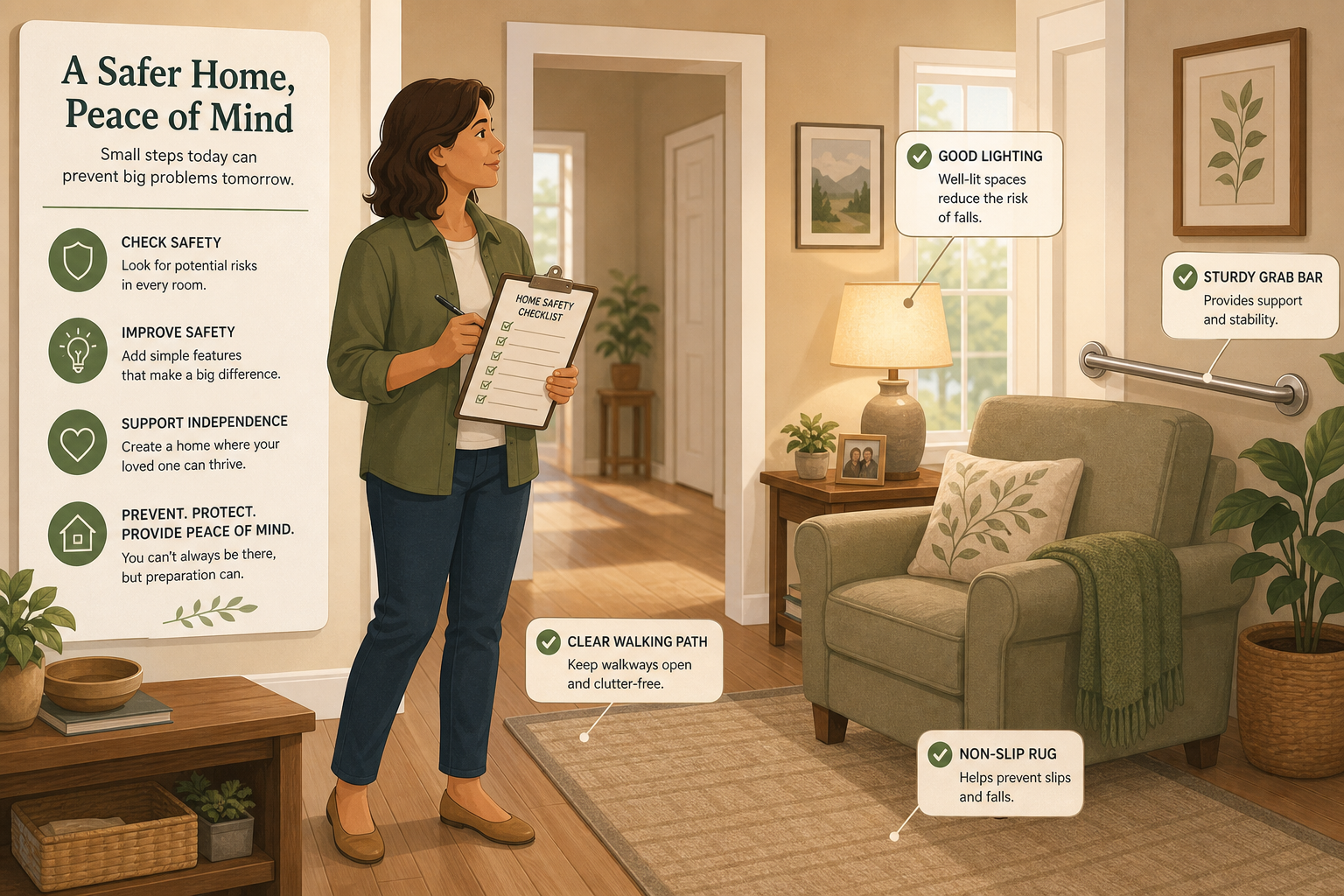
Use the following checklist as a starting point. For each room, note whether the hazard is present, and whether it can be corrected with a simple modification or requires a more significant change.
| Room / Area | Hazard to Check | What to Look For | Can It Be Fixed? |
|---|---|---|---|
| Entryway | Poor lighting | Dark walkway, no motion-sensor light | Yes — install brighter bulbs or motion lights |
| Entryway | Uneven steps | Cracked or uneven walkway, no handrail | Yes — repair surface, install handrails |
| Living Room | Loose rugs | Rugs that slide or curl at edges | Yes — remove or use non-slip backing |
| Living Room | Cluttered pathways | Furniture blocking walking paths, cords across floor | Yes — rearrange furniture, secure cords |
| Living Room | Low seating | Sofa or chair too low to stand from easily | Yes — add risers or replace with higher seat |
| Kitchen | Hard-to-reach items | Frequently used items on high shelves | Yes — reorganize to waist level |
| Kitchen | Stove safety | Burner left on, no automatic shut-off | Yes — install stove knob covers or auto-shutoff device |
| Bathroom | No grab bars | No bars near toilet or in shower/tub | Yes — install grab bars (professional installation recommended) |
| Bathroom | Slippery surfaces | No non-slip mat in tub or shower | Yes — add non-slip mat or adhesive strips |
| Bathroom | Low toilet | Difficulty standing from toilet | Yes — install raised toilet seat or comfort-height toilet |
| Bedroom | Poor lighting | No bedside lamp or light switch within reach | Yes — add touch lamp or motion-sensor night light |
| Bedroom | Cluttered floor | Clothing, shoes, or objects on floor near bed | Yes — clear floor, add storage |
| Stairs | No handrails | Missing or loose handrails on one or both sides | Yes — install or repair handrails |
| Stairs | Poor visibility | Top and bottom of stairs not well lit | Yes — add lighting at both ends |
| Stairs | Cluttered steps | Items stored on stairs | Yes — remove all items from stairs |
Questions to bring to a clinician or OT
This is not medical, legal, or a family's final decision — only a framework. Bring these questions to a clinician, occupational therapist, or your local Area Agency on Aging.
Find Local HelpRelated reading
Noticed something outdated or inaccurate on this page? Flag a correction. We review every report against CDC, NIA, and AARP HomeFit guidance before updating a page.