Carer for Elderly: Understanding the Four Caregiver Types
For: adult childReviewed: 2026-07-09
Carer for Elderly: Understanding the Four Caregiver Types
The term 'carer for elderly' covers at least four distinct caregiver roles — family caregivers, home care aides, home health aides, and nursing care — each with different costs, training, and best-use scenarios. This guide helps adult children understand the options before a crisis forces a rushed decision.
By Editorial Team
new caregiver
experienced caregiver
long-distance caregiving
spousal caregiver
working caregiver
daily routines
medication management
personal hygiene
care coordination
first steps
ADLs
IADLs
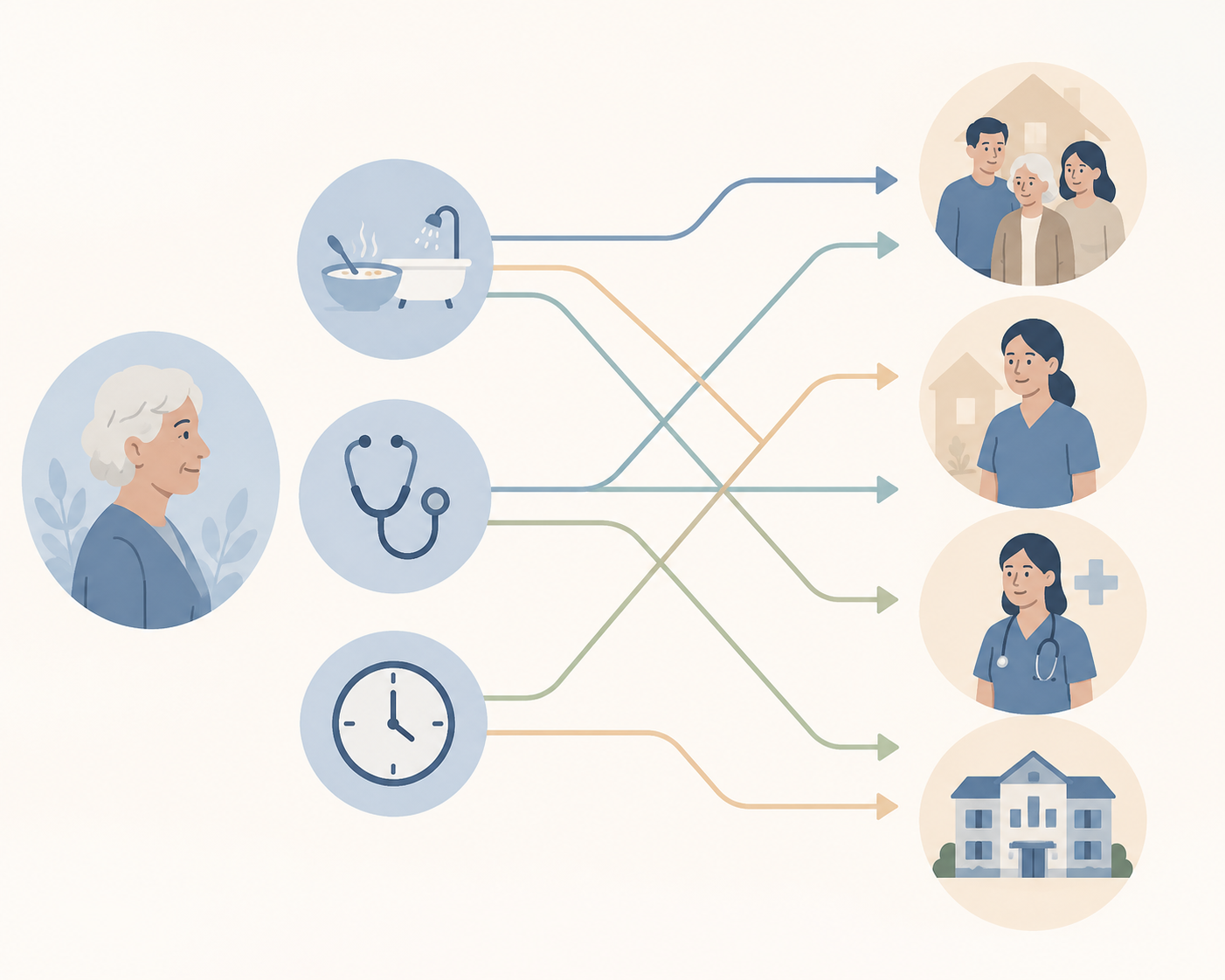
When a family searches for a carer for elderly parent, the problem is usually not vocabulary. It is uncertainty. One person may be imagining a daughter stopping by after work. Another may be picturing a paid aide who helps with bathing and meals. Someone else may be thinking about care after a hospital stay, or a nursing facility with staff present around the clock.
Those are not small differences. They affect who is legally allowed to do what, who pays, how much family labor is still required, and whether the arrangement can safely cover nights, medication changes, mobility risks, or confusion. Before comparing prices or calling agencies, it helps to name the kind of help the parent actually needs.
The four caregiver types families often mean
The word “caregiver” can be useful in ordinary conversation, but it becomes too blunt when a family is making a care decision. These four roles overlap at the edges, but they are not interchangeable.
Caregiver type
Where care usually happens
Typical tasks
Training or licensure expectations
Main cost exposure
Best use
Family caregiver
Parent's home, adult child's home, or shared family setting
Transportation, meals, medication reminders, appointments, household help, supervision, care coordination, emotional support
Usually no formal training required; families often learn while doing
Unpaid labor, reduced work hours, travel, supplies, stress, and time
Early or moderate support needs, coordination, familiar supervision, and filling gaps between paid services
Varies by state and agency; generally not a medical role
Hourly private-pay costs, agency minimums, weekend or overnight premiums
Daily living help when the parent wants to remain at home and does not need skilled medical care during those visits
Home health aide
Parent's home, usually under a care plan after illness, injury, surgery, or decline
Personal care plus medically directed support within the scope of the care plan; may work alongside nurses or therapists
More formal training and supervision than non-medical care; requirements vary by payer, state, and provider
Insurance-covered or time-limited services in some situations, plus possible out-of-pocket gaps
Recovery or stabilization when care is connected to a medical need and ordered or supervised through a health care provider
Facility-based nursing care
Skilled nursing facility or nursing home
24-hour supervision, nursing support, help with activities of daily living, medication administration, meals, safety oversight
Licensed facility staff and regulated nursing services
Monthly room-and-care charges, payer rules, possible long-term private-pay exposure
Higher supervision needs, complex care needs, unsafe home situations, or when family and in-home support cannot cover the risk
The table is not meant to rank the options. It is meant to stop a common family mistake: assuming that one kind of caregiver will quietly perform another kind of job. A companion aide may notice that Mom is weaker this week, but that does not make the aide a nurse. A son may be devoted and reliable, but that does not mean he can safely provide overnight supervision after months of poor sleep.
Family caregiving: the default job no one formally accepts
Family care often begins before anyone calls it care. A daughter starts managing refills. A brother takes over bills. Someone drives to appointments, sits in the exam room, translates the doctor's instructions to the rest of the family, and then checks whether the instructions are actually being followed.
That unpaid work is widespread. NAC and AARP estimated that 63 million Americans were providing unpaid care in 2025, though that figure includes caregivers broadly and is not limited to people caring for adults ages 65 and older.[1] Pew Research Center's 2026 work gives a narrower lens on family care for parents and spouses 65 and older, which is often closer to the situation adult children have in mind when they search for elder care help.[2]
The workload can also be larger than families expect. In the NAC/AARP 2025 report, family caregivers averaged 22.8 hours of care per week, 28% provided 31 or more hours per week, and only one in four said they felt prepared when caregiving began.[1] That is the hidden warning inside phrases like “we'll handle it ourselves.” Sometimes “ourselves” becomes one person, and “a little help” becomes a part-time job.
Family caregivers are often best positioned to notice subtle changes: unopened mail, repeated stories, a refrigerator full of expired food, a new fear of bathing, or a parent who insists everything is fine while quietly giving up routines. Those observations matter. They also do not erase the need to define the job. If the parent needs help with bathing, dressing, toileting, transferring, meal preparation, transportation, medication reminders, and overnight reassurance, the family is no longer simply “checking in.”
A practical next step is to separate activities of daily living from household and coordination tasks. An ADL and IADL assessment gives the family a clearer list than “Mom needs help.” It shows whether the problem is bathing, meals, mobility, medication routines, money management, transportation, safety monitoring, or some combination.
Non-medical home care aides: help with daily life, not skilled medical care
A non-medical home care aide is often the first paid caregiver a family considers. This is the person who may come several hours a week, several hours a day, overnight, or around the clock, depending on the parent's needs and the family's budget.
The aide's work usually centers on daily living: bathing, dressing, grooming, meal preparation, light housekeeping, laundry, companionship, errands, transportation, toileting help, mobility assistance, and general supervision. For an older adult who is physically slower, lonely, mildly forgetful, or unsafe doing certain tasks alone, this can be the difference between a workable home routine and a constant family scramble.
The boundary is just as important as the help. Non-medical aides generally do not diagnose conditions, adjust medications, provide skilled nursing treatments, or replace a clinician's care plan. State rules, agency policies, and payer requirements can affect exactly what an aide may do, so families should ask directly rather than assume.
Ask what tasks the aide is allowed to perform and what tasks require a nurse or clinician.
Ask whether the agency has minimum shift lengths, weekend rates, overnight rates, or cancellation rules.
Ask how backup coverage works if the regular aide is sick or unavailable.
Ask who supervises the aide and how the care plan is updated when the parent's needs change.
Families comparing providers can use a senior care agency selection guide before signing an agreement. The goal is not to find the friendliest brochure. It is to understand staffing, supervision, replacement coverage, training, communication, and the exact scope of care.
Home health aides: care tied to a medical need
Home health care is where many families get tangled. The phrase sounds similar to home care, and in daily conversation people use them almost interchangeably. In practice, they answer different questions.
Non-medical home care asks, “Who can help Dad bathe, eat, move safely, and get through the day at home?” Home health asks, “What medically directed support does Dad need after an illness, injury, surgery, hospitalization, or decline?” A home health aide may help with personal care, but the care is usually connected to a clinical plan and may involve supervision by nurses, therapists, or other licensed professionals.
That distinction affects expectations. A family might receive short-term home health services after a qualifying event and still need to hire non-medical home care for meal preparation, companionship, transportation, or longer blocks of supervision. The two can work together, but one does not automatically replace the other.
If the parent needs...
The family may be discussing...
Help bathing, dressing, cooking, light housekeeping, errands, and staying safe during the day
Non-medical home care aide
Care after hospitalization, illness, injury, or a clinical change that requires a provider-directed plan
Home health services, possibly including a home health aide
Both daily help and medically directed recovery support
A combination of non-medical home care and home health
The cleanest question to ask the doctor, discharge planner, or home health provider is: “What part of this care is medical, what part is daily living support, and who is responsible for each part after services end?” That last clause matters because medically related home services can be time-limited, while the parent's daily needs may continue.
Facility-based nursing care: higher supervision, not family failure
A nursing home or skilled nursing facility enters the conversation when the care need is no longer just “someone should stop by.” The parent may need 24-hour supervision, more help transferring, medication administration, nursing oversight, rehabilitation after a hospital stay, or a safer environment than the home can provide.
Families often treat this option as the emotional opposite of caring. That framing is too hard on everyone and not very useful. A facility is a setting with staff, routines, equipment, and regulated care responsibilities. It may be the wrong setting for some people. It may be exactly the safer setting for others.
The question is not whether the family loves the parent enough. The question is whether the current arrangement can safely cover the actual risks: falls, wandering, toileting needs at night, medication complexity, pressure injuries, repeated hospitalizations, severe caregiver exhaustion, or care needs that now require more than one person.
For readers who need the broader map, a long-term care continuum guide can help place home care, assisted living, nursing care, memory care, and other settings in relation to one another.
Costs make more sense after the role is clear
Cost is usually the first number families want and the last number that should be interpreted alone. A national median is not a local quote, and it does not tell you whether the parent needs four hours a week, four hours a day, overnight care, or a supervised setting.
A Place for Mom's 2026 cost reporting lists professional in-home caregivers at a national median of $34 per hour, with 24/7 home care around $24,733 per month.[3] The same organization's comparison of home care and nursing home costs lists a semi-private nursing home room at about $9,581 per month.[4] Those figures vary significantly by state and by provider, and they should be treated as planning numbers rather than quotes.
Care arrangement
National planning figure from available research
How to read the number
Professional in-home caregiver
$34/hour median in 2026
Useful for estimating part-time help; total cost depends heavily on hours scheduled
24/7 home care
About $24,733/month in 2026
Reflects continuous coverage and may involve multiple caregivers
Semi-private nursing home room
About $9,581/month in 2026
Reflects facility-based care, not an identical substitute for home care
It is tempting to look at those monthly numbers and declare one option cheaper. That shortcut can mislead a family. Twenty-four-hour home care and nursing home care are not the same product in different packaging. They differ in setting, staffing model, privacy, supervision, medical support, family involvement, and the parent's tolerance for risk at home.
For a parent who needs a morning bath, lunch preparation, and a ride twice a week, hourly home care may be the obvious starting point. For a parent who is unsafe alone at night, tries to stand without help, and needs medication oversight, the family is comparing a much heavier care package. A home care cost guide can help estimate local affordability, while a care setting cost comparison can help families compare adult day care, in-home care, and nursing home options without pretending they cover identical needs.
Match the care type to the need you can name today
The useful starting point is not “What kind of caregiver do most families use?” It is “What is the parent unable to do safely, and when does the risk appear?” A parent who is steady in the morning but confused after dinner has a different need than a parent recovering from surgery or a parent who simply cannot keep up with meals and laundry.
Family caregiver support and/or non-medical home care
Which tasks are occasional, and which are now weekly or daily?
Trouble bathing, dressing, toileting, transferring, or preparing meals safely
Non-medical home care aide, with family coordination
How many hours of hands-on help are needed, and at what time of day?
Recent hospitalization, wound care concerns, therapy needs, new weakness, or a provider-directed recovery plan
Home health services, possibly alongside non-medical home care
What is covered by the medical plan, and what daily help remains uncovered?
Unsafe nights, wandering, frequent falls, complex medication needs, or care that regularly requires more than one person
Facility-based nursing care or a much more intensive home care plan
Can the current setting safely cover this risk every day, not just on good days?
The main family caregiver is exhausted, missing work, getting sick, or becoming resentful
Respite care, paid home care, adult day services, or a higher-supervision setting
What must change this month to prevent the care plan from collapsing?
The last row deserves attention because families often wait until the default caregiver is depleted before they call the arrangement unsafe. In one A Place for Mom 2025 caregiver survey of 1,029 respondents, 78% reported burnout, 87% reported stress or anxiety, and 47% said their physical health had declined.[5] That survey should not be treated as a definitive national measure, but it is a serious warning about what happens when care plans depend on endurance instead of structure.
If the family caregiver is already past capacity, a caregiver burnout recovery guide is not a side resource. It may be the piece that keeps the parent safe and the family functioning long enough to make a better care decision.
A simple way to hold the family conversation
Family meetings go better when the question is concrete. Instead of asking, “Do we need a caregiver?” ask everyone to fill in the same four blanks.
The parent needs help with these specific tasks: bathing, dressing, meals, transportation, medications, bills, mobility, supervision, or something else.
The help is needed at these times: mornings, afternoons, evenings, overnight, weekdays, weekends, after appointments, or unpredictably.
The risk if no one helps is: missed meals, falls, medication errors, isolation, wandering, caregiver collapse, hospitalization, or unsafe discharge.
The caregiver type that best fits right now is: family caregiver, non-medical home care aide, home health aide, facility-based nursing care, or a combination.
This exercise also exposes accidental assumptions. If one sibling says “we can rotate,” ask what each person is actually covering and for how many hours. If someone says “hire an aide,” ask whether the need is personal care, medical recovery, transportation, or overnight supervision. If someone says “Dad will never agree to a facility,” ask what level of risk the home plan must cover to make that promise safe.
Some families will also need lower-cost or mixed arrangements, especially when full-time home care or facility care is financially out of reach. An affordable alternatives guide can help widen the conversation to respite, adult day programs, family scheduling, community supports, and other partial solutions.
Expect the answer to change
A parent may begin with family help, add a non-medical aide after bathing becomes difficult, use home health after a hospitalization, and later need facility-based nursing care if safety risks outgrow the home plan. That does not mean the first choice failed. It means the care need changed.
Review the plan when a parent falls, stops eating well, misses medications, becomes confused at new times of day, needs more help transferring, has repeated emergency visits, or when the main caregiver starts showing signs of strain. A stage-based caregiver roadmap can help families revisit decisions as needs move from light support to more intensive care.
For now, define the parent's current needs in plain terms. Identify which of the four caregiver types is actually being discussed. Estimate local costs for that level of care. Then put a review date on the calendar, because elder care decisions should change when the evidence changes, not only after a crisis has made the decision for the family.


Comments
Join the discussion with an anonymous comment.