
Caregiver decision guide
Is Companion Care Enough? A Decision Framework for Choosing Between Companion Care, Personal Care, and a Home Health Aide
Many families make the costly mistake of hiring a companion caregiver when they actually need hands-on personal care, or vice versa. This guide provides a structured ADL/IADL assessment framework to help you match your parent's needs to the correct level of care — companion, personal, or skilled — and avoid safety gaps and unnecessary expenses.
The Most Common Mistake Families Make When Hiring Home Care
When an aging parent begins to struggle, the instinct is to get help — fast. But in the rush to find someone, many families hire a companion caregiver when what they actually need is hands-on personal care, or they pay for a home health aide when companionship and light housekeeping would have been sufficient. The result is a costly mismatch: safety gaps, caregiver scope violations, and thousands of dollars spent on the wrong level of service.
The core problem is that the labels used in home care — companion, personal care aide, home health aide — sound interchangeable to someone who has never navigated this system. They are not. Each tier has a distinct scope of work, a distinct set of legal boundaries, and a distinct price tag. And here is the counterintuitive part: the hourly cost difference between companion care and a home health aide is often negligible, even though the services they provide are fundamentally different.
This guide provides a structured decision framework based on a simple but powerful distinction: activities of daily living (ADLs) versus instrumental activities of daily living (IADLs). By assessing which activities your parent can and cannot perform independently, you can match their needs to the correct care tier — companion, personal, or skilled — and avoid the most common and most expensive mistake families make.
The Three Tiers of Home Care: Companion, Personal, and Skilled
Before you can assess what your parent needs, you need a clear picture of what each tier actually provides. The boundaries are defined by the type of tasks a caregiver is trained and legally permitted to perform — not by the agency's marketing language.

Tier 1: Companion Care (IADL Support)
Companion care is non-medical support focused on social engagement and instrumental activities of daily living. A companion caregiver provides conversation, light housekeeping, meal preparation, transportation to appointments, grocery shopping, and medication reminders. What they cannot do is provide hands-on personal care: they cannot bathe, dress, toilet, or physically transfer your parent.
This boundary is not arbitrary — it is a matter of training, liability, and state regulations. Companion caregivers are not licensed nursing assistants and are not covered by the same insurance or scope-of-practice rules. As the AARP notes, companion care provides intellectual engagement, transportation, and meal prep, but does not include bathing, toileting, or dressing — those are home health aide tasks.
Tier 2: Personal Care / Home Health Aide (ADL Support)
Personal care — often delivered by a home health aide (HHA) or certified nursing assistant (CNA) — includes everything a companion does plus hands-on assistance with activities of daily living: bathing, dressing, toileting, incontinence care, transfer assistance (e.g., moving from bed to wheelchair), and feeding. A home health aide can also take vital signs and assist with self-administered medications.
This is the tier families most often confuse with companion care. The distinction matters because a companion caregiver who attempts to transfer a parent from a chair to a bed is operating outside their scope — and putting both themselves and your parent at risk of injury.
Tier 3: Skilled Home Health (Medical Care)
Skilled home health is a medical service provided by a registered nurse (RN), physical therapist (PT), occupational therapist (OT), or speech-language pathologist. It is typically prescribed by a physician and is often covered by Medicare Part A or B for a limited period following a hospitalization or surgery. Skilled care includes wound care, IV therapy, post-surgical rehabilitation, and monitoring of chronic conditions.
Skilled home health is not a replacement for companion or personal care — it is a short-term, medically focused service that runs alongside or after the other tiers. Most families will interact with this tier only during a recovery period.
| Dimension | Companion Care | Personal Care (HHA) | Skilled Home Health |
|---|---|---|---|
| Primary focus | Social engagement, IADLs | Hands-on ADL assistance | Medical treatment and monitoring |
| Typical tasks | Meal prep, transportation, housekeeping, conversation | Bathing, dressing, toileting, transfer assistance, feeding | Wound care, IV therapy, rehab exercises, vitals monitoring |
| Provider credentials | No license required (varies by state) | HHA or CNA certification | RN, PT, OT, or SLP license |
| Can assist with bathing? | No | Yes | Yes (if within scope) |
| Can assist with transfers? | No | Yes | Yes |
| Medicare coverage | No | No (except limited post-hospital) | Yes (Part A/B, time-limited) |
| 2026 national median hourly cost | $34 | $35.02 | Varies widely; often covered by insurance |
How to Assess What Your Parent Actually Needs: The ADL/IADL Distinction
The single most useful tool for determining the right care tier is the distinction between activities of daily living (ADLs) and instrumental activities of daily living (IADLs). ADLs are the fundamental self-care tasks that a person must be able to perform to live independently. IADLs are the more complex activities that support independent living in a community.
Here is a practical assessment framework. For each activity, ask yourself: Can my parent perform this task safely and consistently without help? If the answer is no for any ADL, companion care alone is insufficient — you need personal care.
ADL Assessment (Personal Care Threshold)
- Bathing: Can your parent get in and out of the tub or shower safely? Can they wash all body parts without assistance?
- Dressing: Can they select appropriate clothing and put it on without help? Can they manage buttons, zippers, and shoes?
- Toileting: Can they get to and from the toilet, clean themselves, and manage clothing independently?
- Transferring: Can they get in and out of bed, a chair, or a wheelchair without physical assistance?
- Feeding: Can they bring food to their mouth and swallow safely? (This does not include meal preparation — that is an IADL.)
- Continence: Can they control bladder and bowel function, or manage incontinence products independently?
IADL Assessment (Companion Care Threshold)
If your parent is independent in all ADLs but struggles with the following, companion care is likely the appropriate tier:
- Meal preparation: Can they plan and cook nutritious meals safely? Do they forget to eat or leave the stove on?
- Transportation: Can they drive safely or use public transit? Do they get lost in familiar areas?
- Housekeeping: Can they maintain a reasonably clean and safe home? Are clutter, spoiled food, or unpaid bills accumulating?
- Medication management: Can they take the right dose at the right time without reminders?
- Money management: Can they pay bills, track expenses, and avoid financial mistakes?
- Communication: Can they use the phone, manage mail, and schedule appointments?
A parent who is independent in ADLs but struggling with IADLs is an ideal candidate for companion care. The companion fills the gap in meal preparation, transportation, and social engagement — preserving independence where it still exists and preventing the decline that often follows isolation.
Research underscores the importance of social connection: a 2023 University of Michigan poll found that 34% of older adults experienced loneliness, and the Merck Manual (2025) reports that nearly 25% of adults age 65 and older are socially isolated. Companion care directly addresses this by providing regular, meaningful human interaction.
What Happens When You Hire at the Wrong Level
The consequences of a care-level mismatch range from inconvenient to dangerous. Here is what actually happens in each scenario:
Hiring a Companion When Personal Care Is Needed
This is the most common and most dangerous mistake. A companion caregiver arrives expecting to prepare meals and provide conversation, but your parent needs help getting to the bathroom or bathing safely. The companion is not trained or insured to perform these tasks. If they attempt a transfer and your parent falls, the caregiver may be liable, the agency (if any) may not cover the incident, and your parent may end up in the hospital.
Even if the companion refuses to perform ADL tasks — as they should — the gap in care remains. Your parent goes unbathed, wears soiled clothing, or attempts dangerous transfers alone. The family pays $34/hour for someone who cannot do what is actually needed.
Hiring a Home Health Aide When Companion Care Is Sufficient
The opposite mistake is less dangerous but more expensive. A home health aide costs roughly the same hourly as a companion — $35.02/hour versus $34/hour — but the family is paying for a higher skill level they do not need. More importantly, a home health aide may be less available for the social engagement and IADL support that is actually needed, because their training and focus are on clinical tasks.
Families who make this mistake often report that the aide spends most of their shift doing light housekeeping and meal prep — tasks a companion could handle at a lower cost — while the parent's real need for companionship and transportation goes unmet.
Cost Comparison Across Tiers: 2026 Data
Understanding the cost landscape helps families make informed decisions — but only when the cost data is paired with a clear understanding of what each tier delivers. The table below summarizes the 2026 national median costs from two major surveys.
| Cost Metric | Companion / Homemaker | Home Health Aide | Skilled Home Health |
|---|---|---|---|
| Hourly median (A Place for Mom 2026) | $34 | N/A (reported as nonmedical in-home care) | Varies; often covered by Medicare |
| Hourly median (Genworth/CareScout 2025) | $33.99 | $35.02 | Not reported in this survey |
| Annual median (44 hrs/week, Genworth 2025) | $77,769 | $80,126 | N/A — typically time-limited |
| Monthly median (44 hrs/week, A Place for Mom 2026) | $6,478 | N/A | N/A |
| Medicare coverage | No | No (except post-hospital) | Yes (Part A/B, time-limited) |
The key takeaway: the hourly cost difference between companion care and a home health aide is minimal — roughly $1–$2 per hour nationally. This means cost should not be the deciding factor. The deciding factor should be whether your parent needs hands-on ADL assistance. If they do, pay the slightly higher rate for a home health aide. If they do not, companion care is the appropriate and sufficient tier.
For a deeper look at payment strategies — including Medicaid HCBS waivers, VA benefits, and long-term care insurance — see our full cost breakdown and funding guide.
How to Transition Between Levels as Needs Progress
Care needs are not static. A parent who is independent in ADLs today may develop mobility issues after a fall or require bathing assistance as arthritis progresses. The ability to recognize when a transition is needed — and to execute it smoothly — is a critical caregiving skill.
Vicki Demirozu, a 30-year home care veteran quoted in A Place for Mom's 2026 guide, notes that families who start companion care early — before a crisis — report smoother transitions when higher levels of care become necessary. The reason is straightforward: the family already has a relationship with a provider, the parent is already accustomed to having help in the home, and the escalation feels like an adjustment rather than an upheaval.
Signs That It Is Time to Move to a Higher Tier
- New difficulty with bathing or dressing: If your parent can no longer wash their back or put on a shirt without help, companion care is no longer sufficient.
- Increased fall risk or a recent fall: A fall is often the event that reveals a need for transfer assistance or hands-on supervision.
- Weight loss or dehydration: If your parent is losing weight because they cannot prepare meals or forget to eat, a companion can help — but if they also need feeding assistance, a home health aide is required.
- Incontinence: Managing incontinence products independently is an ADL. If your parent cannot do it, they need personal care.
- Hospitalization or surgery: Following a hospital stay, your parent may need skilled home health for rehabilitation, even if they were managing with companion care before.
- Caregiver burnout: If the family caregiver is exhausted and the parent's needs are escalating, it is time to bring in professional help at the appropriate level.
When transitioning, communicate clearly with the current caregiver or agency. If you are using an agency, they can often provide a home health aide from the same pool of workers, minimizing disruption. If you hired an independent companion, you may need to end that arrangement and find a licensed home health aide through an agency.
For a broader view of all care options — including assisted living, memory care, and nursing homes — see our complete comparison guide to senior care options. And when home-based care is no longer enough, our guide on knowing when to transition to a facility can help you recognize the signs.
A Decision Flowchart for Families
The following flowchart distills the ADL/IADL assessment into a simple decision tree. Start at the top and follow the branch that matches your parent's current functional status.
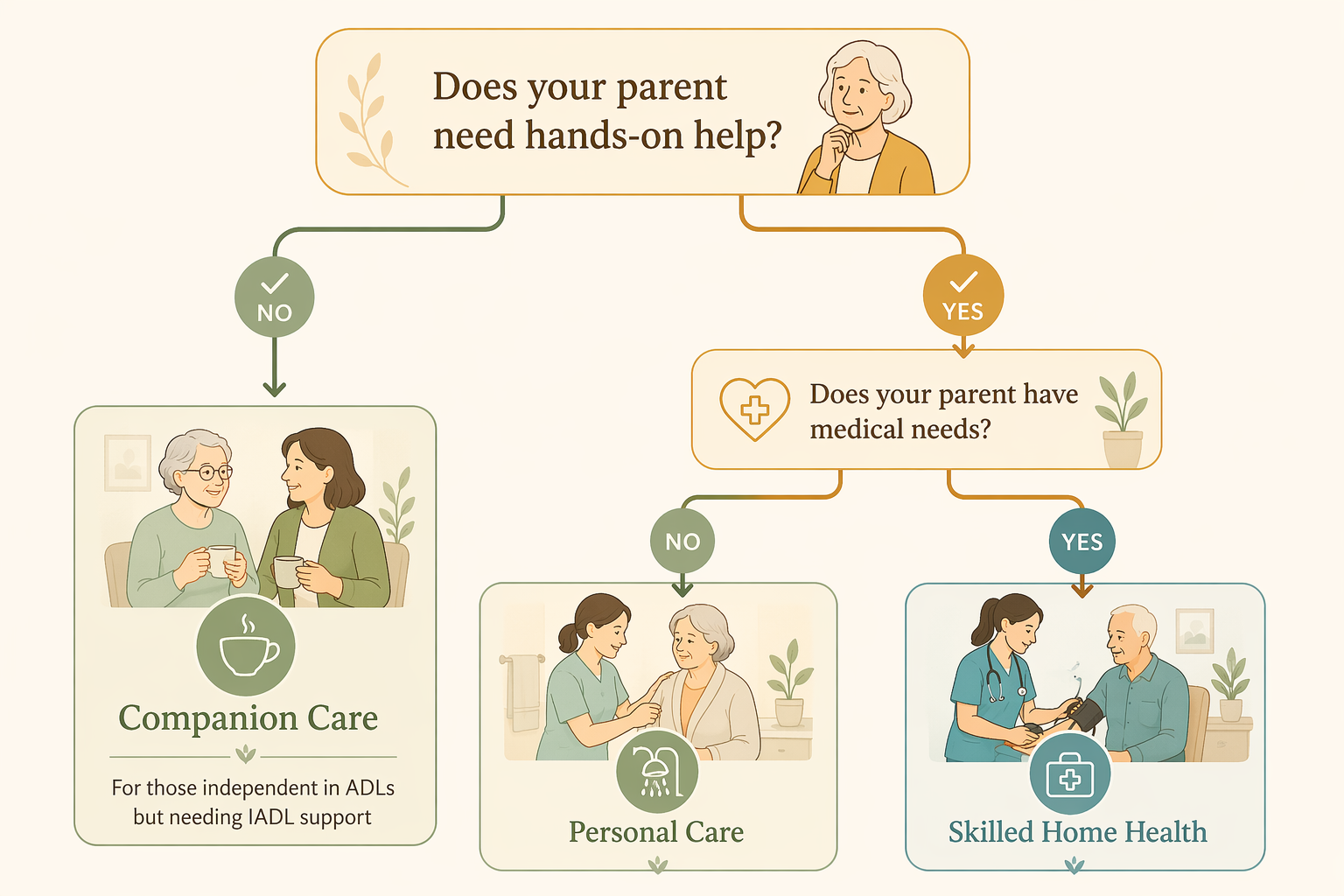
Text-Based Summary of the Flowchart
- Start here: Can your parent perform all six ADLs (bathing, dressing, toileting, transferring, feeding, continence) independently and safely?
- If YES → Move to IADL assessment: Can they perform all IADLs (meal prep, transportation, housekeeping, medication management, money management, communication) independently?
- If YES to both ADLs and IADLs → Your parent may not need any paid care at this time. Monitor for changes every 3–6 months.
- If YES to ADLs but NO to IADLs → Companion care is the appropriate tier. A companion can fill the gap in meal preparation, transportation, housekeeping, and social engagement.
- If NO to any ADL → Personal care (home health aide) is required. Companion care alone is insufficient and potentially unsafe.
- If NO to ADLs AND the parent has a recent hospitalization, surgery, or new medical condition → Consult with their physician about whether skilled home health (RN, PT, OT) is also needed on a temporary basis.
For families who determine that companion care is the right fit, our step-by-step companion caregiver hiring checklist provides practical guidance on finding, vetting, and hiring a companion. And if you are still unsure whether companion care alone is sufficient, our companion care suitability framework offers a deeper assessment.
Questions to bring to a clinician or OT
This is not medical, legal, or a family's final decision — only a framework. Bring these questions to a clinician, occupational therapist, or your local Area Agency on Aging.
Find Local HelpRelated reading
Noticed something outdated or inaccurate on this page? Flag a correction. We review every report against CDC, NIA, and AARP HomeFit guidance before updating a page.